
1. Why Does Aerospace Manufacturing Require Precise Edge Finishing?
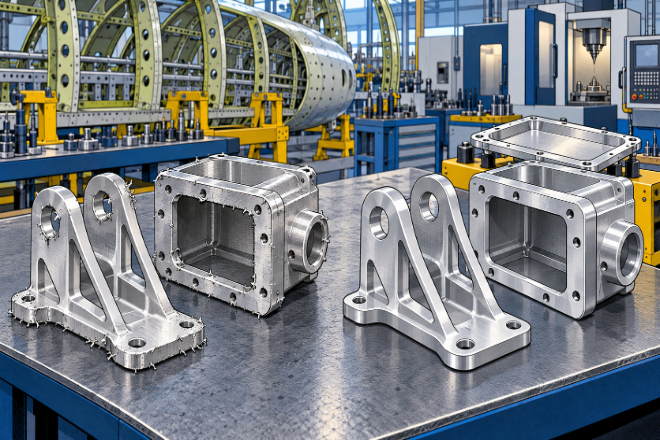
الفضاء الجوي manufacturing involves parts that must fit together accurately and perform reliably under demanding conditions.
Components may be made from aluminum alloys, titanium alloys, high-strength metals, or composite materials. Each material brings its own finishing challenges.
Machining, drilling, cutting, and forming can leave burrs, sharp edges, or small amounts of unwanted material.
These defects need to be removed before a component moves to assembly or inspection.
For example, a burr around a fastener hole may prevent two parts from sitting together properly.
A rough edge on a machined bracket may affect assembly or require extra work before the part can be approved.
In aerospace production, edge finishing helps manufacturers:
Remove burrs and unwanted material.
Prepare components for accurate assembly.
Meet specified edge and surface requirements.
Reduce manual correction and rework.
Keep finishing quality consistent across production batches.
The goal is not simply to make a part look smooth. The finished edge must meet the engineering drawing and inspection requirements without damaging the component.
هذا هو المكان أدوات تشذيب الكربيد can help. Their cutting edges remove material in a controlled way, making them suitable for small finishing tasks that require accuracy.
However, tool selection matters. A tool designed for an aluminum component may not be suitable for a titanium part or a carbon-fiber composite.
The material, edge shape, tolerance, and machining method should guide the choice.
2. How Do Carbide Trimming Tools Improve Aerospace Component Quality?
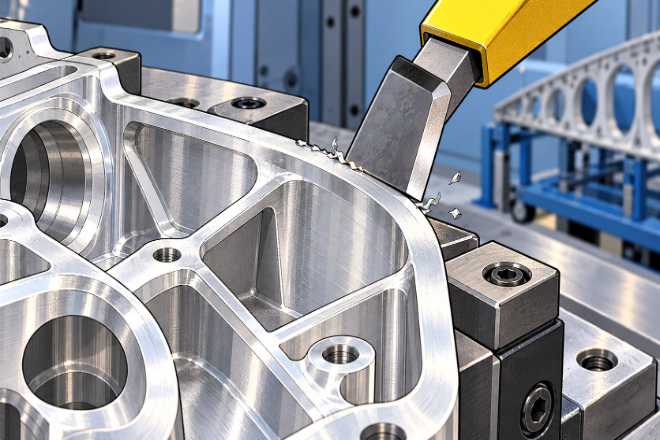
أدوات تشذيب الكربيد use hard cutting edges to remove burrs, excess material, and uneven areas.
When the tool geometry and machining settings match the application, the process can improve edge quality while keeping material removal under control.
1). Removing Burrs from Machined Parts
Burrs can form around drilled holes, milled edges, slots, and other machined features.
If they remain, they may affect assembly or create problems during later processing.
A suitable carbide trimming tool can remove these burrs without requiring a large cutting tool for a small finishing task.
This is useful for brackets, housings, mounting parts, and other components with detailed edges.
2). Maintaining Dimensional Accuracy
الفضاء الجوي components often have defined limits for size and shape. Removing too much material during finishing can be just as problematic as leaving a burr behind.
Carbide trimming tools can provide controlled cutting when the tool profile, cutting path, and operating conditions are selected correctly.
The final result still depends on machine accuracy, tool runout, fixture stability, and inspection. Carbide alone cannot guarantee that a part will meet its tolerance.
3). Reaching Small or Complex Features
Some aerospace components have narrow openings, curved contours, and edges that are difficult to reach with larger tools.
Small-diameter carbide trimming tools or specially designed profiles can help reach these areas.
This allows manufacturers to finish selected features without affecting nearby surfaces.
For high-value components, this level of control is important because damage may lead to costly rework or part rejection.
3. Where Are Carbide Trimming Tools Used in Aerospace Manufacturing?
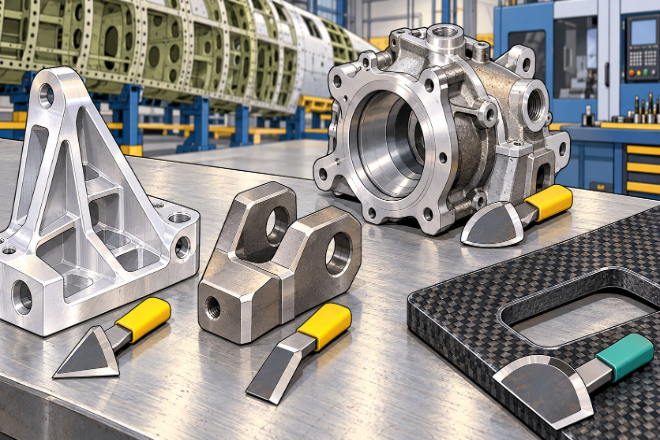
Carbide trimming tools can support different finishing tasks across aerospace production.
Their suitability depends on the component material and the exact operation.
1). Aluminum Aircraft Components
Aluminum alloys are used in many aircraft structures and machined components because they offer a useful balance of strength and weight.
After milling or drilling, aluminum parts may have burrs around holes, slots, and edges.
A suitable أداة تشذيب الكربيد can remove these defects and prepare the component for assembly.
The tool must be selected carefully to prevent built-up material on the cutting edge and avoid damaging the finished surface.
2). Titanium Components
Titanium alloys are used in الفضاء الجوي applications where strength, weight, and resistance to demanding service conditions matter.
However, titanium can be difficult to machine because it produces high cutting temperatures and places demanding loads on the tool.
Carbide tools are widely used in titanium machining, but a small trimming operation still needs the right cutting geometry and operating settings.
Excessive force or unsuitable conditions may cause edge chipping or damage to the workpiece.
For manufacturers, testing the tool on the actual component is a practical way to check finishing quality and tool life.
3). Precision Brackets and Housings
Brackets, housings, and mounting components often include holes, slots, and small contours that need finishing after machining.
Carbide trimming tools can remove burrs and clean selected edges before inspection or assembly.
This helps prepare the part for the next stage without adding unnecessary machining steps.
4). Composite Components
Composite materials, including carbon-fiber-reinforced plastics, are used in some aircraft structures and interior components.
These materials need special care because poor trimming can cause fiber pull-out, rough edges, or delamination.
A carbide trimming tool may be suitable for certain composite finishing tasks, but the cutting geometry and process must match the material.
Not every carbide tool is appropriate for every composite, and some applications may require dedicated diamond or other specialized tooling.
4. Why Is Tungsten Carbide Suitable for Aerospace Edge Finishing?
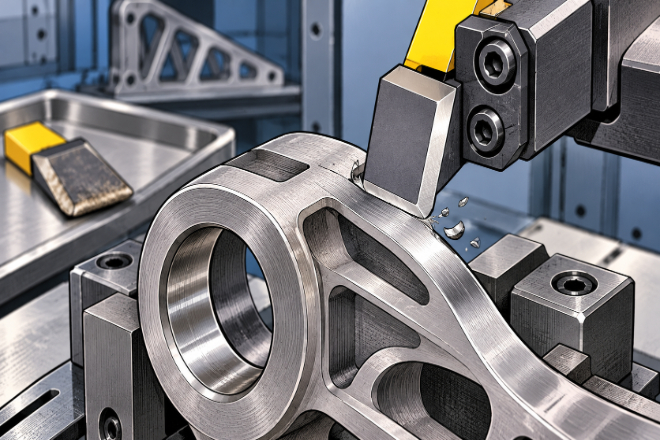
The main advantage of tungsten carbide is its high صلابة and good مقاومة التآكل.
These properties help a properly designed trimming tool retain its cutting edge during repeated operations.
ل الفضاء الجوي manufacturers, this can offer several benefits.
Longer tool life: A suitable carbide tool may complete more finishing operations before replacement.
Stable cutting performance: Better edge retention can help maintain consistent results across a production batch.
Support for small features: Fine tool geometries can be used for narrow edges and detailed areas.
Reduced interruptions: Longer tool life may reduce tool changes and the downtime they cause.
However, hardness is only one part of tool performance. Carbide can be brittle compared with some steel tools, so excessive force, vibration, or impact can cause chipping or breakage.
Aerospace applications may also require close control of surface condition and material removal.
Manufacturers should choose a tool grade and geometry that balance wear resistance with the strength needed for the job.
5. How Do Carbide Trimming Tools Support CNC Aerospace Manufacturing?
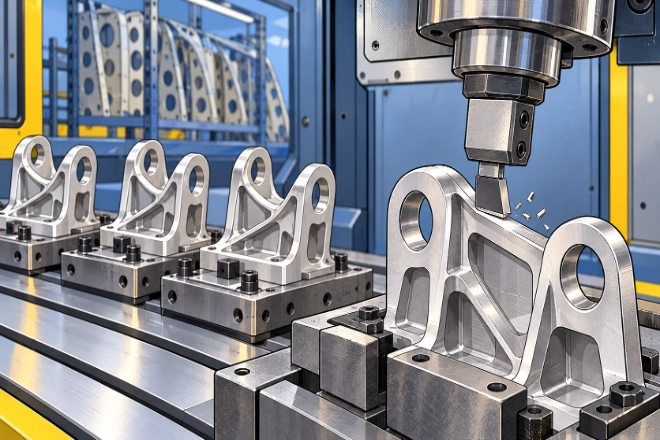
CNC machining is widely used in aerospace production because it can follow precise tool paths and produce repeatable parts.
When a أداة تشذيب الكربيد is suitable for the application, it can be added to a programmed finishing process to remove burrs and clean selected edges.
This may help manufacturers reduce manual finishing and improve process consistency.
1). Repeatable Finishing Paths
A CNC program can guide the tool along a defined path. Once the process has been tested and approved, the same path can be used for similar components.
This helps reduce differences caused by changes in manual pressure or tool angle.
2). Less Manual Correction
Some components require careful hand finishing, particularly around complex shapes. However, suitable CNC trimming can handle certain repeated tasks more consistently.
Reducing manual work can also help production teams focus on inspection and other skilled operations.
3). Better Process Control
Manufacturers can track tool life, cycle time, burr size, and finished-part quality. These measures help identify wear or process changes before they affect a large batch.
Automation does not remove the need for inspection. الفضاء الجوي parts must still meet their defined engineering and quality requirements.
6. How Can Carbide Trimming Tools Help Control Aerospace Manufacturing Costs?
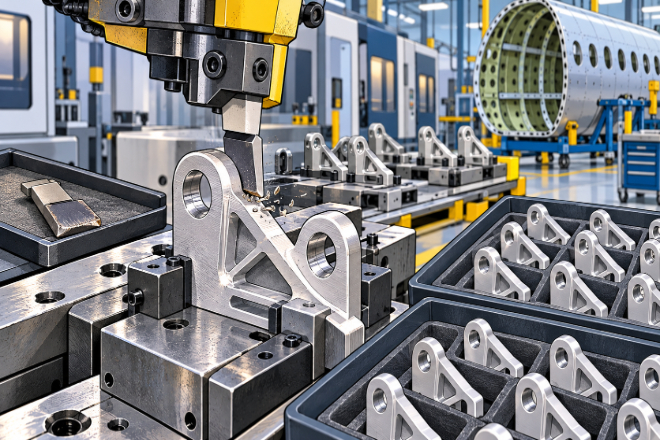
الفضاء الجوي components can require expensive materials, long machining cycles, and careful inspection.
If an edge-finishing operation creates defects or needs repeated correction, the added cost can be significant.
A well-matched أداة تشذيب الكربيد may help reduce some of these costs by maintaining a stable cutting edge and supporting repeatable finishing.
The main areas to monitor include:
Tool replacement: How many parts can be finished before the tool needs changing?
Machine downtime: How much time is spent on tool changes and adjustments?
Rework: How often do parts need additional finishing?
Inspection: Are edge defects causing repeated checks?
Cycle time: How long does the finishing operation take?
Part quality: Does the process consistently meet the required specifications?
The lowest-priced tool is not always the most cost-effective choice.
A more suitable tool may last longer or reduce rework, giving better value across the full production cycle.
The best comparison is based on the cost of producing an acceptable part, not simply the price of an individual tool.
 English
 Español
 简体中文
 Français
 日本語
 한국어
 العربية
 Tiếng Việt