
1. Why Is Composite Cutting Prone to Damage?
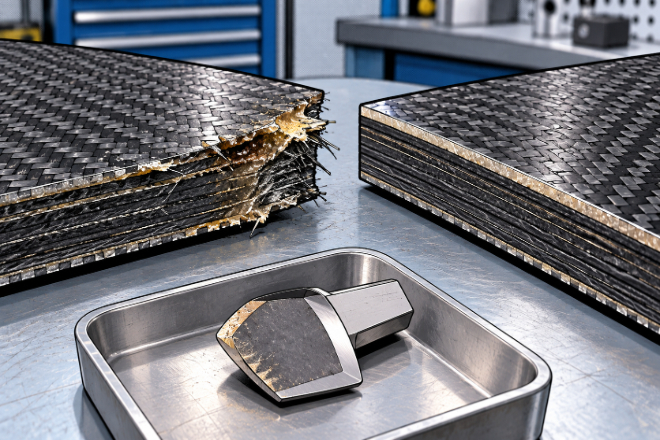
Composite materials do not behave like solid metals. They combine fibers with a resin matrix, and their cutting behavior changes with fiber direction, layer structure, resin type, and part thickness.
Carbon fiber composites (CFRP) and glass fiber composites (GFRP) are common examples.
Both can be abrasive, and both can develop edge defects when the cutting process is poorly controlled.
Research on CFRP trimming has identified fiber pull-out, delamination, resin overheating, and tool wear as key issues that affect finished-part quality.
Fiber Pull-Out and Fuzzy Edges
When a cutting edge is dull or poorly matched to the material, it may pull fibers out of the resin instead of cutting them cleanly. The result can look like tiny hairs sticking out from the edge.
These loose fibers may affect appearance, fit, and later finishing work. In critical parts, the edge may need closer inspection before it can be accepted.
Delamination Between Layers
Many composite parts contain several layers bonded together. Excessive cutting force or poor support can cause these layers to separate near the trimmed edge.
This is known as delamination. It can be difficult to spot without careful inspection, and it may lead to rework or rejection if it falls outside the part’s quality limits.
Heat Damage to the Resin
A worn tool may rub against the composite instead of cutting it cleanly. Friction creates heat, which can soften or damage the resin near the cutting zone.
Signs may include discoloration, a rough surface, or resin buildup on the tool. The risk depends on the resin system and the cutting conditions.
Rapid Tool Wear
Glass and carbon fibers are abrasive. They can wear cutting edges faster than many ordinary plastics and some metals.
As tool wear increases, cutting forces and edge defects may also increase. That is why tool condition is part of quality control, not just a maintenance issue.
2. How Do Carbide Trimming Tools Help Prevent Composite Damage?
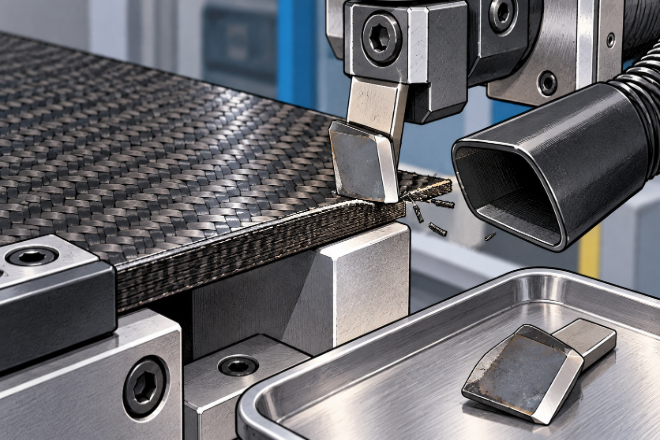
أدوات تشذيب الكربيد offer high صلابة and good مقاومة التآكل, which can help maintain a cutting edge during repeated work.
But there is an important detail: the tool reduces damage only when its cutting design and operating conditions suit the composite.
A standard carbide tool is not automatically the best choice for every composite.
Carbon fiber, glass fiber, and other reinforced materials can need different tool designs, especially in high-volume production.
Keeping the Cutting Edge Sharp
A sharp cutting edge is more likely to cut fibers cleanly instead of pulling them from the resin.
As the edge wears, it may begin to rub, increase cutting forces, and leave a rougher finish.
Checking tool wear and replacing a tool before its performance drops too far can help prevent these problems.
For highly abrasive composites, diamond-coated carbide or PCD tools may provide longer service life than uncoated carbide.
Removing Material in a Controlled Way
Composite trimming often involves removing only a small amount of material along an edge or contour.
A suitable tool profile helps control this process and limits unwanted contact with nearby surfaces.
For example, when trimming a carbon fiber panel to its final size, the cutting tool must follow the planned path without tearing fibers or damaging the outer layers.
Tool diameter, edge design, and cutting direction all affect the result.
Supporting Consistent Edge Quality
When a tool produces a clean edge repeatedly, manufacturers can spend less time on manual correction.
This is especially useful for parts with multiple openings, curved edges, or complex shapes.
However, a good cutting tool cannot compensate for every setup problem. If the workpiece moves or the machine vibrates, even a sharp carbide tool may leave an uneven edge.
3. How Does Tool Geometry Affect Composite Cutting Damage?
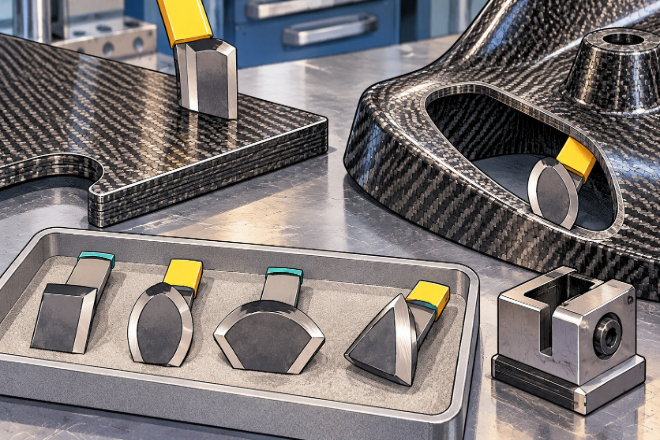
The shape of a trimming tool affects how it enters the material, cuts the fibers, and removes debris. Choosing the right geometry can make a real difference to edge quality.
Cutting edge design: The edge must be sharp enough to cut the fibers cleanly while remaining strong enough for the expected load.
Flute geometry: Flutes help move cut material away from the cutting zone. Poor chip removal can increase friction and make the process less stable.
Tool diameter: Small tools can reach narrow features, but they may be more sensitive to vibration and excessive cutting forces.
Tool reach: Long tool overhang can increase deflection. Using the shortest practical reach helps keep the tool stable.
Cutting direction: Fiber orientation affects how the tool meets the reinforcement. A cutting path that works well on one laminate may produce more pull-out on another.
For layered carbon fiber composites, compression-style cutters may help reduce damage on both faces by directing cutting forces toward the laminate.
The best design still depends on the part geometry and the material’s structure.
In other words, choosing a trimming tool is not just about finding the right diameter. The whole cutting geometry needs to match the job.
4. What Cutting Conditions Help Prevent Composite Damage?
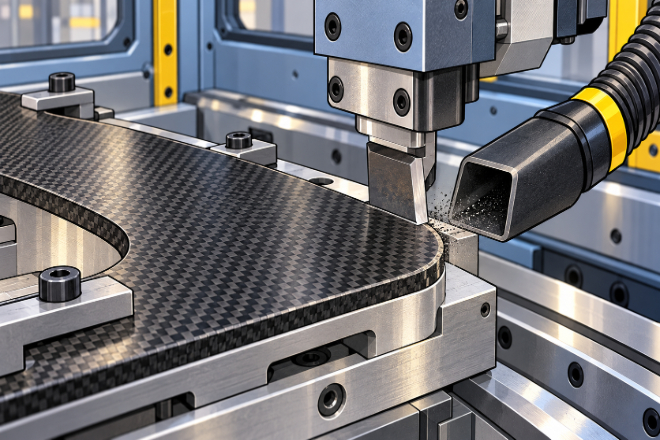
Even the right أداة تشذيب الكربيد can cause damage if it runs under unsuitable conditions.
The goal is to remove material efficiently without creating excessive heat or force.
Set Speed and Feed for the Material
Cutting too aggressively can increase force and raise the risk of fiber pull-out or delamination.
Cutting too slowly may also cause trouble if the tool rubs against the material instead of cutting it cleanly.
Use the tool supplier’s guidance as a starting point, then test the settings on representative parts.
There is no single speed or feed rate that works for every fiber type, resin system, and tool geometry.
Keep the Workpiece Stable
Composite panels may flex when they are not fully supported. That movement can cause vibration, uneven edges, and layer damage.
A stable fixture should hold the part close to the cutting area. Thin panels and complex shapes may need extra support to prevent movement during trimming.
Manage Heat and Dust
Composite dust should be captured near the cutting point with a suitable extraction system. This helps keep the work area clean and reduces exposure to airborne particles.
Heat control matters too. Inspect the resin surface for signs of overheating, and adjust the cutting process if discoloration, smearing, or resin buildup appears.
Follow the material’s safety guidance and the site’s dust-control procedures.
Inspect Tools Before Defects Spread
If one edge begins to look rough, do not assume the material is to blame. Check the cutting edge, tool runout, fixture, and cutting settings.
Finding the cause early can prevent the same defect from appearing across an entire batch.
5. How Can Manufacturers Check Whether the Cutting Process Is Working?
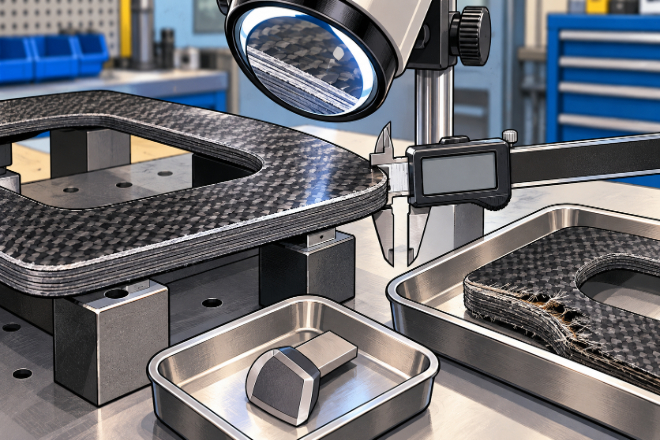
A finished edge may look smooth but still have hidden damage.
Manufacturers should inspect the part against its drawing and quality requirements rather than relying on appearance alone.
Useful checks include:
Fiber pull-out: Look for loose or missing fibers along the trimmed edge.
Delamination: Check for layers separating near the cut.
Resin damage: Look for discoloration, smearing, or signs of overheating.
Dimensional accuracy: Confirm that the part remains within the required limits.
Tool wear: Inspect the cutting edge for dulling, chipping, or uneven wear.
Record the results during production trials. If edge defects increase over time, compare them with tool life and machine settings to find out whether wear is affecting quality.
This approach helps teams decide when to replace a tool, adjust the process, or test a different cutting design.
6. How Can Carbide Trimming Tools Reduce Production Costs?
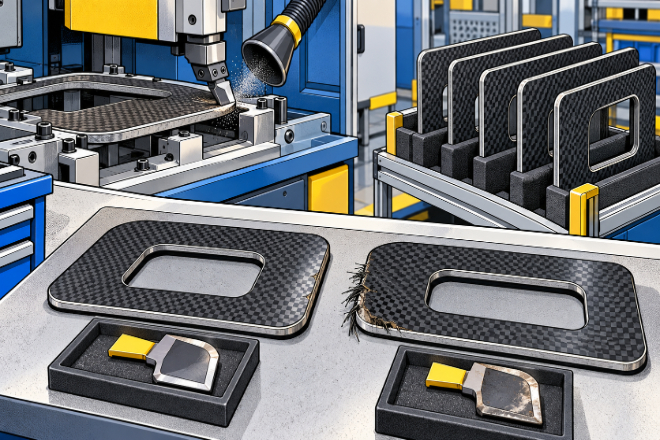
Composite damage can be expensive. Extra sanding, repeated trimming, inspection, and rejected parts all add cost without adding value.
A suitable أداة تشذيب الكربيد can help reduce these losses when it produces stable results and maintains its cutting edge for an acceptable period.
Manufacturers should compare four measures:
Tool life: How many parts can be trimmed before quality begins to drop?
Cycle time: How long does each finishing operation take?
Rework rate: How often do parts need extra work because of edge damage?
Cost per accepted part: What is the total cost of producing a part that passes inspection?
A cheaper tool is not always the more economical option. If it wears quickly or causes repeated edge defects, the savings at purchase can disappear fast.
The better choice is the tool and process combination that delivers the required edge quality with the least waste and downtime.
 English
 Español
 简体中文
 Français
 日本語
 한국어
 العربية
 Tiếng Việt