
Understanding Tungsten Carbide Tips and Their Durability

Tungsten carbide tips are widely used in various industries for cutting, drilling, and machining due to their hardness and ability to withstand extreme conditions.
Their superior wear resistance and ability to maintain sharp edges make them ideal for high-performance applications.
1). What Makes Tungsten Carbide Tips Durable?
The durability of tungsten carbide tips stems from their unique material properties:
Hardness: Tungsten carbide is one of the hardest materials available, second only to diamonds.
Wear Resistance: Due to their hardness, carbide tips can resist wear from abrasive materials, which significantly extends their lifespan.
Temperature Resistance: Tungsten carbide can withstand high temperatures without losing its hardness, making it ideal for operations that generate heat, such as high-speed machining.
These factors combine to provide carbide tips with a much longer lifespan compared to many other materials used for cutting tools.
Lifespan of Tungsten Carbide Tips vs. Other Materials
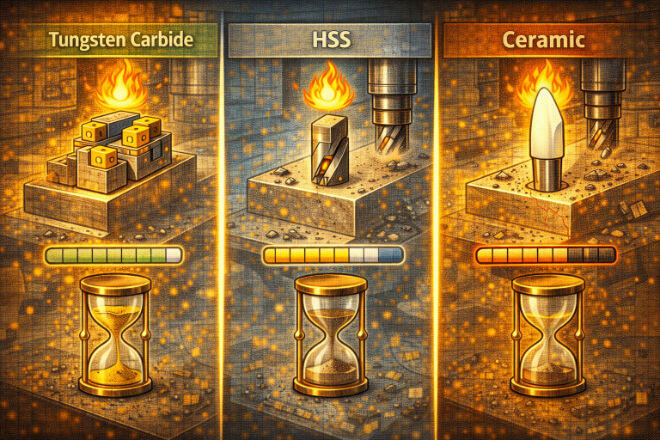
The lifespan of a cutting tool depends on the material it is made from and the conditions it is used in.
Let’s compare the lifespan of tungsten carbide tips with that of other commonly used materials such as High-Speed Steel (HSS) and Ceramic.
1). Tungsten Carbide vs. High-Speed Steel (HSS)
High-Speed Steel is another popular material for cutting tools. While HSS is more affordable than tungsten carbide, it does not last as long.
Tungsten Carbide: Offers a much longer tool life due to its superior hardness and wear resistance. In many cases, tungsten carbide tips can last up to 5–10 times longer than HSS tools, depending on the application.
HSS: While HSS is versatile and performs well in many applications, it wears down faster, particularly when used in high-speed or high-impact environments.
2). Tungsten Carbide vs. Ceramic Tips
Ceramic tips offer high hardness and wear resistance, but they tend to be more brittle than tungsten carbide.
Tungsten Carbide: Tungsten carbide tips are tough and can handle impact and shock better than ceramic tips, leading to longer tool life under varying operational conditions.
Ceramic: Ceramic tools are ideal for very hard materials but are prone to cracking or breaking under impact, reducing their lifespan.
In general, tungsten carbide tips outlast both HSS and ceramic tools in most industrial applications, making them the more cost-effective option over time.
How Lifespan Impacts the Total Cost of Ownership (TCO)

The Total Cost of Ownership (TCO) refers to the total cost of a tool over its entire lifecycle, including initial purchase, maintenance, and replacements.
A longer tool lifespan directly reduces the TCO by decreasing the frequency of replacements and maintenance.
1). Tungsten Carbide and TCO
Due to its long lifespan, tungsten carbide tips help lower the overall cost of ownership.
While the initial cost of carbide tips may be higher than that of HSS or ceramic tools, the reduced need for replacements and repairs can make carbide tips more cost-effective in the long term.
Lower Replacement Costs: Fewer replacements are needed, reducing the costs associated with purchasing new tools.
Reduced Maintenance: Tungsten carbide tools require less frequent sharpening and maintenance, saving time and money.
2). HSS and TCO
HSS tools have a lower upfront cost but tend to wear out quickly, leading to higher long-term costs.
More Frequent Replacements: HSS tools need to be replaced more often, increasing the overall cost of ownership.
Higher Maintenance Costs: HSS tools require more frequent sharpening and care to maintain their performance.
3). Ceramic Tools and TCO
While ceramic tools offer excellent wear resistance, their brittleness means they may need to be replaced more frequently, especially if they crack during operation.
Higher Risk of Breakage: Ceramic tools are more prone to breaking, leading to higher replacement and maintenance costs.
Higher Initial Investment: Ceramic tools typically cost more upfront than HSS, and the risk of breakage increases the overall TCO.
In conclusion, tungsten carbide tips offer the best balance of long tool life and cost savings, particularly for high-volume or high-demand applications.
The Role of Cutting Conditions on Tool Life

The lifespan of any cutting tool is heavily influenced by the conditions under which it operates.
Tungsten carbide tips excel in demanding environments, but certain factors can still affect their performance.
1). Impact of Material Hardness
The harder the material being cut, the greater the wear on the tool. Tungsten carbide tips perform better than HSS or ceramic tools when cutting hard materials like metals or concrete.
2). Cutting Speed and Feed Rate
High cutting speeds and feed rates can wear down any tool more quickly.
Tungsten carbide’s high temperature and wear resistance allow it to handle faster cutting speeds and heavier feed rates compared to other materials, thus extending its lifespan in such conditions.
3). Coolant and Lubrication
Proper use of coolant and lubrication can extend the lifespan of any cutting tool. For tungsten carbide, using the right coolant can reduce heat buildup and minimize wear, ensuring the tool lasts longer.
Maximizing the Lifespan of Tungsten Carbide Tips

To ensure that tungsten carbide tips last as long as possible, proper handling, maintenance, and usage are essential.
1). Proper Handling
Avoid dropping or mishandling carbide tips, as this can cause chips or cracks that shorten the tool’s lifespan. Always handle carbide tools carefully and store them properly.
2). Routine Inspections
Regular inspections can help identify early signs of wear or damage, allowing for timely maintenance or reconditioning, which can extend tool life.
3). Reconditioning and Sharpening
Rather than replacing worn-out carbide tips, consider reconditioning or sharpening them. Reconditioning can restore carbide tips to near-new condition, offering significant savings.
 English
  Español
  简体中文
简体中文  Français
  日本語
日本語  한국어
한국어  العربية
  Tiếng Việt