
1. Why Are Carbide Burrs Useful in Mold Manufacturing?
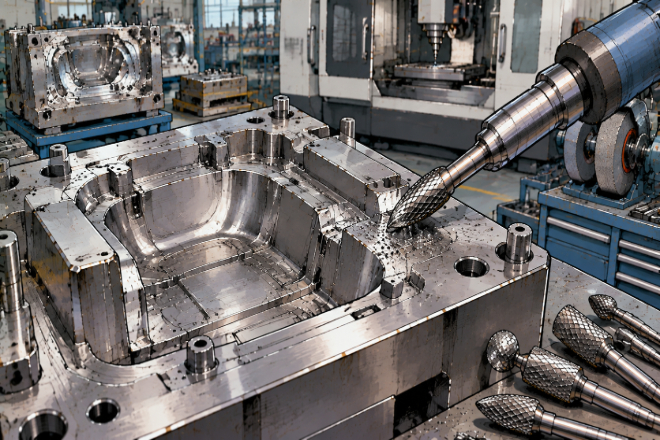
Mold manufacturing is a precision business. A small change in a mold can become a visible change on every part produced from it. That makes local correction very different from general metal grinding.
Fresas de carburo de tungsteno are useful because they combine a small cutting head with high hardness and good wear resistance.
They remove material with defined cutting teeth instead of simply rubbing the surface like an abrasive tool.
For mold makers, that gives them several useful jobs.
A burr can remove a local high spot after machining. It can open a difficult corner, blend a repaired area, remove unwanted material around a cavity, clean an edge, or make a small shape correction before polishing.
The important word is small. A carbide burr should normally support the main mold-making process rather than replace it.
If a large cavity needs to be machined, CNC milling or EDM will usually do the heavy work.
If a bore requires a tight tolerance, it should be produced with the correct precision process. If the final mold surface requires a mirror polish, the carbide burr will not be the last tool to touch it.
The burr lives between these larger processes. It is especially useful when the question is: “Do we really need to set up another machining operation for this tiny area?”
Sometimes the answer is yes. Sometimes a skilled toolmaker and the correct tungsten carbide burr can solve the problem much faster.
Carbide burrs are also available in different cuts for steel, stainless steel, aluminum, cast materials, and fine finishing.
This matters because mold manufacturing can involve several tool steels as well as aluminum molds and other materials.
Fine MICRO-type cuts are particularly interesting for mold work. They are designed for finishing and very fine cleaning, and are specifically used for corrections in tool and mold construction.
That is much closer to what a mold shop needs than simply choosing the most aggressive burr available.
2. Where Are Carbide Burrs Used on Mold Cavities and Cores?
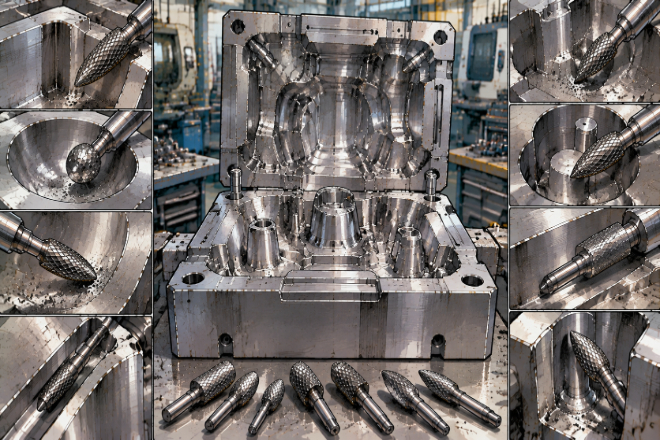
Mold cavities and cores contain complex shapes. There may be deep pockets, rounded transitions, narrow channels, ribs, corners, holes, and surfaces that change direction quickly.
A large grinding wheel cannot follow all of them. A small tungsten carbide burr can.
For example, after CNC machining or EDM, a mold cavity may have a local area that needs blending. A small ball or oval burr can follow the curved surface and remove a controlled amount of material.
A narrow feature may be easier to reach with a tree or flame-shaped burr. A cylindrical radius-end burr can work around flatter surfaces and transitions. A cone-shaped burr may be useful inside tapered features or angled areas.
Different shapes allow the toolmaker to follow the mold rather than forcing the mold to fit the tool. This becomes particularly useful during tryout.
A newly built mold may produce a part with a small fit, flash, release, or local geometry problem. After the cause is identified, the mold may need a controlled correction.
A carbide burr can remove a local high spot or open a permitted area without sending the entire mold back through a long machining process.
But this is also where restraint matters. A carbide burr can remove metal much faster than it can put it back. The toolmaker needs to know the target geometry before starting.
Critical shut-off surfaces, sealing areas, parting surfaces, precision holes, and other controlled mold features should not be changed casually.
If measurement or engineering approval is required, that comes first. The burr should perform the correction. It should not decide what the correction is.
3. How Are Carbide Burrs Used for Mold Repair and Modification?
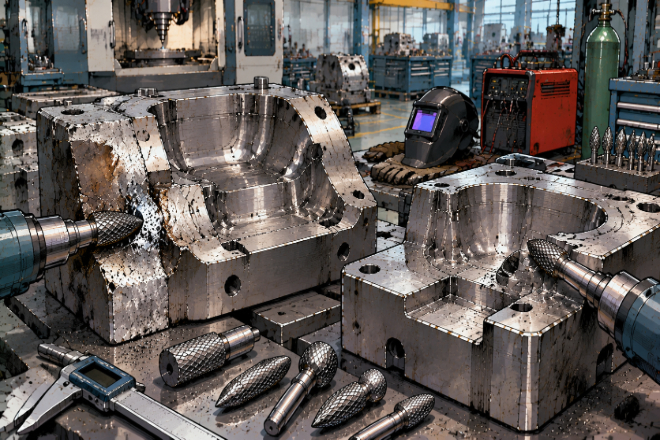
Molds do not stay new forever. Production cycles create wear. Parts change. Engineering changes arrive. Damage happens. Weld repairs may be needed.
This makes mold repair another useful area for carbide burrs. Imagine a damaged mold area that has been repaired by welding.
After the weld is complete, excess repair metal may need to be removed before the original contour can be restored.
A tungsten carbide burr can remove the larger local high spots and begin blending the repaired area into the surrounding tool surface.
The technician can then move to finer finishing tools as the surface gets closer to the required shape.
Carbide burrs can also help prepare local areas before an approved repair process. They may remove damaged material, clean a small feature, or provide access to a defect.
Modification work follows a similar idea. Perhaps a molded product has changed slightly and the tool requires a local adjustment.
If the correction involves removing a small amount of mold material, a carbide burr may be much faster than setting up a large machining operation.
The process might look like this: Inspect → Measure → Mark the correction → Remove material gradually → Measure again → Fine finish → Polish if required
That middle measurement is important. Do not wait until all the metal is gone before checking the result.
For larger or more precise mold modifications, CNC machining, EDM, laser welding, grinding, or another controlled process may still be required.
Carbide burrs are strongest when the correction is local and accessible. They are scalpels, not bulldozers. That is exactly why mold repair departments keep finding jobs for them.
4. Which Burr Shapes and Cuts Work Best for Mold Work?
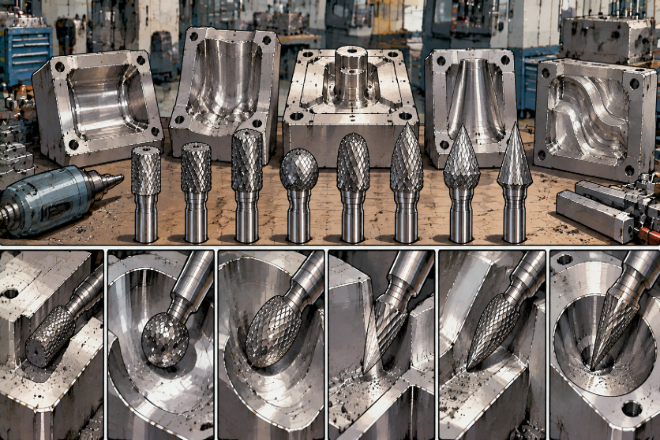
Mold manufacturing rarely has one “best carbide burr.” The correct burr depends on both the material and the geometry.
For rougher local stock removal on mold steel, a steel-specific cut can be useful. For controlled general work, a quality cross or double cut may provide a balance between removal rate and control.
For final carbide-burr finishing, a fine or MICRO-type cut becomes more interesting.
MICRO-cut burrs are designed specifically for finishing and very fine cleaning work.
They can provide high surface quality and low vibration, and their geometry does not change through wear in the same way as a mounted abrasive point.
That last detail matters in mold work. If a tool is following a small radius or contour, maintaining the cutting shape makes the process easier to control.
The head shape then needs to match the mold.
5. How Do Burrs Help with Fine Finishing Before Polishing?
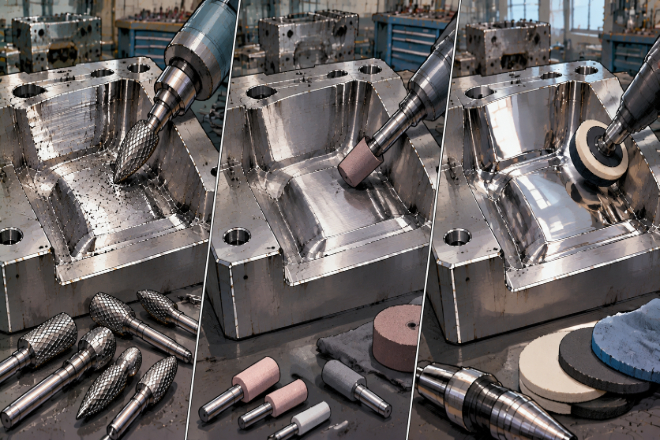
Mold surfaces often move through several stages before they are finished. CNC machining may create the main geometry. EDM may produce complex features.
Carbide burrs can make local corrections. Grinding stones or abrasive tools may refine the surface. Then polishing can create the required final finish.
The carbide burr therefore needs to leave the surface ready for the next process. For fine mold work, a rough cutting pattern creates extra work later. This is where a fine finishing burr becomes useful.
PFERD’s MICRO cut is specifically intended for finishing, very fine cleaning, and corrections in tool and mold construction.
It is designed to produce high surface quality while operating with low vibration. It can also machine many materials up to 68 HRC.
High concentricity is important because it helps the burr run without impact and reduces chatter marks.
That can shorten the work required in later finishing stages. The goal is not necessarily to create the final polished mold surface with the burr.
The goal is to hand the next process a better starting surface. Think of it this way.
If a rough burr removes metal very quickly but leaves deep marks that require twenty extra minutes of stone work, was it actually faster? Maybe. Maybe not.
Production time should be measured across the whole finishing process.
Fine carbide burrs also have an interesting advantage over mounted grinding points: their geometry stays more stable during use.
An abrasive point changes shape as it wears, while a carbide burr keeps its defined cutting geometry much more consistently.
For complex mold contours, that can make local corrections easier to repeat. Still, do not chase a perfect surface with the wrong process.
If the mold requires a specific polished finish, use the correct polishing sequence after the burr work.
A carbide burr should make polishing easier. It does not need to steal the polisher’s job.
6. How Should Mold Shops Control Burr Work and Tool Costs?
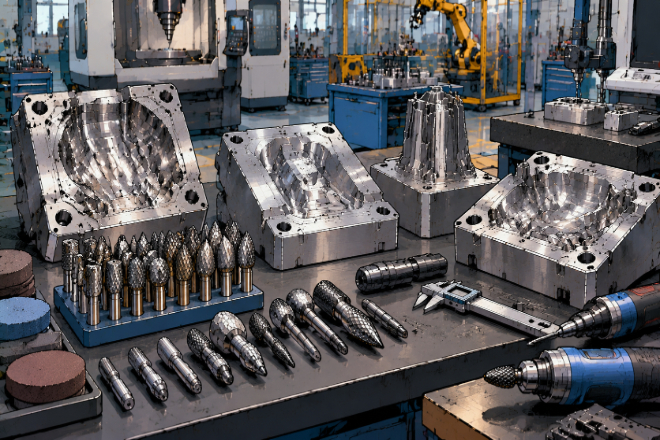
The biggest risk in mold work is not that the carbide burr cannot remove metal. It is that it removes the wrong metal.
A mold can represent many hours of machining, EDM, fitting, heat treatment, finishing, and polishing. One careless local correction can create far more cost than the price of the burr.
So mold shops need a controlled process. Start by defining where hand burr work is allowed. A rough repair area may have plenty of freedom.
A cavity wall close to final size has much less. A shut-off or precision sealing feature may require engineering approval or another machining method entirely.
Then standardize burr selection. Toolmakers should know which cut is used for rough stock removal, which shapes are preferred for common mold features, and when to change to a fine finishing burr.
Speed also needs control. There is no universal RPM for every mold burr. The correct rotational speed depends on material, cut, application, and burr diameter. Manufacturer guidance should be followed for the specific tool.
Contact should remain controlled as well. For normal burr work, PFERD recommends keeping the contact area below roughly one-third of the burr circumference.
Too much contact can create rough cutting behavior and increase the risk of tooth damage.
Tool condition matters. A worn or damaged burr may cut less cleanly and encourage the operator to use more pressure.
The grinder matters too. Poor spindle condition, a worn collet, or unnecessary shank overhang can create vibration even when the carbide burr itself is excellent.
For production managers, it is worth measuring more than burr price. Track correction time, secondary finishing time, burr life, polishing time, rework, and repeatability.
If one fine finishing burr costs more but saves ten minutes of polishing on repeated mold work, its purchase price tells only a small part of the story.
Automation is also possible in suitable applications. MICRO-type finishing burrs can be used with straight grinders, flexible shaft drives, machine tools, and robotic systems.
For repeated mold corrections or automated deburring, this can improve consistency. The real goal is not to make the burr last forever.
It is to reduce the total time required to produce an acceptable mold. That is the number worth putting on the purchasing report.
 English
  Español
  简体中文
简体中文  Français
  日本語
日本語  한국어
한국어  العربية
  Tiếng Việt