
1. When Should You Use a Carbide Burr to Enlarge a Hole?
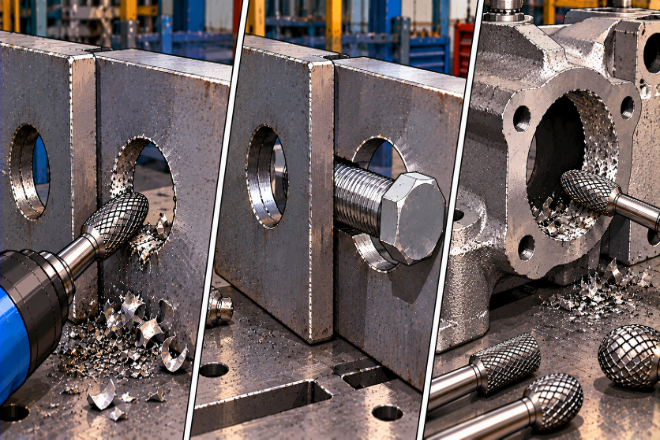
A tungsten carbide burr is useful when a hole already exists but needs additional material removed from its edge or internal wall.
This is common in fabrication, maintenance, casting work, automotor repair, shipbuilding, structural steel work, and equipment assembly.
Imagine two steel plates that need to be bolted together. The holes are already drilled, but one is slightly out of position. The bolt cannot pass through cleanly.
Drilling the whole hole again may not be practical. A carbide burr can remove a small amount of material from the side that is causing the interference.
The same idea applies when:
A bolt needs slightly more clearance
A rough opening needs to be enlarged
A casting hole contains excess material
A welded component has shifted slightly
A slot needs local adjustment
A pipe or plate opening needs a larger passage
An irregular cutout needs reshaping
A hole edge needs both enlargement and deburring
This is where carbide burrs have an advantage. They do not need to follow the exact center of the original hole in the same way as a drill.
The operator can remove material from one specific side. That makes the tool useful for local correction.
However, this freedom is also the reason a carbide burr should not be confused with a precision hole-making tool.
A burr will happily remove more material from the left side than the right side. It has no interest in keeping the hole perfectly round.
The operator or machine controls that. For clearance holes, fabrication adjustments, and irregular openings, this flexibility is useful.
For a precision bearing bore, dowel hole, or other tightly controlled feature, it may be exactly what you do not want.
2. Which Carbide Burr Shapes Work Best for Hole Enlargement?
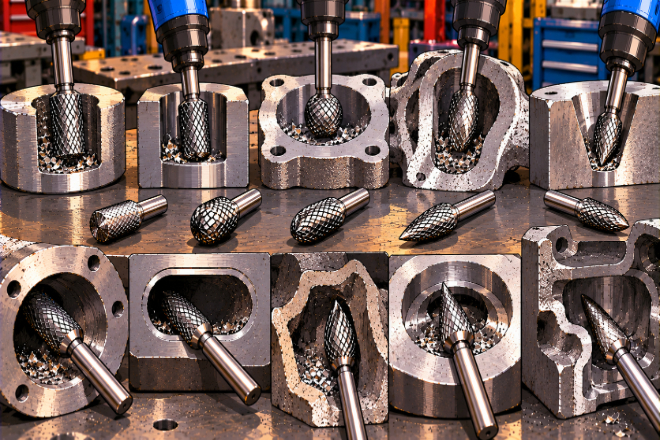
The best burr shape depends on what needs to happen to the hole.
Are you increasing the whole diameter?
Correcting only one side?
Opening the entrance?
Creating an oval opening?
Working deep inside the hole?
These jobs need different shapes.
3. How Do You Enlarge a Hole Without Removing Too Much Metal?
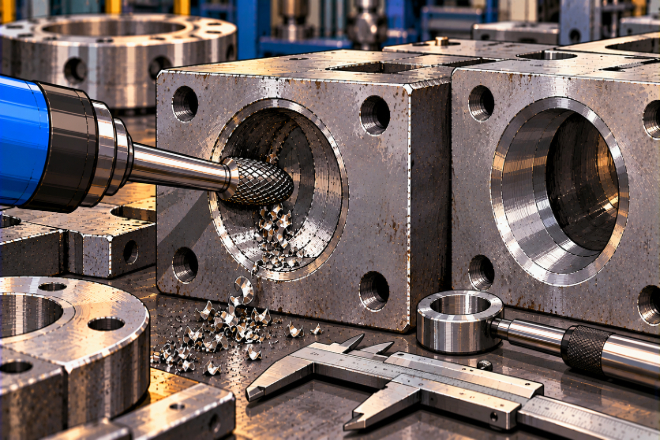
This is where a simple job can go wrong very quickly. A carbide burr removes metal fast. That is the good news. It is also the bad news if the operator stops measuring.
Before starting, determine how much material actually needs to be removed. If the goal is bolt clearance, test the required bolt or use a suitable gauge.
If the opening has a dimensional requirement, measure it before cutting and during the process. Marking the area that needs correction can also help. Then begin removing material gradually.
Do not immediately bury the burr into the hole and try to reach the final size in one pass. Use controlled movement around the wall.
Remove a small amount. Stop. Measure. Then continue. A useful process is: Measure → Mark → Remove → Check → Remove again if needed → Deburr → Final check
This may sound slower than simply grinding until the part fits. In practice, it can be much faster than explaining why the hole is now too large. Pressure should also stay controlled.
The cutting teeth should do the work. Heavy side pressure can make the tool harder to guide and may increase vibration.
Keep the burr moving rather than holding it against one point for too long. For a round hole, try to distribute material removal evenly around the required area.
For an offset correction, work only where extra clearance is needed. That is one of the main strengths of using a carbide burr.
You do not always have to make the entire hole larger just because one small area is causing the problem.
4. How Does the Workpiece Material Change Burr Selection?
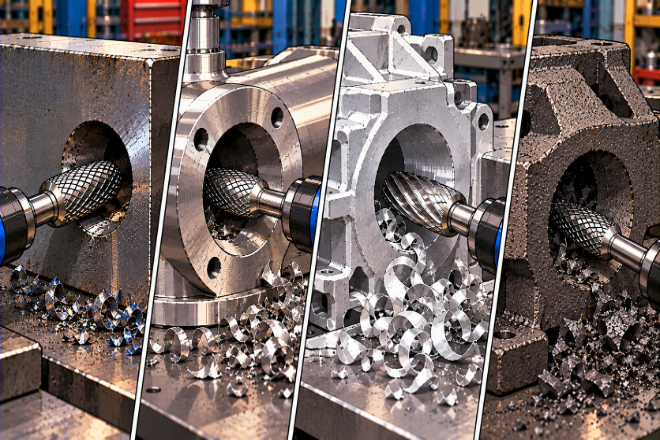
Hole enlargement may involve steel, stainless steel, aluminum, cast iron, titanium, or other materials.
The hole may look the same. The cutting behavior does not. For carbon steel and cast steel, a steel-specific cut can provide strong stock removal.
For stainless steel, an INOX-type geometry can be useful where controlled cutting and lower heat generation are important.
Cast iron can benefit from a CAST-specific burr designed for its abrasive cutting behavior. Aluminum needs special attention because soft chips can stick between the teeth.
An open ALU cut provides more chip space and helps reduce loading. This is especially useful when enlarging holes in:
Aluminum housings
Automotor castings
Aeroespacial structures
Fabricated aluminum frames
Pump components
If the shop works with many different metals and changes jobs frequently, a high-performance multi-material cut can reduce the number of burr types that need to be stocked.
But a universal tool is not always the fastest tool. For high-volume work on one material, a material-specific burr can make more sense.
Tool diameter matters too. A burr that nearly fills the hole may remove material quickly, but it gives the operator less room to move.
A smaller burr provides more freedom for local correction. For a production team, the right balance is between stock removal and control. The fastest burr is not useful if it turns a clearance hole into an accidental slot.
5. Can Carbide Burrs Enlarge Irregular Holes and Cutouts?
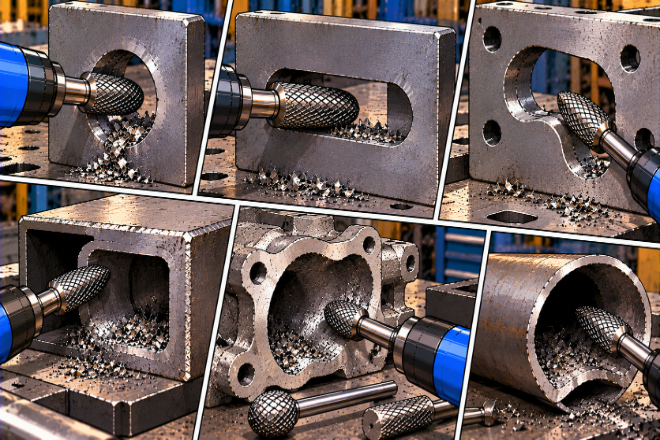
This is one area where carbide burrs become especially useful. Not every opening needs to be perfectly round.
Fabrication work often includes:
Slots
Oval holes
Cable openings
Pipe cutouts
Access holes
Irregular casting openings
Custom mounting holes
Openings around welded structures
A drill naturally wants to create a round hole. A carbide burr is much less opinionated. It can move sideways.
That allows the operator to change the outline of an existing opening. For example, a round pilot hole can be expanded sideways to create an oval clearance opening.
Several holes can also be connected and the material between them removed to create a larger cutout.
In casting work, a rough opening may contain flash or excess material. A carbide burr can follow the irregular wall and remove only the unwanted areas.
High-performance carbide burrs are specifically used for applications such as milling out and cutting out holes, which makes this type of work a natural fit for the tool.
Shape becomes important again. Cylindrical burrs can straighten walls. Ball and oval burrs help create curved transitions.
Tree and flame shapes can reach narrow sections. Cone shapes can open angled entrances.
For automated production, robots and machine tools can also use suitable carbide burrs for controlled milling and cutout work.
This opens the door to repeatable hole correction without relying completely on manual finishing.
6. When Should You Use a Drill, Reamer, or Milling Machine Instead?
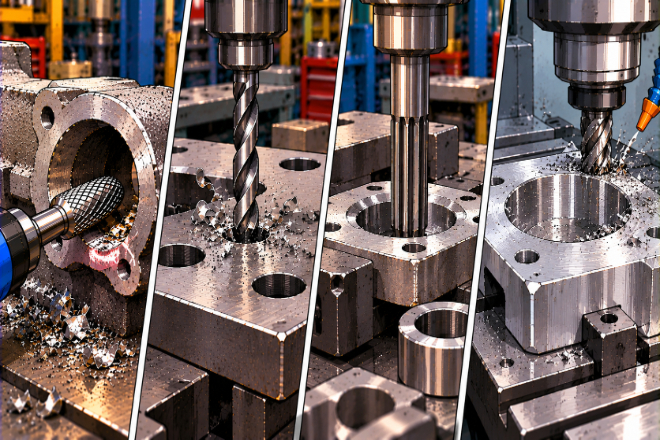
A carbide burr can enlarge a hole. That does not mean it should enlarge every hole. This is the most important limit to understand.
If the final feature requires a precise diameter, roundness, position, straightness, or surface finish, another machining process may be better.
A drill is designed primarily to create a hole. A reamer can bring an existing hole to a more accurate diameter and surface finish.
A boring or milling process can control hole position, geometry, and size more precisely. A carbide burr is better suited to flexible local material removal.
That makes it useful for:
Clearance adjustment
Repair work
Irregular enlargement
Removing casting excess
Opening rough cutouts
Local assembly correction
Deburring while reshaping
It is less suitable as the final tool for:
Bearing bores
Precision dowel holes
Accurate shaft fits
Critical sealing bores
Tight-tolerance locating holes
There is also a difference between correcting a hole and hiding a manufacturing problem.
If workers need to enlarge the same misaligned hole on every part, the carbide burr may be treating the symptom.
The real issue could be upstream drilling, welding distortion, fixture position, casting variation, or assembly tolerance.
A burr is excellent at saving a difficult part. It should not become a permanent employee in the quality department because another process refuses to behave.
7. How Can Manufacturers Make Hole Enlargement More Consistent?
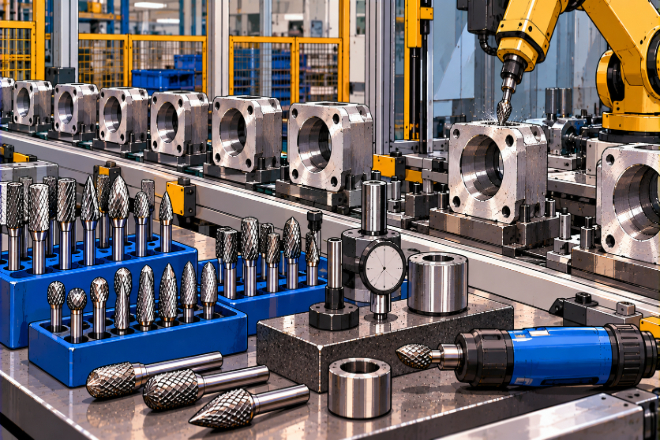
For occasional maintenance, an experienced operator may enlarge a hole by feel. For repeated production, “by feel” becomes difficult to measure.
Companies should standardize the process. Start with the reason for enlargement.
Is the goal bolt clearance?
Removing casting flash?
Correcting an offset?
Creating an oval opening?
Increasing flow area?
Each purpose should have a defined final condition. Then standardize the tool.
Record:
Burr shape
Burr diameter
Cut geometry
Material
Tool reach
Recommended speed range
Inspection method
Simple go/no-go gauges can be useful for repeated clearance holes. Templates may work for irregular openings.
Calipers or other measuring tools can be used when dimensions need closer control.
For automated deburring or robotic finishing, the tool path, spindle speed, feed, and burr wear should also be monitored.
Do not forget tool condition. A worn burr removes material differently from a sharp one.
If the process depends on repeatability, replacement criteria should be based on cutting performance and output quality rather than waiting until the burr can barely cut.
Purchasing teams can also compare tools using more useful numbers than unit price.
Look at:
Time per corrected hole
Number of holes per burr
Rework
Tool changes
Operator control
Final opening quality
Cost per acceptable part
That gives a clearer picture of value. The best tungsten carbide burr for enlarging holes is not simply the one that removes the most metal.
It is the one that removes the right metal, from the right place, without turning a small correction into a larger repair.
 English
  Español
  简体中文
简体中文  Français
  日本語
日本語  한국어
한국어  العربية
  Tiếng Việt