
What Is Abrasion in Carbide Rings?
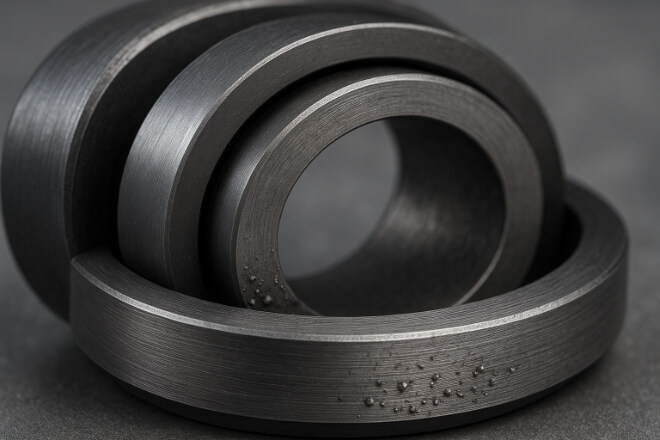
Abrasion occurs when hard particles or contaminants in the sealing fluid continuously scratch or cut the carbide surface. Over time, this friction wears down the smooth sealing face.
Typical signs include:
A dull, rough, or matte surface instead of a mirror finish
Grooves or scoring marks following the rotation direction
Reduced sealing efficiency due to uneven contact
For example, in slurry pumps handling sand or ceramic particles, abrasive wear is common.
Even with high-dureté carbide, continuous exposure to these solids gradually removes material.
1). Main Causes of Abrasion
Poor filtration or absence of a clean flush system
Use in high-solid-content liquids (slurry, mud, pulp)
Improper material pair — for instance, using carbide vs. carbide in dirty environments
2). How to Reduce Abrasion
To prevent abrasive wear, system designers often use:
Better filtration systems to remove solid particles
Harder grades of tungsten carbide (low cobalt content)
Proper seal flushing to keep faces clean
Edge Chipping in Carbide Seal Rings
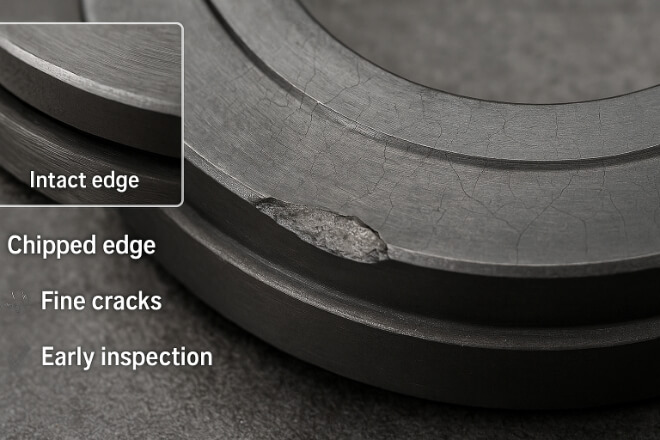
Edge chipping is another common failure mode, especially during installation or sudden load changes.
Tungsten carbide is extremely hard, but also brittle — meaning sharp impacts can cause localized cracks or small chips along the seal edge.
Typical symptoms include:
Tiny chips along the outer or inner edge of the seal face
Leakage due to uneven sealing
Progressive cracking under cyclic stress
For example, if a seal is installed with uneven torque or dropped during handling, micro-chips can appear that later propagate during service.
1). Causes of Edge Chipping
Mishandling or dropping during assembly
Poor seal alignment or over-tightening
Contact between faces during dry running
Vibration or shaft misalignment
2). Prevention Methods
Train technicians on proper installation procedures
Use chamfered edge designs to distribute stress
Avoid dry starts — ensure lubricating film before operation
Check concentricity and alignment before startup
Thermal Shock in Tungsten Carbide Seals
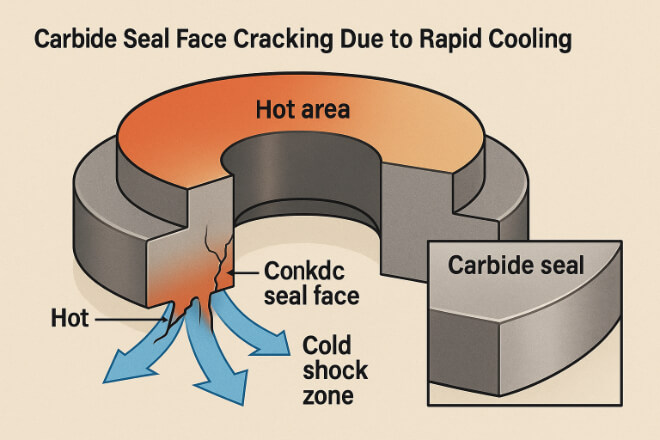
Thermal shock happens when the seal face experiences a rapid temperature change — such as sudden cooling after a hot run.
The extreme difference in temperature between surface and interior creates internal stress, which can lead to cracks or even complete ring fracture.
1). Recognizable Symptoms
Network-like surface cracks (spider-web pattern)
Radial cracks running from the inner diameter to outer edge
Broken or split seal rings
In a real-world case, a pump operating in hot oil was suddenly flushed with cold water during maintenance.
The temperature drop was over 150°C — the tungsten carbide ring cracked immediately due to thermal stress.
2). Common Causes
Rapid cooling or heating during operation
Lack of cooling control or sudden flow change
Poor material selection for high-temperature fluids
3). Prevention Tips
Maintain steady temperature conditions
Avoid flushing with cold fluid after hot operation
Choose nickel-bonded tungsten carbide for better thermal resistance
Practical Example: When Multiple Failures Overlap
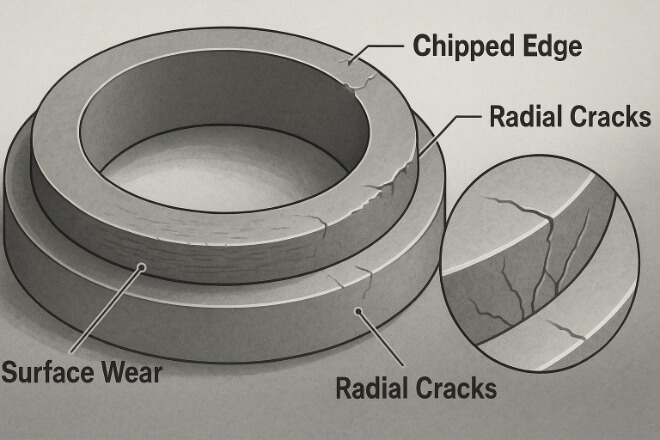
In real conditions, seal rings often show a mix of these failure types. For instance, a seal that runs dry may first chip its edges.
Once the fluid returns, thermal stress adds micro-cracks, and abrasive particles worsen wear.
In one refinery case, a mechanical seal failed within 2 weeks due to:
Improper flushing system setup
Frequent temperature cycling
Slurry ingress from an upstream filter leak
This example highlights the importance of system-level design and not just material selection.
Choosing the Right Material and Design
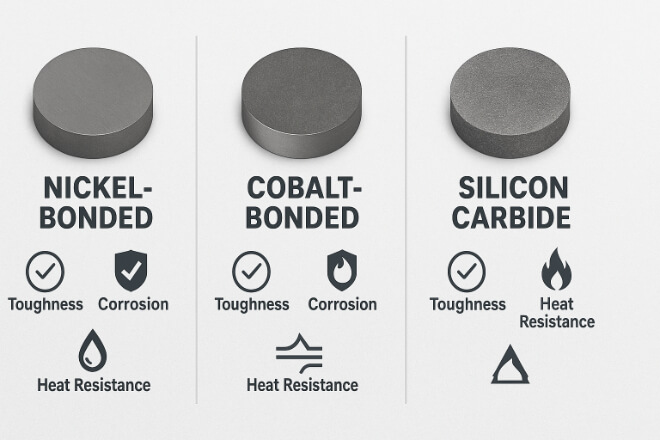
For harsh or unpredictable conditions, choosing the right carbide composition is critical.
Decision-makers can improve seal reliability by considering:
Nickel-bonded carbides for résistance à la corrosion and thermal resistance
Cobalt-bonded carbides for higher dureté
Silicon carbide vs tungsten carbide pairing for cleaner sealing
Additionally, proper surface finish (Ra 0.02–0.04 µm) and flatness ensure better face contact, reducing local stress.
Recommandations en matière d'entretien et d'inspection

Routine inspection helps detect early-stage failures before they lead to full shutdowns.
A good inspection plan should include:
Visual checks for micro-chipping or dullness
Measurement of face flatness and surface roughness
Monitoring of temperature and flush flow rate
By identifying these early signs, companies can extend seal life and reduce unplanned maintenance costs.
 English
  Español
  简体中文
简体中文  Français
  日本語
日本語  한국어
한국어  العربية
  Tiếng Việt