
1. Why Is Hardened Steel Difficult to Cut?
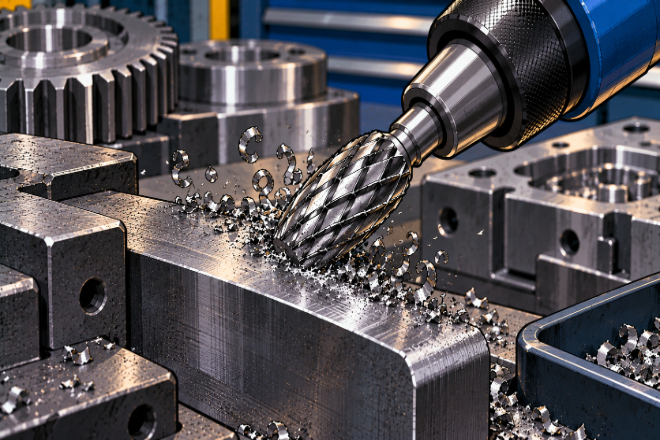
Hardened steel is made to resist wear and deformation. That is useful in dies, molds, shafts, gears, machine parts, and many other industrial components.
Unfortunately, those same properties make it harder to machine. A softer steel may allow a cutting edge to bite easily into the surface. Hardened steel pushes back.
The cutting teeth face higher stress, and the contact area can generate heat quickly if the burr is not cutting cleanly. This creates several common problems. The first is slow material removal.
If the cutting geometry is too fine or the burr is worn, the teeth may rub more than they cut.
The second is heat. Heat can reduce cutting efficiency and make the operator instinctively press harder. That usually makes the situation worse.
The third is vibration. Hardened steel gives very little under the tool. If the burr is too large, badly balanced, or held with too much shank exposed, chatter can start quickly.
Then there is the burr itself. Tungsten carbide is much harder than common tool steels, which is why it works well on hardened material. But carbide is also less forgiving of impact than steel.
A good burr should cut the material. It should not be bounced, hammered, or forced into it. That difference is important.
For hardened steel, the best setup is not the one that feels strongest. It is the one that lets the cutting edges work steadily with as little unnecessary stress as possible.
2. Which Cut Style Works Best on Hardened Steel?
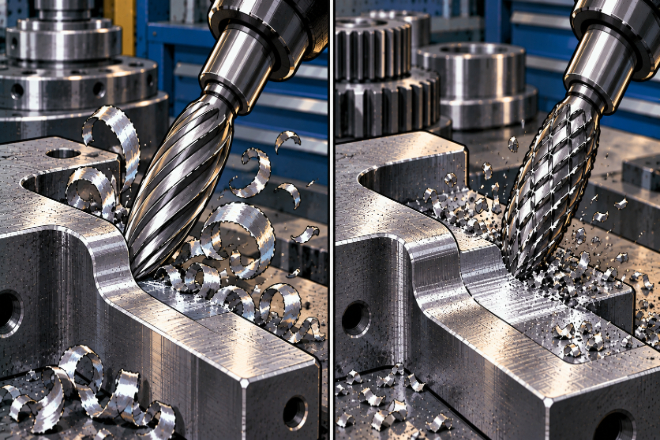
For many hardened steel jobs, double cut carbide burrs are a strong starting point.
The crossed flute pattern creates more cutting edges and usually breaks the removed metal into smaller chips.
This can give the operator better control and make the burr easier to guide on hard surfaces.
That is useful for:
deburring hardened parts
die and mold correction
weld cleanup on hard steel
edge shaping
removing small high spots
controlled stock removal
A single cut burr can also be useful.
If the main goal is heavier material removal and the surface does not need to be especially smooth, a single cut pattern may give a more direct cutting action.
So there is no rule saying double cut is always better. The job decides.
A simple way to look at it is this:
3. Which Burr Shape Should You Choose?
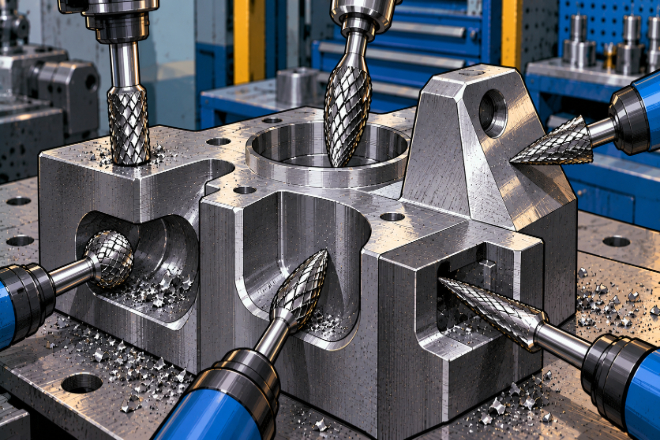
Cut style tells you how the burr removes metal. Shape tells you where it can remove it.
This becomes very important on hardened steel because poor contact can create heat and vibration quickly.
For flat surfaces and straight edges, a cylindrical burr is often useful. Its side cutting area can work across broader surfaces and remove material in a controlled path.
For rounded cavities, a ball burr is usually a better fit. The round head follows curves naturally and gives the operator freedom to change cutting angle.
Tree and flame burrs are useful around changing contours, weld areas, and narrow curved sections.
Cone and pointed burrs are better for tighter corners, tapered holes, and small internal areas.
The mistake is choosing a burr that only “sort of” fits.
If the operator has to hold a cylindrical burr at a strange angle just to reach a curved cavity, only a small part of the cutting surface may touch the steel.
That creates concentrated load. Concentrated load creates heat. Heat creates problems. The correct shape spreads the cutting action where it should be.
That can make a hard material feel much easier to work.
For production teams, matching burr shape to workpiece geometry is one of the cheapest ways to improve cutting performance.
No new machine required. Just a better match.
4. Why Does Carbide Quality Matter More on Hardened Steel?
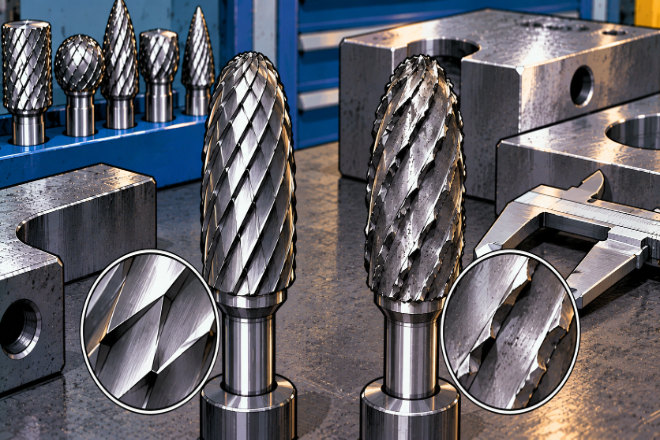
Not all tungsten carbide burrs perform the same. That becomes much easier to notice on hardened steel.
The burr head is usually made from cemented carbide, where tungsten carbide grains are held together with a metallic binder.
The quality of that material, grain structure, manufacturing process, grinding accuracy, and brazed connection to the shank can all affect how the tool performs.
For hardened steel, the cutting edges need to stay sharp under high contact stress.
If the carbide is poorly made, the teeth may wear early or chip under load.
If the flute grinding is inconsistent, one part of the burr may cut more than another.
That can create vibration. If the head is poorly balanced, high-speed rotation can make the problem even more obvious.
This is why industrial buyers should not compare carbide burrs only by size and price.
A cheap burr that loses cutting ability quickly can be more expensive in the real process.
It may increase:
cutting time
tool changes
operator effort
secondary finishing
rejected parts
For hardened steel, consistency matters. One good sample is not enough.
If a company buys hundreds of burrs, they need hundreds that behave in a similar way. That is a much harder test.
5. How Should You Run a Carbide Burr on Hardened Steel?
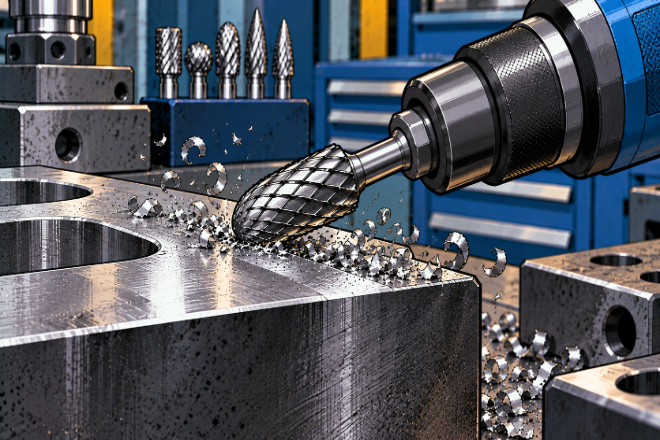
A good carbide burr can still perform badly if the operating setup is poor. Start with speed.
The correct speed depends on burr diameter, material, rotary tool, and manufacturer recommendations. Avoid using one fixed speed for every burr.
Small burrs and large burrs behave differently. Then look at pressure. Heavy pressure is one of the most common mistakes.
It feels natural to push harder when the steel is difficult to cut. But excessive pressure can increase side load, vibration, and heat.
The goal is to let the cutting edges remove small pieces of metal continuously. If the burr sounds rough, chatters, or needs strong force to keep cutting, something should be checked.
The cutting edges may be worn. The speed may be unsuitable. The burr may be too large. The shank may be extended too far. Or the shape may simply be wrong for the area.
Keep the burr moving across the workpiece rather than holding it in one small point. This reduces local heat and avoids digging deep grooves into the surface.
Also make sure the rotary tool itself is in good condition. Poor bearings or a worn collet can create runout.
On soft material, slight runout may already be annoying. On hardened steel, it becomes even more obvious. A precision burr needs a stable tool behind it.
6. How Can You Prevent Chipping and Early Wear?
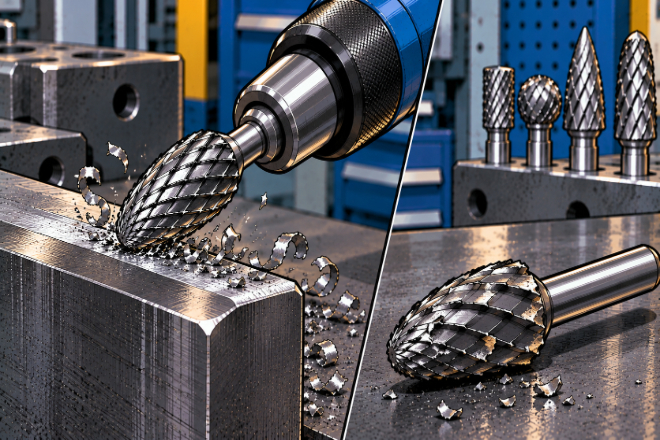
Tungsten carbide is very hard. That does not mean it likes abuse.
Hardened steel work can create strong impact if the burr catches an edge or is pushed sideways too aggressively.
Avoid sudden contact with the workpiece. Bring the burr into the cut smoothly. Do not use the tool like a lever.
And do not allow a long section of shank to stick out of the collet unless the burr is designed for long-reach use.
More overhang means more chance of vibration. Vibration is bad for surface quality and bad for carbide teeth.
Another warning sign is a sudden change in cutting sound. If a burr starts producing more noise or feels less smooth than before, stop and inspect it. Continuing to run a damaged burr can make the problem worse.
Operators should look for:
chipped teeth
uneven wear
damaged flute edges
bent or damaged shanks
poor head-to-shank connection
heavy vibration during rotation
This kind of inspection does not need to be complicated. It simply needs to happen before the burr becomes a problem in the middle of an expensive part.
Hardened steel components are often high-value parts. Saving a worn burr is rarely worth damaging one.
7. How Should Buyers Test Carbide Burrs for Hardened Steel?
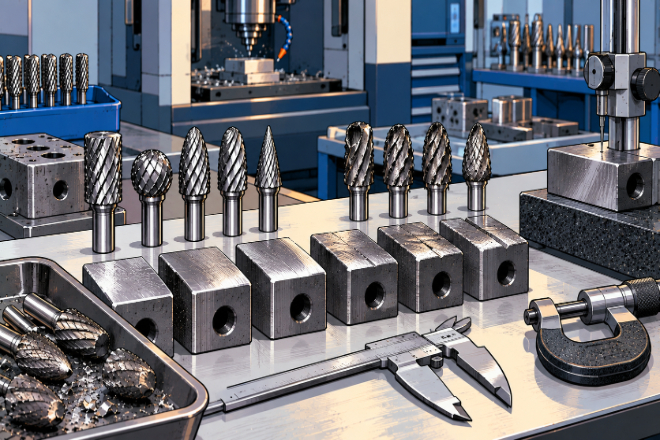
For decision-makers, this is where the question becomes less about “Which burr is best?” and more about “Which burr is best in our process?”
Start with the actual steel used in production. Do not test only on mild steel because it is convenient.
Then use the same type of rotary tool, similar burr size, and similar operating method. Compare several things at the same time.
How fast does the burr remove material?
How easy is it to control?
Does chatter appear?
What does the surface look like?
How many parts can it process before cutting performance drops?
Does the tool remain consistent from one burr to the next?
This last point matters for purchasing. A supplier may send one excellent sample. Volume production needs repeatable quality.
If five burrs from the same batch all behave differently, that is not a stable production tool. Companies should also consider total process cost.
A burr that costs more but lasts longer and reduces finishing work may be the cheaper option overall.
A low purchase price looks good on paper. A long cycle time does not.
For hardened steel applications, the best supplier is the one that can provide consistent carbide quality, stable flute grinding, reliable construction, and repeatable performance.
 English
  Español
  简体中文
简体中文  Français
  日本語
日本語  한국어
한국어  العربية
  Tiếng Việt