
1. What Makes a Carbide Burr Good for Weld Removal?
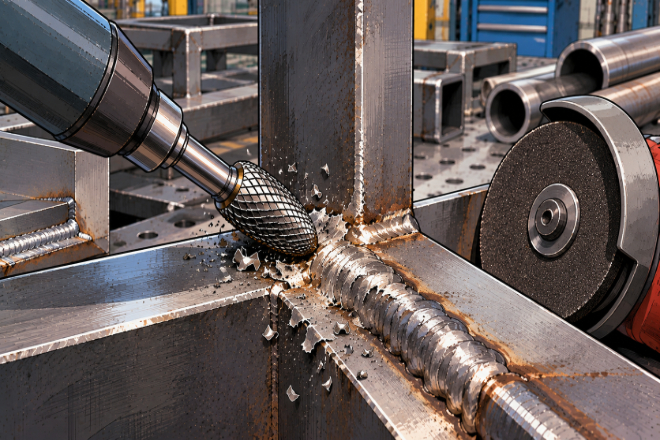
Weld removal is not one single operation.
Sometimes a fabricator needs to remove a heavy raised weld from a steel component. Sometimes the job is only to blend a small weld bead.
In repair work, the technician may need to remove a defective weld from a narrow joint without cutting deeply into the parent metal.
These jobs need different levels of aggression and control. This is where tungsten carbide burrs for weld removal are useful.
Carbide burrs use defined cutting teeth to remove chips from the workpiece. Industrial burr manufacturers list weld-seam work, levelling, deburring, surface work, and milling out among their normal applications.
Compared with a large grinding wheel, a carbide burr has a much smaller contact area.
That can be an advantage. Imagine a weld running along the inside corner of a fabricated bracket. An angle grinder may remove the weld quickly, but the disc can also touch both walls around it.
A tree or flame-shaped carbide burr can follow the weld much more closely.
The same idea applies around pipes, cast components, repaired machinery, frames, and complex fabricated structures.
Tungsten carbide also provides high dureté et résistance à l'usure. This allows the cutting teeth to keep working on steel and other tough materials when the burr is used correctly.
But the fastest-cutting burr is not automatically the best.
Weld removal has two goals:
Remove the unwanted weld.
Keep the metal that is supposed to stay.
The second part is easy to forget.
An extremely aggressive burr can save time during rough removal, but it can also create extra finishing work if the operator cuts too deeply.
The best carbide burr therefore balances stock removal, control, access, and finish. That balance changes from one weld to another.
2. Which Burr Shape Works Best for Different Welds?
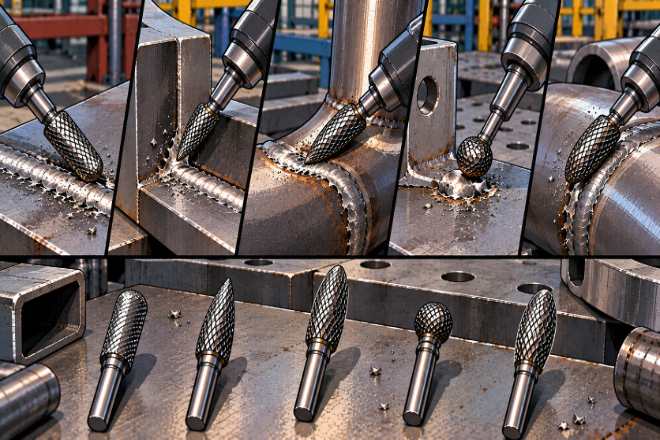
If someone asks for the best carbide burr for weld removal but does not describe the weld, the question is only half finished.
Shape determines where the cutting teeth can make useful contact. A cylindrical carbide burr is a strong choice for relatively flat and open weld areas.
It provides a broad cutting surface and can remove raised weld metal efficiently.
A cylindrical burr with a radius end gives more flexibility because the rounded end can work into transitions without creating such a sharp contact point.
For welds in corners, a tree-shaped burr is often more practical. Its tapered body can enter narrower areas while the rounded or pointed end reaches deeper into the joint.
A flame-shaped carbide burr is useful for curved welds and changing contours. It can move between wider and narrower areas without forcing the operator to hold the tool at an awkward angle.
A ball burr is useful around concave surfaces, rounded joints, and local weld defects. Its curved cutting surface makes it easy to change direction.
An oval burr also works well for blending and curved surfaces where a cylindrical burr feels too rigid.
Cone and pointed shapes can reach narrow grooves, but they require careful control because their smaller contact area can remove metal from a very focused point.
The simple version looks like this:
3. Should You Use an Aggressive or Fine Cut?
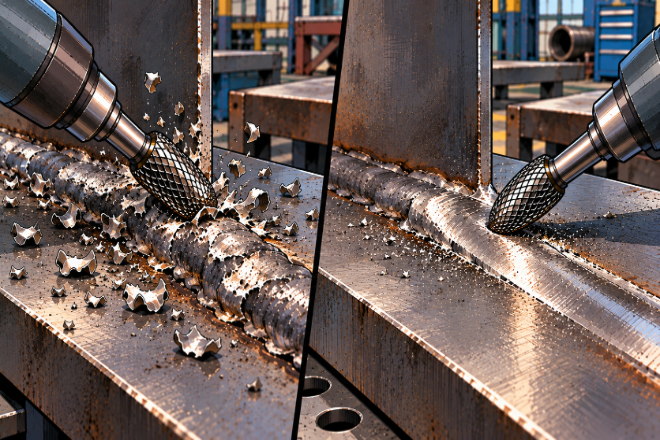
Once the shape is selected, the next question is the cutting geometry. For heavy weld removal on carbon steel, a burr designed for high stock removal on steel can be a very effective choice.
Modern steel-specific carbide burrs are designed to cut aggressively while still giving the operator useful guidance.
Some current high-performance STEEL designs use tooth geometry that creates larger chips and improves chip removal.
That makes sense for rough weld removal. If a large amount of raised weld metal needs to disappear, there is little benefit in using an extremely fine burr and spending all afternoon doing it.
But aggression has a limit. As the burr approaches the base metal, control becomes more important than maximum stock removal.
A practical weld-removal process may therefore have two stages. The first stage removes most of the unwanted weld quickly. The second stage works more carefully near the final surface.
Depending on the required finish, abrasive finishing tools may follow the carbide burr. This is important because a carbide burr is primarily a cutting tool. It does not always need to create the final cosmetic finish.
General-purpose or cross-cut burrs can also be useful when the operator wants a balance between material removal and control.
High-performance multi-material cuts are another option when a fabrication or repair shop works on several metals rather than only carbon steel.
PFERD’s current ALLROUND/OMNI-type designs, for example, are intended for steel, stainless steel, non-ferrous metals, and cast iron and include weld-seam work among their applications.
The purchasing question should therefore be more specific than: “Which burr cuts fastest?”
Ask: “Which burr removes this weld quickly without adding another finishing problem?” That question usually produces a more useful answer.
4. Does the Weld Material Change the Best Burr?
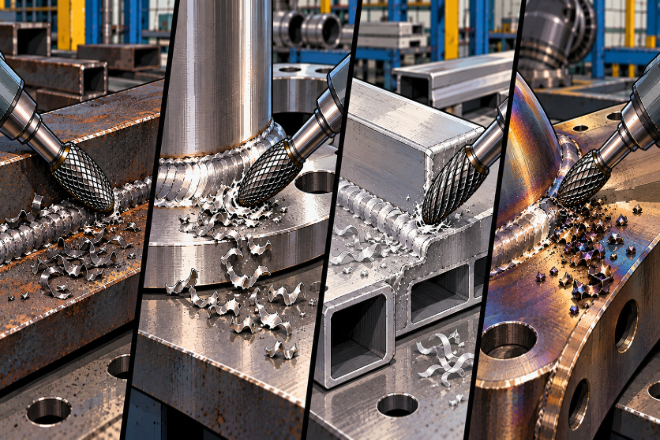
Absolutely. A carbide burr that performs well on carbon steel is not automatically the best choice for every welded material.
Carbon and alloy steel are common weld-removal materials. A steel-specific high-performance cut is a logical option when fast stock removal is important.
Stainless steel changes the situation. It benefits from a cutting geometry suited to stainless material. Efficient cutting helps avoid unnecessary rubbing and heat while giving the operator better control.
For fabrication companies working across several materials, a multi-material burr can reduce the number of different tool families that need to be stocked.
Current industrial ALLROUND-type burrs are designed for steel, stainless steel, non-ferrous metals, and cast iron.
Aluminum needs another approach. Soft aluminum can load tightly spaced cutting teeth.
For welded aluminum components, an open ALU-style cutting geometry gives chips more room to escape and reduces the chance of material packing between the teeth.
Then there are high-temperature alloys. Nickel-based and other difficult alloys may appear in aerospace, energy, chemical processing, and high-temperature equipment.
These applications need burrs and cutting conditions selected specifically for the material and repair procedure.
The important point is simple: Choose the material first. Choose the shape second. A perfect tree-shaped burr with the wrong cutting geometry is still the wrong burr.
This also affects tool inventory. A company doing structural steel fabrication may benefit from a focused set of aggressive steel burrs.
A maintenance contractor moving between stainless equipment, cast components, and carbon steel may get more value from a broader selection.
The best burr is the one that matches the work actually arriving at the shop. Not the one with the most impressive description in the catalog.
5. How Do You Remove a Weld Without Damaging the Base Metal?
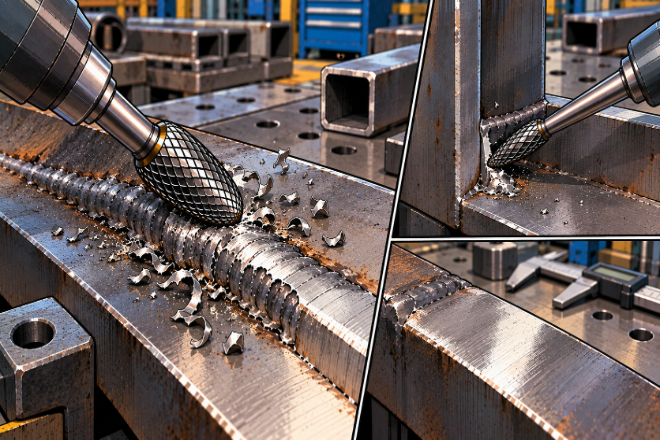
This is where technique becomes more important than the carbide itself. Start by identifying exactly what needs to be removed.
If the weld is defective and part of a controlled repair, inspection should define the repair area before aggressive grinding begins.
Do not erase useful evidence first and ask questions later. During removal, begin with the raised weld metal rather than immediately cutting down to the parent surface.
Keep the burr moving. Holding it in one place can create a low spot.
Pressure should remain controlled. The burr should cut with its teeth rather than being forced into the workpiece.
As the weld becomes lower, reduce the aggression of the operation. The last part of weld removal often deserves more patience than the first.
A useful mental rule is: Fast at the top. Careful at the bottom. Tool angle also matters.
Try to position the burr so its shape naturally follows the weld. If the operator needs to twist the grinder into a strange position just to make contact, another burr shape may provide better control.
For tight areas, long-shank burrs can improve access. PFERD offers long-shank versions specifically for small, difficult-to-reach areas.
But extra length increases the importance of stability. Too much unsupported shank can increase vibration. Use the shortest burr that comfortably reaches the weld.
Finally, know when to stop. The goal is not always to make the repaired area look like the weld never existed.
Structural, pressure-containing, aérospatial, railway, and other critical components may have specific repair and inspection requirements.
Those requirements decide the final geometry. The carbide burr only helps you get there.
6. What Mistakes Make Weld Removal Slower or Riskier?
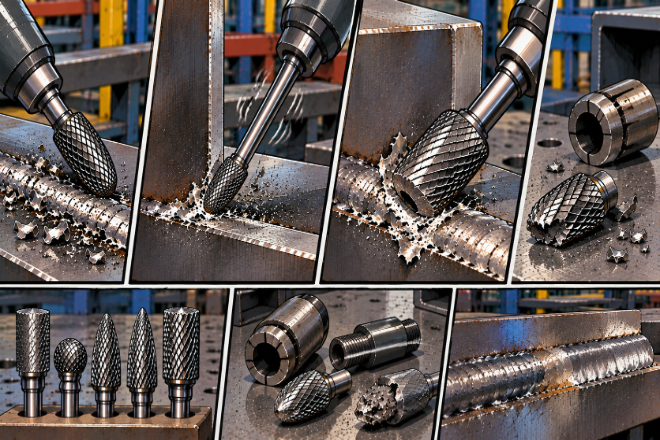
One of the most common mistakes is heavy pressure. If the burr is not cutting well, pushing twice as hard rarely turns it into the correct tool.
It may be dull. The cut may be wrong for the material. The speed may be incorrect. The grinder or collet may have a problem.
Or the burr shape may simply be wrong for the weld. Check those things first. Rotational speed is another important factor.
Do not use one RPM setting for every burr in the workshop. Recommended speed changes with burr diameter, material, cut geometry, and product design. Manufacturer speed guidance should be followed for the specific tool.
Vibration deserves attention too. Good concentricity helps a burr run smoothly. PFERD notes that accurate concentricity on its high-performance steel burrs supports impact-free work and helps avoid chatter marks.
A worn collet or poor grinder bearing can undo that advantage. Another mistake is using the largest burr available because the weld is large.
Large burrs remove material quickly on open surfaces, but they can become difficult to control near corners and base metal.
Sometimes a smaller tool finishes the job faster because the operator spends less time correcting mistakes.
Do not ignore burr condition either. Damaged or chipped cutting teeth can change cutting behavior and increase vibration.
Finally, avoid turning weld removal into unnecessary polishing.
If the required weld metal has been removed and the repair specification is satisfied, another ten minutes of grinding may add no value at all.
Production time is still production time, even when the grinder sounds busy.
7. How Should Companies Choose Weld Removal Burrs?
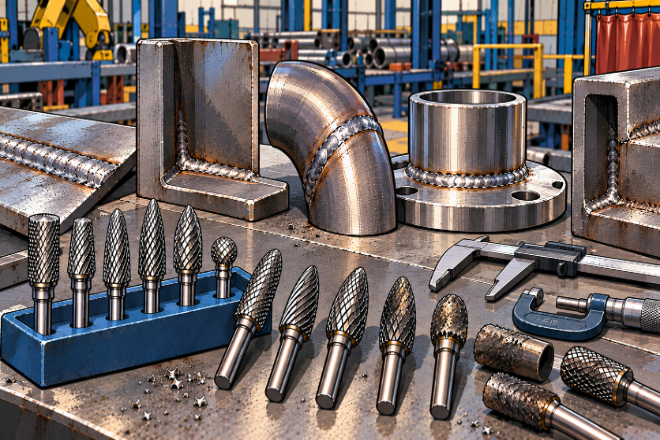
For a fabrication or repair company, choosing carbide burrs should begin with the welds found on the production floor.
Collect representative jobs. Include flat welds, inside corners, curved joints, pipe welds, and hard-to-reach repairs. Use the real materials.
Then test several burr shapes and cutting geometries. Measure removal time. But do not stop there.
Look at operator control, vibration, the condition of the base metal, secondary finishing time, and tool life.
A burr that removes the first 80 percent of a weld extremely fast but makes the last 20 percent difficult may not be the best overall choice.
Also compare the results between operators. A production tool should not perform beautifully only in the hands of the most experienced technician.
For steel fabrication with frequent heavy weld removal, a high-performance steel-specific burr can make sense because high stock removal is the main requirement.
Current STEEL-cut burrs are available in cylindrical, radius-end cylindrical, ball, oval, tree, flame, and conical shapes, so the cutting geometry can be combined with the shape required by the weld.
For mixed-material maintenance work, a versatile cut may simplify inventory. The company may also need long-shank versions for confined repairs.
Purchasing teams should therefore evaluate a weld removal burr system, not just one burr.
A practical kit might include an aggressive cylindrical or radius-end burr for open steel welds, tree and flame shapes for corners, an oval or ball shape for curved work, and selected long-shank tools for deep access.
Then look at the total cost. Tool price matters, but so do technician time, secondary grinding, tool changes, rework, and damaged parts.
The useful measure is cost per acceptable weld-removal job. The cheapest burr in the drawer can become surprisingly expensive when somebody spends twenty extra minutes using it.
 English
  Español
  简体中文
简体中文  Français
  日本語
日本語  한국어
한국어  العربية
  Tiếng Việt