1. Why Does Surface Preparation Matter Before Coating?
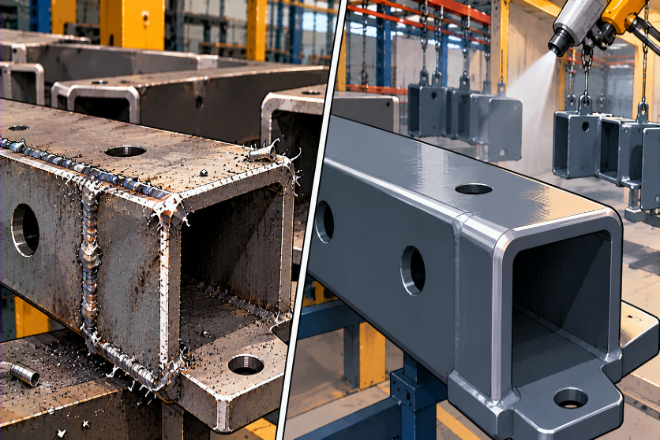
A coating cannot hide every surface problem.
If the metal underneath has sharp edges, loose material, weld remains, or unwanted high spots, these problems can remain after coating. In some cases, they can even become more noticeable.
Surface preparation is therefore an important part of coating performance. Sharp edges can be difficult to coat evenly, and they may become areas where the protective layer is weaker.
C'est ici tungsten carbide burrs for surface preparation can be useful.
A carbide burr has cutting teeth that remove metal instead of simply rubbing over it.
This makes it useful for small areas where an operator needs to change the shape of the metal before the coating process.
Typical examples include:
Sharp outer edges
Small metal burrs
Weld remains
Local high spots
Rough transitions
Damaged corners
Hole edges
Hard-to-reach areas
The goal is not necessarily to make the whole part smooth and shiny.
The goal is to give the coating process a better starting surface.
This difference is important. A production manager may not need a carbide burr to prepare an entire steel plate.
But the same manager may need one to correct several difficult edges or weld areas before the part enters the coating process.
That is where the tool becomes valuable.
2. What Can Tungsten Carbide Burrs Do Before Coating?
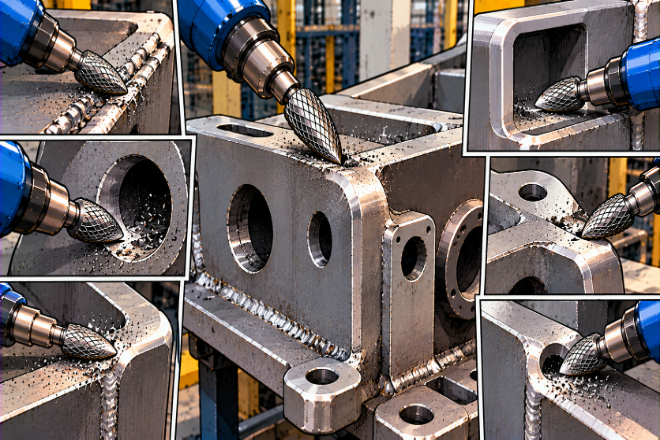
The main advantage of a carbide burr for coating preparation is its ability to work on specific areas.
Consider a welded steel frame. Most of the frame may already be ready for the next preparation step, but the weld zones can have small raised areas, sharp transitions, or unwanted metal left after fabrication.
A carbide burr allows the operator to work directly on those locations.
It can also help with edge preparation. Sharp edges are especially important because coating thickness can be less even around a sharp corner. A rounded edge provides a better shape for a more even protective layer.
Common uses include:
3. Why Is Edge Rounding So Important for Coating?
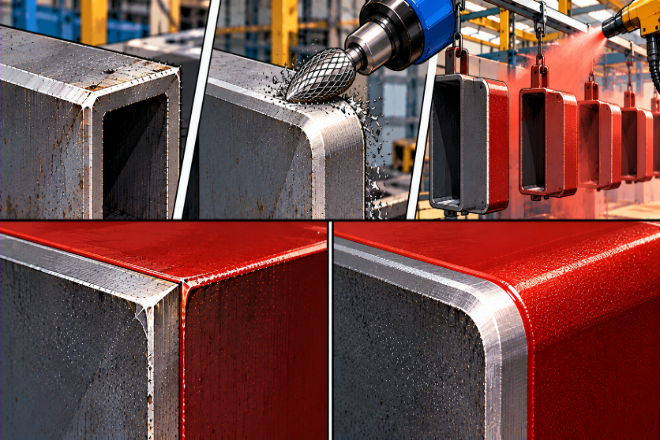
If there is one part of this topic that deserves extra attention, it is edge rounding.
A sharp 90-degree metal edge may look small, but it can become a weak point in a protective coating system.
Coating thickness can be lower around sharp edges, making those areas more vulnerable to damage and corrosion. A rounded edge allows the coating to cover the transition more evenly.
This is why edge preparation is not simply a cosmetic step.
For some coating systems and specifications, the required edge treatment may be clearly defined. The exact radius or chamfer depends on the project and coating requirements.
UN tungsten carbide burr can help create that shape. For flexible work, a standard radius or suitable general-purpose burr may be enough.
For a defined radius, a concave radius carbide burr is a better choice because its cutting shape follows the outside corner.
Specialized carbide burrs can also be used for defined edge work, including tools designed to create specific outer radii or chamfer angles.
That gives production teams an important choice: Do you only need to remove the sharp edge, or do you need to create a defined edge shape?
Those are two different jobs. If the radius is important, relying only on visual judgment can create inconsistent results.
A dedicated radius burr or guided setup can make the process much easier to control.
4. How Should You Use a Carbide Burr for Coating Preparation?
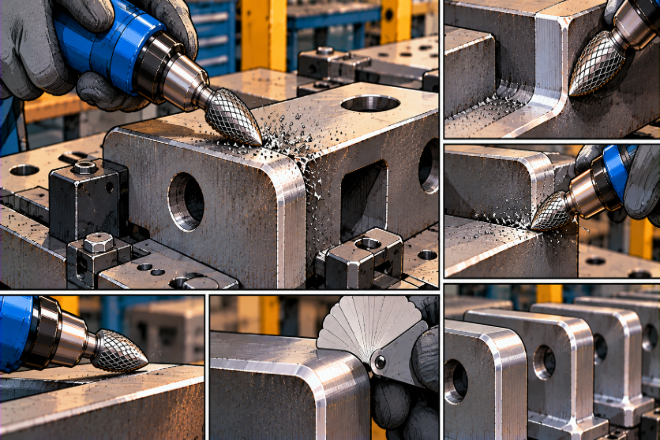
The basic process is straightforward, but small details can have a big effect on the result.
Start with inspection
Before touching the metal, inspect the part.
Look for sharp edges, weld remains, burrs, damaged sections, and areas that may need repair. Also check whether the coating specification requires a particular edge shape.
There is little value in removing metal that did not need to be removed.
Choose the right burr
The burr should match the material and the job.
Steel, stainless steel, aluminum, cast iron, and other metals can require different cutting approaches. Burr shape also matters.
A cylindrical shape may suit a straight area, while a radius burr is better for a defined outer curve.
Secure the workpiece
The part should be stable.
If it moves while the burr is cutting, the tool can jump, leave uneven marks, or remove too much material.
Control speed and pressure
There is no single RPM that works for every carbide burr.
The correct speed depends on factors such as burr diameter, material, tool design, and application. Different burr designs and materials can require different operating speeds.
Pressure should also be controlled.
Pushing harder does not automatically mean faster production. Excess pressure can make the tool harder to control and can increase vibration and tool wear.
The better approach is to let the cutting teeth remove the material.
Inspect again
After preparation, check the edge or repaired area.
For simple work, visual inspection may be enough. When a defined radius is required, use an appropriate gauge or measurement method.
The objective is simple:
Prepare the metal without creating another surface problem.
5. Which Carbide Burr Should You Choose?
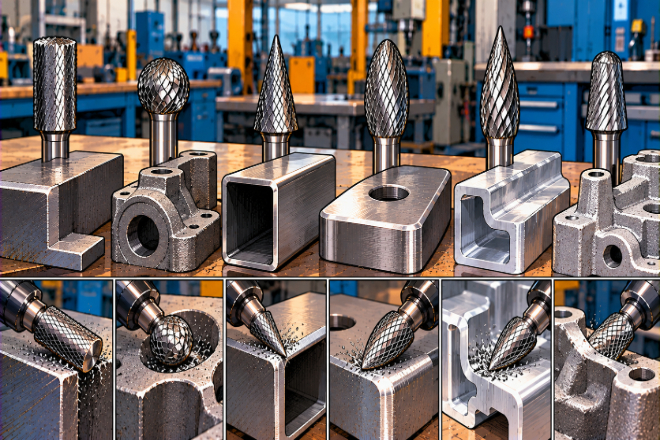
Choosing a tungsten carbide burr for coating preparation should start with the job, not the catalog.
The first question is the material.
For steel construction, a burr designed for steel can provide efficient cutting. Stainless steel may require a burr suited to stainless materials.
Aluminum often needs a cutting design that gives chips enough room to leave the tool instead of building up around the teeth.
The second question is the edge.
If you only need to remove a sharp corner, a flexible edge-working burr may be enough.
If you need a specific radius, choose a radius burr designed for that shape. If you need a chamfer rather than a radius, a conical burr may be more suitable.
The third question is production volume.
For occasional repair work, an operator-guided burr may be perfectly practical. For repeated work, a guided tool or machine setup can improve consistency.
This gives purchasing managers a useful way to compare tools: Material + edge shape + production volume + required consistency
That is much more useful than simply asking which burr has the lowest purchase price.
A slightly more expensive burr may make more sense if it reduces rework, improves edge consistency, and lasts longer in the same application.
6. Can a Carbide Burr Replace Other Surface Preparation Methods?
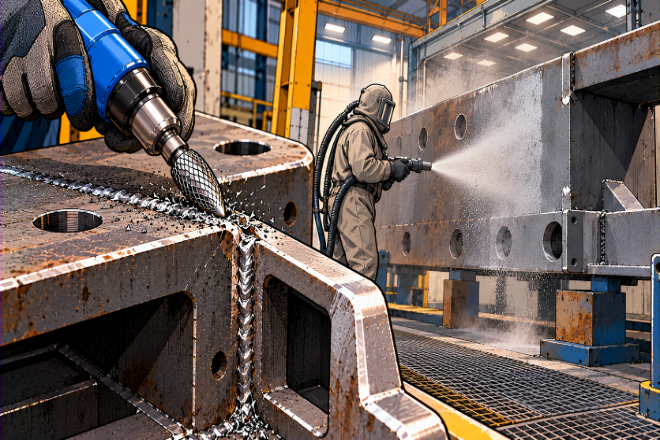
This is where expectations need to stay realistic.
UN tungsten carbide burr for surface preparation is excellent for local metal removal, but it is not a universal replacement for full-surface preparation.
Large coating projects may require cleaning, abrasive blasting, power-tool cleaning, surface-profile control, or other preparation methods.
A burr has a different job.
It is especially useful when the problem is:
Local rather than widespread
Mechanical rather than contamination-related
Located on an edge or corner
Around a weld
Inside a difficult area
Related to unwanted metal shape
For example, a large steel structure may go through a broad surface-preparation process, while a carbide burr is used first to round selected edges and correct small weld areas.
That combination makes much more sense than asking one tool to do everything.
It is also important to remember that a burr does not automatically remove oil, grease, salts, dust, or other contaminants.
Surface cleanliness still needs to follow the requirements of the coating system and project specification.
So the smart question is not: “Can a carbide burr prepare the whole surface?” It is: “Which parts of surface preparation can a carbide burr handle best?”
That answer is much more useful for production planning.
7. How Can Companies Improve Coating Preparation with Carbide Burrs?
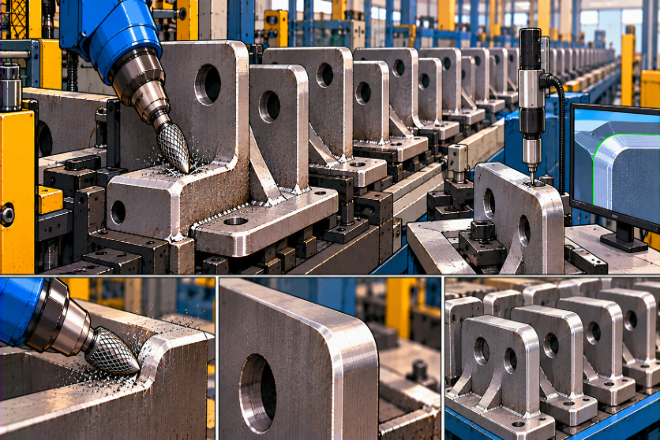
For a company using carbide burrs regularly, the biggest improvement usually comes from standardizing the process.
Instead of letting every operator choose a different burr and work at a different speed, define a simple method for common parts.
Start with the required edge condition.
If a drawing or coating specification calls for a defined radius, record that requirement clearly. If only basic edge breaking is needed, do not over-process the part.
Then standardize the tool.
Use the same burr shape, size, and suitable cut for the same type of job whenever possible. This makes training easier and makes tool performance easier to compare.
The next step is process control.
Record the machine setting, working method, inspection method, and tool replacement point.
For high-volume work, guided tools, machines, or automated systems can provide more repeatable results than freehand work.
Finally, measure the result.
Useful production questions include:
Are the edges consistent?
Is the required radius being reached?
Is rework increasing?
Are operators spending too much time on edge preparation?
Are burrs wearing out too quickly?
Are coating problems appearing around edges?
These questions connect the burr to the real business result.
The cheapest burr is not necessarily the cheapest process. If a low-cost tool creates inconsistent edges, extra labor and coating rework can quickly erase the saving.
 English
  Español
  简体中文
简体中文  Français
  日本語
日本語  한국어
한국어  العربية
  Tiếng Việt