
1. Why Are Complex Contours Difficult to Machine?
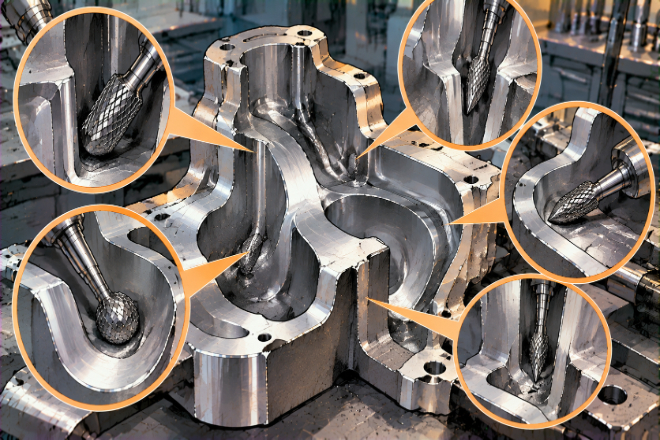
Complex contours are different from simple flat surfaces or straight edges.
A contour may include multiple curves, different angles, and smooth transitions between surfaces.
These shapes are common in molds, cast components, aerospace parts, automotive parts, and custom industrial components.
The main challenge is controlling material removal.
On a flat surface, the cutting tool maintains a stable contact area. On a complex contour, the contact point changes constantly as the tool moves.
If the tool removes too much material in one area, the original shape may be damaged.
Another difficulty is tool access. Some contours contain deep areas, narrow transitions, or curved sections that are difficult to reach with standard cutting tools.
A large cutter may not fit into the area, while a small tool may require more time to complete the work.
Surface quality is also important. Complex contours often need smooth transitions because rough areas can affect assembly, airflow, fluid movement, or appearance.
A poor finishing process may leave visible tool marks or uneven surfaces. There is also a balance between flexibility and accuracy.
Tungsten carbide burrs allow operators to follow complex shapes manually or through controlled machine movement. They are useful for local correction, blending, and finishing.
However, they are not always the best choice for creating a complete precision contour from raw material.
For highly accurate production machining, CNC milling tools, grinding tools, or dedicated form tools may provide better dimensional control.
Carbide burrs are most valuable when manufacturers need flexibility. They help solve difficult finishing problems without requiring a large machining setup.
2. Which Tungsten Carbide Burr Shapes Work Best for Complex Contours?
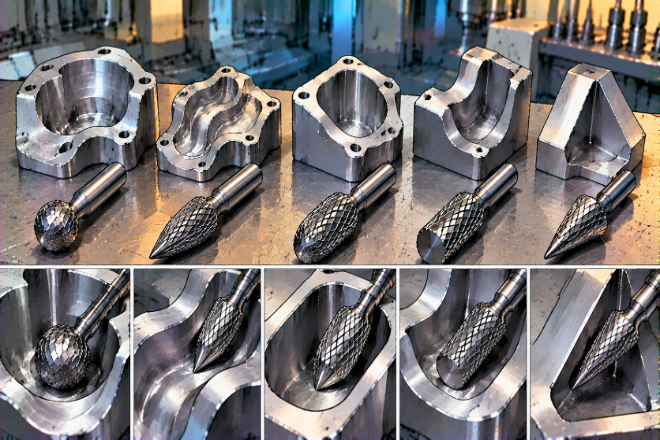
The shape of the burr determines how well it can follow a complex surface. Different contour designs require different cutting profiles.
1). Ball Burrs
Ball-shaped tungsten carbide burrs are one of the most popular choices for contour finishing.
Their rounded cutting head allows smooth movement across curved surfaces.
They are useful for:
Blending curved transitions
Removing local defects
Smoothing irregular surfaces
Finishing rounded cavities
The main advantage is that the tool does not create sharp marks easily when following curved paths.
2). Flame Burrs
Flame-shaped burrs are suitable for changing contours and narrow transitions.
Their tapered shape allows access to areas where a larger tool cannot reach.
They are often used for:
Mold finishing
Curved edge correction
Profile blending
The operator can control the cutting depth by changing the contact position along the tapered surface.
3). Oval Burrs
Oval burrs provide a wider curved cutting area. They are useful for larger contour surfaces where more contact is needed.
Compared with a small ball burr, an oval burr can remove material more efficiently on wider curved areas.
4). Radius-End Cylindrical Burrs
These burrs combine straight sides with a rounded end. They are useful when a contour includes both flat and curved sections.
The side cutting edges help remove material from walls, while the rounded end helps create smooth transitions.
5). Cone Burrs
Cone burrs are useful for narrow contour areas and angled transitions.
They can reach smaller spaces but require careful control because the pointed area can remove material quickly.
The following table provides a basic guide.
3. How Do Material and Cutting Conditions Affect Contour Machining?
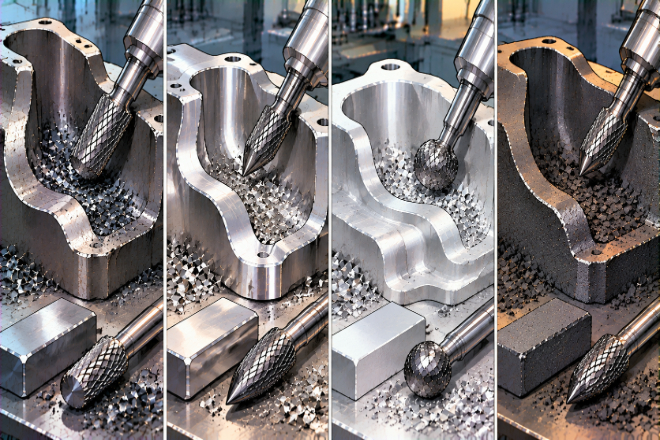
Complex contour machining is affected not only by shape but also by material. Different metals create different cutting conditions.
For steel components, carbide burrs can provide strong material removal and good wear resistance. They are commonly used for contour correction, surface blending, and removing excess material.
Stainless steel requires more control because it can generate heat and may become harder during machining.
Using the correct cutting speed and avoiding excessive pressure helps maintain stable performance. Aluminum creates another challenge.
Because aluminum is softer, chips may stick to the cutting teeth. This problem can become worse when working on detailed contours because the tool may move through different angles.
For aluminum contour work, burrs with suitable chip space can help reduce clogging.
Cast iron is another common material for complex shapes. Carbide burrs can remove casting defects and improve surface transitions.
However, dust management is important because cast iron creates fine particles during machining. The cutting condition also affects the final result.
Important factors include:
Burr diameter
Rotation speed
Feed movement
Cutting pressure
Tool holding stability
A good tool can still produce poor results if the operating conditions are incorrect. For manufacturers, the best process combines the right burr design with suitable machining parameters.
4. How Can Carbide Burrs Follow Complex Contour Profiles?
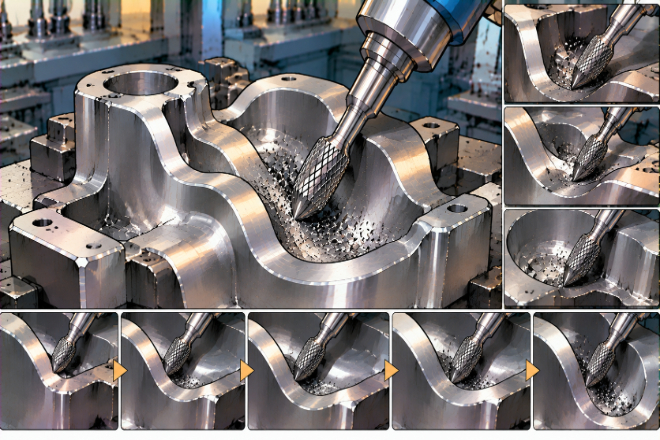
Following a complex contour requires controlled tool movement. The first step is understanding the surface.
Before machining, manufacturers should identify:
Where material needs to be removed
Which areas must remain unchanged
The required surface finish
The acceptable tolerance
This prevents unnecessary cutting. During operation, the burr should follow the contour gradually. Heavy pressure is usually not recommended because it can create uneven surfaces.
Light and controlled passes provide better results. Tool angle is also important. When the angle changes suddenly, the cutting force changes as well.
This can create visible marks or remove more material from certain areas. For manual finishing, smooth hand movement is essential.
The operator should avoid stopping the burr in one location for too long. For CNC or robotic applications, the tool path must match the contour.
The machine needs correct control of:
Position
Vitesse
Taux d'alimentation
Tool orientation
A poor tool path can reduce surface quality even when the burr itself is suitable.
Chip removal should also be considered. Complex contours often contain small valleys and transitions where chips can collect.
Removing chips during the process helps maintain consistent cutting.
A practical workflow is: Inspect the contour → Select the burr → Create a controlled path → Remove material gradually → Check the surface
This approach improves repeatability and reduces the risk of damaging expensive components.
5. How Do You Prevent Damage When Using Burrs on Complex Shapes?
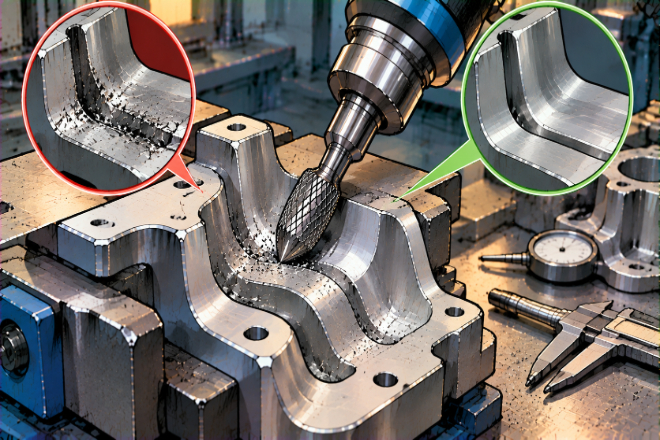
The biggest risk during contour finishing is changing the original geometry. A complex contour usually has a specific purpose. Even a small change can affect how the part works.
The first protection method is choosing the correct burr size. A very large burr may remove material too quickly. A very small burr may create unnecessary machining time.
The tool should match the contour size. Tool speed is another important factor. Too much speed can create heat and increase wear. Too little speed may reduce cutting efficiency.
The tool holder also matters. A loose holder or excessive tool extension can create vibration. On a complex surface, vibration can quickly damage the finish.
The workpiece must also be secured properly. Any movement during cutting can create uneven contour results. Regular inspection is important.
Operators should check:
Surface condition
Burr wear
Material removal amount
Final contour shape
For production environments, creating a standard process helps improve consistency. A stable process reduces variation between different parts and operators.
6. When Should Manufacturers Use Carbide Burrs for Complex Contours?
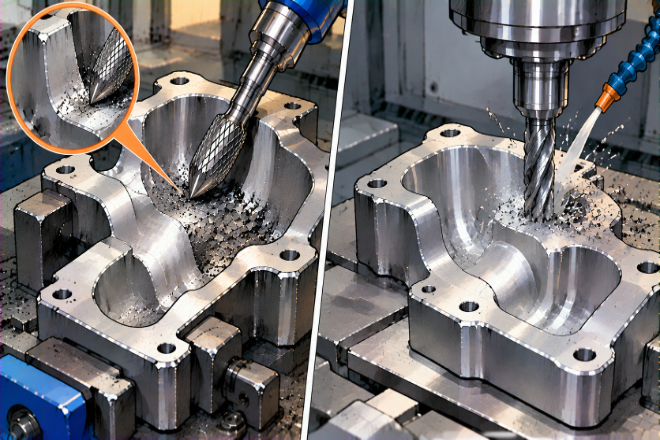
Tungsten carbide burrs are valuable when flexibility is more important than complete automated precision.
They are especially useful for:
Mold repair
Casting cleanup
Local contour correction
Surface blending
Prototype work
Maintenance operations
For example, a large metal component may have a small defect on a curved surface. Re-machining the entire part may waste time and material.
A carbide burr can remove only the problem area. They are also useful when the part shape makes traditional tooling difficult.
However, if thousands of identical parts require the same highly accurate contour, dedicated CNC tools may provide better efficiency.
The decision should consider:
Required accuracy
Production quantity
Tool accessibility
Finishing cost
Carbide burrs are not always the fastest tool. They are valuable because they provide flexibility when standard machining methods are difficult.
 English
  Español
  简体中文
简体中文  Français
  日本語
日本語  한국어
한국어  العربية
  Tiếng Việt