
Total Cost of Ownership for Carbide Seal Rings: Repairability and Lifecycle Strategy
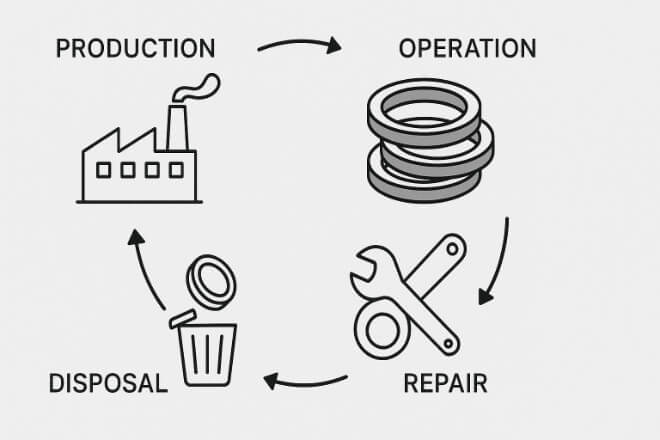
When companies buy carbide seal rings, they often focus on the initial purchase price. However, the true cost of these components goes far beyond that. For decision-makers in industries like oil and gas, chemical processing, or mechanical equipment manufacturing, the total cost of ownership (TCO) is what truly defines long-term value. This article explains how repairability and a smart lifecycle strategy can reduce the total cost of ownership of tungsten carbide seal rings. With the right approach, companies can extend part life, minimize downtime, and improve overall equipment efficiency. What Total Cost of Ownership Really Means The total cost of ownership (TCO) includes all expenses related to the purchase, operation, […]
RFQ Checklist for Custom Carbide Seal Rings: Dimensions, Tolerances, and Finish
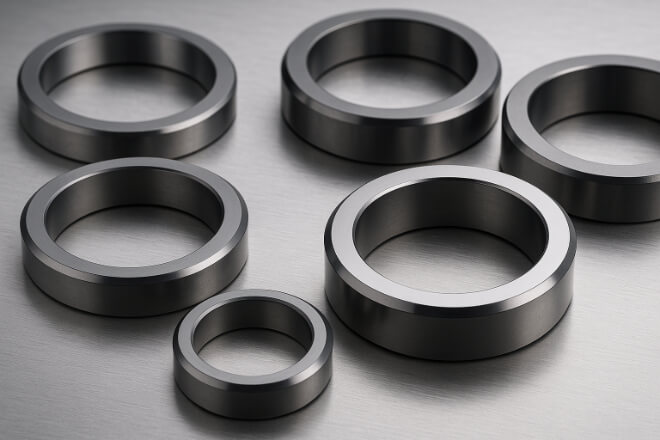
When preparing a Request for Quotation (RFQ) for custom carbide seal rings, many decision-makers focus only on price and delivery time. However, the real value of a quote depends on the accuracy of technical details you provide. Missing or unclear information about dimensions, tolerances, and surface finish can lead to production delays, design mismatches, or costly rework. This guide offers a practical checklist to help engineering and procurement teams send complete and clear RFQs for tungsten carbide seal rings. It will help you communicate your needs precisely and ensure you receive accurate quotations from manufacturers. Understanding the Role of Carbide Seal Rings Tungsten carbide seal rings are critical components in […]
Sizing Carbide Seal Rings for High Differential Pressure and High RPM Service
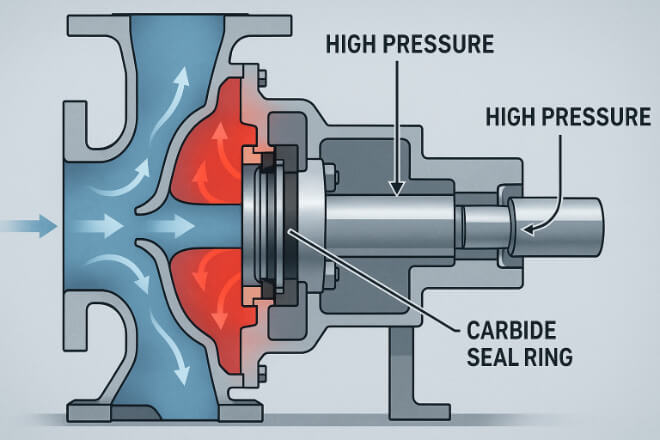
When mechanical seals operate under high differential pressure and high rotational speed (RPM), the demands on the sealing faces increase sharply. These conditions cause greater surface stress, heat buildup, and fluid turbulence, which can quickly wear down an improperly sized or poorly selected seal ring. Carbide seal rings, particularly those made from tungsten carbide, are widely used for these severe applications. They provide the hardness, strength, and thermal conductivity required to resist distortion and maintain a stable seal under dynamic pressure. This article explains how to size carbide seal rings correctly for systems that operate under high pressure differences and high-speed rotation, while maintaining long-term performance and reliability. The Challenge […]
Specifying Carbide Seal Rings for Aggressive Chemicals: Media, pH, and Temperature Map
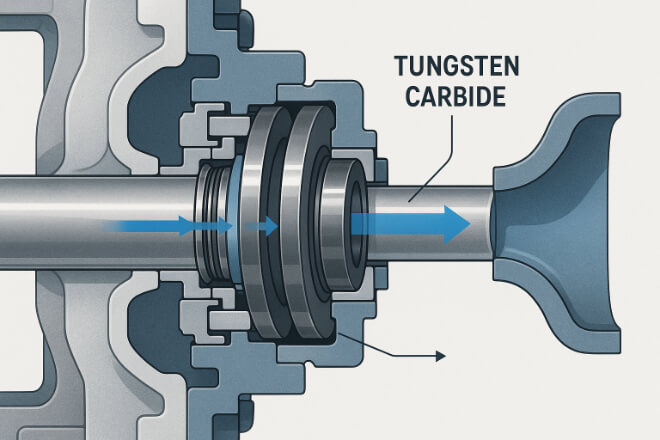
Choosing the right carbide seal rings for aggressive chemical applications is not only about material hardness or wear resistance. It is about matching the seal material to the process conditions — including media composition, pH value, and temperature range. In industries like chemical processing, oil & gas, or pharmaceuticals, seal failure can mean production downtime, safety risks, and high replacement costs. For decision-makers, specifying the right carbide material at the start can save both money and maintenance effort in the long term. This article will guide you through how to specify carbide seal rings based on media type, pH, and temperature, with a practical mapping chart for quick reference. Understanding […]
API-682 Aligned Selection of Carbide Seal Faces: Practical Criteria and Trade-Offs
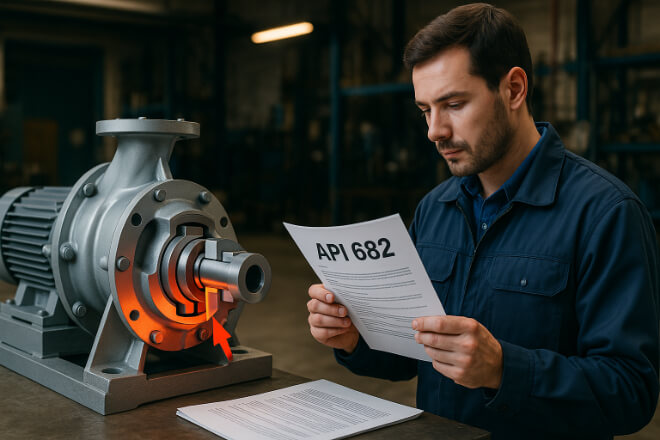
Choosing the right carbide seal face under API-682 is less about ticking a box and more about avoiding surprises in the field. A choice that looks good on paper can perform poorly if the flush is wrong, if there’s vibration, or if the fluid chemistry is harsher than expected. This write-up is for engineers and decision-makers who want practical guidance — not theory — so you can pick seal faces that keep pumps running and maintenance predictable. Why API-682 Matters for Carbide Face Selection API-682 gives a consistent way to specify seal types, support plans, and material groups. It makes it easier to compare vendors and to set expectations for […]
Commissioning Checklists for Carbide-Faced Mechanical Seals (Alignment, Flush, Face Load)
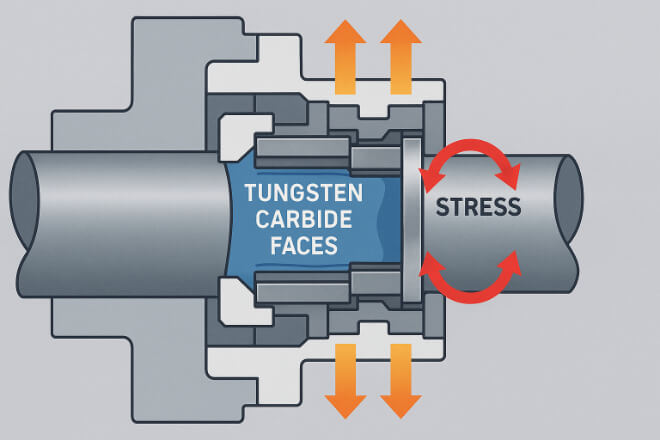
When new equipment is being started — a pump, a compressor, or a mixer — the mechanical seal is often the last thing people check. Yet it’s one of the first components to fail when something isn’t quite right. Carbide-faced seals, especially those using tungsten carbide or silicon carbide, are strong and wear-resistant, but they’re not indestructible. Small mistakes made during installation or commissioning can lead to leakage, vibration, or total seal failure before the machine even completes its first week of service. That’s why having a clear, practical commissioning checklist matters. This article walks through the key areas you need to verify — alignment, flush system, and face load […]
How Carbide Seal Rings Reduce Rotating Equipment Downtime (With Field Examples)
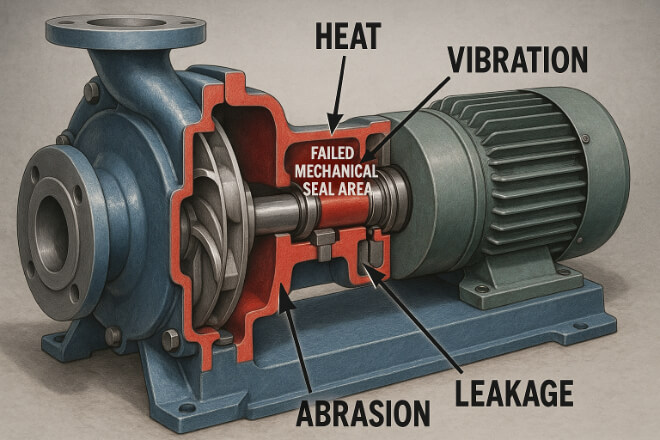
In industries such as chemical processing, mining, oil and gas, and power generation, rotating equipment like pumps and compressors must operate continuously. Every hour of downtime can mean lost production, high repair costs, and safety risks. Mechanical seals are among the most critical components that determine how long this equipment runs without failure. And at the heart of these seals are the carbide seal rings — precision-engineered components that directly affect sealing life and equipment uptime. This article explains how carbide seal rings reduce downtime, the mechanisms behind their performance, and real field examples showing their impact on operational efficiency. Why Downtime Happens in Rotating Equipment Downtime often originates from […]
Re-Lapping and Re-Use of Tungsten Carbide Faces: When It’s Cost-Effective
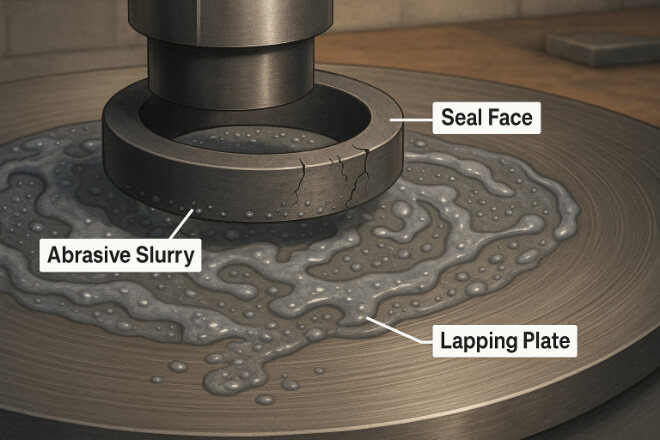
Tungsten carbide has long been one of the most reliable materials for mechanical seal faces. It combines hardness, wear resistance, and dimensional stability — key properties for long service life in pumps, compressors, and mixers. However, even the strongest materials wear over time. When a tungsten carbide face becomes scratched, warped, or worn, plant engineers often face a difficult question: should we re-lap and reuse it, or replace it entirely? This article discusses how re-lapping works, when it is cost-effective, and what technical factors decision-makers should consider before approving re-use. What Is Re-Lapping of Tungsten Carbide Faces? Re-lapping is the process of restoring the flatness and surface finish of a […]
Abrasion, Edge Chipping, and Thermal Shock: Carbide Ring Failure Signatures
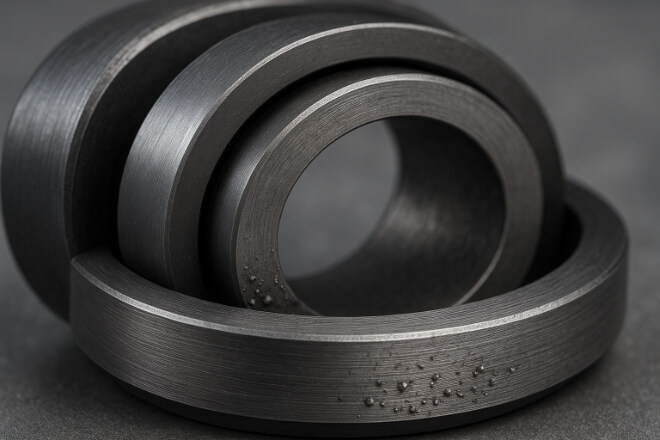
In the world of mechanical seals, tungsten carbide rings are trusted for their strength, hardness, and wear resistance. Yet even the toughest materials can fail when exposed to harsh conditions. Three of the most common failure types in carbide rings are abrasion, edge chipping, and thermal shock. Understanding these failure signatures helps maintenance teams and decision-makers prevent costly equipment downtime and premature replacement. This article explains what each failure looks like, why it happens, and how to prevent it. What Is Abrasion in Carbide Rings? Abrasion occurs when hard particles or contaminants in the sealing fluid continuously scratch or cut the carbide surface. Over time, this friction wears down the […]
Leaching in Tungsten Carbide Seal Faces: Causes, Symptoms, and Mitigation
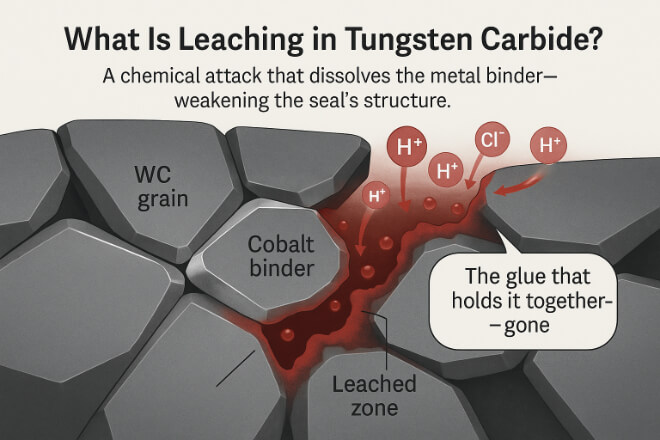
Tungsten carbide seal faces are known for their excellent hardness and wear resistance. They are used in pumps, mixers, and compressors across industries such as chemical processing, oil and gas, and water treatment. Despite their toughness, these seal faces are not immune to all forms of damage. One issue that quietly develops in some applications is leaching—a chemical attack that removes the metallic binder from the carbide structure. Leaching can weaken the seal surface, increase leakage, and cause early failure. This article explains the causes, symptoms, and prevention of leaching, using real-world examples to help plant managers and engineers identify and mitigate it effectively. What Is Leaching? Tungsten carbide is […]
 English
  Español
  简体中文
简体中文  Français
  日本語
日本語  한국어
한국어  العربية
  Tiếng Việt