
1. Why Are Carbide Burrs Useful in Exhaust Fabrication?
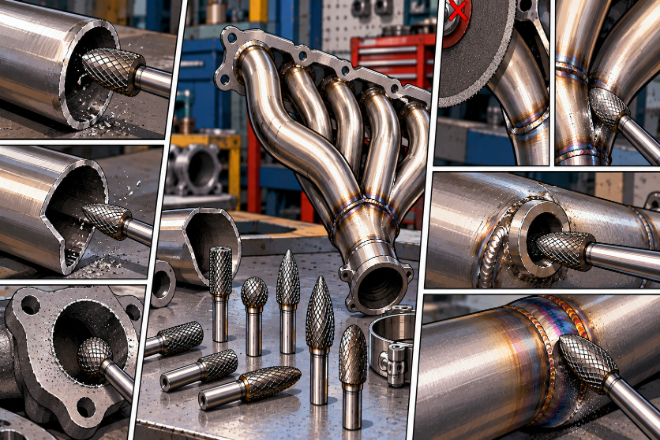
Exhaust fabrication is a game of fit. Two tubes need to meet correctly. A flange opening needs to match the tube.
A collector needs smooth transitions. A sensor bung needs the right opening. A bracket has to sit where it belongs.
When the fit is poor, welding becomes harder. And welding is not very good at hiding bad preparation.
あ tungsten carbide burr gives fabricators a simple way to make small corrections before parts are joined.
Carbide burrs have cutting teeth rather than an abrasive surface. They can remove metal quickly from a small area and are widely used for deburring, levelling, hole work, surface work, and weld-seam work.
That makes them a useful middle ground between a file and a large grinder. A file gives good control but can be slow.
An angle grinder removes material quickly but may be too large for a small tube opening or collector.
The carbide burr sits nicely between them. It can reach inside a tube, follow a curved opening, work around a flange, or remove a local high spot without touching half the component.
Tungsten carbide also has strong 硬度 そして 耐摩耗性, which helps the cutting edges remain useful during repeated metalworking.
For exhaust manufacturers producing many similar systems, this can make small finishing jobs more predictable.
And there are plenty of small jobs. One exhaust system may contain several tube sections, flanges, brackets, sensor ports, muffler connections, and welds.
A few minutes saved on each correction can start adding up rather quickly. The burr may be one of the smallest tools in the workshop. It can still have a surprisingly busy day.
2. How Do Carbide Burrs Improve Tube Fit-Up?
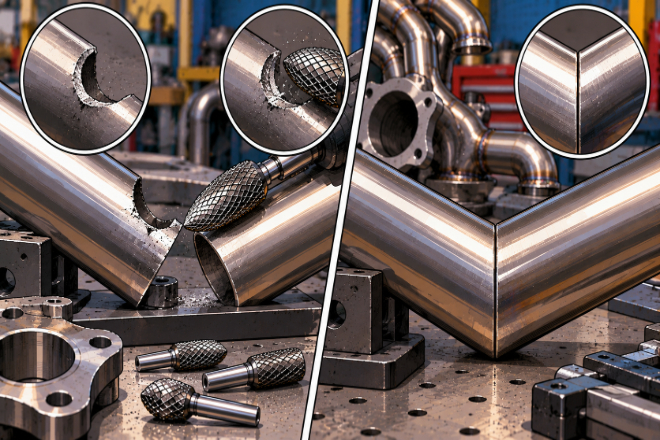
Good welding begins before the welding torch comes out. The tube ends need to fit together properly.
After cutting an exhaust tube, the edge may contain burrs or small irregular areas. These can interfere with fit-up or simply make handling unpleasant.
A carbide burr can quickly clean the inside and outside edges. It can also correct small local high spots after tube notching.
This becomes particularly useful in custom exhaust and header fabrication, where tubes often meet at angles.
The notch may be produced by a tube notcher, saw, laser, or another cutting process, but the first cut does not always create perfect contact.
A small cylindrical, oval, or tree-shaped carbide burr can remove material exactly where the two parts are touching.
Remove a little.
Check the fit.
Remove a little more.
Check again.
That is usually much better than attacking the whole joint because one corner is slightly high.
Carbide burrs can also help around flanges. If a cut tube extends slightly into a flange opening, or a local edge needs blending after fitting, a burr gives the fabricator good access.
However, the burr should be used for correction, not to replace accurate cutting. If every tube needs major hand grinding before it fits, the fabrication process has a bigger problem.
Maybe the cutting setup is wrong.
Maybe the fixture needs adjustment.
Maybe the tube dimensions are inconsistent.
A carbide burr is very good at fixing small metal problems. It should not become the workshop’s permanent solution to bad upstream production.
For managers, that distinction matters. Hand finishing should make a good process better—not rescue a bad process all day.
3. Where Do Burrs Help With Headers, Collectors, and Flanges?
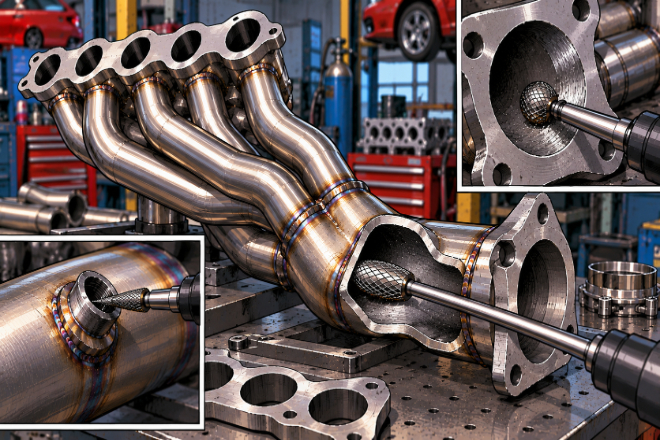
Headers and collectors are where exhaust fabrication becomes more interesting.
Several tubes may need to merge into one collector while maintaining smooth internal transitions. Flanges add more openings, edges, and welded areas.
These shapes are exactly where carbide burrs become useful. Inside a collector, a normal grinding disc has limited access.
A long-shank carbide burr can reach farther into the assembly and remove small raised edges or blend local transitions.
Ball and oval burrs work well around curved internal surfaces. Tree and flame shapes can follow changing angles. Cylindrical burrs are useful on straighter walls and flange openings.
Cone-shaped burrs can help around smaller openings and tapered areas. Flanges provide another common application.
After cutting or welding, a port opening may contain a sharp edge or local mismatch. A suitable carbide burr can remove the unwanted metal while leaving the rest of the flange alone.
The same idea applies to mounting brackets and hangers. These parts may need drilled holes, slots, welded joints, or local edge cleanup during fabrication.
Then there are oxygen sensor bungs and other small fittings. A hole may be drilled or cut into the exhaust tube before the bung is welded in place. The opening may need deburring or a small local correction.
A carbide burr can reach the hole easily. But there is an important rule here: Do not turn a small correction into a much larger hole. If the opening has a required size, measure it.
The spinning burr has no opinion about tolerances. It will happily keep cutting until somebody tells it to stop.
4. Why Are Carbide Burrs Useful Around Exhaust Welds?
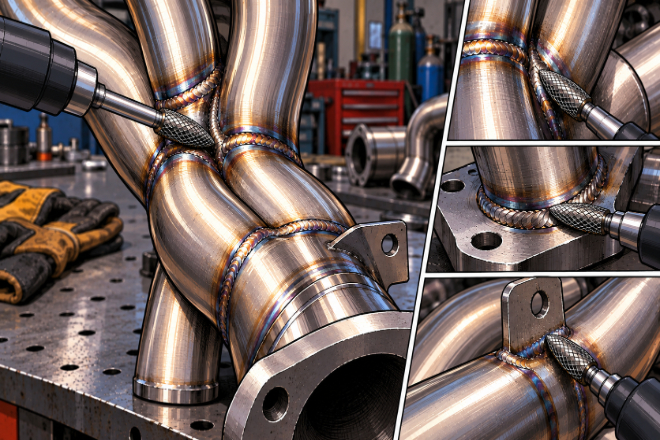
Welding is everywhere in exhaust fabrication. Headers, collectors, mufflers, resonators, flanges, brackets, and pipe sections can all contain welded joints.
Carbide burrs are useful both around preparation work and after welding. Before welding, they can remove burrs, correct small fit-up problems, and clean permitted metal areas.
After welding, they can help with local weld cleanup or blending where the fabrication specification requires it.
The advantage is access. Consider a weld beside a collector. A large grinding wheel may not follow the shape very well. A ball or flame carbide burr can work around the curved area with much better control.
A burr can also reach between closely spaced header tubes where larger finishing tools simply do not fit. But not every exhaust weld should be ground flat.
A sound weld should not lose useful material simply because somebody wants the surface to look smoother. This is especially important on thin-wall exhaust tubing.
Removing too much metal can reduce wall thickness or damage the area beside the weld.
The fabrication requirement should decide how much finishing is needed. Carbide burrs are cutting tools. They are not beauty filters. Another issue is heat.
Stainless steel exhaust fabrication already involves careful heat control during welding. When additional finishing is needed, a burr that cuts cleanly is better than one that rubs heavily against the material.
Material-specific stainless steel burr geometries are designed to support good chip formation while reducing unnecessary heat generation during cutting.
For a production shop, this can make stainless exhaust finishing faster and easier to control.
5. Which Burrs Work Best for Exhaust Materials?
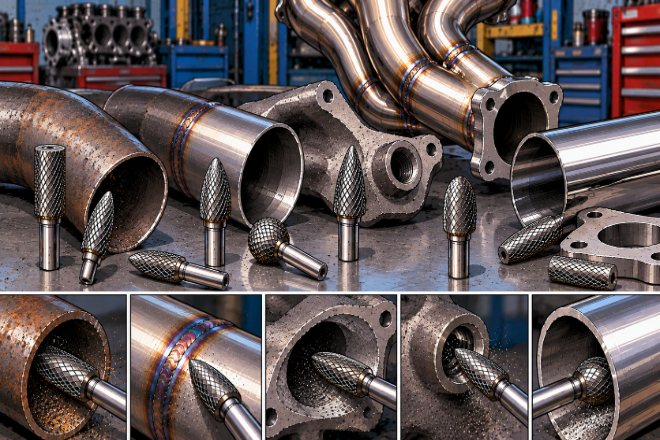
Not every exhaust system uses the same material.
Mild steel can still be found in exhaust fabrication, while stainless steels are common where corrosion resistance and longer service life are important.
Grades such as 409 and 304 are widely associated with automotive exhaust systems, while other alloys may be selected for more demanding applications.
That means burr selection should begin with the material. For normal steel, a steel-specific carbide burr can provide aggressive but controlled stock removal.
For stainless steel, a burr designed for stainless applications is often a better choice.
PFERD’s INOX geometry, for example, is specifically designed for austenitic and corrosion-resistant steels and is intended for applications including deburring, holes, surface work, and weld seams.
Shape then needs to match the fabrication job.
6. What Mistakes Reduce Burr Performance in Exhaust Work?
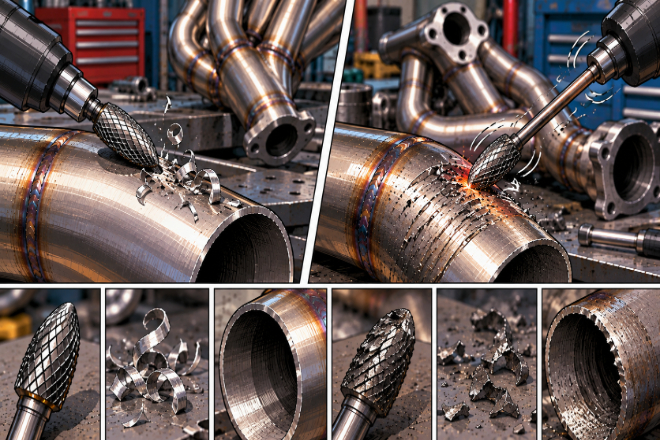
The first mistake is using too much pressure. Carbide burrs work by cutting with their teeth. Heavy pressure can increase vibration, heat, and stress on the cutting head.
Let the burr cut. If it suddenly requires much more force, check the tool and the setup instead of immediately pushing harder.
Speed matters as well. There is no single RPM that is correct for every carbide burr. Burr diameter, material, shank length, cut geometry, and manufacturer guidance all affect the recommended operating range.
Long-shank burrs deserve extra attention. They are very useful inside collectors and other deep exhaust parts, but the additional overhang can make vibration easier to create.
Use only the length that is actually required. The grinder and collet also matter. A worn collet or poor spindle can create runout even when the carbide burr itself is well made.
High concentricity is useful because stable rotation reduces chatter and makes controlled finishing easier.
Another common mistake is using the wrong burr on stainless steel. A tool that rubs rather than cuts efficiently can generate more heat and make the work slower.
For shops processing stainless exhaust parts regularly, dedicated stainless cutting geometry can make more sense than asking one general-purpose burr to handle everything.
Clean tool control also matters. Stainless fabrication often uses shop procedures intended to avoid contamination from carbon steel tools and debris.
If the company separates tools for stainless work, carbide burrs should be included in that system.
Finally, do not chase a perfect-looking surface when the part does not need one. Every extra minute spent grinding is labor.
Every unnecessary pass also creates another chance to remove metal that should have stayed on the exhaust. Sometimes the correct finishing step is knowing that the job is already finished.
7. How Should Exhaust Manufacturers Evaluate Carbide Burrs?
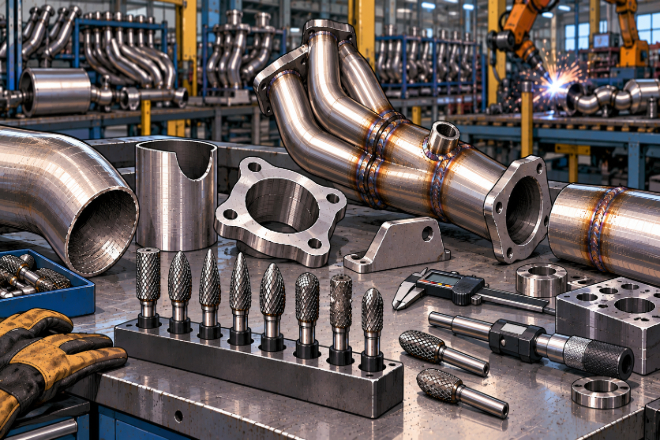
For an exhaust manufacturer, the best carbide burr is not simply the one that lasts the longest. Production efficiency is more complicated than that. Start with the actual fabrication jobs.
Test burrs on the tube materials the company really uses. If production includes 304 stainless, test on 304 stainless. If the shop works mainly with 409 stainless or mild steel, use those materials.
Then reproduce real operations. Deburr cut tube ends. Correct tube notches. Blend collector transitions. Clean sensor openings. Work around flange and bracket welds.
This gives much more useful information than running the burr across a flat scrap plate.
Measure cutting time and control. Check whether the tool produces chatter. Look at the surface after cutting. Does another tool need to come behind it? Then measure tool life.
A burr that remains sharp through many fabrication operations can reduce tool changes, but long life means little if technicians dislike using it.
Batch consistency is also important. For a manufacturer producing hundreds of exhaust assemblies, one excellent sample is not enough. Burr geometry, dimensions, concentricity, and cutting behavior should remain stable from tool to tool.
Finally, look at the entire fabrication cost. A low-cost burr that saves a few dollars at purchasing but adds several minutes to every collector is not really inexpensive.
The same applies to an aggressive burr that removes metal quickly but creates extra finishing work. The useful measure is cost per completed exhaust component.
That includes burr consumption, technician time, finishing time, rework, and production consistency.
Exhaust systems may eventually make plenty of noise. The tools used to build them do not need to create extra drama.
 English
  Español
  简体中文
简体中文  Français
  日本語
日本語  한국어
한국어  العربية
  Tiếng Việt