
1. How Are Carbide Trimming Tools Used in Carbon Fiber Composites?
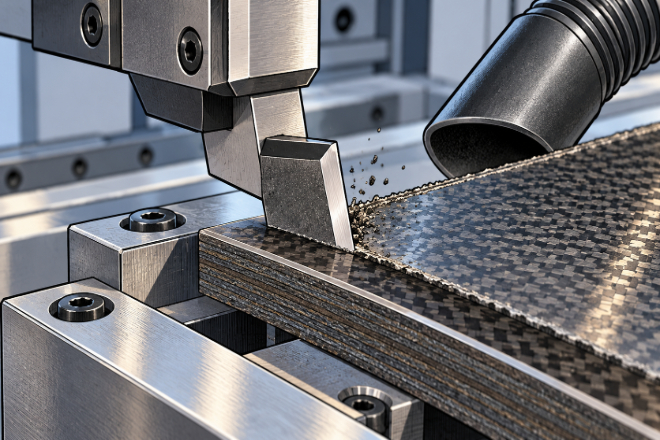
Carbon fiber composite parts often need trimming after molding or curing. The goal is to bring the part to its final size, remove excess material, and prepare its edges for assembly.
Carbide trimming tools can be used for several types of finishing work, depending on the composite structure and required quality.
Trimming Edges to Final Size
Composite panels may leave the molding process with extra material around their outer edges. A suitable trimming tool removes this excess material and brings the part closer to its required dimensions.
This is common in 航空宇宙 panels, vehicle body parts, and lightweight structural components.
The cutting path should be planned carefully. Too much material removal can change the part dimensions, while a poor cutting direction may leave broken fibers along the edge.
Finishing Openings and Cutouts
Carbon fiber parts often include openings for fasteners, connectors, mounting points, or other components.
Carbide trimming tools can help clean selected edges around these features. Small tools are useful when access is limited, but the diameter and cutting length must be suitable for the workpiece.
Removing Small Burrs and Loose Fibers
Some composite finishing operations leave loose fibers or small edge defects. A suitable trimming tool may help remove these defects, provided the process does not pull out more fibers or damage the resin.
The finished edge should be inspected after trimming. A surface that looks clean from a distance may still contain small areas of fiber pull-out or layer separation.
2. Which Carbide Trimming Tool Design Works Best for Carbon Fiber?
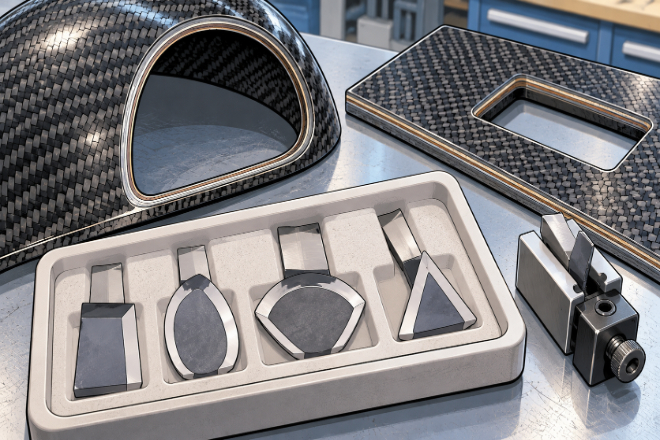
The best design depends on the composite layup, part shape, cutting direction, and required edge quality.
A tool that works well on a flat panel may not produce the same result on a curved or layered component.
Three design features deserve particular attention.
Sharp cutting edges: Sharp edges help cut fibers instead of pushing them away from the resin. However, the edge must also have enough strength to avoid early damage.
Suitable flute geometry: Flutes provide space for cut material to leave the cutting area. Their shape affects cutting forces, chip removal, and heat.
Correct tool diameter and reach: A small tool can reach narrow openings, but excessive tool length can increase vibration. Use the shortest practical tool reach that allows the required cutting path.
Tool geometry should be selected for the composite and operation rather than copied from a metal-trimming process.
For demanding CFRP applications, manufacturers should also compare carbide with diamond-coated carbide and PCD tools.
Research on CFRP edge trimming has examined diamond-coated carbide tools as an alternative to PCD, with attention to cutting forces, edge quality, and tool performance.
3. How Can Manufacturers Prevent Fiber Pull-Out and Delamination?
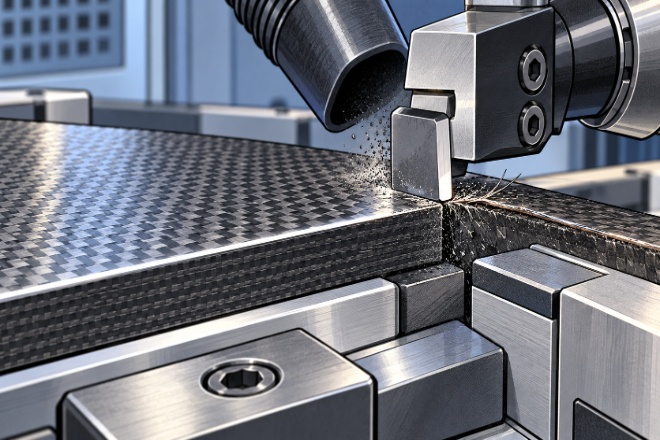
A clean composite edge is not just about appearance. Fiber damage and layer separation may affect assembly, inspection, and the performance of the finished part.
The good news is that many trimming problems can be reduced by controlling the tool and the process.
Match the Cutting Direction to the Composite Structure
Carbon fibers may run in different directions within a laminate. The cutting direction affects how the tool meets those fibers and how the layers respond to cutting forces.
A suitable tool path can reduce the chance of pulling fibers from the edge.
For complex parts, manufacturers should test the planned path on a representative sample before approving it for production.
Control Heat and Cutting Forces
Too much heat can damage the resin, while excessive cutting forces may cause fiber pull-out or delamination.
Cutting speed and feed should follow the tool and material guidance, then be checked during trials. Effective chip and dust removal also helps keep the cutting area clear.
Support the Workpiece Properly
A thin composite panel can flex or vibrate during trimming. This movement makes it harder to maintain a consistent edge.
Secure fixtures and suitable support near the cutting area help keep the part stable.
For high-value 航空宇宙 components, fixture design should be treated as part of the finishing process, not as an afterthought.
Inspect the Edge Before Approving the Process
Check for loose fibers, rough areas, layer separation, and dimensional changes. Use inspection methods suited to the part and its quality requirements.
If defects appear, review the tool condition, cutting path, settings, and fixture before simply increasing cutting speed or pressure.
4. How Should Manufacturers Compare Carbide and Other Composite Trimming Tools?
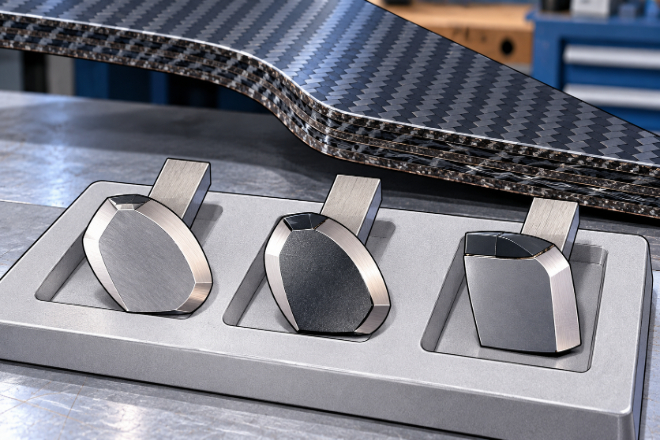
Uncoated carbide is not automatically the best choice for every carbon fiber composite.
Because carbon fibers are abrasive, tool wear can become a major issue during long production runs.
Diamond-coated carbide and PCD tools are common alternatives for demanding composite cutting tasks.
The choice should reflect tool life, edge quality, production volume, and total cost.
5. What Should Manufacturers Check Before Buying Carbon Fiber Trimming Tools?
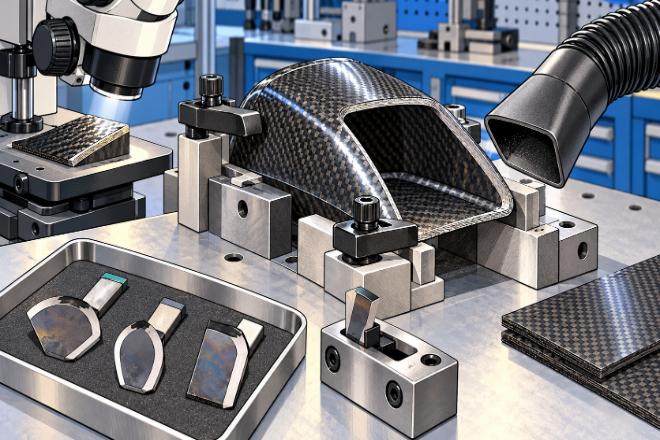
Purchasing decisions should connect tool performance with actual production needs.
A low purchase price means little if the tool wears quickly or leaves edges that fail inspection.
Before selecting a tool, review these questions:
What type of composite is being trimmed? Identify the fiber type, resin system, laminate structure, and part thickness.
What edge quality is required? Define acceptable limits for fiber pull-out, delamination, roughness, and dimensions.
What is the production volume? A tool for occasional finishing may not be suitable for continuous high-volume work.
Can the machine hold the tool steadily? Check spindle condition, tool runout, fixture strength, and tool reach.
How will dust be controlled? Carbon fiber machining creates fine dust that requires suitable extraction, cleaning, and worker protection.
What is the cost per accepted part? Include tool replacement, cycle time, inspection, rework, and downtime.
A controlled trial is the most useful next step. Run the tool on representative parts, inspect the finished edges, and record how many acceptable components can be produced before tool performance drops.
This gives engineering and purchasing teams real data for comparing different tool options.
6. How Can Carbide Trimming Tools Reduce Composite Manufacturing Costs?
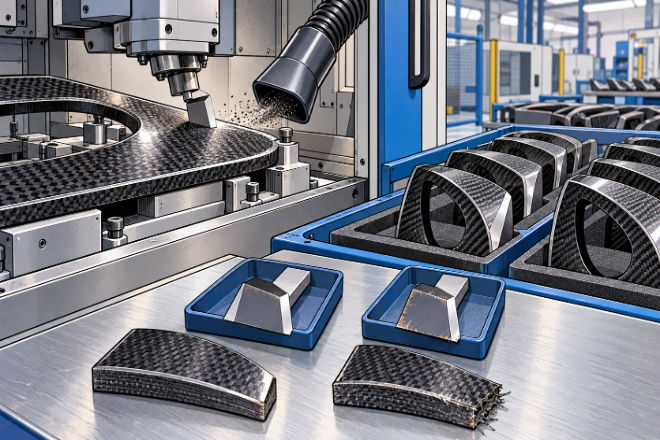
Carbon fiber composites can be costly to produce, so avoidable finishing defects can quickly affect the total manufacturing cost.
A suitable 超硬トリミングツール may help reduce costs when it delivers acceptable edge quality with limited rework and reasonable tool life.
Manufacturers should track four key measures:
Tool life: How many parts can the tool finish before wear affects quality?
Cycle time: How long does each trimming operation take, including any extra finishing passes?
Defect rate: How often do fiber damage, rough edges, or dimensional errors require correction?
Cost per accepted part: What is the full cost of producing a component that meets the required standard?
A cheaper tool may be suitable for a short run but less economical for continuous CFRP production.
Likewise, a more expensive tool is only worthwhile if its longer life or improved quality offsets the extra cost.
The best purchasing decision comes from comparing actual results rather than assuming one tool type will always be better.
 English
 Español
 简体中文
 Français
 日本語
 한국어
 العربية
 Tiếng Việt