
What is Corrosion and Why is it a Problem for Tungsten Carbide Bushings?

Corrosion refers to the gradual degradation of materials, typically metals, due to chemical reactions with their environment.
In the case of tungsten carbide bushings, corrosion occurs when the binder material, often cobalt or nickel, reacts with acids, salts, moisture, or other aggressive chemicals.
1.1). Corrosion Effects:
Weakening of the bushing’s structure
Loss of dimensional stability
Decreased 耐摩耗性
耐用年数の短縮
While tungsten carbide itself is highly resistant to wear, the binder materials are more prone to corrosion, which can cause the entire bushing to fail.
Anti-corrosion treatments aim to protect the binder and prevent these issues.
Types of Anti-Corrosion Treatments for Tungsten Carbide Bushings

There are several effective anti-corrosion treatments for tungsten carbide bushings.
Each treatment has its specific application and provides protection against different types of corrosion. Here are the most commonly used methods:
1). Surface Coatings
Surface coatings are one of the most effective ways to protect tungsten carbide bushings from corrosion.
Coatings act as a barrier, preventing corrosive substances from coming into contact with the material.
1.1). Popular Coatings for Tungsten Carbide Bushings:
Titanium Nitride (TiN): TiN is a hard, durable coating known for its 耐腐食性 そして 耐摩耗性. It forms a protective layer that helps to prevent corrosion in acidic and alkaline environments.
Diamond-Like Carbon (DLC): DLC coatings offer ultra-low friction and excellent corrosion resistance. DLC is often used in high-performance applications where bushings are exposed to chemicals and high temperatures.
Chromium (Cr) Coating: Chromium coatings are highly resistant to both abrasion and corrosion, making them ideal for bushings used in harsh, abrasive environments such as mining or chemical processing.
1.2). Why Choose Surface Coatings?
Enhanced Protection: Surface coatings create a protective layer, significantly extending the life of the bushing in corrosive environments.
Improved Performance: Coatings can also improve the friction and wear resistance of the bushings, leading to fewer maintenance needs and reduced downtime.
2). Plasma Spray Coating
Plasma spray coating involves heating a coating material (often metal or ceramic) to a molten state and spraying it onto the surface of the bushing.
This method provides a thick and durable coating that offers excellent protection against corrosion, high temperatures, and wear.
2.1). Benefits:
High resistance to corrosive chemicals and abrasion
Ability to coat irregular shapes and hard-to-reach areas
Provides excellent thermal resistance
Plasma spray coatings are especially useful for bushings in extreme environments, such as those in the oil & gas industry or marine applications.
3)電気めっき
Electroplating is a method where a thin layer of metal, typically nickel or chrome, is deposited onto the surface of the tungsten carbide bushing.
This provides a highly resistant barrier against corrosion while maintaining the structural integrity of the bushing.
3.1). Benefits:
Cost-effective compared to other coating methods
Provides good corrosion protection without adding significant bulk
Ideal for smaller components or parts requiring a precise coating thickness
Electroplating is commonly used in machinery and valves that are exposed to mildly corrosive environments.
4). Chemical Vapor Deposition (CVD)
Chemical vapor deposition (CVD) is a highly advanced process where a thin, uniform film of a corrosion-resistant material is deposited onto the tungsten carbide surface.
CVD is commonly used to create coatings like titanium carbide or boron carbide, which are highly resistant to both wear and corrosion.
4.1). Benefits:
Provides a very uniform and durable coating
Protects against a wide range of corrosive substances
Excellent for high-performance applications requiring high precision
CVD coatings are used in aerospace and high-temperature machinery where maximum protection is needed.
Benefits of Anti-Corrosion Treatments for Tungsten Carbide Bushings
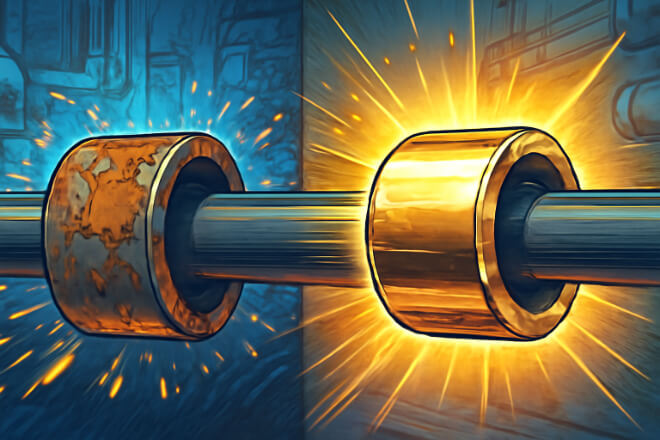
The key benefits of anti-corrosion treatments include:
1). Increased Longevity
By applying the right coating, the life of the tungsten carbide bushing can be significantly extended, even in the harshest environments. This results in fewer replacements and reduced maintenance costs.
2). Improved Performance
Anti-corrosion treatments enhance the performance of tungsten carbide bushings by improving 耐摩耗性, friction, and corrosion resistance, making them more reliable and efficient.
3)費用対効果
Though anti-corrosion treatments may increase the upfront cost, they are highly cost-effective in the long run.
The reduction in maintenance, downtime, and replacement costs makes them a worthwhile investment for industries that rely on high-performance machinery.
 English
  Español
  简体中文
简体中文  Français
  日本語
日本語  한국어
한국어  العربية
  Tiếng Việt