
The Basics of Tungsten Carbide’s Heat Resistance

Tungsten carbide is a composite material made from tungsten and carbon.
It is widely used in industries that require high-performance materials due to its extreme hardness, wear resistance, and durability. However, tungsten carbide’s performance can be influenced by temperature.
At high temperatures, the material can undergo changes that may affect its 硬度, 強靭さ、 そして wear resistance.
To understand how these changes occur, it is important to look at the basic thermal properties of tungsten carbide and how it behaves under heat stress.
Key Thermal Properties of Tungsten Carbide:
Melting Point: Tungsten carbide has a high melting point of about 5,200°F (2,870°C), which allows it to withstand extreme temperatures without losing its structure.
Coefficient of Thermal Expansion: Tungsten carbide has a low coefficient of thermal expansion, meaning it expands very little when exposed to heat, making it resistant to thermal stresses.
熱伝導率: Tungsten carbide has good thermal conductivity, allowing it to quickly dissipate heat, which helps maintain its hardness even at high temperatures.
Effects of High Temperatures on Tungsten Carbide Tips
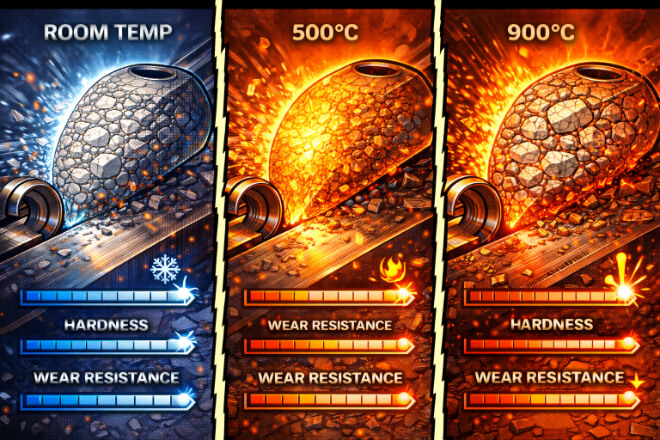
When tungsten carbide tips are exposed to high temperatures, several factors come into play that can affect their performance.
Let’s explore the key effects of temperature on tungsten carbide tips.
1). Loss of 硬度 at Elevated Temperatures
One of the most important characteristics of tungsten carbide is its hardness. However, at high temperatures, the hardness of tungsten carbide can decrease.
This is because heat causes the material to undergo changes in its microstructure, affecting its ability to resist wear.
At temperatures above 1,000°F (537°C), tungsten carbide starts to lose some of its hardness. As the temperature increases, this loss becomes more significant.
At temperatures over 2,000°F (1,093°C), tungsten carbide can experience a significant reduction in hardness, which may lead to a decrease in performance in cutting and drilling operations.
2). Thermal Expansion and Stress
Though tungsten carbide has a low coefficient of thermal expansion, it is not immune to thermal stresses.
When exposed to high temperatures, the material can expand slightly, leading to internal stresses.
If the temperature change is too rapid or if the material is exposed to prolonged high temperatures, these stresses can cause the tungsten carbide to crack or fracture.
3). 耐摩耗性 at High Temperatures
The wear resistance of tungsten carbide tips also decreases as the temperature rises.
High temperatures can cause changes in the material’s surface properties, leading to increased wear.
This is particularly true when tungsten carbide is exposed to extreme temperatures in abrasive environments.
At high temperatures, the bond between tungsten and carbon can weaken, making the material more susceptible to wear.
At extreme temperatures (over 2,000°F or 1,093°C), the material may begin to soften, leading to more significant wear.
Enhancing the High-Temperature Performance of Tungsten Carbide Tips
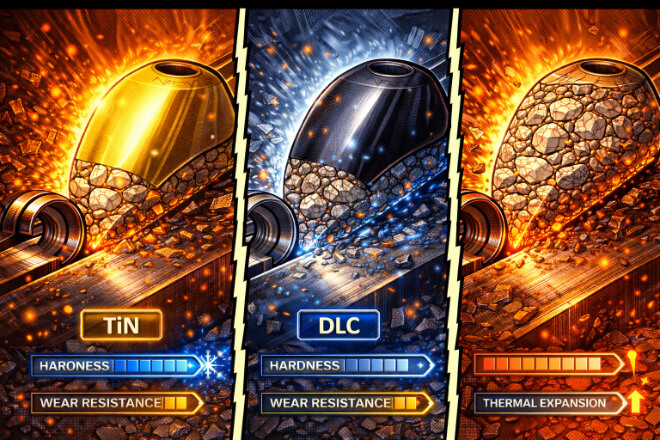
To improve the high-temperature performance of tungsten carbide tips, manufacturers can employ several techniques that help maintain the material’s properties even in extreme conditions.
These include adding coatings, adjusting binder content, and using advanced processing methods.
1). Coatings for High-Temperature Protection
One of the most effective ways to protect tungsten carbide tips from the effects of high temperatures is by applying coatings.
Various coatings, such as diamond-like carbon (DLC) or TiN (Titanium Nitride), can be applied to tungsten carbide tips to improve their heat resistance and 耐摩耗性 at high temperatures.
DLC Coatings: These coatings provide a hard, smooth surface that reduces friction and enhances wear resistance at elevated temperatures.
TiN Coatings: Titanium Nitride coatings are commonly used for tools exposed to high temperatures, as they provide excellent hardness and heat resistance.
2). Adjusting Binder Materials
Another method to enhance high-temperature performance is to adjust the binder material used in tungsten carbide.
Cobalt is the most common binder, but it has limitations in high-temperature applications.
Nickel-based binders offer better performance in high-heat environments, as nickel has a higher melting point and better resistance to oxidation.
Cobalt-Bonded Tungsten Carbide: Offers good high-temperature performance but may lose hardness at very high temperatures.
Nickel-Bonded Tungsten Carbide: Provides better high-temperature resistance and is ideal for applications exposed to heat and chemicals.
3). Advanced Manufacturing Techniques
By using advanced manufacturing techniques, such as hot isostatic pressing (HIP), manufacturers can enhance the microstructure of tungsten carbide, improving its performance at high temperatures.
HIP involves applying high pressure and temperature to the material, which helps reduce 気孔率 and improve its density, making it more durable under heat stress.
 English
  Español
  简体中文
简体中文  Français
  日本語
日本語  한국어
한국어  العربية
  Tiếng Việt