
1. Why Are Carbide Burrs Useful in Pump Repair?
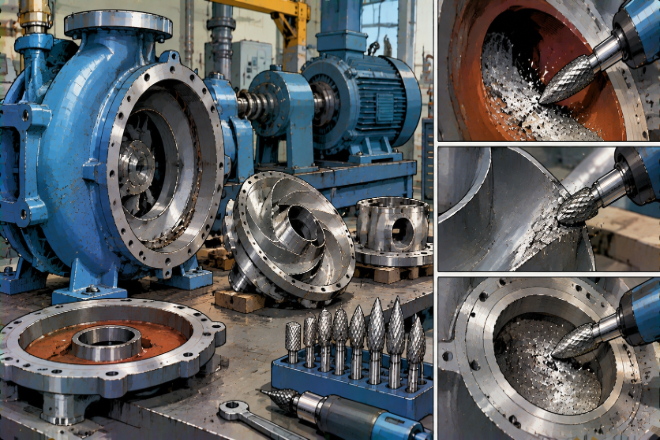
Industrial pumps are built to handle demanding conditions.
Depending on the application, pumps may transport water, chemicals, oil, slurry, wastewater, or other fluids.
Over time, components can experience wear, corrosion, erosion, cavitation damage, or mechanical damage.
Common pump parts that may require maintenance include:
Pump housings
Impellers
Valve parts
샤프트
Wear rings
Sealing areas
Welded repair sections
Many repair jobs are not about removing large amounts of material.
Instead, technicians often need to fix a small problem:
A rough edge inside a housing.
A damaged corner after welding.
A small area of corrosion.
A casting defect.
A difficult-to-reach surface.
여기가 바로 그곳입니다 tungsten carbide burrs become valuable.
A carbide burr is a small rotary cutting tool with hardened teeth. Unlike abrasive wheels that remove material through grinding, carbide burrs cut the surface with defined cutting edges.
This gives technicians better control for local repair work.
For example, a maintenance team may need to remove damaged metal from a pump casing before welding. A large grinding disc may remove too much surrounding material. A carbide burr allows more focused work.
The same advantage applies when cleaning internal areas.
Pump components often have curves, narrow passages, and complex shapes. A small burr can reach areas that larger tools cannot easily access.
However, carbide burrs are not a replacement for every repair process. A pump shaft that needs precision diameter restoration still requires machining.
A sealing surface that needs a specific flatness may require grinding or another controlled process. A carbide burr is strongest when the job is local, controlled, and difficult to reach.
That is why many maintenance teams keep them available. They solve the small problems that can otherwise slow down a much larger repair.
2. Where Are Tungsten Carbide Burrs Used on Pump Components?
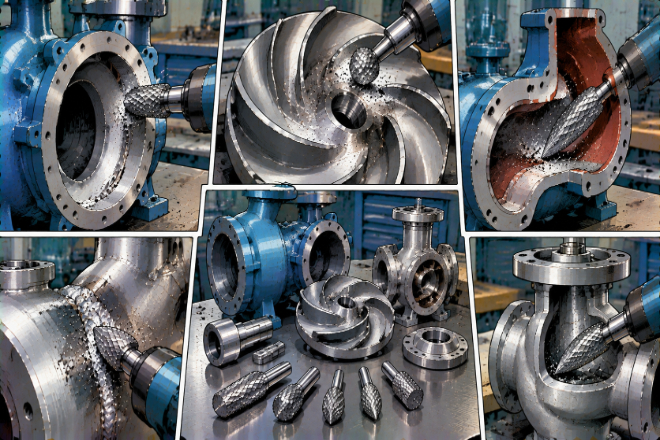
Pump repair involves many different parts, and each part creates different challenges.
Pump Housings
Pump housings often experience erosion, corrosion, and local damage.
에이 carbide burr can help remove rough edges, clean repair areas, and prepare damaged sections before further work.
For cast pump housings, a suitable carbide burr can remove unwanted material from casting imperfections or repair zones.
Impeller Repair
Impellers are critical because they control fluid movement. During service, impellers may suffer from wear caused by abrasive particles, cavitation, or corrosive fluids.
A carbide burr can help with local shaping, edge correction, and removal of unwanted material during approved repair procedures.
However, the original impeller geometry is important. Removing too much material from blade areas can affect pump performance.
Weld Repair Areas
Welding is common during pump restoration. A damaged casing or component may require material addition before the final shape is restored.
Carbide burrs are useful after welding because they can remove excess weld material and blend the repair area.
Different burr shapes help technicians work around different weld locations. Cylindrical burrs work well on open areas.
Ball burrs can follow curved surfaces. Tree and flame burrs can reach corners and narrow sections.
Internal Passages
Some pump parts contain internal channels where access is limited. A compact rotary tool with a carbide burr can reach these areas more easily than larger grinding equipment.
This is especially useful during maintenance shutdowns when speed and access are important.
A simple application guide:
3. How Do Carbide Burrs Help Remove Corrosion and Wear Damage?
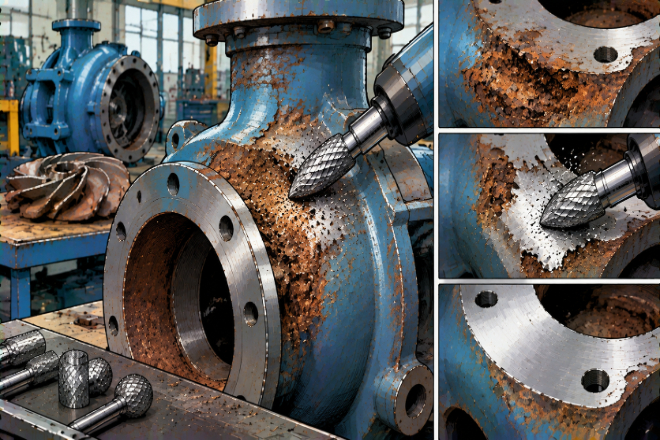
Corrosion and wear are common enemies of pump equipment. Pumps that handle chemicals, seawater, slurry, wastewater, or abrasive fluids often face aggressive operating conditions.
Damage does not always appear as a large failure. Sometimes it starts as a small damaged area that needs attention before it becomes a bigger problem.
A tungsten carbide burr can help remove affected material during repair preparation.
예를 들어:
A corroded area may need cleaning before welding.
A rough surface may need leveling.
A damaged edge may need reshaping.
A casting defect may need removal.
Because carbide burrs cut instead of simply grinding, technicians can control the amount of material removed more easily.
This matters when the surrounding material is still valuable. A pump housing or impeller may not need replacement.
It may only need a carefully controlled repair. The hardness and wear resistance of tungsten carbide make these burrs suitable for demanding industrial environments.
Tungsten carbide tools are widely used in industries where wear resistance and durability are important, including oil and gas, sealing equipment, and other harsh operating conditions.
However, corrosion repair requires judgment. Removing damaged material is only one step. The technician also needs to understand why the damage happened.
Was it chemical corrosion?
Abrasive wear?
Cavitation?
Poor operating conditions?
If the cause remains, the repair may not last. A carbide burr can fix the damaged area. It cannot fix the operating environment.
4. Which Carbide Burr Shapes Work Best for Pump Repairs?
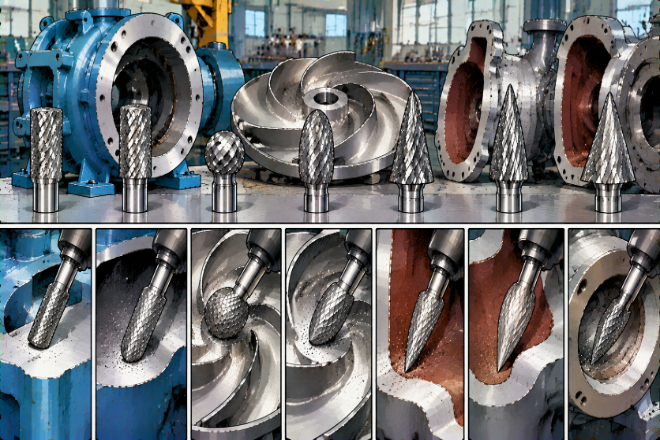
Pump components rarely have simple shapes. That means burr selection matters. A cylindrical carbide burr is useful for open surfaces and straight areas.
It provides stable contact and works well for general material removal. A cylindrical radius-end burr adds flexibility because it can handle transitions and curved sections.
Ball-shaped burrs are useful for curved areas, internal surfaces, and blending work. Oval burrs work well where smooth transitions are needed.
Tree-shaped burrs can reach narrow corners and internal areas. Flame-shaped burrs are useful for detailed shaping around changing profiles.
Cone burrs can enter angled openings and smaller features. The correct shape can make a repair faster.
A technician using a large cylindrical burr inside a small curved passage may spend more time fighting the tool than repairing the component.
The burr should follow the component. Not the other way around. Material also matters.
Pump components may include:
Carbon steel
스테인리스 스틸
주철
Nickel alloys
Hardened materials
Different materials may require different carbide burr cuts. For example, stainless steel repair may benefit from an INOX-style cut, while cast materials may require a different tooth design.
Choosing only by shape is not enough. The material and operation must also be considered.
5. How Can Maintenance Teams Use Carbide Burrs More Effectively?
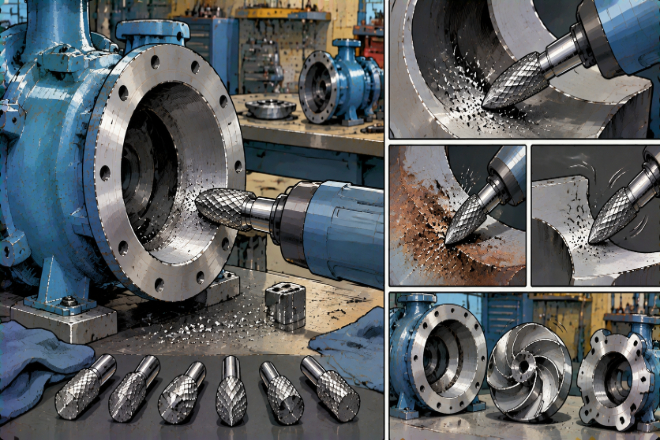
The performance of a carbide burr depends heavily on how it is used. The first step is correct speed. There is no single RPM that works for every burr.
The correct speed depends on:
Burr diameter
Cutting geometry
재료
애플리케이션
A small burr usually requires a higher speed than a larger burr. Using the wrong speed can create vibration, poor cutting, or unnecessary wear.
The second step is controlled pressure. Many operators make the mistake of pushing harder when cutting slows down.
But carbide burrs are cutting tools. The teeth should remove the material. Excessive pressure can increase heat and damage the cutting edges.
The third step is keeping the burr moving. Holding the tool in one place can create uneven surfaces and unnecessary heat.
Smooth movement usually produces better results. The grinder condition also matters. A worn collet, poor spindle, or excessive burr overhang can create vibration.
Even a high-quality carbide burr cannot perform well in an unstable setup. Maintenance teams should also inspect burr condition.
Replace tools when:
Cutting becomes slow
Teeth are damaged
Vibration increases
The burr no longer produces acceptable results
Do not wait until the tool completely fails. A small cutting tool can influence the total repair time of a large pump.
6. How Should Companies Select Carbide Burrs for Pump Maintenance?
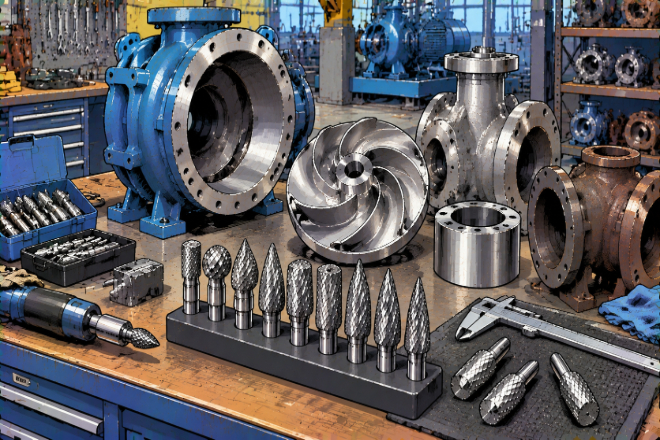
For companies managing large pump systems, carbide burr selection should be part of a maintenance strategy. Start with real repair tasks.
What problems happen most often?
Housing repairs?
Weld blending?
Impeller correction?
Internal cleaning?
Then select tools based on those needs. A practical pump maintenance burr set may include:
Cylindrical burrs for general removal
Ball burrs for curved areas
Tree burrs for narrow sections
Flame burrs for detailed repair work
Material-specific cuts for different alloys
The goal is not to buy the most burrs. It is to have the right burrs available when downtime matters. Testing tools on actual components is also important.
Compare:
Repair time
공구 수명
Surface quality
Operator control
Secondary finishing work
A cheaper burr may become expensive if it creates more finishing work or needs frequent replacement.
For purchasing teams, the better question is not: “How much does one burr cost?” The better question is: “How much does this burr reduce total repair time?”
Tungsten carbide burrs are small tools. But during a pump shutdown, small tools can have a very large effect.
 English
  Español
  简体中文
简体中文  Français
  日本語
日本語  한국어
한국어  العربية
  Tiếng Việt