
1. Why Is Deep-Hole Finishing Difficult in Metalworking?
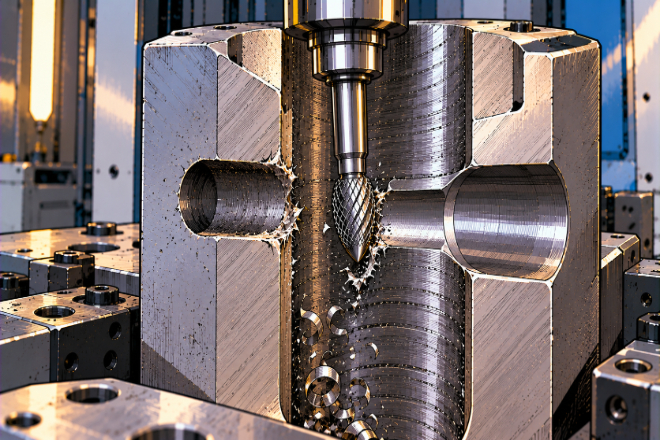
A deep hole may look simple from the outside, but its internal surface can create several manufacturing problems.
During drilling, boring, or milling, small burrs may remain along internal edges.
Tool marks, casting defects, and uneven transitions can also appear inside the hole. These problems become more difficult to remove as the hole gets deeper.
The first challenge is access.
A standard cutting tool may not reach the damaged area. Even when it can enter the hole, the tool body or holder may contact the surrounding wall before reaching the correct position.
Visibility is another problem. Operators cannot always see the cutting area directly, especially inside long or narrow bores. This makes it harder to judge how much material has been removed.
Deep holes also create problems with chip removal.
When a cutting tool removes metal, the chips need somewhere to go. Inside a narrow passage, chips may collect around the tool or remain at the bottom of the hole.
If these chips are not removed, they can interfere with the finishing process or remain inside the component.
This is particularly important for hydraulic blocks, pump housings, valve bodies, and other components containing internal passages.
A small loose burr inside a fluid passage can become a serious problem when the equipment starts operating.
There is also a difference between deep-hole finishing and precision bore machining.
Precision boring, reaming, and honing are used when a hole must meet strict requirements for diameter, roundness, or surface finish.
텅스텐 카바이드 버 are better suited to local correction work, where a specific unwanted feature needs to be removed without machining the entire bore.
Understanding this difference helps manufacturers avoid using the wrong tool for the job.
2. What Can Tungsten Carbide Burrs Do Inside Deep Holes?
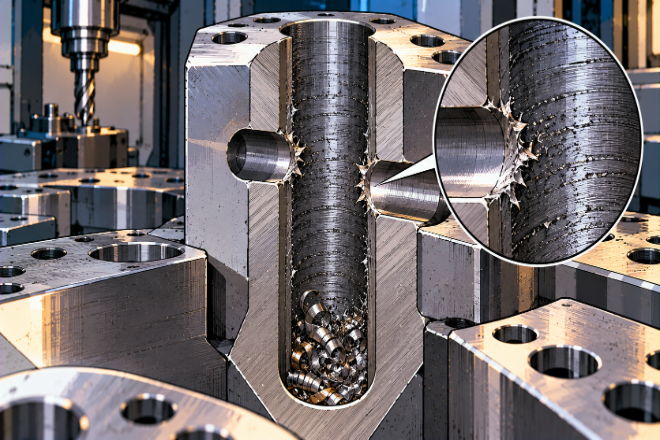
텅스텐 카바이드 버 remove material through rotating cutting teeth. When a suitable burr can reach an internal defect, it can cut away unwanted metal without requiring the entire bore to be machined again.
One common application is internal burr removal.
A drilled hole may contain small raised edges around an opening or internal feature. A suitably sized carbide burr can remove these burrs when there is enough room for safe tool movement.
Another application is cleaning cross-hole intersections.
Many industrial components contain holes that connect with other drilled passages. When the second hole is drilled, material may be pushed into the first passage, leaving a burr at the intersection.
If the intersection is accessible, a small carbide burr may help remove a localized burr. However, hidden intersections often require dedicated cross-hole deburring tools rather than a standard rotary burr.
Carbide burrs can also help with local surface correction.
For example, a cast metal housing may have a small raised area inside an internal passage. If the area is accessible and material removal is permitted, a burr can help smooth the transition.
Other possible applications include removing local casting flash, cleaning accessible internal corners, and correcting small irregular openings.
The important word here is local. A carbide burr is not designed to make every part of a deep bore perfectly smooth or round. It works best when the problem is limited to a specific area.
For manufacturing companies, this can be useful during component production, repair, and maintenance.
Instead of machining a larger area than necessary, technicians can focus on the defect that actually needs attention.
3. Which Tungsten Carbide Burr Shapes Work Best for Deep Holes?
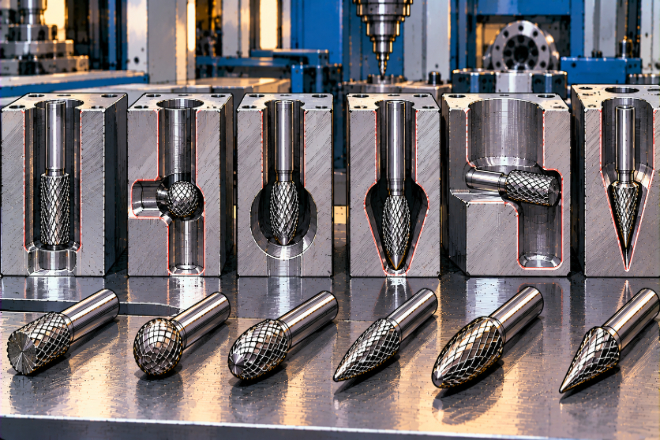
The right burr shape depends on what is inside the hole.
A cylindrical burr can work on relatively straight internal surfaces when there is enough clearance. It may be useful for removing raised material along an accessible section of a bore.
A ball-shaped burr is useful for rounded areas and local defects. Its curved head can approach some internal transitions more smoothly than a flat-ended tool.
An oval burr can help blend curved surfaces, while a tree-shaped or flame-shaped burr may be useful around tapered passages and irregular internal contours.
Cone-shaped burrs can help clean angled openings or small accessible transitions.
However, tool shape alone does not determine whether a burr is suitable.
The burr must also fit through the hole without contacting surfaces that should remain untouched.
For example, a large ball burr may be useful for an open internal cavity but completely unsuitable for a narrow deep bore.
The cutting pattern also matters.
For steel components, a cut designed for steel may provide effective material removal. Stainless steel may require a suitable stainless-specific cut. Aluminum can benefit from more open cutting teeth that reduce chip loading.
For deep-hole finishing, chip control becomes especially important because removed material has limited space to escape.
The following table provides a basic selection guide.
4. How Do Long-Shank Carbide Burrs Reach Deep Areas?
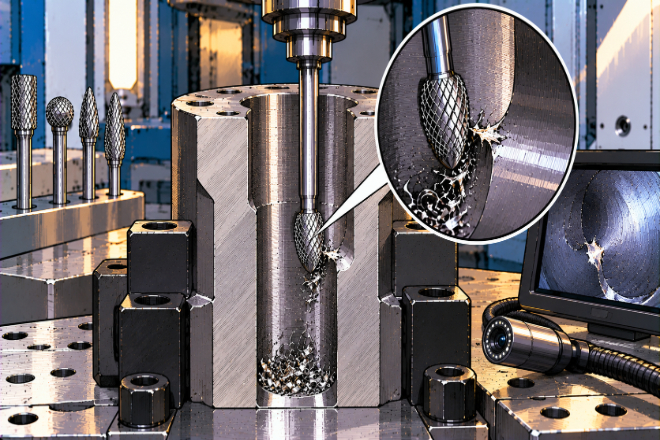
One of the biggest challenges in deep-hole finishing is reaching a defect that lies far from the opening.
Standard carbide burrs have limited reach. When the problem is deeper inside the component, a longer tool may be necessary.
Long-shank tungsten carbide burrs are designed for certain hard-to-reach areas. Their extended shanks allow the cutting head to reach locations that a standard burr cannot.
This can be useful in large castings, internal cavities, and other components with accessible deep features.
However, a longer shank creates a new problem: reduced stiffness.
As the distance between the cutting head and the tool holder increases, the shank becomes more sensitive to bending and vibration.
Even a small cutting force can create noticeable movement at the burr head.
This is why long-shank carbide burrs require much more care than standard versions.
The tool must be used within its approved speed range, with suitable rigid holding and controlled contact. Some long-shank burr designs require the head to be inside the bore and in contact with the workpiece before the drive starts.
Long-shank burrs should never be treated as ordinary burrs with extra length.
Certain long-shank designs are specifically unsuitable for robotic or stationary machine applications because of the risk of bending and breakage.
For CNC deep-hole finishing, manufacturers should therefore select tools specifically approved for the intended machine and operation rather than placing a general-purpose extended burr into a CNC spindle.
In some cases, a supported spindle extension or a dedicated internal finishing tool may be safer and more effective.
This is particularly important when the hole is narrow, the required reach is long, or the tool must operate at high rotational speed.
The correct decision should be based on the complete tool setup, not simply the length printed in a product description.
5. How Can You Finish Deep Holes Without Damaging the Bore?
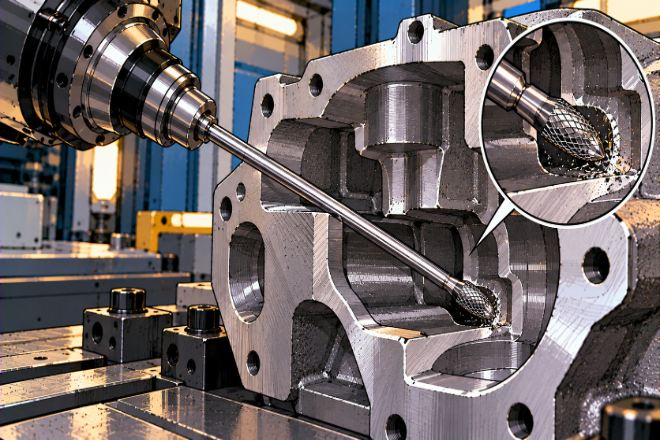
Deep-hole finishing requires a controlled process because mistakes are difficult to see and may be expensive to repair.
The first step is inspection.
Before selecting a carbide burr, identify the exact location of the defect. Determine whether the problem is a burr, raised casting material, tool mark, or damaged edge.
For difficult areas, a borescope or suitable internal inspection method can help locate the problem.
Next, confirm that the unwanted material can be removed without changing a critical dimension.
If the bore contains a sealing surface, bearing fit, precision diameter, or other controlled feature, freehand burr work may not be appropriate.
Once the correct tool has been selected, secure the workpiece and use a suitable drive system.
The tool should enter the hole without scraping the surrounding wall.
During cutting, use controlled contact and avoid forcing the burr sideways. Heavy side pressure can increase bending, vibration, and the risk of tool damage.
It is better to remove a small amount of material and inspect the result than to attempt the entire correction in one pass.
A practical sequence is: Inspect → Select the tool → Confirm safe reach → Remove material carefully → Clear chips → Inspect again
Chip removal deserves special attention.
Inside a deep hole, loose chips may remain after the burr is removed. These particles can damage equipment or block internal passages if the component is assembled without proper cleaning.
Use an approved cleaning method suitable for the component, such as controlled air, flushing, or another specified process. Blind holes and connected passages may require different cleaning methods.
Finally, inspect the finished area.
A clean-looking entrance does not prove that the deeper part of the bore is free from burrs.
For critical components, inspection should confirm both the local repair and the cleanliness of the internal passage.
6. When Are Carbide Burrs Better Than Other Deep-Hole Finishing Tools?
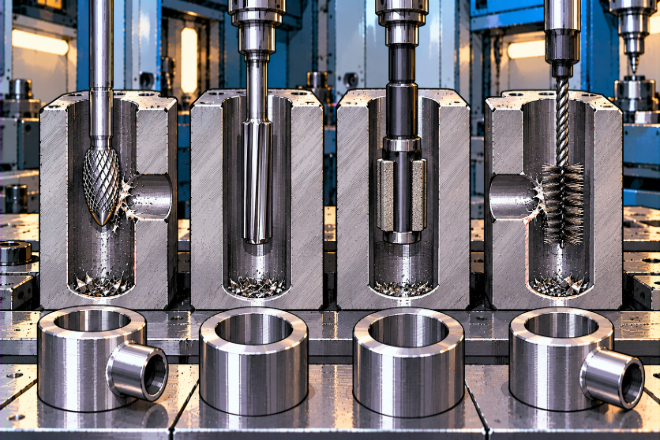
텅스텐 카바이드 버 are useful, but they are not always the best choice.
The correct method depends on the problem that needs to be solved.
If a deep hole has a small local casting defect, a suitable carbide burr may remove it efficiently.
If the entire bore has an incorrect diameter, however, a precision boring or reaming operation is usually more appropriate.
If the goal is to improve the surface finish along the full bore, honing may provide more consistent results.
For very small internal burrs, abrasive brushes can sometimes reach areas that a rigid carbide burr cannot safely access.
Cross-hole intersections are another example.
A specialized cross-hole deburring tool may be designed to pass through a bore and remove burrs at hidden intersections without damaging the surrounding wall.
Trying to perform the same task with a standard carbide burr may create unnecessary risk.
This is why manufacturers should not select deep-hole finishing tools based only on material removal speed.
The decision should consider access, required accuracy, tool life, inspection, and total production cost.
For production managers, several questions are worth asking.
Can the tool reach the defect safely? Can it remove the material without damaging the bore? Will the process produce the same result on repeated parts? How will the finished area be inspected?
A suitable carbide burr may provide a low-cost solution for occasional repair work. For high-volume production, a dedicated internal finishing tool may offer better consistency.
There is also the cost of rejected components.
A deep-hole defect may be small, but a damaged precision bore can make an expensive part unusable.
That makes process reliability more important than simply choosing the fastest cutting tool.
The best deep-hole finishing process removes the unwanted material while protecting the geometry and function of the component.
 English
  Español
  简体中文
简体中文  Français
  日本語
日本語  한국어
한국어  العربية
  Tiếng Việt