
What is Thermal Expansion and Why Does It Matter for Tungsten Carbide Bushings?

Thermal expansion refers to the change in size or volume of a material when it is subjected to a temperature change.
All materials, including tungsten carbide, expand when heated and contract when cooled.
In the case of tungsten carbide bushings, controlling this expansion is critical for several reasons:
Fit and Tolerances: If the bushing expands or contracts too much, it can lead to poor fit with the shaft, resulting in mechanical issues or failure.
Wear and Tear: Thermal expansion can cause additional stress and strain on the material, accelerating wear or even leading to cracks if not properly managed.
Operational Efficiency: If the bushing changes size too much with temperature fluctuations, it can cause increased friction, leading to less efficient operation and more frequent maintenance.
The Coefficient of Thermal Expansion (CTE) in Tungsten Carbide
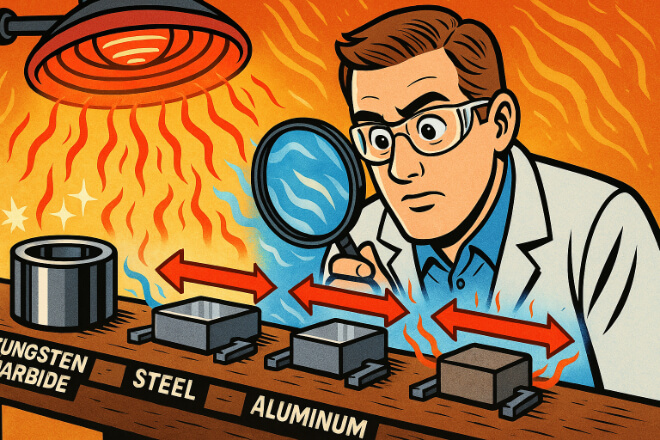
The Coefficient of Thermal Expansion (CTE) is a material property that quantifies how much a material expands or contracts when its temperature changes.
Tungsten carbide has a relatively low CTE compared to other materials, which makes it resistant to dimensional changes under temperature fluctuations.
However, in high-precision applications, even small changes in size can be significant.
CTE of Tungsten Carbide: Tungsten carbide has a CTE of approximately 4–6 × 10⁻⁶ /°C, meaning it expands very little compared to many metals.
Comparing CTE with Other Materials: Materials like stainless steel have a higher CTE, meaning they expand more with heat. When tungsten carbide is used in combination with other materials, it’s important to account for these differences to avoid stress and failure at the interface.
How to Control Thermal Expansion in Tungsten Carbide Bushings

There are several strategies to manage thermal expansion in tungsten carbide bushings, especially when these components operate in environments with temperature fluctuations:
1). Select the Right Material Combination
The first step in controlling thermal expansion is selecting the right materials for your application.
When tungsten carbide is used with metals or alloys, differences in their CTEs can create stress and affect the fit. Using a combination of materials with similar CTE values can help reduce thermal stress.
Nickel-Bonded Tungsten Carbide: This material has a slightly higher CTE than pure tungsten carbide, but it also offers better resistance to thermal shock and can help balance expansion with other components.
Matching Materials: If the bushing will interact with another material, such as a shaft or housing, choose a material with a similar CTE to avoid creating thermal mismatch.
2). Use of Cooling and Heating Systems
In environments where temperature fluctuations are extreme, using controlled cooling or heating systems can help manage thermal expansion.
By maintaining a consistent temperature within operational limits, you can prevent excessive thermal expansion and contraction of the bushing.
Thermal Management Systems: These systems include heaters, coolers, or heat exchangers that maintain the temperature of both the bushing and other critical components, reducing the risk of thermal expansion affecting performance.
Insulation: In some cases, insulating the bushing or the surrounding components can help maintain a stable temperature, reducing the impact of thermal changes.
3). Design for Thermal Expansion
When designing systems that incorporate tungsten carbide bushings, it’s important to account for thermal expansion during the design phase.
This means factoring in the CTE of the bushing and the other components to ensure that the clearance and fit are appropriate for temperature changes.
Allow for Clearance: Design the bushing and housing with a slight gap or clearance to accommodate expansion without causing interference.
Thermal Expansion Compensation: Some systems incorporate features such as expansion slots or flexible housings to allow the bushing to expand and contract without affecting the performance.
Measuring and Testing Thermal Expansion

To effectively control thermal expansion, it’s essential to monitor and measure the thermal behavior of the tungsten carbide bushings under operational conditions.
Regular testing can help identify issues early and prevent failures.
Thermal Expansion Testing:
Conduct tests to measure the expansion of tungsten carbide bushings at different temperatures.
This will provide a clear understanding of how much the material will change in size during typical operating conditions.
Stress Testing:
Perform stress testing to identify how the bushing reacts to thermal cycling (the repeated heating and cooling process) and determine if it maintains its integrity under these conditions.
CTE of Common Materials Used in Bushings
Benefits of Controlling Thermal Expansion in Tungsten Carbide Bushings

Controlling thermal expansion in tungsten carbide bushings brings several benefits:
Improved Performance: By minimizing changes in size due to temperature fluctuations, you ensure that the bushing maintains its designed fit and function throughout its service life.
Extended Lifespan: Preventing thermal stresses from occurring reduces wear and tear, leading to longer-lasting bushings.
Higher Efficiency: Properly controlled thermal expansion helps maintain smooth movement between components, reducing friction and enhancing the efficiency of the entire system.
 English
  Español
  简体中文
简体中文  Français
  日本語
日本語  한국어
한국어  العربية
  Tiếng Việt