
1. Why Are Carbide Burrs Useful in Wind Turbine Repair?
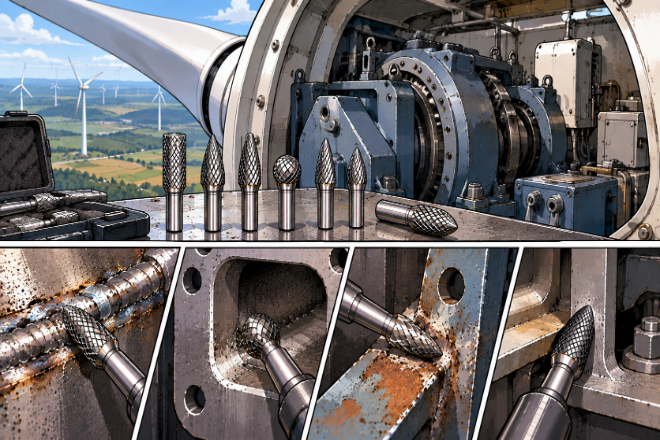
Wind turbines spend years dealing with changing loads, vibration, moisture, temperature changes, and continuous operation.
Eventually, parts need attention.
Wind turbine gearboxes, for example, contain several bearing locations, including planet, intermediate-shaft, and high-speed-shaft bearings.
Bearing and gearbox reliability remains an important maintenance issue for wind farm operators.
The main shaft and its bearing system may also need inspection and repair. Depending on the condition of the component, professional repair can include machining, bearing replacement, and work on damaged shaft surfaces.
Where does a carbide burr fit into all this? Usually around the smaller jobs.
A technician may need to remove a sharp edge after another repair. A welded bracket may need local blending.
A hole may need deburring. A corroded area may require careful cleanup before inspection. A damaged steel edge may need a small correction.
These jobs do not always justify setting up heavy machining equipment.
A tungsten carbide burr removes material with defined cutting teeth.
Burrs designed for steel and cast steel are used for deburring, levelling, surface work, cutting out holes, milling out material, and working on weld seams.
The burr is also small. That matters inside a nacelle.
A wind turbine may be enormous, but the space around the gearbox certainly does not feel enormous when someone is trying to reach a small metal defect behind another component.
This is one of the main reasons carbide burrs are useful in wind turbine repair: large machine, surprisingly small working spaces.
2. Where Do Carbide Burrs Help Around Gearboxes and Main Shafts?
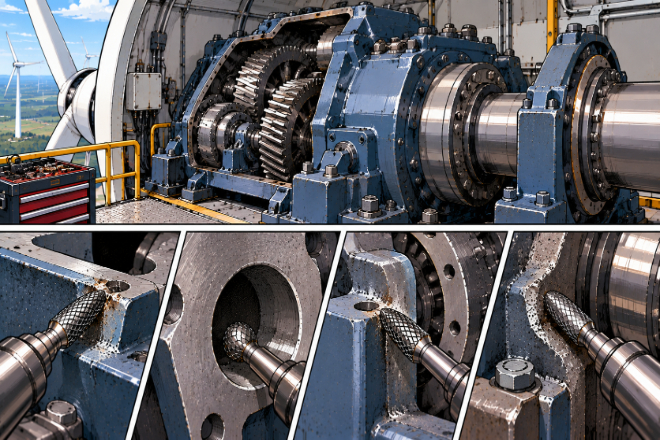
The gearbox is one of the most important areas inside many wind turbine designs.
It transfers power between the slowly rotating rotor system and the faster generator side. Bearings support different gearbox shafts, and these parts can experience demanding loads over long periods.
Gearbox maintenance may involve bearing work, inspection, replacement components, or more extensive refurbishment.
Carbide burrs should not be confused with the precision tools used to repair gear teeth, bearing seats, or other tightly controlled surfaces.
Those areas require proper machining and measurement. Instead, a carbide burr can support the work around them.
For example, a removed gearbox component may have a small sharp edge that needs cleaning.
A non-critical opening may need deburring after repair work. A local rough area around a housing may need blending before the next operation.
Main-shaft repair follows the same logic. SKF describes wind turbine main-shaft repair that can include turning the shaft and fitting bearings. That is clearly precision work, not a job for a hand-held burr.
But during disassembly and related repair, technicians can still encounter small metal areas that need controlled cleanup.
The distinction is important: Bearing seat restoration? Precision machining. Small burr beside a repaired feature? A carbide burr may be useful.
A good maintenance team knows the difference. The goal is not to use carbide burrs everywhere. It is to use them where their size and control actually save time.
3. How Are Carbide Burrs Used for Weld and Structural Repairs?
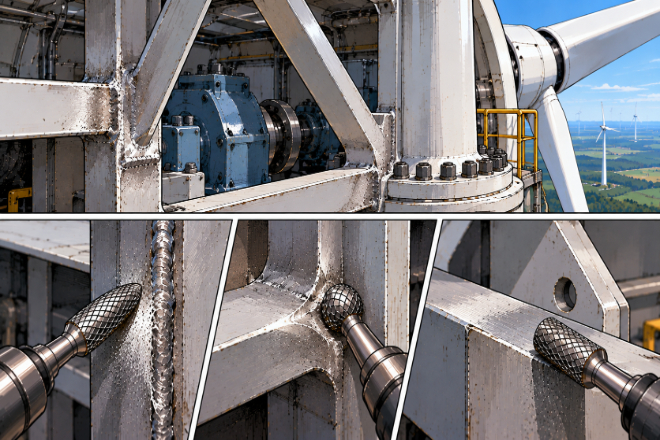
A wind turbine contains plenty of metal outside the gearbox. Tower sections, internal platforms, brackets, frames, nacelle structures, generator supports, and other steel parts may contain welded joints.
Maintenance or modification can create new weld-finishing work.
After a local weld repair, extra metal may need to be blended. Sharp transitions may need cleaning. A difficult corner may require finishing before inspection or coating.
This is a natural job for a carbide burr. Burrs made for steel can be used for work on weld seams as well as general surface work and deburring.
Shape selection makes the job easier. A cylindrical burr works well on straighter surfaces. A ball burr can enter rounded corners.
Tree and flame burrs are useful around changing contours and welded joints. Cone-shaped burrs can reach narrow areas. This gives technicians more freedom than a large grinding disc when access is limited.
mũi khoan cacbua can also be useful when an edge needs controlled preparation. Specialized edge-cut burrs are designed for deburring, chamfering, and rounding steel edges.
However, structural repairs should always follow the approved maintenance or engineering procedure.
A burr can shape metal very efficiently. That does not mean the operator should decide that a structural weld “looks about right” and move on.
For critical wind turbine structures, repair geometry, inspection, coating, and acceptance requirements still control the job. The burr is the cutting tool. It is not the engineer.
4. Where Do Burrs Help in Tight Nacelle Maintenance Areas?
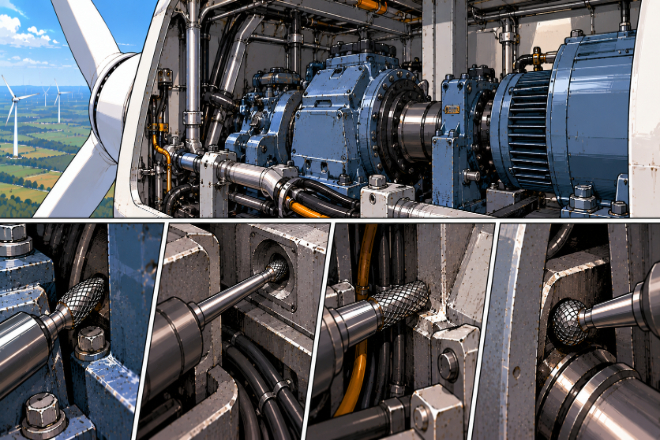
This may be the application where carbide burrs make the most practical sense. The nacelle contains a lot of equipment in a limited space.
Depending on turbine design, technicians may work around the main shaft, gearbox, generator, brake system, frames, housings, electrical equipment, lubrication systems, and structural supports.
Access can become awkward very quickly. Imagine finding a rough metal edge behind a bracket. The area is small.
The repair is simple. The tool just has to reach it. A large grinder may be too wide. A machine tool may be completely unrealistic without removing the component.
A compact straight grinder with a suitable carbide burr can provide another option. Different burr shapes help technicians work around curves, openings, brackets, and narrow gaps.
Long-shank burrs can provide additional reach when required. But extra length comes with a warning. More overhang can increase vibration.
If the burr starts jumping around the surface, the extra reach has stopped being useful. The best approach is to use the shortest burr that can comfortably reach the repair area.
Tool condition matters as well. Good concentricity helps reduce chatter, while a stable spindle and correctly mounted burr improve control.
PFERD specifically recommends observing the correct rotational speed and using suitable drives to limit vibration.
This is particularly important when working in a nacelle. The technician may already be dealing with limited access. The cutting tool does not need to add its own little earthquake.
5. Which Wind Turbine Materials Need Different Burrs?
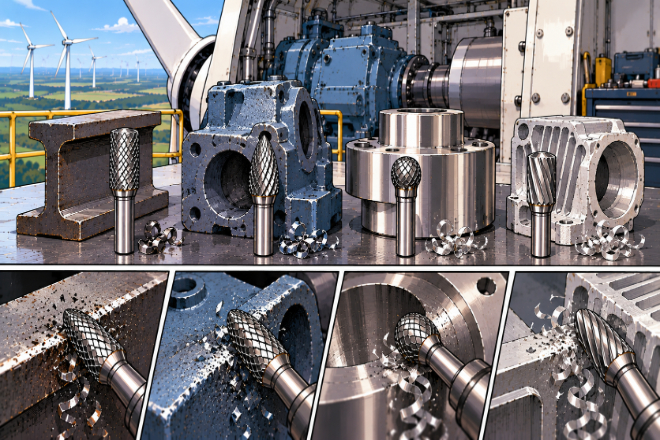
Wind turbine maintenance can involve several metals. Steel and cast steel are common in structural and mechanical components.
Stainless steel can appear where corrosion resistance is important. Some components and structures may also use non-ferrous metals.
One burr design should not automatically be used for all of them. Steel-specific carbide burrs are designed for applications such as deburring, levelling, surface work, hole work, and weld-seam processing on steel and cast steel.
Stainless steel can benefit from a cutting geometry designed specifically for stainless materials. These burrs are also used for deburring, surface work, levelling, holes, and weld seams.
Material choice is only half of the decision. The repair geometry matters too.
6. How Can Maintenance Teams Avoid Damaging Expensive Parts?
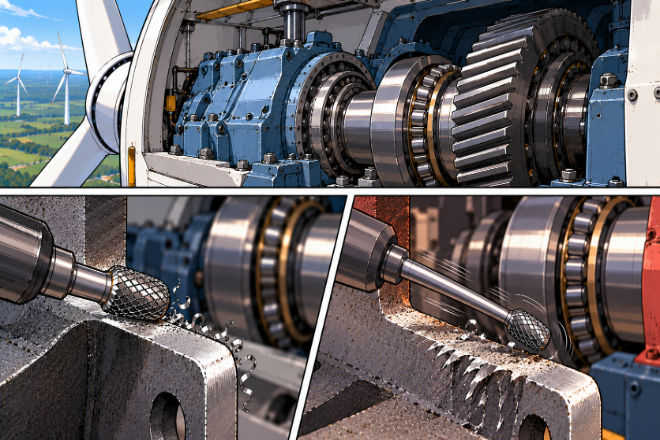
Wind turbine components are expensive. That makes “remove a little metal” a job that deserves more thought than the sentence suggests.
The first rule is simple: do not push the burr too hard. Tungsten carbide is very hard and chống mài mòn, but the cutting teeth can still be damaged by impact, heavy side loading, or unstable operation.
The burr should cut with its teeth. It should not be forced into the workpiece. Correct speed also matters.
There is no universal RPM that fits every carbide burr. Suitable speed depends on burr diameter, material, cut geometry, and manufacturer guidance.
Manufacturers provide different speed ranges for different burr sizes and materials.
Keep the burr moving instead of holding it in one place for too long. Check the grinder, collet, shank, and bearings if vibration suddenly increases. And most importantly, know which surfaces should not be touched.
Bearing seats, shaft fits, gear teeth, brake surfaces, and other precision areas may require controlled machining and inspection.
Wind turbine gearbox damage can involve bearings, gear surfaces, corrosion, wear, and other complex failure modes.
A carbide burr should not become a shortcut around the correct repair process. A five-minute shortcut is not much of a bargain if it damages a main shaft.
7. How Should Wind Farm Operators Evaluate Carbide Burrs?
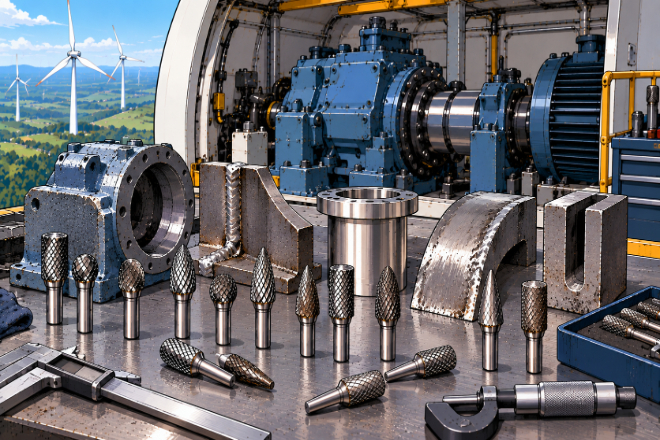
For wind farm operators and maintenance companies, the purchase price of a carbide burr is only one number. The more useful number is the cost of completing the repair.
Wind turbine maintenance becomes especially expensive when access, technician time, component removal, cranes, and turbine downtime enter the picture.
Reliability and reduced maintenance demand are therefore major concerns for wind turbine operators.
Start tool evaluation with real maintenance tasks. Test burrs on representative steel, cast steel, stainless steel, and repaired weld samples.
Include realistic access conditions. A burr that performs beautifully on a flat plate at a workshop bench may feel very different when used around a gearbox housing.
Measure removal speed, vibration, control, surface condition, and tool life. Then compare consistency between burrs.
Good concentricity is particularly useful because it helps reduce chatter and unnecessary wear on both the burr and the drive.
Maintenance managers should also look at inventory. Do technicians really need twenty shapes? Maybe not. But supplying only one general-purpose shape can create slow and awkward work.
A small, carefully selected range for common steel work, weld cleanup, curved surfaces, holes, stainless steel, and difficult access can be more useful.
Finally, measure technician time. If the right burr turns an awkward local repair into a simple operation, that value is much larger than the difference between two burr prices.
Up in a nacelle, nobody wants to spend another hour fighting the wrong tool.
 English
  Español
  简体中文
简体中文  Français
  日本語
日本語  한국어
한국어  العربية
  Tiếng Việt