
1. What Makes Tungsten Carbide Burrs Useful for Precision Chamfering?
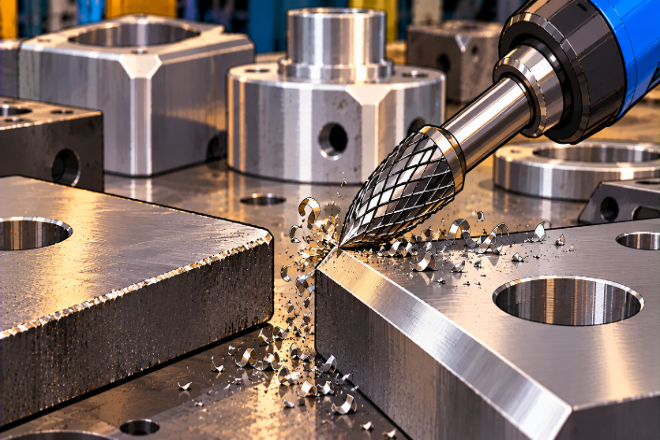
Chamfering means removing a controlled amount of material from an edge to create a sloped surface.
Simple enough.But there is a big difference between breaking a sharp edge and producing a controlled chamfer.
If a worker only needs to remove a sharp corner, many tools can do the job.Precision chamfering asks for more.
The chamfer may need a defined angle, controlled width, smooth surface, and consistent shape from one component to the next.
This is where the correct tungsten carbide burr becomes useful.Carbide cutting teeth remove material rather than simply rubbing it away.
The high khả năng chống mài mòn of tungsten carbide also helps the cutting geometry stay useful during repeated production work.
More importantly, dedicated edge-working carbide burrs are available.
Conical counterbore burrs can be designed specifically for controlled chamfering.
Some systems use guide features that allow the tool to follow the edge instead of relying completely on the operator’s hand.
This changes the job from:“Try to hold the grinder at about the right angle.”to:“Let the tool geometry help create the angle.”
That difference matters when a company is processing dozens or hundreds of similar components.Tungsten carbide burrs can also work on a wide range of materials, including:
Carbon steel
Cast steel
Thép không gỉ
Gang đúc
Nhôm
Other non-ferrous metals
Harder alloys
The exact burr cut should still match the material and application.
For manufacturers, the main benefit is flexibility. A carbide burr can perform local chamfering on parts that may be difficult to place in a large milling machine or dedicated edge-processing system.
That makes it useful for fabrication, repair, welding, casting, machining, and final part preparation.
2. Which Carbide Burr Shapes Work Best for Chamfering?
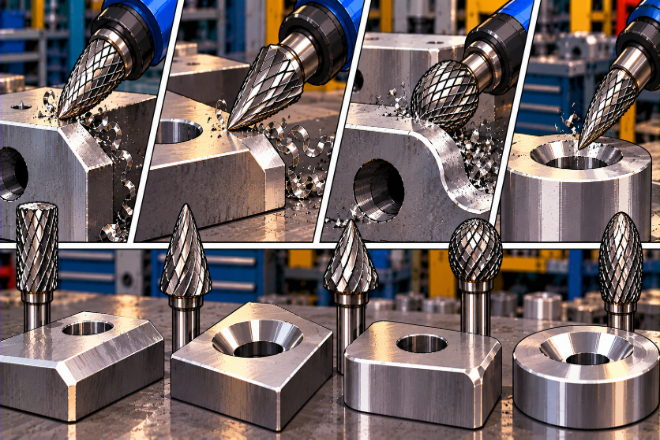
Not every carbide burr shape is equally suitable for chamfering.A ball burr can remove material from an edge.So can an oval burr.
But if the goal is a controlled angled surface, a conical or conical counterbore carbide burr is usually a more natural choice.
Its geometry already matches the type of surface being created.For defined edge work, special carbide burrs are available for producing fixed chamfer angles such as 30° and 45°.
That gives the operator a much clearer path to a repeatable result.
For flexible chamfering, standard conical counterbore shapes can also be used where the exact chamfer does not need the same level of fixed guidance.
3. How Can Carbide Burrs Make Chamfers More Consistent?
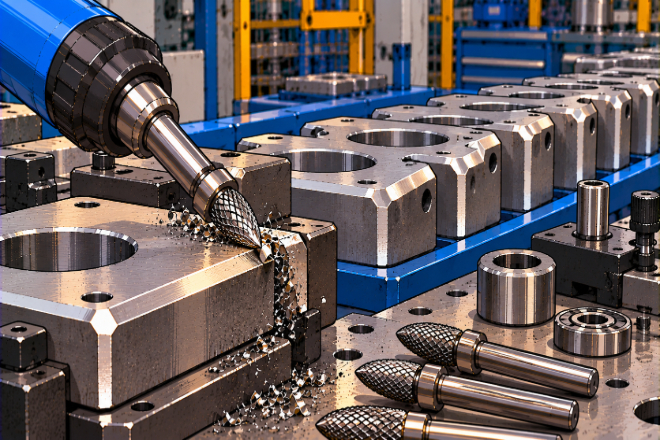
Freehand chamfering has one obvious weakness:
Humans are very good at being slightly different every time.
An experienced operator can create excellent results with a standard carbide burr. But if the part requires repeatable chamfer width and angle across a large batch, relying completely on hand position creates variation.
Dedicated edge-working burrs help reduce this problem.
Some defined chamfering burrs include a guide or bearing design that follows the original workpiece edge.
This allows the cutting section to maintain a more controlled relationship with the part.
Guide sleeves can provide another level of stability in suitable systems.
Instead of the operator controlling every part of the geometry, the tool helps control:
Cutting position
Chamfer angle
Contact with the edge
Tool movement
For example, defined EDGE-type carbide burrs are available for 30° and 45° chamfers. A guided 45° edge-cutting system can also create a controlled chamfer width.
That kind of setup is very different from using a general cylindrical burr and trying to create a chamfer by eye.
Concentricity matters as well.
A burr that rotates accurately around its center can produce a cleaner cutting action with less chatter.
Tool holding should therefore be part of the process.
Check:
Collet condition
Burr shank condition
Grinder spindle
Tool runout
Burr installation
Workpiece stability
The cutting tool can be precise only if the system holding it gives it a fair chance.
For repeated manufacturing, a simple inspection gauge or sample part can also help operators confirm that the chamfer remains inside the required range.
Precision is rarely one magic feature.
It is usually several small controls working together.
4. Where Does Precision Chamfering Matter Most?
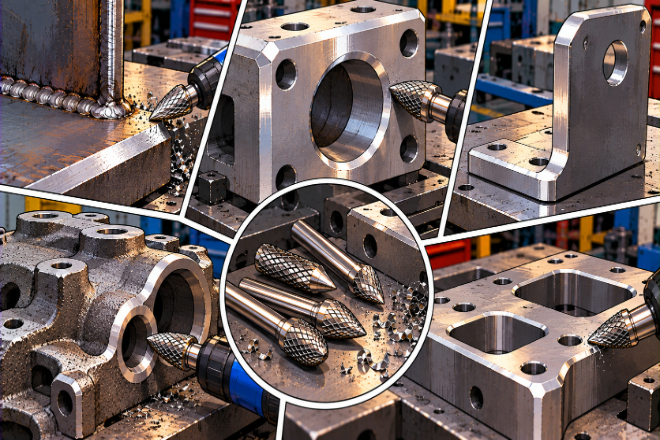
Chamfers appear in many places for different reasons.
Sometimes they make assembly easier. Sometimes they remove dangerous sharp edges. Sometimes they prepare a component for welding. Sometimes they help protect the edge during handling.
Weld Preparation
Defined chamfering can be used to prepare edges for certain weld joint designs.
Instead of freehand grinding a large edge and hoping the angle is close enough, a controlled carbide burr can help produce a more repeatable edge shape in suitable applications.
This can be useful during local fabrication, repair, and preparation work where a large beveling machine is not practical.
For large, long, or highly controlled weld preparations, dedicated beveling equipment may still be the better production choice.
Machined Components
After machining, holes and edges may need a small chamfer to remove burrs and make assembly easier.
A controlled carbide burr can process areas that are difficult to reach with larger tools.
- Fabricated Steel Parts
Brackets, frames, plates, supports, and structural components often contain cut edges that need additional finishing.
Carbide burrs can create local chamfers without requiring the entire component to return to a machining center.
Cast Components
Casting edges and machined openings may also need controlled edge work after other production stages.
A carbide burr can follow local areas without removing large amounts of surrounding material.
Maintenance and Repair
Replacement parts do not always fit perfectly in old equipment. Local chamfering may help remove interference or prepare an edge during repair.
The important word is local. Carbide burrs are especially valuable when only a small area needs work.
There is little reason to set up a large machine when the actual job is one short edge hidden behind a bracket.
5. How Do Material and Cutting Conditions Affect Chamfer Quality?
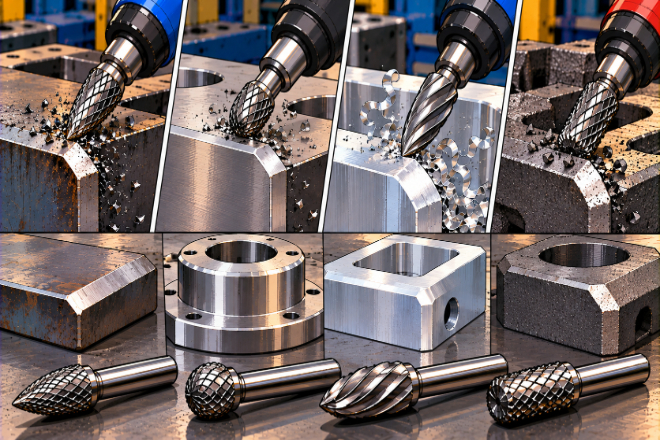
The same carbide burr does not behave exactly the same way on every material.
Carbon steel, stainless steel, cast iron, and aluminum create different chips and cutting forces.
For repeated work, choose a burr cut designed for the material whenever possible.
Aluminum is a good example. Soft aluminum chips can stick to closely spaced cutting teeth. An open cutting geometry can provide more chip space and help reduce loading.
Stainless steel has different cutting behavior and may benefit from a geometry designed specifically for stainless applications.
Speed also matters. There is no single RPM that is correct for every chamfering burr.
The recommended rotational speed changes with:
Burr diameter
Vật liệu
Cut geometry
Tool design
Ứng dụng
Follow the manufacturer’s recommended range for the specific burr. Pressure should stay controlled as well.
A carbide burr should cut the edge. It should not be forced into it.
Excessive pressure can make the tool harder to guide and may increase vibration or create an uneven surface.
Tool direction can also influence the result.
For some dedicated edge-working burrs, counter-rotational movement can be used for faster material removal, followed by movement in the direction of rotation to improve the final surface.
The exact method should follow the tool manufacturer’s instructions.
This is particularly important when “precision chamfering” is part of a repeatable production process rather than occasional manual deburring.
6. When Is a Carbide Burr Better Than Other Chamfering Tools?
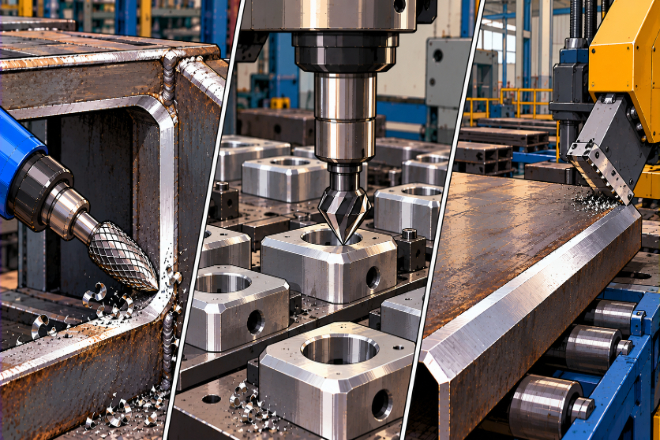
Tungsten carbide burrs are not automatically the best chamfering tool for every part. Their strength is flexibility.
Suppose a factory needs to create the same chamfer around thousands of identical parts on a CNC machine.
A dedicated chamfer mill may be the better solution. Suppose a steel fabrication shop needs to prepare many meters of straight plate edge for welding.
A dedicated plate beveling machine may provide higher production speed and stronger control.
But now imagine a large welded frame with several small edges that need local chamfering.
Or a repair component that cannot easily be moved to a milling machine. Or a complex casting with an edge hidden inside an awkward area. That is where carbide burrs become interesting.
They work well when the job needs:
Local material removal
Portable equipment
Flexible access
Different component shapes
Short production runs
Repair work
Edge correction after fabrication
The choice should therefore depend on the process.
A simple comparison is: High-volume identical precision features → dedicated machining may be better.
Local, flexible, hard-to-reach chamfers → carbide burrs can be very effective.
Good manufacturing decisions are not about making one tool win every argument. They are about giving each tool the job it does well.
7. How Can Manufacturers Control Chamfering Cost and Quality?
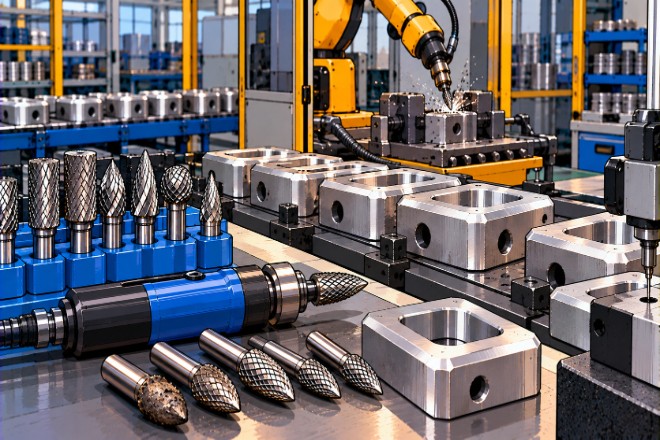
For decision-makers, chamfering should not be treated as a tiny operation that does not deserve attention.
Small edge operations can quietly consume a lot of labor. If operators repeatedly change tools, rework uneven chamfers, or spend too much time checking each edge, the cost adds up.
Start by separating chamfering jobs into groups.
Which edges only need simple breaking?
Which need a defined angle?
Which need a controlled chamfer width?
Which need a radius instead?
Which are part of weld preparation?
Then match the tool to each group. A company may find that general carbide burrs are enough for flexible repair work, while defined edge burrs make sense for repeated 30° or 45° chamfering.
Next, standardize the operating method.
Record the approved:
Burr type
Burr size
Vật liệu
Tool drive
Speed range
Direction of movement
Inspection method
Replacement condition
Tool life should also be monitored. A worn burr may still remove material, but it may require more pressure and produce less consistent results.
Purchasing teams can compare carbide burrs using practical production measures such as:
Time per chamfer
Parts completed per burr
Chamfer consistency
Rework rate
Secondary finishing
Operator control
Tool-change frequency
Cost per acceptable part
This is more useful than asking only which burr has the lowest purchase price. Precision chamfering is a small feature with a very simple business rule:
If every edge needs to be corrected twice, the first operation was not cheap. The right tungsten carbide burr for precision chamfering should make the process easier to control the first time.
 English
  Español
  简体中文
简体中文  Français
  日本語
日本語  한국어
한국어  العربية
  Tiếng Việt