
1. Why Are High-Strength Aerospace Materials So Difficult to Trim?
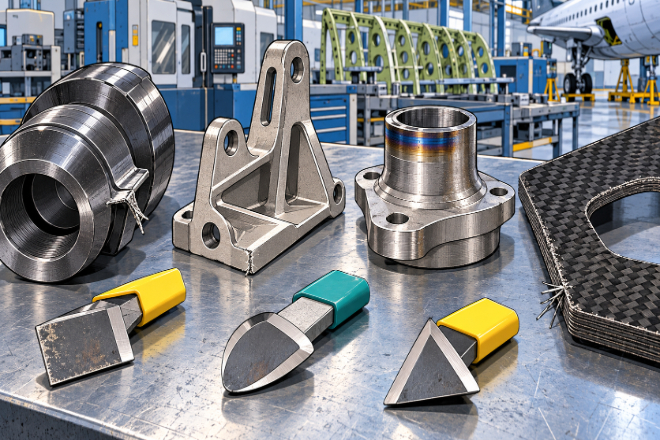
Hàng không vũ trụ components are designed to handle heavy loads, heat, vibration, and long service periods.
Materials such as titanium alloys, hardened steel, and nickel-based alloys help meet these demands, but their strength can create headaches during machining.
Each material brings a different challenge.
Hardened steel can place heavy loads on the cutting edge. If the tool is not suitable for the material’s hardness, its edge may wear or chip before the job is complete.
Titanium alloys are strong for their weight, but heat can build up near the cutting edge because it does not move away from the cutting zone easily. Poor cutting conditions may shorten tool life or damage the finished surface.
Nickel-based alloys retain strength at high temperatures, making them useful in demanding aerospace applications.
The same property can make machining difficult, as the cutting edge faces high heat and mechanical loads.
Fiber-reinforced composites create a different problem. Their hard fibers can wear tools quickly, while poor trimming may cause fiber pull-out or damage between layers.
These challenges affect more than the tool itself. A worn cutting edge may leave rough surfaces, create inconsistent dimensions, or force operators to repeat the finishing process.
For aerospace manufacturers, that is an expensive chain of events. The goal is to remove unwanted material while keeping the component within its required size and surface limits.
This is where choosing the right carbide trimming tool becomes important. But carbide is not a magic wand. The tool grade, cutting geometry, machine setup, and workpiece support must all suit the job.
2. How Do Carbide Trimming Tools Handle High-Strength Aerospace Materials?
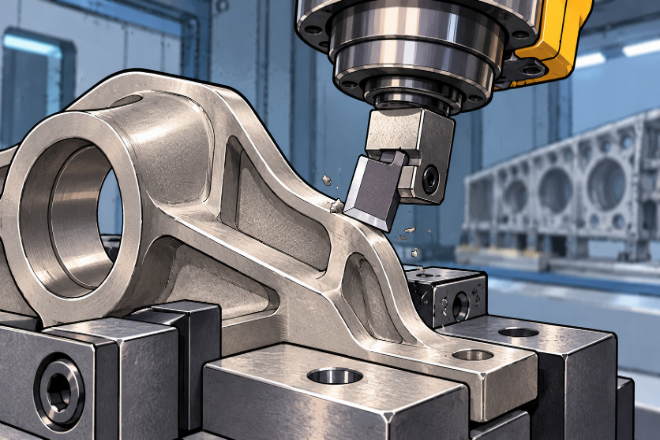
Tungsten carbide is known for its high độ cứng and good khả năng chống mài mòn.
These properties help dụng cụ cắt cacbua keep their cutting edges effective during repeated operations.
When a tool works on a difficult material, its edge must resist wear while remaining strong enough to handle cutting forces. The right carbide grade helps balance these needs.
Resisting Wear During Repeated Cutting
A cutting edge gradually loses material as it rubs and cuts against the workpiece. With abrasive or hard materials, this wear can happen quickly.
Carbide’s hardness helps slow the wear process. A suitable carbide trimming tool can therefore maintain its cutting shape for longer than many conventional steel tools under demanding conditions.
This can be useful when removing small burrs from hardened metal parts or finishing repeated features on aerospace components.
Keeping the Edge Stable
A worn tool does not always stop cutting immediately. Sometimes, it simply begins to produce poorer results.
Edges may become rougher, burrs may remain, and cutting forces may change. These small differences can create problems when parts must meet tight quality requirements.
A carbide tool with suitable wear resistance can help maintain more stable finishing results. However, tool wear still needs to be checked, especially during long production runs.
Handling Heat Without Ignoring It
Carbide can retain useful hardness at elevated temperatures better than many ordinary tool steels. This makes it suitable for a range of demanding cutting operations.
Still, heat remains a serious concern when trimming titanium and nickel-based alloys. Excessive heat can damage the cutting edge, affect a coating, or harm the workpiece.
Correct speed, feed, tool geometry, and chip removal are essential. The aim is not to make the tool work harder. It is to make the cutting process work smarter.
3. How Do Carbide Trimming Tools Reduce Edge Damage?
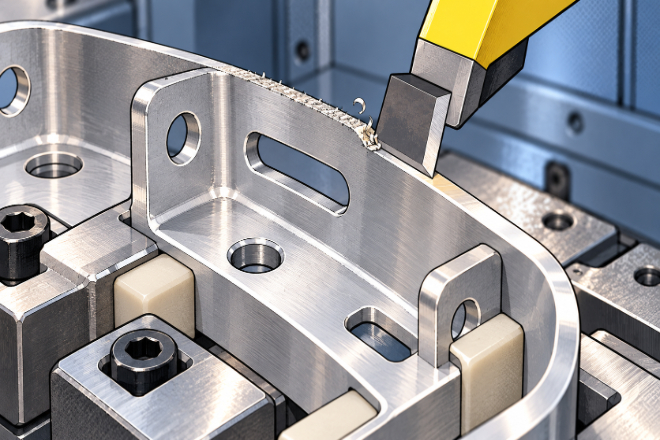
Removing unwanted material is only half the job. The finished component must also keep its intended shape, dimensions, and surface condition.
Hàng không vũ trụ parts can contain narrow slots, small holes, curved edges, and thin sections. One careless trimming pass may damage a nearby feature or remove more material than allowed.
Carbide trimming tools can help reduce this risk when their geometry matches the task.
Controlled Material Removal
A suitable cutting edge removes unwanted material in a controlled way.
This is useful for removing burrs around holes, cleaning narrow edges, and finishing small contours.
For example, a machined aerospace bracket may have a small burr near a mounting hole. The tool needs to remove that burr without changing the hole or damaging the surrounding surface.
Choosing the right tool diameter and cutting profile helps make this possible.
Stable Finishing Results
If the tool, fixture, or machine vibrates during cutting, the finished edge may become uneven. Vibration can also increase the risk of tool damage.
A secure workpiece, stable tool holder, and suitable cutting settings help the tool follow its intended path.
This is particularly important when working with thin components or small features.
Less Rework
When the edge meets the required standard on the first pass, manufacturers spend less time correcting defects.
That does not mean every job can be completed in one pass. Some parts need several finishing steps. The aim is to avoid unnecessary passes caused by poor tool selection or unstable machining.
4. How Do Carbide Trimming Tools Perform on Different Aerospace Materials?
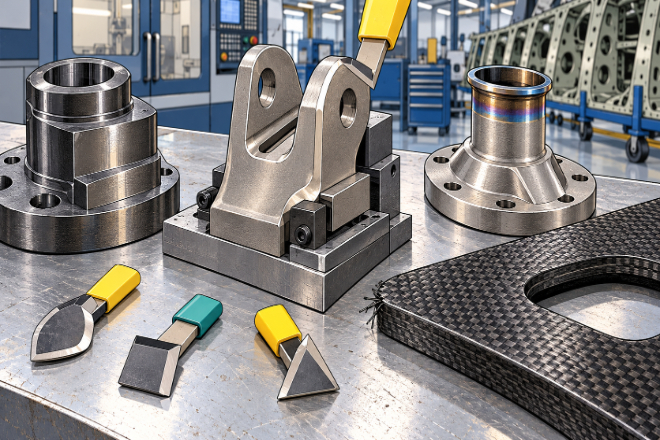
There is no single tool setup that works equally well for every high-strength material. The best choice depends on the material grade, heat treatment, component shape, and finishing task.
Thép tôi cứng
Hardened steel can quickly wear a cutting edge that lacks sufficient hardness.
A suitable carbide grade can help maintain the edge during selected trimming and deburring operations.
However, if cutting forces are high or impact is likely, the tool also needs enough toughness to resist chipping.
Titanium Alloys
Titanium is strong and lightweight, but its machining behavior makes heat control important.
A suitable carbide trimming tool can finish selected edges and small features when used with carefully tested cutting settings.
Short tool overhang, stable workholding, and proper chip removal can help improve performance.
Nickel-Based Alloys
Nickel-based alloys are often used where parts must retain strength at high temperatures.
They can place heavy demands on cutting tools, so tool grade and geometry need careful selection.
For light edge finishing, carbide may be suitable. More demanding operations may require a tool designed specifically for the alloy and cutting load.
Carbon-Fiber Composites
Composite trimming creates a different set of challenges. The cutting edge must remove fibers cleanly without causing excessive fiber pull-out, roughness, or delamination.
Carbide trimming tools can suit some composite finishing tasks, but uncoated carbide may wear quickly during demanding carbon-fiber-reinforced polymer (CFRP) production.
Diamond-coated tools or polycrystalline diamond (PCD) tools may offer better wear life in some high-volume applications.
The lesson is simple: the hardest material does not always need the hardest tool. It needs the right tool for the way it is cut.
5. How Can Manufacturers Choose the Right Carbide Trimming Tools?
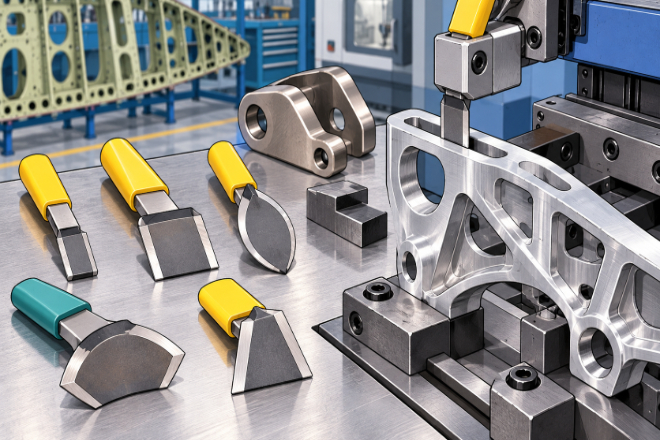
The best carbide trimming tool is not necessarily the most expensive one or the one with the highest độ cứng. It is the one that meets the finishing requirements and performs reliably under real production conditions.
Start with four questions.
1). What material is being trimmed?
Identify the exact alloy, heat-treated condition, or composite type. A tool suitable for hardened steel may not perform equally well on titanium or CFRP.
2). What needs to be removed?
Removing a tiny burr is different from trimming a thick edge or finishing a complex contour. The size and location of the unwanted material help determine the tool profile.
3). How much space is available?
Narrow openings may need small-diameter tools. However, excessive tool reach can increase vibration and breakage risk, so the tool should be only as long as necessary.
4). What quality level is required?
Review the engineering drawing and inspection rules before choosing the tool. The process must remove the defect without changing important dimensions or damaging the surface.
Once these points are clear, test the tool on representative parts. Record tool life, cycle time, edge quality, and the number of parts that pass inspection.
That gives manufacturers a much stronger basis for selection than relying on a product description alone.
6. How Can Carbide Trimming Tools Improve Production Efficiency?
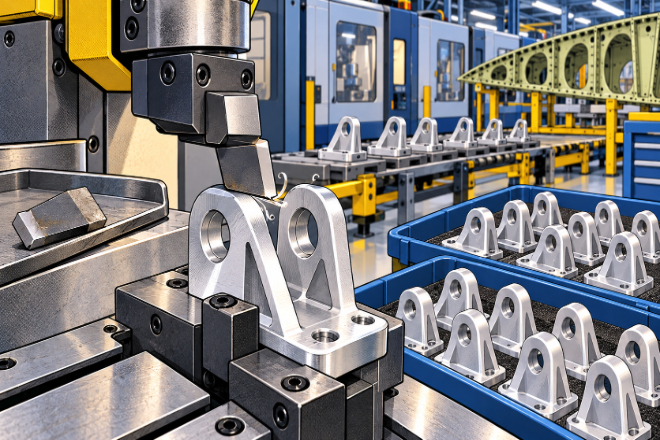
Difficult materials can turn a small finishing operation into a production bottleneck.
If the tool wears quickly or leaves inconsistent edges, the factory may lose time to tool changes, inspection, and rework.
A well-matched carbide trimming tool can help reduce these problems.
Fewer Tool Changes
When the tool retains its cutting edge for longer, operators may spend less time replacing it. The actual benefit depends on the material, carbide grade, cutting conditions, and required finish.
More Consistent Cycle Times
A tested tool and stable machining setup make finishing time easier to predict. This helps production teams plan output and spot changes in performance.
Less Rework
A tool that produces the required edge quality consistently can reduce the number of parts needing another finishing pass. This is especially valuable when the workpiece is expensive or difficult to replace.
Better Cost Control
The full cost of trimming includes the tool, machine time, labor, replacement frequency, and rejected parts.
A tool with a higher initial price may still provide better value if it lasts longer and produces more acceptable components.
The goal is not to make every operation faster at any cost. It is to achieve the required quality with fewer interruptions and less waste.
 English
 Español
 简体中文
 Français
 日本語
 한국어
 العربية
 Tiếng Việt