
1. Why Do Tungsten Carbide Burrs Work Well on Cast Iron?
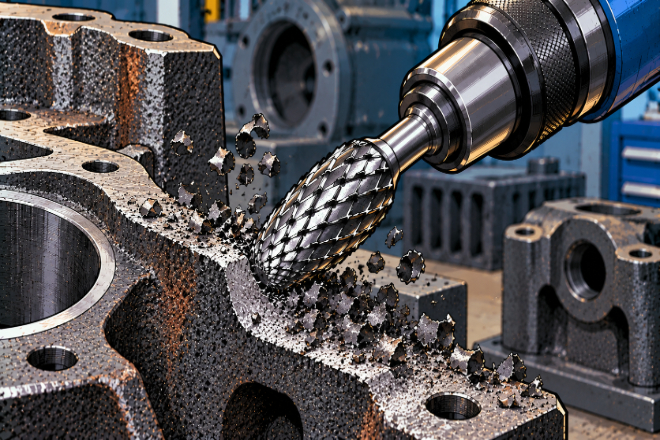
Cast iron can be tough on tools because its surface is often uneven and abrasive.
After casting, parts may have flash, rough edges, gates, riser marks, or small surface defects that need to be removed.
Some areas may also be hard to reach with larger grinding tools.
This is where tungsten carbide burrs become useful.
Tungsten carbide is much harder than common tool steels, so the cutting edges can keep working on hard and abrasive surfaces for a long time when the burr is used correctly.
Another advantage is control.
A grinding wheel can remove a lot of material, but it may be too large for corners, small cast features, or detailed repair areas.
A carbide burr can reach smaller spaces and remove material only where it is needed.
That makes it useful for jobs such as:
removing casting flash
cleaning parting lines
smoothing rough cast surfaces
shaping internal areas
correcting holes and edges
removing excess metal around gates and risers
Cast iron also tends to break into shorter chips rather than long, sticky chips.
That is helpful. The burr teeth are less likely to become packed with material in the same way they can when cutting soft aluminum.
So in many cast iron jobs, the burr can keep cutting cleanly with less loading. That does not mean any carbide burr will work equally well. The right flute pattern still matters.
2. Should You Use Single Cut or Double Cut on Cast Iron?
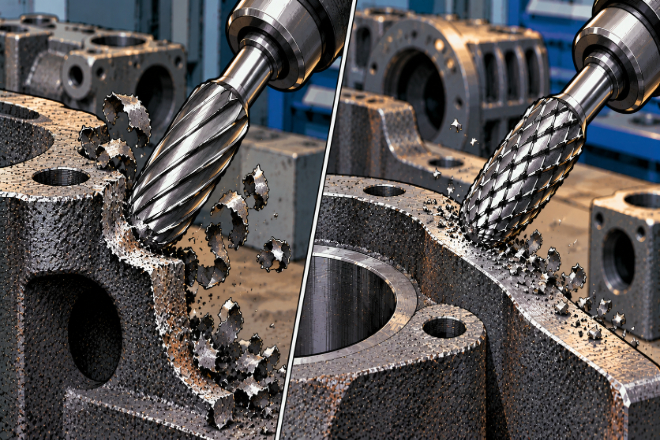
Both can work, but they do different jobs. A single cut carbide burr is often a strong choice when fast stock removal is the main goal.
Its teeth cut in one main direction and usually take a more direct bite into the material.
On rough cast iron surfaces, that can be useful for removing flash, reducing raised metal, and rough shaping.
A double cut carbide burr creates smaller chips and usually gives a more controlled cutting feel.
That makes it useful when the operator needs to blend a surface, clean a detailed edge, or work closer to the final shape of the part.
A simple way to decide is to ask what stage of the job you are working on.
3. Which Burr Shapes Are Best for Cast Iron Parts?
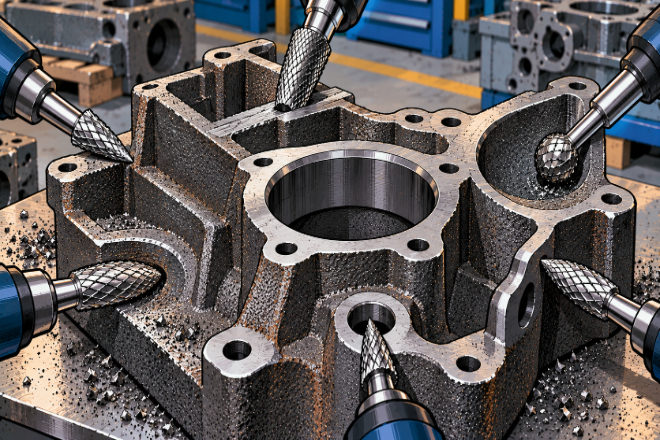
Cast iron parts come in many shapes, so burr shape matters just as much as cut style. A cylindrical burr is useful for flat areas, straight edges, and broad internal walls.
A ball burr works better in rounded cavities and curved internal areas. Tree-shaped burrs are useful around changing angles, cast corners, and welded or repaired sections.
Flame burrs can follow curved contours and reach into tighter spaces. Cone and pointed burrs are better for grooves, holes, small internal corners, and narrow details.
This matters because castings are rarely perfectly simple. A pump housing, valve body, machine base, or automotive casting may have flat surfaces, ribs, holes, corners, and curved areas on the same part.
Trying to process all of that with one burr shape is possible. It is also a good way to make the job slower than it needs to be.
A burr that matches the surface makes better contact. Better contact means the operator can remove material without twisting the tool into strange angles.
That usually gives better control and less vibration. For production teams, it also makes training easier.
Instead of telling operators to “make this burr work,” the process can define which shape should be used for which feature. That saves a surprising amount of trial and error.
4. What Cast Iron Jobs Benefit Most From Carbide Burrs?
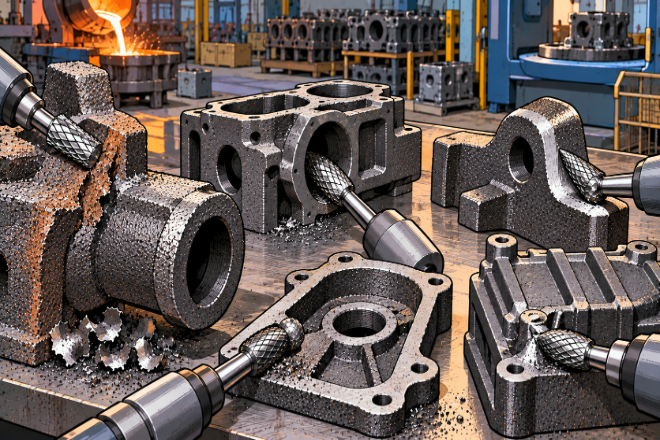
Carbide burrs are especially useful in jobs where the area is too small, uneven, or detailed for larger grinding tools.
One common example is casting flash removal. Thin unwanted metal can form around mold parting lines. A carbide burr can remove this quickly while following the part shape.
Another common job is gate and riser cleanup. After the larger sections are removed, smaller raised areas may still remain.
A burr can bring these areas closer to the final surface without removing too much surrounding material.
They are also useful for repair work.
A cast iron component may need a local correction after machining, welding, or inspection. Instead of setting up a larger machine, an operator can use a carbide burr to remove a small amount of material in the problem area.
Internal areas are another strong application. Pump housings, valve bodies, exhaust parts, and machine castings often contain corners and curved passages that are difficult to reach with wheels or discs.
A small ball, tree, or flame burr can reach these areas much more easily. This is where carbide burrs earn their place. They are not always the fastest tool for removing huge amounts of metal.
But for local, controlled work on a complicated casting, they are very hard to beat.
5. How Should You Run a Carbide Burr on Cast Iron?
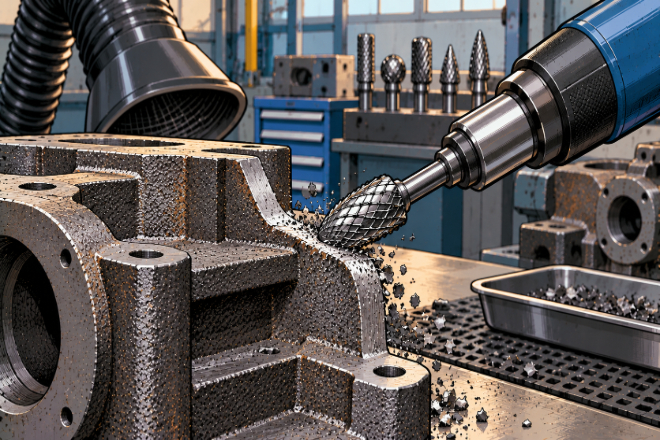
Cast iron may be easier to chip than some steels, but good operating habits still matter. Start with the correct speed range for the burr size and tool supplier’s guidance.
A small burr can normally operate differently from a large one. Do not assume one machine setting is correct for every diameter. Use controlled pressure.
The burr should cut into the cast iron with its teeth. If the operator has to lean heavily into the tool, something may be wrong.
The burr could be worn. The speed may be unsuitable. The shape may not fit the surface. Or too much of the cutting head may be in contact at once.
Keep the burr moving instead of holding it in one place. This helps avoid deep grooves and keeps the surface more even. It is also important to control vibration.
Cast iron is hard and rigid, so chatter can become obvious quickly if the rotary tool has worn bearings, a poor collet, or too much burr shank exposed.
Use stable support and keep overhang sensible. Dust also deserves attention.
Cast iron machining can create fine particles as well as chips. Production areas should use suitable extraction and personal protection according to their own safety procedures.
Cutting faster is useful. Breathing the workshop is less impressive.
6. What Problems Should You Watch for During Cast Iron Cutting?
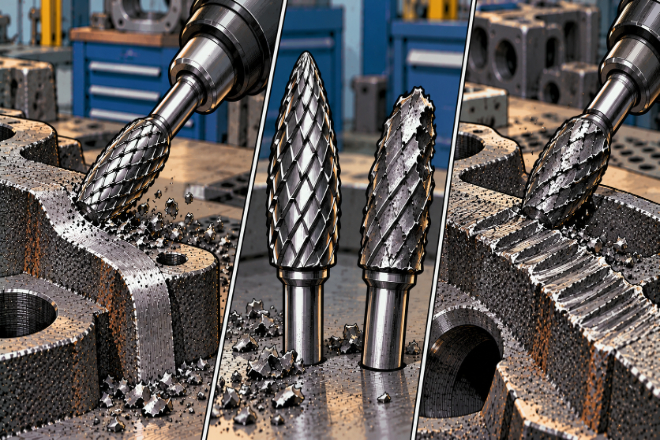
A carbide burr that works well should produce a steady cutting action. If the process suddenly changes, do not ignore it.
One common problem is chatter. This may happen because the burr is badly supported, the tool is worn, the contact area is too large, or the operator is using the wrong angle.
Another problem is early edge wear. Cast iron can be abrasive, especially when the surface contains hard areas or casting skin.
A low-quality burr may lose sharpness faster than expected.
Once the edges become dull, the operator often compensates with more pressure.
Then heat and vibration increase. That is the point where the process starts going downhill.
Chipped carbide teeth are another warning sign. Tungsten carbide is hard, but it can still chip under impact or strong side loading.
Operators should avoid hitting the workpiece suddenly or using the burr like a lever.
Surface condition also matters. If the burr leaves deep grooves or uneven marks, the issue may not be the cast iron itself.
The burr shape, cut style, pressure, or movement may simply be wrong.
The smart response is not always “buy a stronger burr.” Sometimes the setup needs fixing.
7. How Should Buyers Choose Carbide Burrs for Cast Iron?
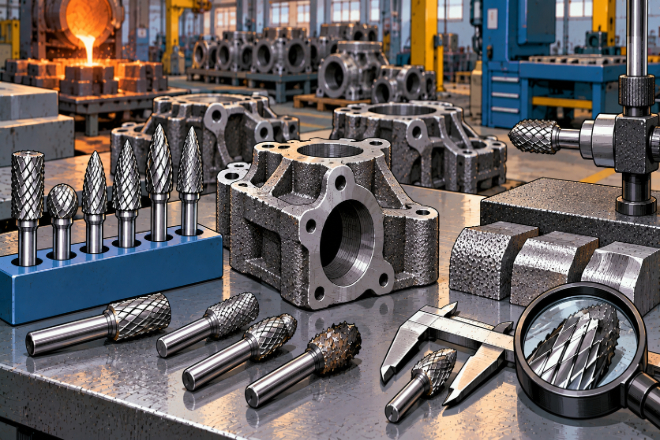
For purchasing teams, cast iron is a good material for separating average burrs from reliable ones.
A good burr should stay sharp, run smoothly, and give similar performance from tool to tool.
Look closely at the cutting teeth. The flute grinding should be clean and even. The burr should also run with low vibration when installed correctly.
Check the head-to-shank connection and general balance. These details matter because rotary tools operate at high speed.
Small manufacturing errors can become very noticeable once the burr starts spinning.
Then test the burr on the cast iron parts you actually make. This is important.
A supplier may show excellent results on a simple test block, but your production parts may have harder skin, rougher surfaces, tighter access, or more complex geometry.
Measure real results such as:
material removal time
tool life
surface quality
operator control
vibration
frequency of tool changes
consistency between burrs
Price should be part of the comparison, but not the whole comparison.
A cheap burr that takes longer on every casting can become very expensive when production volume increases.
A more reliable burr may cost more per tool but reduce cycle time and replacement frequency.
That is why the best carbide burr for cast iron is not always the lowest-cost one. It is the one that gives the most stable result per part.
 English
  Español
  简体中文
简体中文  Français
  日本語
日本語  한국어
한국어  العربية
  Tiếng Việt