
1. Why Is Edge Rounding Important in Metal Manufacturing?
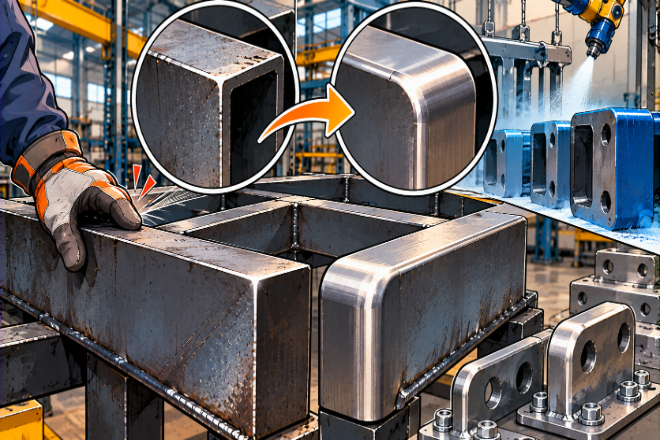
Edge rounding is more than making a metal part look nicer.
A freshly cut or machined component often has sharp corners left by cutting, milling, sawing, drilling, or welding. These edges can create several practical problems.
First, there is a safety issue. A sharp edge can cut gloves, hands, cables, seals, and other nearby parts.
Second, sharp edges can cause assembly problems. A part may need to slide into another component, accept a seal, or sit against another surface. A small sharp corner or burr can make that process harder.
Third, edge shape can affect surface protection. On a sharp metal edge, a protective coating can be thinner than it is on a flat surface.
This can leave the edge more exposed to damage and corrosion. Rounded edges allow a more even coating layer.
That is especially important for steel structures, heavy equipment, shipbuilding parts, welded frames, and other products that may face moisture or outdoor conditions.
So, when a production team talks about tungsten carbide burrs for edge rounding, the goal is not simply “remove the sharp bit.”
The real goal is to create an edge that is safe, useful, consistent, and suitable for the next production step.
2. How Do Tungsten Carbide Burrs Round Metal Edges?
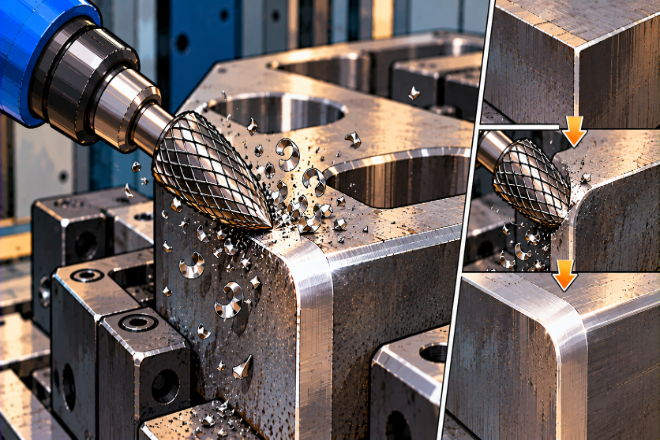
A tungsten carbide burr works by cutting the metal with many small cutting teeth.
When the burr moves along an edge, these teeth remove small chips from the material. With the correct tool shape and movement, the sharp corner gradually becomes a rounded edge.
The basic process is simple: Inspect → Select the burr → Set up the part → Remove material → Check the radius → Finish the edge
The difficult part is controlling the result.
For a simple hand-finishing job, an operator may guide a suitable burr along the edge and make several light passes.
For repeated production work, however, a defined-radius burr or guided system can make the process much more repeatable.
There is an important difference between breaking an edge and rounding an edge.
Breaking an edge only removes the sharp corner. Rounding creates a curved transition with a measurable radius.
For example, a general-purpose burr may be useful when the exact radius is not critical. A dedicated concave radius burr is more suitable when a defined outer radius is required.
Current carbide-burr guidance includes dedicated tools for producing defined radii, including 3 mm outer radii.
This distinction matters for purchasing decisions. If the drawing or coating specification requires a certain radius, a normal deburring burr may not provide enough control.
3. Which Tungsten Carbide Burr Shape Is Best for Edge Rounding?
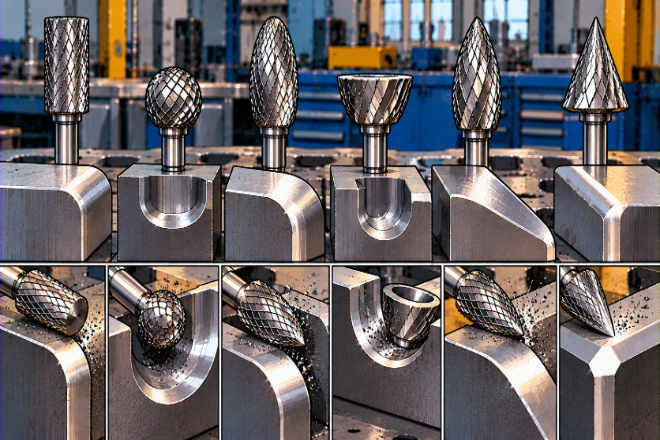
There is no single burr shape that works best for every edge.
The right choice depends on the edge location, the required radius, and how much material needs to be removed.
4. How Do You Control the Quality of the Rounded Edge?
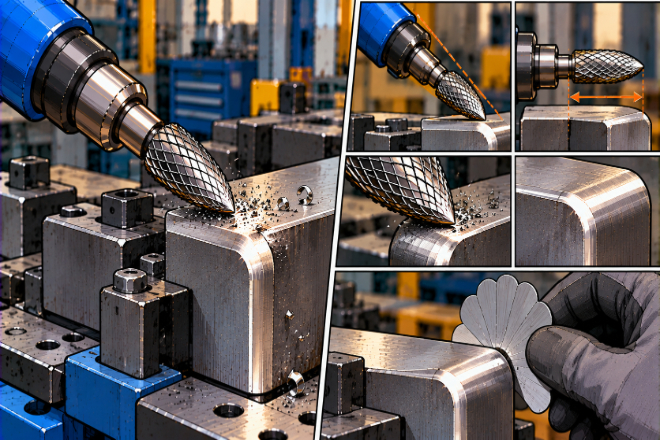
Good edge rounding is mostly about control.
The first step is to secure the workpiece. If the part moves during cutting, the burr can jump across the edge and create an uneven radius.
Next, choose a burr diameter that fits the work area. A very large burr may not reach a narrow corner properly, while a very small burr may require more passes and take longer.
Speed is also important. The correct rotational speed depends on factors such as burr diameter, material, tool design, and application.
Manufacturer guidance for specific edge-rounding burrs gives different speed ranges for different materials, which shows why one fixed RPM should not be used for every job.
Pressure matters just as much.
Many operators make the mistake of pushing harder because they want faster material removal. But excessive pressure can make the tool harder to control and may increase vibration and wear.
A better approach is to let the cutting teeth do the work.
For repeated production, it is useful to standardize:
Burr shape
Burr diameter
Material-specific cut
Machine speed
Tool angle
Feed or hand movement
Number of passes
Edge inspection method
Once these factors are controlled, edge rounding becomes a process rather than an operator’s personal technique.
That is a big difference when dozens, hundreds, or thousands of parts must receive the same edge treatment.
5. How Can Edge Rounding Improve Coating and Part Performance?
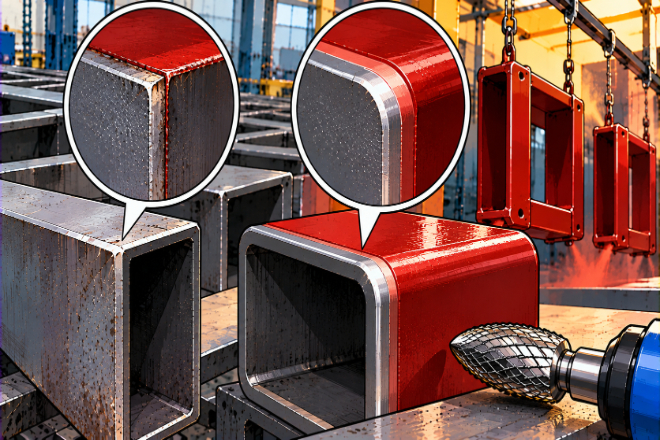
One of the most valuable reasons for edge rounding is surface protection.
Imagine coating a steel component with a sharp 90-degree corner. The coating has to cover a sudden change in direction.
The layer around that corner can be thinner and more vulnerable than the layer on the surrounding flat surface.
A rounded edge creates a smoother transition.
This does not mean that a carbide burr replaces cleaning, blasting, or the complete coating-preparation process.
Instead, it handles a specific problem that large-area preparation may not solve well: the shape of the edge itself.
Defined edge rounding is used as part of preparation for anti-corrosion coating on steel structures and similar applications.
Industry guidance also distinguishes between flexible edge work and defined edge work, depending on whether the required edge shape is controlled or more general.
This makes carbide burrs useful before:
Paint coating
Powder coating
Anti-corrosion coating
Metallic coating
Repair coating
Edge rounding can also help in applications where a sharp edge may damage another component.
For example, a rounded edge may reduce the chance of cutting a seal during assembly or damaging a cable routed around a metal frame.
In other words, the burr may only remove a small amount of metal, but that small change can solve a much larger production problem.
6. How Can Companies Make Edge Rounding More Consistent?
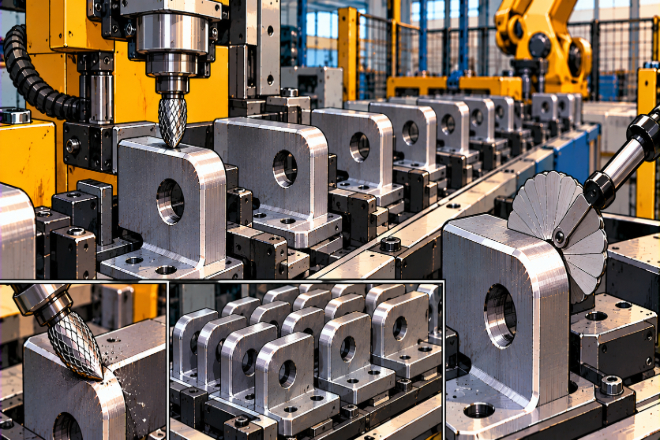
This is where edge rounding becomes a management issue rather than just a tool issue.
If one operator creates a small radius and another creates a much larger one, the final parts may not behave in the same way.
This becomes even more important when the rounded edge is connected to coating quality, assembly fit, or a customer specification.
For companies producing large quantities, the process should therefore be defined before the tool is purchased.
Start by asking four questions:
What radius is required?
If the drawing or process specification requires a defined radius, select a tool designed for that radius rather than relying on visual judgment.
What material is being processed?
Steel, stainless steel, aluminum, cast iron, and other materials do not cut in exactly the same way. Application-specific carbide burr cuts are available for different materials and tasks.
How will the burr be guided?
For occasional repair work, hand guidance may be enough.
For repeated work, a guide sleeve, machine tool, robot, or other controlled setup can improve repeatability.
Defined edge systems are specifically designed to improve guidance during edge work.
How will the result be checked?
A visual check may be enough for basic deburring, but a defined radius should be checked with an appropriate gauge or measurement method.
A useful production metric is not simply “How many burrs did we use?”
Instead, track: parts completed + acceptable edge quality + working time + tool consumption + rework
That gives purchasing and production managers a much clearer picture of the real cost.
7. When Should You Not Use a Tungsten Carbide Burr for Edge Rounding?
Tungsten carbide burrs are flexible tools, but they are not the answer to every edge-rounding job.
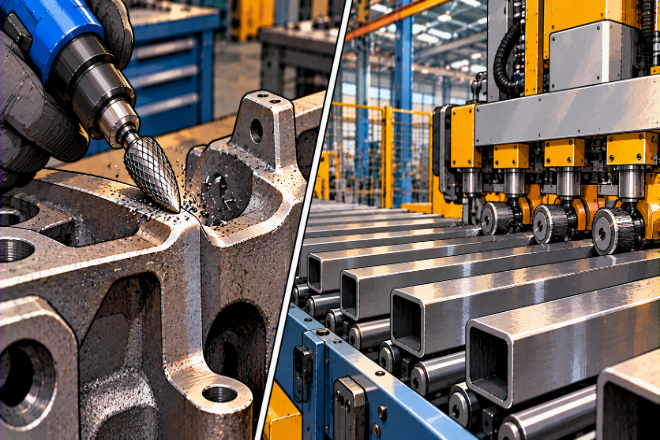
For a small number of parts, repair work, complex contours, or hard-to-reach edges, a carbide burr can be extremely practical.
But if a factory needs to round thousands of identical long edges every day, manual burr work may not be the best production method.
A dedicated edge-rounding machine, CNC process, automated finishing cell, or other controlled process may provide better cycle time and repeatability.
The same applies when the radius is extremely tight or when dimensional accuracy is critical.
A burr can create a controlled edge, but the required accuracy should always determine the process.
There is also a difference between edge rounding and surface finishing. If the goal is to create a highly polished surface, a carbide burr may be only the first step. A finer finishing process may still be required afterward.
The smart approach is not to ask whether carbide burrs are good or bad.
Ask whether they are the right tool for this particular edge, material, production volume, and quality requirement.
That question usually leads to a much better purchasing decision.
 English
  Español
  简体中文
简体中文  Français
  日本語
日本語  한국어
한국어  العربية
  Tiếng Việt