
1. Why Are Concave Surfaces Difficult to Finish?
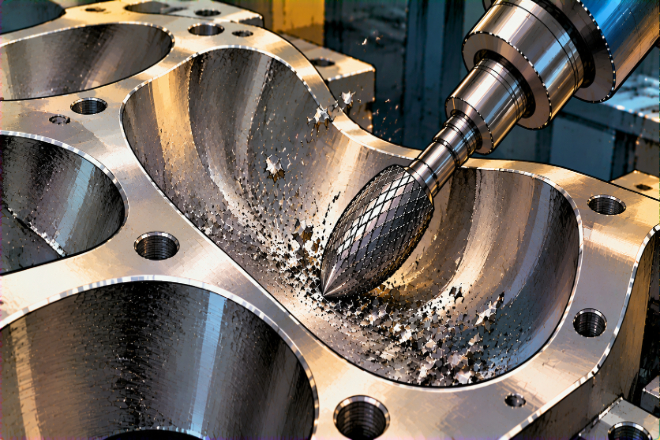
Concave surfaces have inward curves that create special finishing challenges.
Unlike flat areas, where a tool can move in a straight line, concave areas require the cutting tool to follow a changing surface angle. This makes tool control more difficult.
One major challenge is tool contact.
When the burr touches a concave surface, only part of the cutting area may contact the material. If the contact is not stable, the tool may create uneven marks or remove too much material from certain areas.
Another issue is access.
Deep concave areas may have limited space. A large burr may not reach the bottom of the curve, while a very small burr may require more time to finish the surface.
Surface consistency is also important.
Many concave surfaces are designed for specific functions. They may control airflow, fluid movement, stress distribution, or part fitting. Changing the original curve too much can affect performance.
Heat and vibration create additional problems.
Because the tool often works at an angle, cutting forces can change during movement. Poor control may cause vibration, rough finishes, or faster tool wear.
Common problems when finishing concave surfaces include:
Uneven material removal
Tool marks
Difficult access
Excessive vibration
Changing the original curve shape
For manufacturers, the goal is not simply to remove material. The goal is to create a smooth and accurate surface while keeping the intended geometry.
Tungsten carbide burrs are useful because they offer strong cutting ability and are available in many shapes for different curved surfaces.
2. Which Tungsten Carbide Burr Shapes Work Best on Concave Surfaces?
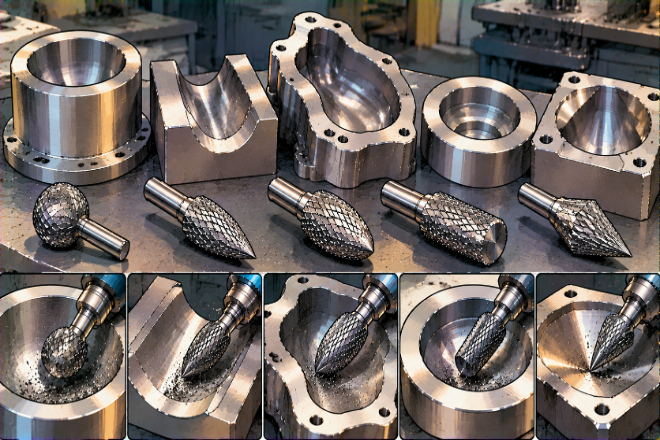
The burr shape has a direct effect on how well the tool can follow an inward curve. Different concave surfaces require different solutions.
1). Ball Burrs
Ball burrs are one of the most common choices for concave finishing.
The rounded head allows the tool to move smoothly along curved areas. It creates even contact and reduces the chance of creating sharp marks.
They are useful for:
Internal curved surfaces
Radius finishing
Smooth blending
Removing small defects
Ball burrs work especially well when the surface requires a consistent curve.
2). Flame Burrs
Flame burrs are useful for deeper or more complex concave shapes. The tapered design allows better access into narrow curved areas.
They are commonly used for:
Mold cavities
Complex profiles
Curved transitions
The operator can control the cutting position by adjusting where the tapered section contacts the surface.
3). Oval Burrs
Oval burrs provide a wider curved cutting area.
They are suitable for larger concave surfaces where more material needs to be removed while maintaining smooth movement.
They can improve efficiency compared with very small burrs.
4). Radius-End Cylindrical Burrs
These burrs combine straight sides with a rounded end. They are useful when a concave area connects with flat walls or other surfaces.
They provide balanced cutting performance for mixed geometries.
5). Cone Burrs
Cone burrs are useful for narrow concave areas and small openings.
They provide good access but require careful control because the tip area can remove material quickly.
The following table shows common options.
3. How Do Tungsten Carbide Burrs Improve Concave Surface Finishing?
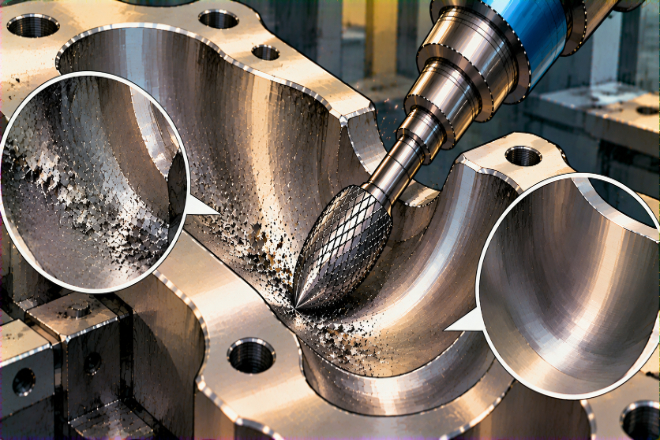
Tungsten carbide burrs improve concave finishing because they combine hardness, cutting ability, and toughness.
The first advantage is controlled material removal.
Concave surfaces often need careful adjustment rather than aggressive cutting. Carbide burrs allow operators to remove small amounts of material while maintaining control.
This is useful for:
Removing machining marks
Smoothing casting defects
Blending curved areas
Correcting surface problems
The second advantage is durability. Concave surfaces can create uneven cutting conditions because the contact angle changes constantly.
A softer tool may wear quickly under these conditions. Tungsten carbide tools maintains its cutting longer, helping improve consistency.
Another advantage is shape variety. Because concave surfaces have different designs, manufacturers need different tools.
Carbide burrs are available in multiple profiles, allowing better matching between tool and surface.
For example:
Ball burrs follow smooth curves
Flame burrs reach deeper areas
Oval burrs cover wider surfaces
This flexibility reduces the need for multiple finishing methods.
4. How Do You Select the Right Burr for Different Concave Surfaces?
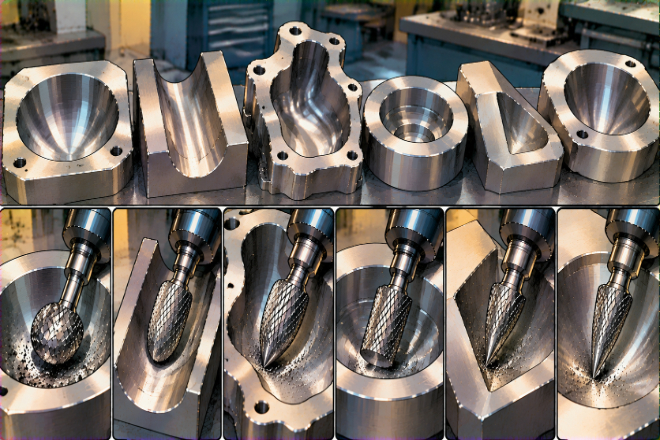
Selecting the correct burr starts with understanding the surface design. The first factor is curve size.
A small concave radius usually requires a smaller burr. A large curved surface can often use a larger burr to improve efficiency.
The second factor is depth. Deep concave areas require tools with enough reach. However, longer burrs can increase vibration risk, so balance is important.
The third factor is finishing requirement. Different applications require different surface results.
Some parts only need excess material removal. Others require a smooth surface because the curve affects performance.
Important selection factors include:
Surface radius
Material type
Required finish
Cutting amount
Tool accessibility
Material also affects the choice. For softer materials, operators may focus on preventing clogging.
For harder metals, wear resistance becomes more important. The burr should match both the surface and the material.
A common mistake is choosing a tool only based on size. A smaller burr is not always better for detailed work, and a larger burr is not always faster.
The best tool is the one that provides stable cutting control.
5. How Can You Avoid Damage When Finishing Concave Surfaces?
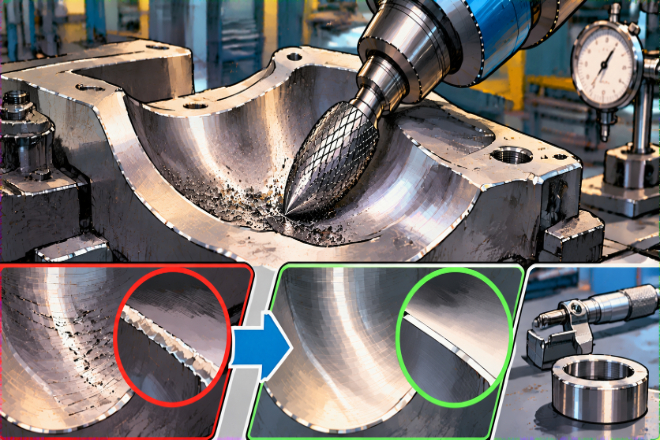
Concave finishing requires careful control because mistakes can change the original curve.
The first step is using the correct pressure. Heavy pressure does not always increase cutting speed.
Instead, it can create:
Excess heat
Vibration
Uneven surfaces
Faster tool wear
The burr should perform the cutting action naturally. Tool speed is another important factor.
Too much speed may create heat and reduce tool life. Too little speed may reduce cutting efficiency.
The correct speed depends on:
Burr diameter
Material hardness
Surface condition
Keeping the tool moving is also important. Stopping in one area can create unwanted marks.
For manual operations, smooth movement helps maintain the curve. For automated systems, the tool path should follow the surface accurately.
The workpiece should also be secured properly. Movement during finishing can create inconsistent results.
Regular inspection helps identify problems early.
Manufacturers should check:
Surface smoothness
Curve accuracy
Burr condition
Material removal amount
A controlled process produces better results than aggressive cutting.
6. When Should Manufacturers Use Tungsten Carbide Burrs for Concave Surfaces?
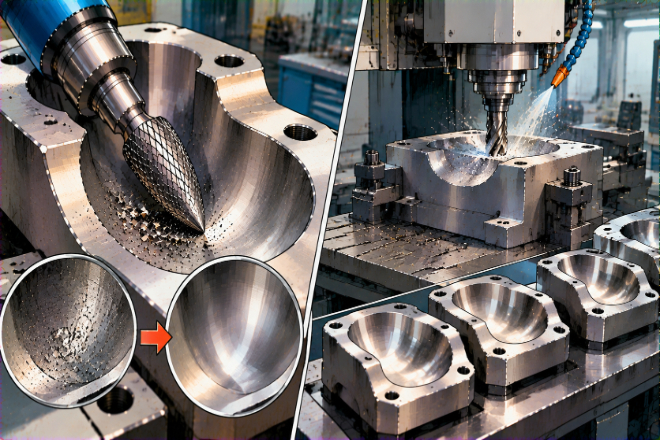
Tungsten carbide burrs are useful for many concave surface finishing tasks.
Common applications include:
Mold cavity finishing
Curved edge blending
Casting repair
Internal surface cleanup
Component repair
Complex profile finishing
They are especially valuable when flexibility is needed.
For example, a component may have a small defect inside a curved area. Re-machining the entire part may waste time and material.
A carbide burr can correct the local problem quickly.
However, for extremely high-volume production with strict dimensional requirements, specialized machining equipment may provide better repeatability.
The decision should consider:
Production volume
Required accuracy
Surface quality
Tool access
Total cost
Carbide burrs provide the most value when manufacturers need controlled finishing in difficult areas.
 English
  Español
  简体中文
简体中文  Français
  日本語
日本語  한국어
한국어  العربية
  Tiếng Việt