
1. Why Is Carbon Fiber Composite Finishing Difficult?
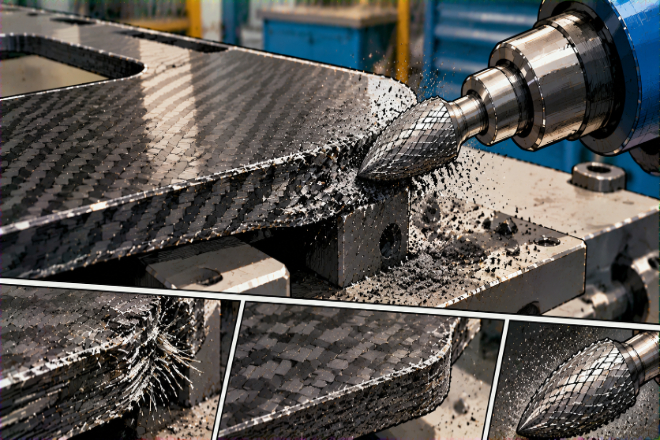
Carbon fiber composites are widely used because they offer a strong combination of light weight and high strength.
Unlike traditional metals, carbon fiber materials are made from multiple layers of carbon fibers combined with a resin matrix.
This structure gives excellent performance, but it also creates challenges during finishing. The first challenge is fiber separation.
When cutting or grinding carbon fiber incorrectly, the surface may develop loose fibers, rough edges, or small cracks between layers. These problems can reduce the quality and appearance of the final component.
Another challenge is uneven material behavior.
Carbon fibers are extremely strong, while the resin around them is softer. During machining, the cutting tool must deal with two different materials at the same time.
If the tool removes resin too aggressively, fibers may become exposed. If the tool cannot cut the fibers effectively, the surface may become rough.
Dust is another important concern.
Carbon fiber machining creates very fine particles. These particles can spread easily and may affect the working environment if proper control methods are not used.
Heat management is also important.
Although carbon fiber composites do not conduct heat like metals, friction from an unsuitable tool can still create heat. Excess heat may soften the resin and affect the surface structure.
Common finishing problems include:
Fiber pull-out
Rough edges
Delamination between layers
Uneven surfaces
Excessive dust
Poor dimensional accuracy
For manufacturers, the goal is not simply removing material. The goal is achieving a clean surface while keeping the original strength and shape of the carbon fiber component.
This is why tungsten carbide burrs are often selected for composite finishing.
Carbide burrs provide sharp cutting edges, high hardness, and good wear resistance. They can remove composite material efficiently while maintaining better control compared with many traditional finishing tools.
2. How Do Tungsten Carbide Burrs Work on Carbon Fiber Composites?
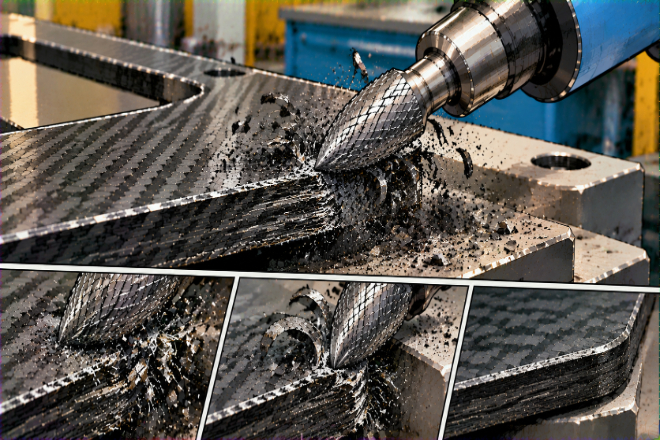
Tungsten carbide burrs remove carbon fiber composite material through a cutting action.
The burr contains multiple sharp teeth that rotate at high speed. These teeth cut through the composite layers and remove small pieces of material.
This is different from simple sanding, which mainly wears the surface. The cutting action of carbide burrs provides several advantages.
1). Controlled Material Removal
Carbon fiber parts often need small adjustments rather than heavy cutting.
For example, manufacturers may need to:
Adjust an opening
Remove extra material after trimming
Smooth a sharp edge
Correct a small surface defect
A carbide burr allows operators to focus on specific areas without affecting the entire component.
2). Better Edge Finishing
Edges are one of the most sensitive areas of carbon fiber composites.
Poor finishing can leave sharp fibers or weak areas. A suitable carbide burr can create smoother edges while reducing fiber damage.
3). Strong Wear Resistance
Carbon fiber contains hard fiber materials that can wear cutting tools over time.
Tungsten carbide provides strong hardness, allowing the burr to maintain its cutting performance longer.
This helps reduce:
Tool replacement frequency
Production interruptions
Finishing costs
4). Flexible Shape Options
Carbon fiber components often have complex shapes. Different burr designs allow manufacturers to handle different finishing tasks.
For example:
Ball burrs for curved surfaces
Cylindrical burrs for straight edges
Flame burrs for detailed areas
Cone burrs for narrow sections
This flexibility makes carbide burrs useful for many composite applications.
3. Which Tungsten Carbide Burr Shapes Are Best for Carbon Fiber?
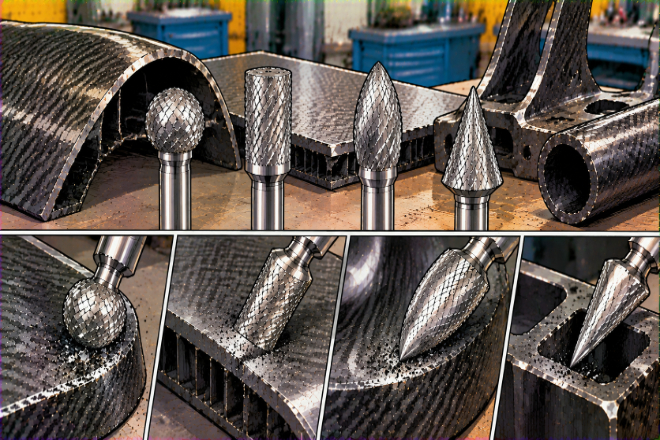
The correct burr shape depends on the carbon fiber component design.
Different shapes provide different advantages.
4. How Can Manufacturers Prevent Damage When Using Carbide Burrs on Carbon Fiber?
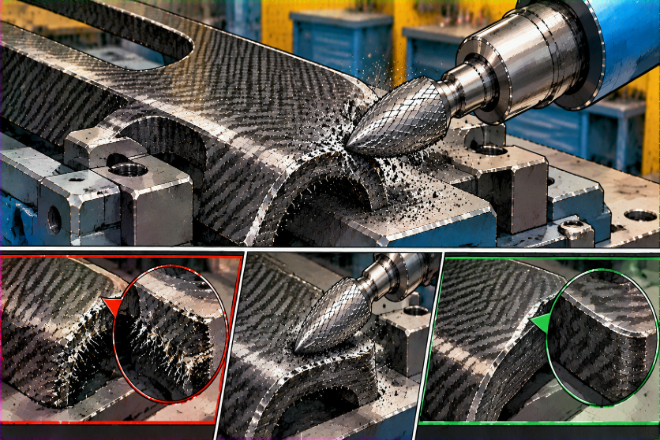
Preventing damage is one of the most important parts of carbon fiber finishing. A suitable tool can still create poor results if the process is not controlled.
The first step is choosing the correct burr. A very aggressive burr may remove material quickly, but it can increase the risk of fiber damage.
A finer burr may provide better surface quality for final finishing. Pressure control is also important. Many finishing problems happen because operators push the tool too hard.
Excess pressure can cause:
Fiber breakage
Resin damage
Heat buildup
Uneven surfaces
The burr should cut naturally instead of being forced into the material. Tool movement also affects the result.
Keeping the burr moving helps prevent concentrated heat and uneven cutting. The workpiece should be fixed securely.
Movement during finishing can create vibration, which may damage the composite layers. Dust control should also be considered.
Carbon fiber dust should be managed properly to maintain a cleaner working environment.
A stable finishing process usually includes: Correct burr selection → Proper speed → Light pressure → Smooth movement → Surface inspection
This approach improves consistency and reduces unnecessary damage.
5. What Cutting Conditions Should Be Used for Carbon Fiber Finishing?
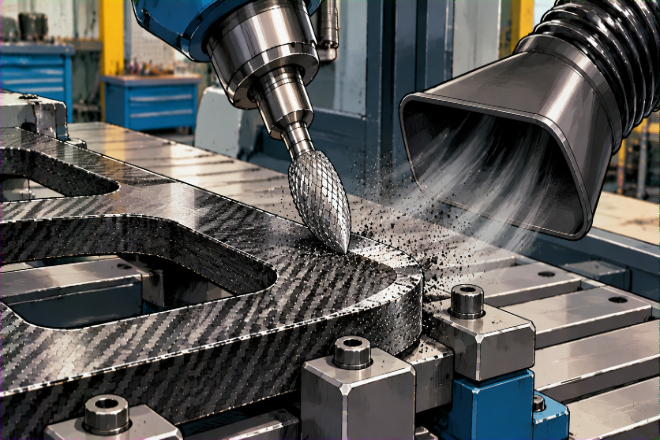
Carbon fiber composites require different cutting methods compared with metals. The first factor is rotation speed.
The correct speed depends on:
Burr diameter
Composite thickness
Fiber direction
Finishing purpose
Very high speed may increase friction and heat. Very low speed may reduce cutting efficiency. Pressure should remain controlled.
Heavy pressure does not always mean faster cutting. It may instead create more surface damage.
The direction of cutting also matters. Carbon fibers have a directional structure. Cutting across different fiber directions can create different results.
Manufacturers should test the best cutting method for each component. Tool condition should also be monitored.
A worn burr may require more force and create lower-quality surfaces. Regular inspection helps maintain stable performance.
Important inspection points include:
Edge quality
Fiber condition
Surface smoothness
Burr wear
For production environments, creating standard finishing procedures can improve repeatability.
6. When Should Manufacturers Use Tungsten Carbide Burrs on Carbon Fiber Composites?
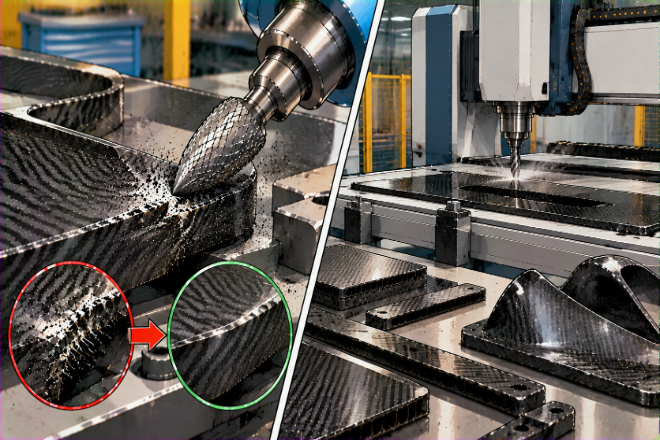
Tungsten carbide burrs are useful for many carbon fiber finishing applications.
Common uses include:
Edge trimming
Hole adjustment
Removing excess composite material
Surface repair
Shape correction
Final edge smoothing
They are especially valuable when manufacturers need flexible finishing methods.
For example, a carbon fiber component may have a small rough edge after cutting. Replacing the entire part may waste time and cost.
A carbide burr can correct the local problem quickly. However, carbide burrs are not always the only solution.
For large production operations with strict automated requirements, specialized machining systems may provide better repeatability.
The correct choice depends on:
Part design
Production volume
Required surface quality
Finishing location
Cost requirements
For repair work, small batches, and complex composite shapes, tungsten carbide burrs provide a practical solution.
 English
  Español
  简体中文
简体中文  Français
  日本語
日本語  한국어
한국어  العربية
  Tiếng Việt