1. Why Does Carbide Burr Shape Matter So Much?
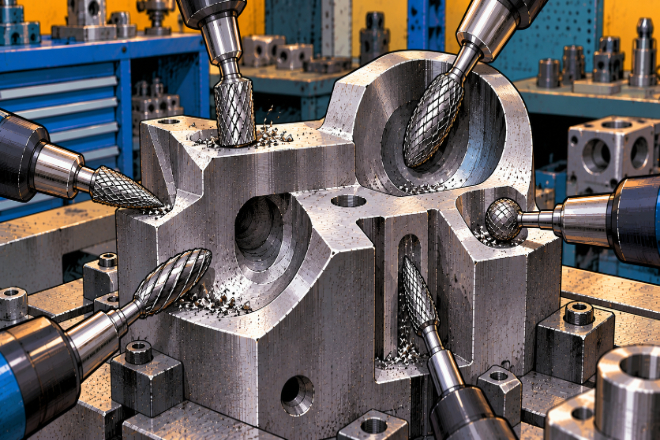
A tungsten carbide burr does not cut only because it spins fast. It also needs the correct part of its cutting head to touch the workpiece.
That sounds obvious, but it is where many tool choices go wrong.
Imagine trying to smooth a deep rounded cavity with a flat-ended cylindrical burr.
It can still remove metal, but the contact is awkward. The operator has to keep changing the angle, and some areas are difficult to reach.
Now switch to a ball-shaped burr.
Suddenly, the rounded head follows the cavity much more naturally.
This is why carbide burr shape selection matters. A well-matched shape gives better contact, easier movement, and more control over where material is removed.
For factories, that can affect more than operator comfort. It can change cycle time, surface quality, tool life, and the amount of finishing needed later.
The goal is not to find one “best” burr shape.
The goal is to find the shape that makes the specific job feel easy.
2. When Should You Use a Cylindrical Carbide Burr?
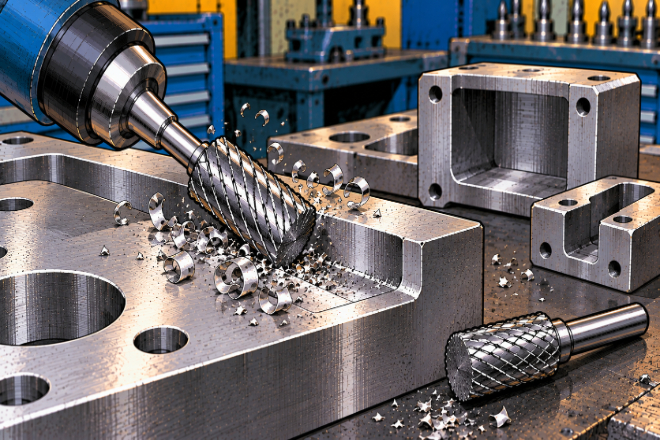
Cylindrical burrs are a strong choice when the workpiece is mostly flat or straight.
Their long, straight sides create a wide cutting area, which makes them useful for flat surfaces, straight edges, internal walls, and general stock removal.
They are often used for:
flattening raised metal
cleaning broad weld areas
shaping straight edges
working inside larger slots
smoothing flat surfaces
A cylindrical burr can cover more area than a small round burr, so it often feels faster on broad surfaces.
There are also cylindrical burrs with different end designs. Some have a flat end that does little or no cutting at the tip, while others have cutting teeth on the end.
That difference matters when the burr needs to enter a surface directly.
Here is the simple rule: If the workpiece gives you a flat area, the cylindrical shape usually deserves a look.
But do not force it into curved work just because it happens to be sitting in the tool tray.
That is where other shapes start winning.
3. When Is a Ball-Shaped Carbide Burr Better?
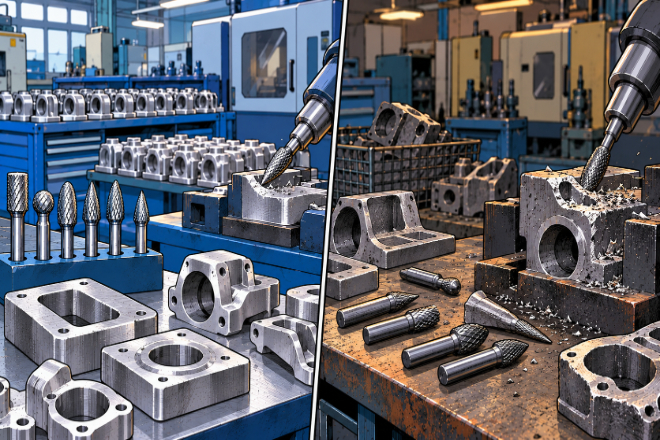
Ball-shaped carbide burrs are made for curves.
Their round cutting head can contact the workpiece from many angles, which makes them useful for concave surfaces, rounded holes, curved profiles, and smooth internal shaping.
This shape is especially useful in mold work, die repair, cast part cleanup, and detailed metal shaping.
Suppose you need to enlarge a rounded opening without creating a sharp corner. A cylindrical burr may leave a shape that is too flat. A ball burr can remove material while keeping the surface rounded.
The same advantage appears inside cavities.
Because the ball has no long straight side, the operator can roll the contact point around the surface as the tool moves.
That gives good freedom of movement. Of course, a ball burr is not ideal for everything.
Try using it on a large flat plate and you will quickly discover its weakness: only a small part of the round head touches the surface at one time.
It works. It just is not the smartest choice.
4. What Is an Oval Carbide Burr Good For?
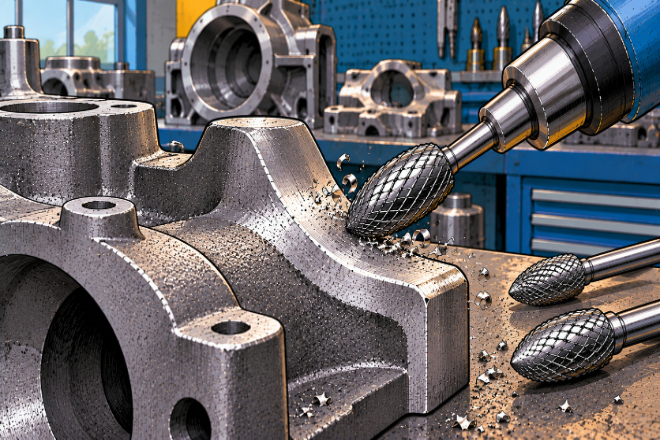
Oval burrs are useful when the surface is curved but not deeply rounded.
Their shape gives more contact area than a ball burr while still allowing smooth movement across curved metal.
That makes them useful for blending, contouring, smoothing rounded edges, and working across cast or forged surfaces.
Think of an oval burr as a bridge between a ball and a cylindrical shape.
It can follow curves, but it also gives the operator a longer cutting surface.
This is handy when the goal is not to dig into one small point but to gently blend one area into another.
For example, after removing excess metal from a cast component, there may be a raised area that needs to flow smoothly into the surrounding surface.
An oval burr can make that transition easier.
For companies working with molds, dies, castings, or complex curved parts, oval burrs can be surprisingly useful—even though they are often less famous than ball or cylindrical shapes.
5. Why Choose a Tree-Shaped Carbide Burr?
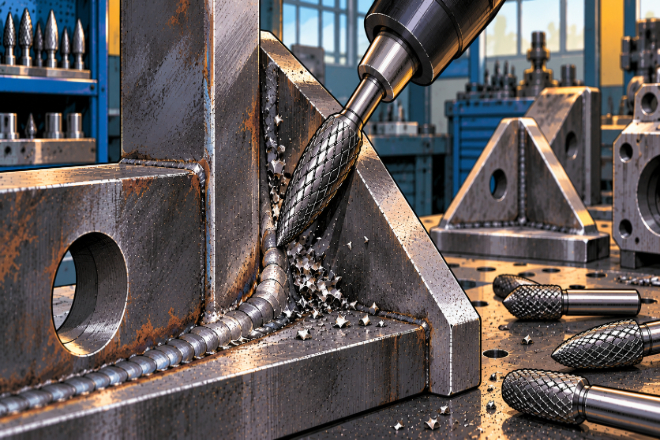
Tree-shaped burrs are easy to recognize because their body becomes narrower toward the end.
That tapered profile makes them useful in areas where the space gets tighter as the burr moves deeper.
They are often used for:
angled surfaces
weld joints
narrow internal areas
curved edges
contour shaping
Some tree burrs have a rounded nose, while others have a more pointed end.
A rounded tree shape works well for smooth contouring. A pointed tree shape can reach tighter corners and smaller angled areas.
Imagine cleaning metal around a welded joint where two surfaces meet.
A cylindrical burr may hit the outer edges before it reaches the deeper part of the joint. A tree burr can follow the angle more naturally.
That better fit can make the job faster and reduce the chance of damaging nearby metal.
This is one reason tree-shaped burrs are common in fabrication and weld work.
6. When Should You Pick a Flame-Shaped Burr?
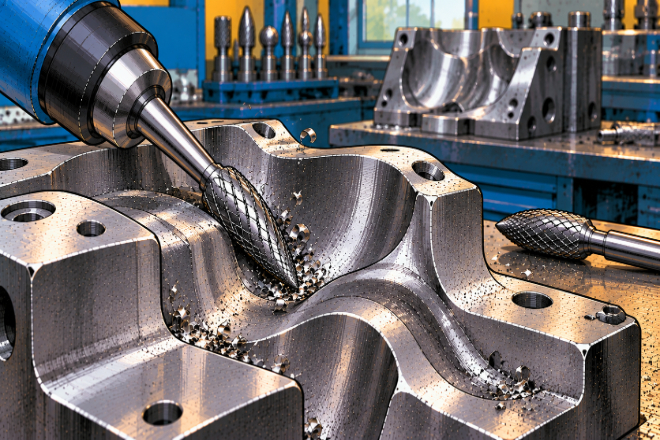
A flame burr has a long, smooth body that narrows toward the tip.
It is useful when you need both contouring and access.
The wider middle section can shape curved surfaces, while the narrow end can reach into tighter areas. This makes the flame shape useful for molds, dies, detailed castings, concave surfaces, and narrow curved grooves.
One big advantage is flexibility.
The operator can change the contact point simply by changing the angle of the tool.
Use the wider section for broader shaping. Move toward the tip for tighter detail work.
That makes the flame burr useful when the workpiece geometry changes across one area.
It is not the first choice for large flat surfaces or very deep straight holes.
But for flowing shapes and complex contours, it can be one of the most useful burrs in the box.
7. What Can Cone-Shaped Burrs Do?
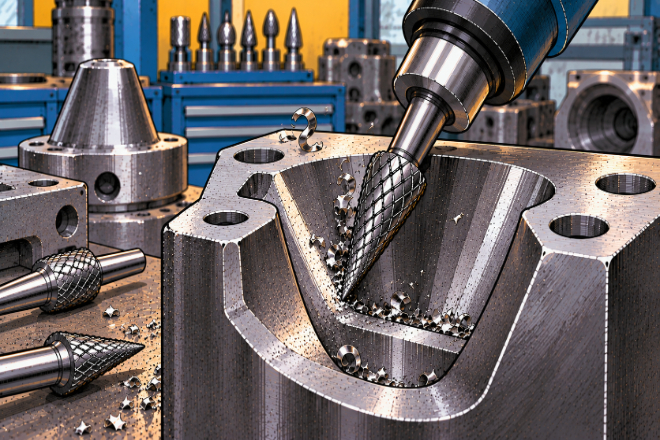
Cone-shaped burrs are useful when the work area narrows.
They can reach into tapered holes, angled spaces, grooves, countersunk areas, and internal corners where a wide burr cannot fit.
Because the head becomes smaller toward the tip, the operator can choose how much cutting area contacts the metal.
The wider part can remove more material. The smaller tip can work more precisely.
That gives cone burrs a useful mix of access and control.
They can also be used when shaping chamfers or tapered surfaces, depending on the specific design.
But there is one thing to watch.
The narrow end concentrates the cutting action into a smaller area. That makes it easy to remove too much material if the operator pushes too hard or stays in one spot too long.
Precision is the advantage here. And precision still needs a steady hand.
8. When Do Pointed Burrs Make Sense?
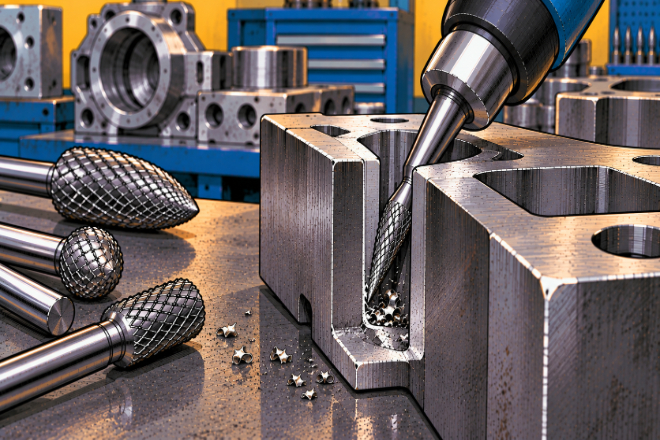
Sometimes the problem is simple: nothing else fits.
Pointed burrs are designed to reach tight corners, narrow grooves, small internal features, and detailed areas.
They can be very useful for fine correction work where a larger head would touch surrounding surfaces.
For example, imagine a narrow metal groove with a small burr left at the bottom.
A ball burr may be too wide. A cylindrical burr may not reach the corner. A pointed burr can enter the area much more easily.
This makes pointed shapes useful in detailed repair work, mold correction, engraving-related metal shaping, and small internal finishing jobs.
But they are not designed for fast removal over large surfaces.
Using a pointed burr to clean a broad weld would be a long day.
This is a good example of why burr selection should always start with the surface shape, not with whichever tool looks most aggressive.
11. Does Burr Size Matter as Much as Shape?
Yes.
Choosing the correct shape but the wrong size can still make the job difficult.
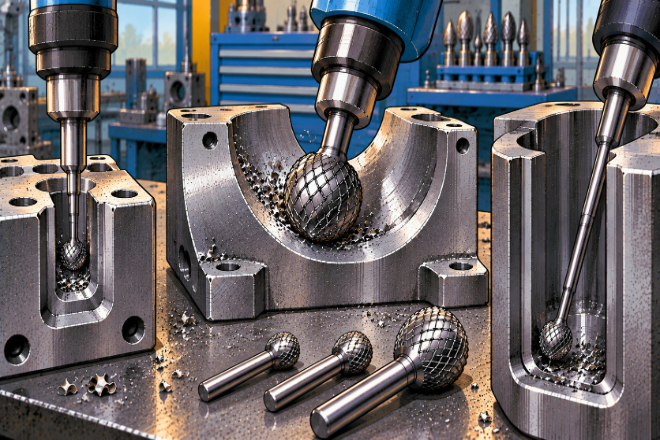
A large ball burr may have the perfect geometry for a curved cavity but still be too big to enter it.
A tiny cylindrical burr may fit the job but take too long to cover a broad surface.
The burr head should be large enough to remove material efficiently but small enough to reach and control the work area.
This balance matters in production.
Larger burrs can be useful for heavier material removal and broad surfaces. Smaller burrs are better for detailed work, small openings, and delicate corrections.
Reach matters too.
If the cutting area is deep inside a component, the shape may be correct but the standard shank may not provide enough access.
In that case, a longer-reach burr may be needed.
Do not solve this by simply pulling a standard burr far out of the collet. Excessive overhang can increase vibration.
Shape, size, and reach should be treated as one decision.
12. Should You Use One Burr Shape for the Whole Job?
Sometimes yes. Often, no.
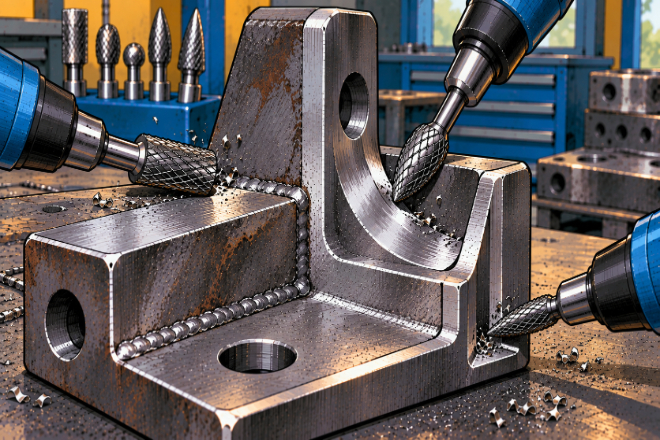
A single metal component can have a flat weld, a curved transition, and a tight corner all within a few centimeters.
Trying to finish all three areas with one burr may save a tool change but increase total cutting time.
A better approach may be to use a cylindrical burr for the flat area, an oval or ball burr for the curve, and a pointed or tree burr for the corner.
That sounds like more tools.
But the goal is not to minimize the number of burrs used.
The goal is to minimize the time needed to produce an acceptable part.
This matters even more when the same operation is repeated hundreds of times.
A tool change that saves two minutes of awkward cutting is probably a good trade.
For production planning, burr combinations can therefore be just as important as individual burr selection.
13. How Should Decision-Makers Choose Burr Shapes for Production?
For purchasing teams, the biggest mistake is choosing burr shapes only from a catalog.
Look at the actual work.
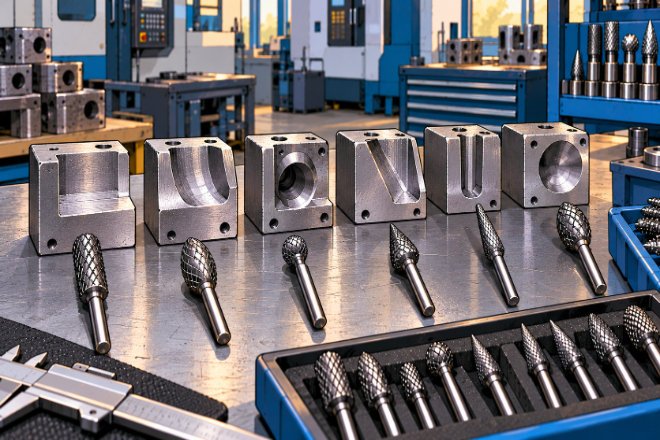
Walk through the production area and identify the surfaces operators work on most often. Are they flat? Curved? Internal? Deep? Narrow? Around weld joints?
Then check which burr shapes are being used.
If operators constantly tilt a burr at strange angles or switch positions just to make contact, the shape may be wrong.
If they spend too long on one small area, another geometry may work better.
A simple production trial can be very useful.
Give operators two or three suitable shapes for the same task and compare cutting time, control, surface finish, and tool life.
The results may be more valuable than any product brochure.
For a company buying carbide burrs in volume, the right question is not: “Which shape should we stock the most?”
It is: “Which shapes remove the most wasted time from our production process?”
That is the decision that can actually affect cost.
 English
  Español
  简体中文
简体中文  Français
  日本語
日本語  한국어
한국어  العربية
  Tiếng Việt