
1. Why Are Carbide Burrs Useful During Power Plant Outages?
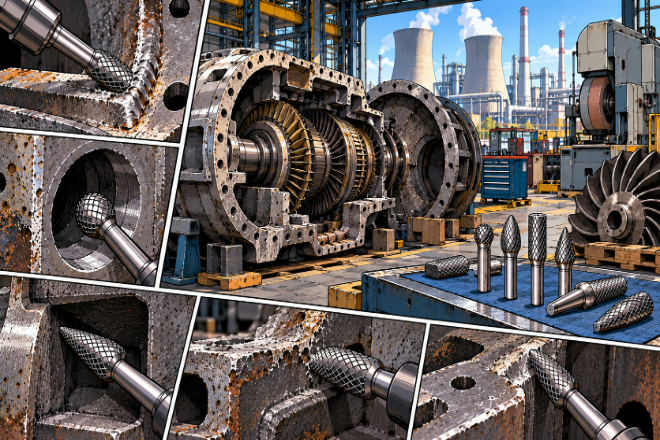
Power plant equipment works under difficult conditions for long periods.
Steam turbines can suffer from rubbing, chemical exposure, solid-particle erosion, water erosion, repeated starts, and changes in operating conditions.
Over time, turbine blades, valves, casings, rotors, and other parts may require inspection or repair.
When equipment is opened during an outage, maintenance teams may find rough welds, damaged edges, local corrosion, erosion marks, cracks that need repair, or small areas that require preparation before another process.
Large machine tools are essential for major dimensional work. Large grinders are useful for broad surfaces. A tungsten carbide burr fills the space between them.
Its small cutting head can remove metal from a very specific area. Different shapes allow technicians to reach curves, holes, grooves, corners, and internal surfaces.
That makes carbide burrs useful for jobs such as local deburring, weld cleanup, surface blending, edge correction, and preparation around repair areas.
Their carbide cutting teeth also offer strong wear resistance when working on steels, stainless steels, cast materials, and other metals commonly found around power generation equipment.
But the biggest advantage during an outage may simply be convenience. Imagine finding a small rough area deep inside a turbine casing.
The repair itself may take ten minutes. Setting up a large machine to reach it could take considerably longer.
Sometimes productivity is not about owning the biggest tool in the building. It is about having the right small one when the clock is running.
2. Where Are Carbide Burrs Used in Turbine Repair?
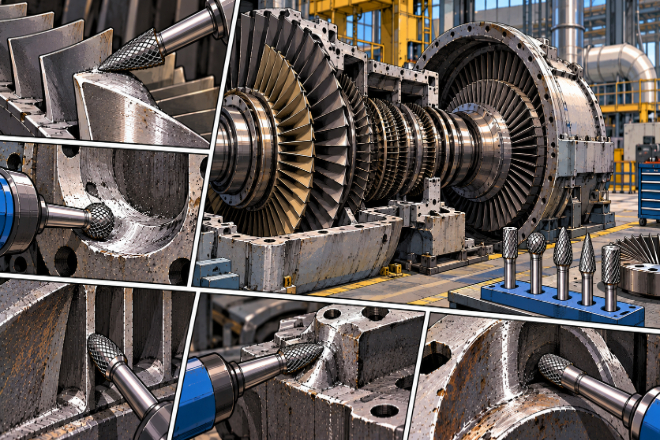
Steam turbines contain complicated metal parts packed closely together.
Rotors, blades, diaphragms, casings, glands, valves, and related components can all require repair during their service life.
Current turbine repair programs include blade dressing, weld repair, rotor work, casing correction, erosion and corrosion repair, and seal work.
نتوءات كربيد can support some of these jobs by handling small-scale metal removal.
A damaged blade edge, for example, may require local dressing as part of an approved repair process. A welded repair may need excess material carefully blended before inspection or final machining.
Casings can present another useful application.
They contain curves, bolt areas, internal passages, joint regions, and difficult corners.
If a small repair area needs local cleanup, a ball, oval, tree, or flame-shaped burr can often follow the geometry more easily than a large grinding disc.
Cylindrical burrs suit straighter surfaces. Ball and oval burrs work naturally around curved areas.
Tree and flame shapes are useful around changing contours. Cone-shaped burrs can reach narrower features. However, turbine parts are precision components.
A carbide burr should not be used as a casual replacement for controlled machining.
Rotor geometry, blade profiles, seal areas, bearing surfaces, and other critical features may have strict dimensional requirements.
OEM turbine repairs can involve dedicated machining, balancing, welding, inspection, and other controlled processes.
The burr handles the local work. Engineering requirements decide how far that work can go. That line matters a lot when the component being repaired is spinning at turbine speed.
3. How Do Carbide Burrs Help With Valve and Pump Maintenance?
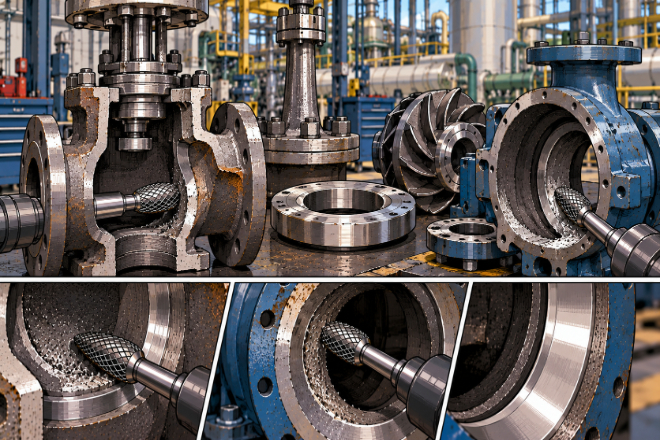
Valves may look less dramatic than a turbine rotor, but they can create serious maintenance problems.
Steam turbine valve systems can suffer from casing cracks, oxidation, sticking, erosion, and damage to internal components. Solid particles in the steam flow can also contribute to erosion in valve areas.
During valve repair, technicians may need to clean rough local areas, prepare damaged sections, remove burrs after machining, or blend repaired metal.
This is where carbide burrs can help. Valve bodies often contain deep internal geometry that is difficult to reach with broad grinding tools. A smaller burr can work around openings, curved walls, pockets, and local welded areas.
Pumps create similar access problems.
Power plants use many pumps and auxiliary systems, and maintenance can involve casings, impellers, mounting parts, and other metal components.
A burr may help remove a sharp edge, clean a repaired opening, blend a local surface, or prepare a small area before further work.
But sealing areas deserve special attention. A valve seat, pump sealing surface, bearing fit, or other precision feature should not be casually reshaped with a hand-held burr.
If the surface has a defined tolerance or finish, use the specified machining and inspection process.
There is a big difference between cleaning an edge next to a valve seat and “improving” the valve seat itself.
One is maintenance. The other may become tomorrow’s maintenance.
4. Why Are Carbide Burrs Useful for Weld and Casing Repairs?
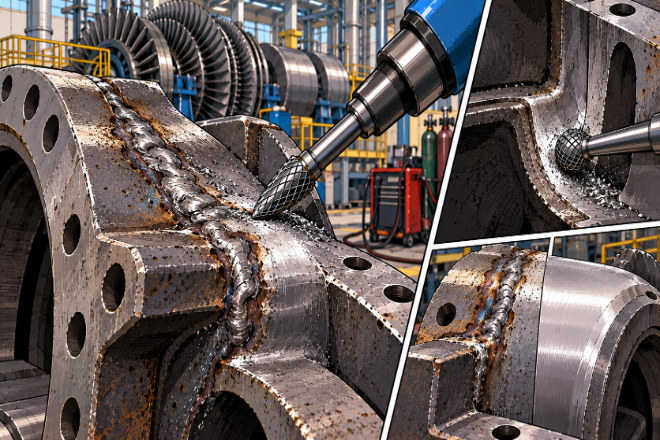
Welding plays an important role in power plant repair.
Steam turbine maintenance can include rotor weld repairs, blade repairs, casing repairs, and the addition of new weld material to damaged areas.
On-site welding is also used in some casing and power plant component restoration work.
Before welding, damaged metal may need to be prepared according to the repair procedure.After welding, extra material may need local shaping or blending.
أ tungsten carbide burr can be very useful at both stages when the approved repair process calls for local mechanical metal removal.
Its main advantage is control.A large grinder can remove a lot of weld metal very quickly. That is useful until the repair sits beside a corner, internal curve, bolt hole, or thin feature.
Then “very quickly” can become slightly worrying.A carbide burr lets the technician work on a smaller area.
Tree and flame burrs can follow welds around curved surfaces. Ball burrs can blend rounded areas. Cylindrical shapes can work along flatter sections.
The burr can also help clean small corrosion or erosion repair zones before subsequent operations where the repair specification permits it.
GE Vernova, for example, describes turbine casing repairs involving erosion and corrosion damage, welding, re-rounding, and geometry correction.
The important point is that a carbide burr supports the repair process rather than defines it.
Crack removal depth, weld preparation geometry, heat treatment, inspection, and final dimensions should follow the approved procedure.
A burr is excellent at removing metal.It is less talented at reading an engineering drawing.
5. Where Do Carbide Burrs Help in Tight Maintenance Areas?
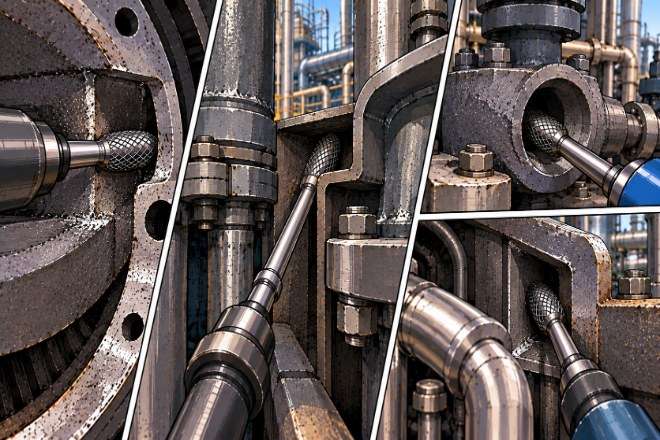
Power plants are full of equipment that seems to have been designed without asking the person who will eventually repair it.
Pipes sit beside valves.Brackets sit beside pipes.Casings contain deep corners.Bolts hide behind other components.
And somehow the damaged area is often in the least convenient place.This is where carbide burrs earn their place in the maintenance toolbox.
Their small heads can reach around structural features and into openings that larger grinding tools cannot easily enter.
Long-shank burrs can extend that reach further.But longer is not automatically better.
Extra overhang can increase vibration and reduce control. If a standard-length burr can reach the work, there is little reason to use a much longer one.
The rotary tool matters too.A stable collet, good bearings, correct burr installation, and sensible tool speed all help the burr cut smoothly.
If the tool starts vibrating badly, the answer is not always to grip it harder.
Check the burr.
Check the shank.
Check the collet.
Check the bearings.
Check the amount of overhang.
The problem may be in the setup rather than the metal.
This becomes especially important during field maintenance. Power plant service teams often carry out repairs on-site to reduce downtime, and OEM field-service programs include on-site machining and welding for complex power-generation components.
A compact rotary tool can therefore be valuable when the component is staying in the plant instead of traveling to a repair shop.
6. How Should Carbide Burrs Be Matched to Power Plant Materials?
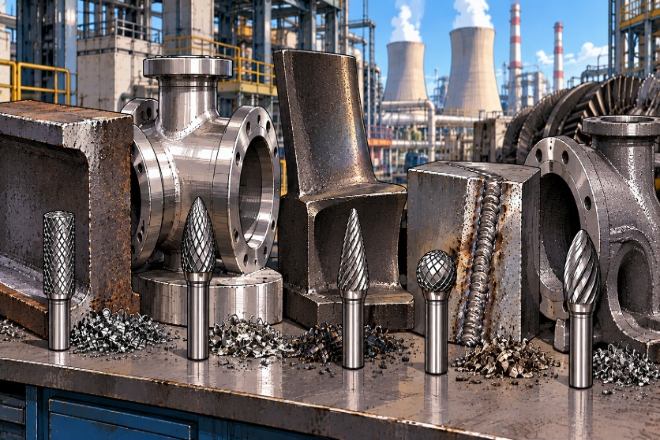
Power plants do not use one metal everywhere.
Carbon and alloy steels appear throughout plant equipment. Stainless steels are used where corrosion or operating conditions require them. Turbine and high-temperature systems can contain more demanding alloys.
The burr should match the material. A steel-suitable cutting geometry may work well for general repair on steel components. Stainless steel benefits from a burr that cuts cleanly without excessive rubbing and heat.
More difficult heat-resistant alloys can require cutting geometries designed for harder materials.Cast components may need another approach.Material is only the first decision.
The repair job matters too.
7. How Should Power Plants Evaluate Carbide Burr Performance?
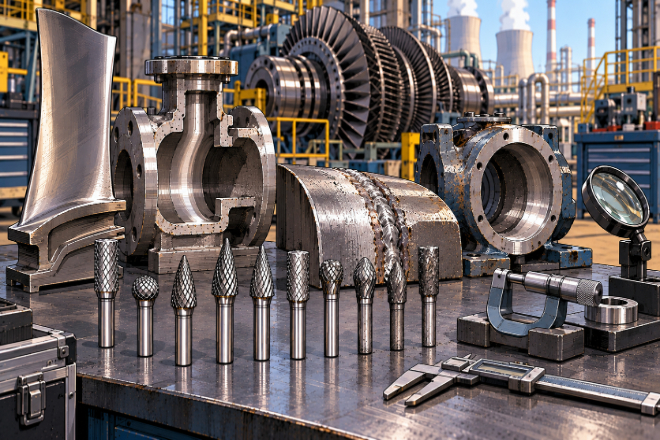
Power plant maintenance managers should look beyond the price of the burr itself.
During an outage, labor time and schedule pressure can be far more important than the cost of a small cutting tool.
Turbine service providers specifically focus on outage planning and on-site repairs because unexpected work and longer outages directly affect plant availability.
So test carbide burrs on representative maintenance work.Start with cutting performance.Does the burr remove the required metal without excessive pressure?
Then look at control.Can technicians reach the repair area without marking nearby surfaces?
Check vibration, surface condition, and tool wear.A burr that cuts aggressively for five minutes and then loses performance may be less useful than one that remains stable through a longer repair.
Consistency between tools matters as well.Maintenance teams do not want one burr to run smoothly while the next one from the same box vibrates badly.
For important maintenance programs, buyers can compare flute quality, concentricity, dimensional consistency, shank condition, and the connection between the carbide head and shank.
Real tests should include the materials and geometry found in the plant. A flat piece of mild steel on a comfortable workshop bench tells you very little about how a burr will behave inside a turbine casing during an outage.
Finally, measure the whole operation.
How much technician time is needed?
How many burrs are consumed?
Is secondary finishing required?
Does the tool help complete the repair within the planned maintenance window?
OEM power-generation service programs emphasize that repair rather than replacement can reduce lead time and, in suitable cases, shorten outage-related delays.
The burr is only a tiny part of that equation.But during an outage, tiny things have a strange habit of becoming very important.
 English
  Español
  简体中文
简体中文  Français
  日本語
日本語  한국어
한국어  العربية
  Tiếng Việt