1. Why Are Carbide Burrs Used for Engine Porting?
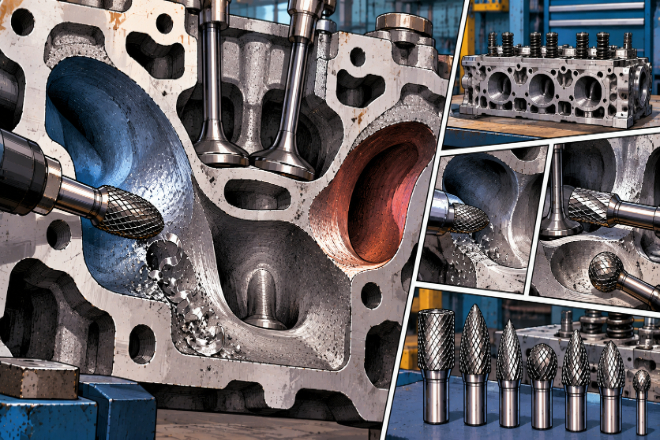
Cylinder head porting is basically controlled reshaping. The intake port guides air, or an air-fuel mixture in some engines, toward the intake valve. The exhaust port gives burned gases a path out of the cylinder.
The basic idea sounds simple: improve the passage so gas can move through it effectively. The actual work is not so simple.
A cylinder head contains curves, narrow sections, valve guide areas, bowls, port openings, and transitions that all interact. Removing metal from one area changes the shape of the passage.
That is why a tungsten carbide burr is useful.
Unlike a sanding roll, which is better suited to lighter finishing, a carbide burr has defined cutting teeth that can remove material more quickly.
It can be used to cut down casting irregularities, open selected areas, reshape curves, and blend surfaces.
Carbide burrs are also available in many shapes. That matters because an engine port is definitely not a flat plate.
Ball, oval, flame, tree, cylindrical, and tapered burrs can each reach different areas inside a cylinder head.
There is another advantage: tungsten carbide is highly wear-resistant.
Cylinder heads are commonly made from aluminum alloys or cast iron.
Carbide-tool manufacturers offer material-specific cutting geometries for both aluminum and cast iron, which helps match chip formation and cutting action to the work material.
But porting is not simply about removing as much metal as possible. That is where beginners can get into trouble. The goal is to create the required port shape. A bigger hole is not automatically a better port.
If it were, cylinder head development would be much easier—and die grinders would be much more dangerous.
2. Which Parts of an Engine Port Can Carbide Burrs Modify?
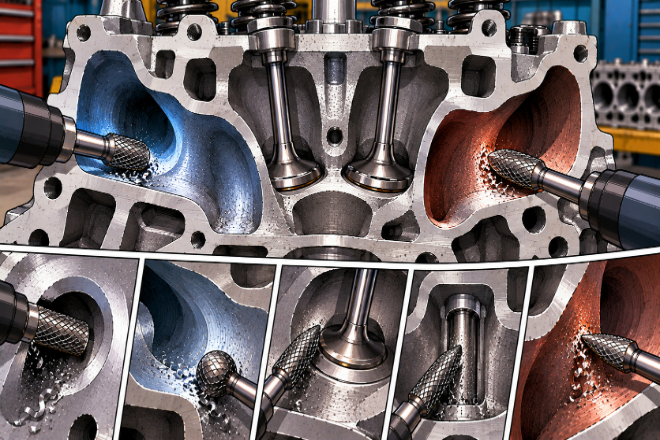
A port contains several areas where a carbide burr may be used during modification. The first is the port entrance.
Engine builders may need to correct casting differences or match the port opening to the required manifold or header interface.
A suitable burr can remove small amounts of material around the opening and help create a smoother transition.
Further inside the port, casting marks and rough high spots may need removal. These are good carbide burr jobs because the cutting head can reach inside the passage while the shank remains outside.
Then there is the bowl area near the valve. This area often changes shape quickly, so ball, oval, flame, or tree-shaped burrs can be easier to control than a straight cylindrical tool.
The short-side area is another important part of port geometry. It contains a tight curve as the passage approaches the valve area.
This is where control becomes more important than speed. Removing too much material can change the port in a way that is difficult—or impossible—to put back.
The area around the valve guide may also require careful blending depending on the cylinder-head design and porting plan.
However, carbide burrs should not be used casually on valve seats or other precision-machined surfaces. Those areas require dedicated equipment and controlled dimensions.
Think of the carbide burr as a sculpting tool. It removes the unwanted material around the important geometry. It should not eat the important geometry for lunch.
For professional engine shops, the porting plan should therefore come before the grinder starts.
Measurements, previous development work, flow testing, CNC data, or another proven process should define where metal needs to be removed. The burr simply makes that plan happen.
3. How Do Burr Shapes Change the Porting Process?
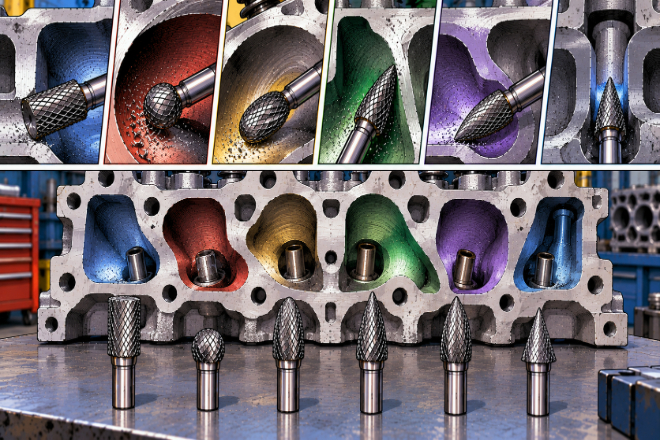
Choosing a carbide burr only by diameter misses half the job. Shape is just as important.
A cylindrical burr can remove material efficiently from straighter port walls or broader local areas. A radius-end cylindrical burr provides more freedom when the wall begins to curve.
A ball burr is useful around bowls and rounded areas. Because the cutting surface is curved, it can move through changing angles without one sharp corner digging into the cylinder head.
An oval burr works well for blending curved surfaces and transitions. A tree-shaped burr can reach tapered or changing areas while still providing a relatively large cutting surface.
A flame burr is useful for flowing curves and narrower sections. Its shape can be especially practical when the operator needs to blend rather than create a flat surface.
A cone or pointed burr can reach tighter areas, but it needs careful control. A small cutting point concentrates the cutting action in a small area, so an operator can remove more metal than expected surprisingly quickly.
Long-shank burrs are also common in porting because normal burrs may not reach far enough into an intake or exhaust passage.
But reach has a price. The farther the cutting head sits from the grinder’s collet, the easier it becomes for vibration to appear.
The solution is not to hold the grinder tighter and hope for the best. Use only the reach needed for the job, keep the tool stable, and avoid unnecessary side pressure.
For a production cylinder-head shop, having several useful shapes is usually more practical than forcing one favorite burr to do everything.
A ball burr does not want to become a cylinder. Neither does a cylinder want to become a flame.
4. What Changes Between Aluminum and Cast Iron Heads?
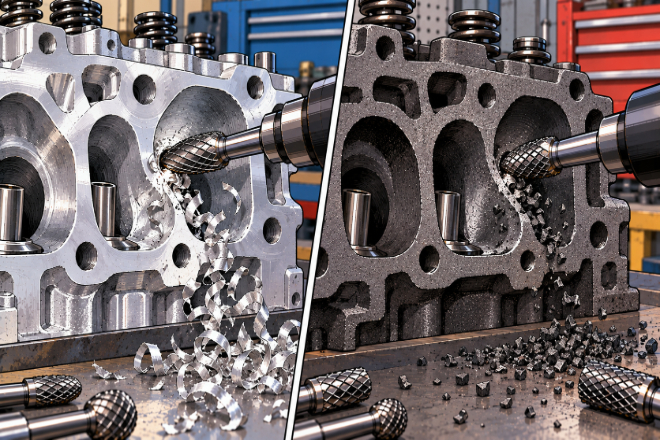
The porting process changes noticeably when the cylinder-head material changes.
Aluminum cylinder heads are common in modern engines. Aluminum is relatively easy to cut, but its chips can stick between the teeth of a poorly selected burr.
Once the flutes begin to fill, the tool stops cutting efficiently. It starts rubbing. Heat rises. The operator pushes harder. And a job that was going nicely suddenly becomes much less enjoyable.
For this reason, carbide burrs made for aluminum usually have more open cutting geometry that gives chips room to escape.
Material-specific ALU cuts are designed for aluminum and aluminum alloys, and anti-adhesion tool options can further reduce chip loading.
Cast iron behaves differently. Instead of producing the same long, sticky chips, cast iron tends to break into shorter material during cutting.
Burr manufacturers therefore offer CAST-specific cutting geometries for high stock removal on cast iron.
This means an engine shop working on both materials should not assume one burr is ideal for everything.
5. How Do You Control Material Removal Inside a Port?
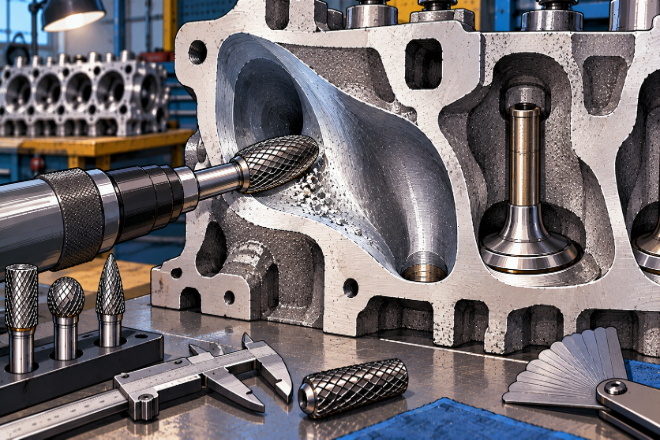
أ carbide burr can remove metal surprisingly quickly. That is useful right up until the moment it removes metal you wanted to keep. Good porting therefore depends on control.
Before cutting, the operator should know the target shape. Marking areas that need modification can help maintain a clear boundary during manual work.
Do not attack the full port immediately. Work gradually. Remove a small amount, inspect the shape, and continue.
This is especially important around thin walls, the short-side area, valve guide regions, and other features where the available material may be limited.
The operator should also keep the burr moving. Holding the cutting head in one place can create a low spot. Smooth movement makes it easier to blend one area into another.
Pressure should remain controlled. Pushing harder does not turn a carbide burr into a better carbide burr. It can increase vibration and make precise movement more difficult.
Speed should follow the burr manufacturer’s recommendation for the burr diameter, cut, and work material rather than one universal RPM setting.
Professional cylinder-head shops can go further by using templates, measuring tools, section data, flow-bench results, or CNC programs to control repeatability.
This is especially important when the same port design needs to be produced across many cylinder heads.
The first head may be hand-developed. The next fifty should not depend entirely on whether the operator had enough coffee that morning.
For higher-volume work, dedicated carbide port cutters can also be used in CNC cylinder-head machining. Custom solid-carbide porting cutters are available specifically for aluminum and cast-iron cylinder heads and manifolds.
The production method may change. The basic goal does not: remove only the metal that improves the intended geometry.
6. What Mistakes Can Ruin an Engine Port?
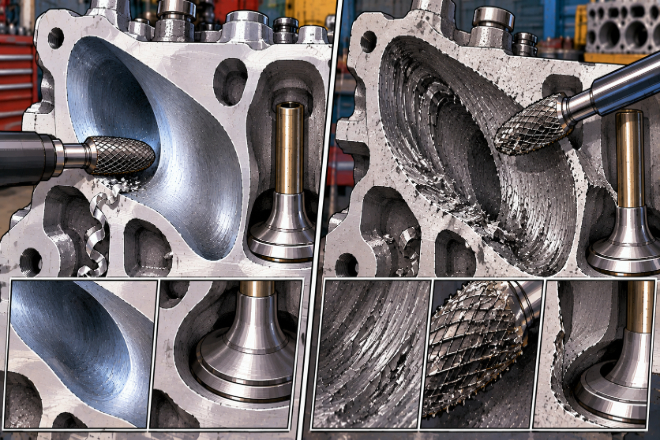
The most obvious mistake is over-porting. People sometimes assume that a larger port must flow better.
But air speed, port shape, valve size, engine speed, and the rest of the intake and exhaust system all matter.
Removing too much material can produce the wrong shape for the engine. Another mistake is trying to make every surface perfectly smooth with the carbide burr itself.
A burr is primarily a cutting and shaping tool. After the main geometry is established, abrasive tools may be used for lighter blending or the required final surface.
Using the wrong burr for aluminum is another common problem. A tight cutting pattern can load quickly with soft aluminum. Once the burr begins rubbing instead of cutting, continuing with more pressure usually makes the situation worse.
Poor tool support creates another problem. A long burr with too much unsupported shank can chatter inside the port. Chatter makes it harder to create a smooth shape and can leave unwanted grooves.
Then there is the most painful mistake: hitting a surface that should never have been touched. Valve seats are the obvious example. A spinning carbide burr does not know that the shiny ring beside it is expensive precision work.
The operator has to know. The same care applies near water passages and thin casting sections. Removing too much material can break through a wall and turn a useful cylinder head into an interesting desk ornament.
Professional shops can reduce these risks by standardizing burr types, porting stages, inspection points, and operator procedures.
Porting may look like freehand metal carving. Good production porting is anything but random.
7. How Should Engine Shops Evaluate Carbide Burrs?
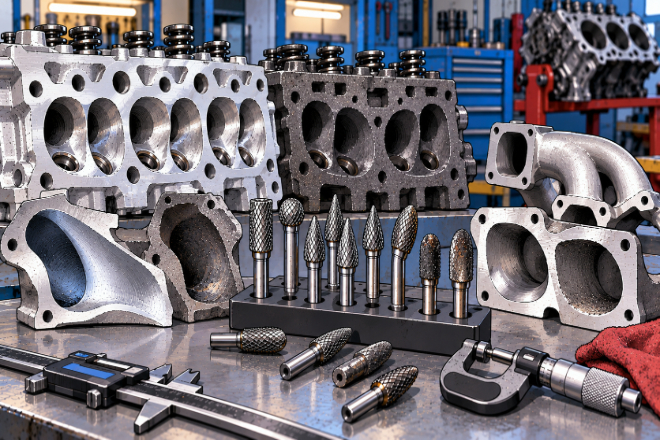
For an engine builder or cylinder-head company, a carbide burr should be judged by what it does to the whole porting process.
Start with material removal. Does the burr cut the aluminum or cast iron cleanly without requiring heavy pressure? Then look at control.
A burr that removes metal extremely fast but constantly tries to pull itself across the port wall may not be the best production tool.
Check chip evacuation on aluminum. If technicians repeatedly stop to clean loaded cutting teeth, the lost time should be part of the tool evaluation.
Vibration matters too. A well-made burr with good concentricity is easier to guide through a port, especially when longer shanks are required.
Surface condition is another useful measure. The burr does not need to create the final polished surface, but it should leave a predictable shape that does not create unnecessary finishing work.
Tool life should be measured across real cylinder heads rather than a short test on a scrap block. Most importantly, compare port-to-port consistency.
A performance engine shop may modify eight, sixteen, twenty-four, or more ports across a production batch. The cutting tool should help technicians repeat the intended geometry rather than make every port feel different.
For larger operations, the same thinking applies to automated porting. Dedicated solid-carbide port cutters are used in multi-axis CNC cylinder-head applications, including aluminum cylinder heads.
The business case is therefore bigger than burr price. Measure cutting time, finishing time, tool changes, operator control, repeatability, and rejected parts.
A cheap burr is not cheap if it makes an expensive cylinder head harder to control.
 English
  Español
  简体中文
简体中文  Français
  日本語
日本語  한국어
한국어  العربية
  Tiếng Việt