
1. Why Are Composites Difficult to Cut Cleanly?
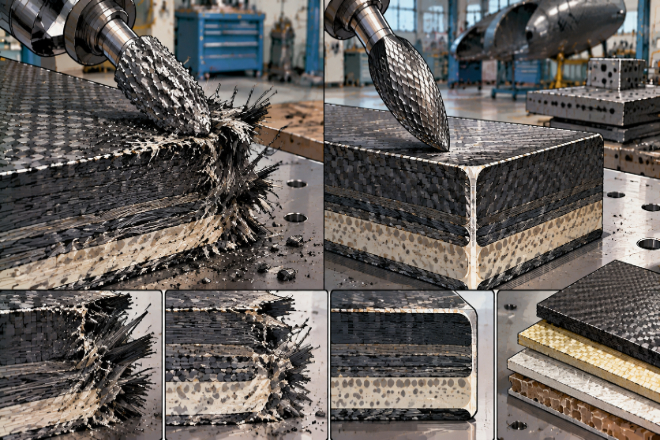
Composite materials are not one simple material.
A carbon fiber reinforced plastic, for example, contains strong fibers held inside a resin matrix.
Glass fiber reinforced plastic uses glass fibers instead. Other composite parts may contain different fibers, resins, layers, cores, or mixed materials.
This structure gives composites many of their useful properties. It also makes machining more interesting.
With ordinary metal, a cutting edge normally enters one relatively uniform material. With a composite, the tool may be cutting hard fibers and softer resin at the same time.
The fibers can behave differently depending on their direction. Instead of producing the type of chip seen when cutting steel, a poor tool can pull, tear, or break fibers around the edge.
This can lead to fraying. Another concern is delamination. The layers inside a laminated composite can begin to separate when cutting forces are not well controlled.
Then there is edge damage. A composite part may look fine across most of the surface but have rough fibers sticking out around a trimmed edge or hole.
That can create more finishing work and, in some cases, make the part unacceptable.
Tool wear is another challenge. Glass and carbon fibers can be abrasive. Cutting edges that work well on softer materials may lose their performance quickly when exposed to reinforced composites.
This is one reason tungsten carbide is useful. Carbide provides high صلابة و مقاومة التآكل, making it suitable for cutting abrasive materials. But carbide alone does not solve the complete problem.
The cutting geometry still matters. A normal metalworking burr may be made to create and remove metal chips. A composite-specific burr is designed around fibers. That difference is important.
If a factory regularly trims CFRP or GFRP components, buying a generic carbide burr simply because it is hard is not a complete tool-selection strategy.
The burr needs to understand the material—even if the purchasing department would prefer one tool for everything.
2. Which Tungsten Carbide Burr Cuts Work on Composites?
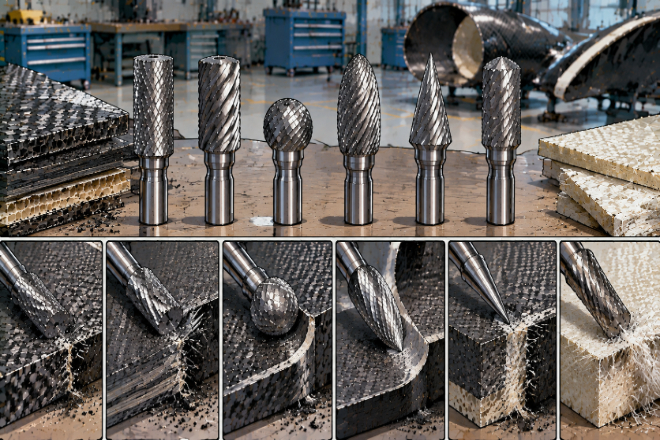
For composite work, dedicated PLAST, FVK, FVKS, or similar composite-specific cuts are better starting points than standard metalworking cuts.
These burrs use tooth patterns designed to cut fiber-reinforced plastics more cleanly.
For less hard glass and carbon fiber reinforced materials with lower fiber content, a PLAST-type cut can be useful.
PFERD’s PLAST cut, for example, is designed for glass fiber and carbon fiber reinforced plastics with fiber content up to 40%, as well as fiber-reinforced thermoplastics.
Its cutting geometry is similar to PCD milling and is designed to reduce delamination and fraying.
For harder composites and materials with higher fiber content, FVK and FVKS cuts provide another option.
These cuts are designed for hard glass fiber and carbon fiber reinforced plastics and can also be used where fiber content is above 40%.
The FVK design focuses on smooth milling and a clean cut edge, while FVKS is suitable for machine and robotic applications with higher feed rates.
That gives production teams several choices rather than one universal “composite burr.”
3. What Composite Operations Can Carbide Burrs Handle?
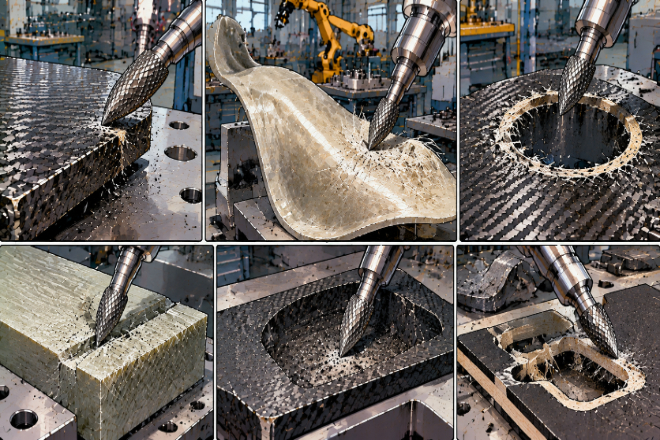
One of the main applications is edge trimming. Composite panels and molded components often need their outer edges trimmed after production.
A composite-specific tungsten carbide burr can remove excess material while helping control fiber damage along the edge.
Contour milling is another useful operation. Many composite parts are not simple rectangles.
الفضاء الجوي panels, السيارات components, marine parts, sports equipment, machine covers, and industrial composite structures can contain curves and changing profiles.
A carbide burr can follow these contours, especially when the tool geometry is designed for fiber-reinforced plastics.
Deburring is also possible. After drilling or another machining operation, fibers may remain around an edge. A suitable burr can clean these areas without attacking a much larger part of the component.
Some composite carbide burr designs can do more than edge work. Special end-cut versions can mill grooves and pockets.
Other designs can drill blind holes or combine drilling and milling in one tool. This can be useful in automated production where a robot or machine needs to perform several local operations without constant tool changes.
Cutting out openings is another application. A composite panel may need access holes, local cutouts, or openings for another component.
A carbide burr designed for this work can cut through the material and then follow the required contour.
This flexibility is one reason these tools appear in both manual and automated composite processing.
However, the carbide burr should not automatically replace dedicated composite drills, routers, or end mills.
If a production line needs thousands of controlled holes, a purpose-designed composite drill may be a better choice.
If a CNC machine needs to trim long panel edges at high speed, a dedicated router may make more sense.
The carbide burr becomes especially useful for local work, complex access, corrections, smaller production runs, repair, and flexible trimming operations.
Use it where its flexibility adds value. There is no prize for making one tool do every job in the factory.
4. How Do You Reduce Delamination and Fraying?
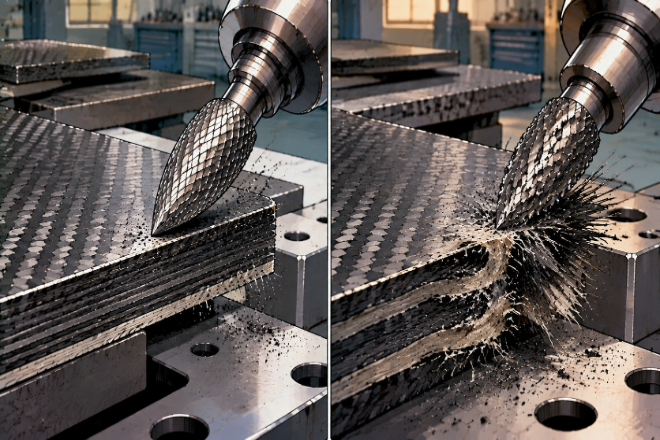
The first step is choosing a cutting geometry made for composites.
A standard aggressive metal burr may remove material, but that does not mean it will leave the fiber edge in good condition.
Composite-specific PLAST cuts are designed to reduce delamination and fraying. That should be the starting point. The second factor is tool condition.
A sharp carbide cutting edge cuts fibers more cleanly than a worn tool. As the burr wears, cutting forces can rise and edge quality may begin to change.
Do not judge tool life only by whether the burr is still physically capable of removing material. For composite production, the more useful question is:
Is it still producing an acceptable edge? Speed also matters. There is no universal RPM for every composite carbide burr.
The correct speed depends on tool diameter, cutting geometry, material, fiber content, and application.
For example, current PFERD FVK guidance gives 24,000–48,000 RPM for one 6 mm burr used on reinforced thermoplastics and GRP/CRP with fiber content above 40%. An 8 mm version lists 18,000–36,000 RPM.
The change is important. Larger diameter, different speed. So copying one grinder setting across every composite burr is not a good production standard.
Stable rotation also helps. High concentricity reduces impact and chatter. That supports smoother milling and can help create cleaner cut edges.
The workpiece should be supported properly as well. A thin composite panel that moves or vibrates during trimming creates another source of unstable cutting.
Keep the process controlled. Composite machining has enough variables already. There is no need to invite the workpiece to dance.
5. Where Should Carbide Burrs Be Used Carefully?
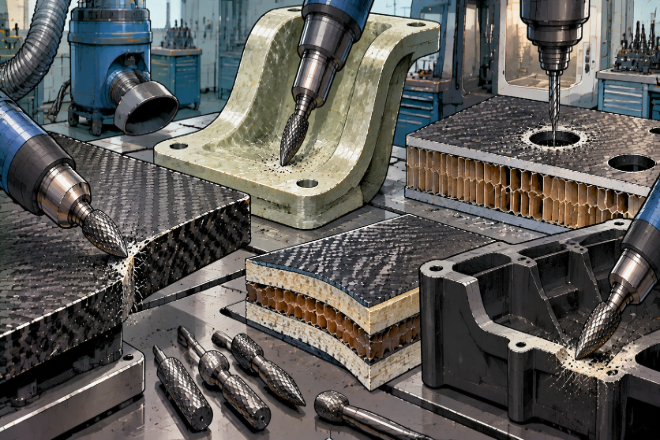
The answer to “Can tungsten carbide burrs be used on composites?” is yes. The answer to “Can they be used carelessly on every composite?” is definitely no.
Not all composites are the same. CFRP, GFRP, reinforced thermoplastics, sandwich panels, honeycomb structures, and hybrid laminates can require different cutting methods.
A burr proven on one carbon fiber laminate should not automatically be treated as the best tool for every composite part in the plant.
Critical الفضاء الجوي components deserve particular care. The machining method may be controlled by the drawing, process specification, customer requirement, or approved manufacturing procedure.
In that situation, tool selection follows the process—not personal preference. Hole quality also needs attention.
A carbide burr may be capable of producing or modifying a hole, but precision holes can have requirements for diameter, roundness, edge condition, and delamination.
Dedicated composite drills and routers use special cutting geometry specifically to control burr formation and delamination.
If the hole is critical, use the tool and process required for the feature. Dust is another important issue.
Machining fiber-reinforced composites can create fine dust and small fibers. The workplace needs suitable extraction, containment, PPE, and handling procedures based on the actual composite material and resin system.
This should be planned before production begins. Do not wait until the workshop looks as though someone opened a bag of carbon-flavored flour.
Finally, avoid excessive tool pressure. The burr should cut the fibers. Forcing it against the laminate can increase cutting forces and make edge damage harder to control.
With composites, a clean edge is often more valuable than an impressive pile of removed material.
6. How Should Manufacturers Select Carbide Burrs for Composite Work?
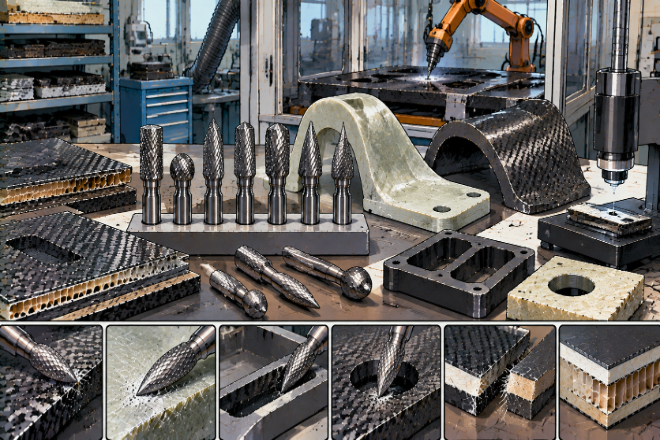
For decision-makers, the selection process should start with the actual composite structure.
Identify the resin system, reinforcement, fiber type, fiber content, laminate thickness, and production operation.
Then define what the finished feature needs.
Is the goal rough trimming?
A clean visible edge?
A local repair?
A contour?
A groove?
A hole?
A pocket?
The answer changes the tool. If the company works mainly with GRP or CFRP below roughly 40% fiber content, a PLAST-type cut is worth testing.
If hard GRP or CFRP with higher fiber content is common, FVK or FVKS-type designs may be more suitable.
For manual work, check whether the exact burr is approved for hand-held operation.
For automated work, look at feed capability, concentricity, tool life, and whether the design supports machine or robotic use. Then test the burr on real parts. Do not evaluate it only by material removal speed.
Look at delamination, fraying, edge quality, cycle time, tool wear, dust control, vibration, and secondary finishing.
A tool that cuts 10% faster but creates extra edge repair may not be faster at all. Automation can change the calculation further.
Some composite-specific carbide burrs are designed for high feed rates on machines and robots. That can make them useful for repeated trimming and contour milling where consistent tool paths are available.
Purchasing teams should therefore compare cost per acceptable composite part, not only cost per burr.
Tool price matters. But so do damaged edges, rejected parts, extra hand finishing, tool changes, machine time, and production stops.
Composite parts can be expensive. Saving a few dollars on the cutting tool while creating delamination in a valuable component is not a particularly exciting form of cost reduction.
 English
  Español
  简体中文
简体中文  Français
  日本語
日本語  한국어
한국어  العربية
  Tiếng Việt