
1. What Are Tungsten Carbide Burrs?
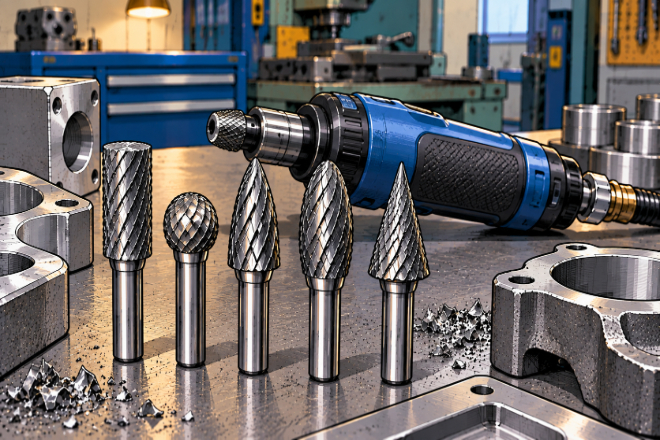
UN fraise en carbure de tungstène is a rotary cutting tool made mainly from tungsten carbide. It is normally used with a die grinder, rotary tool, or similar high-speed machine.
The cutting head has many sharp teeth that remove small chips of material as the burr rotates.
What makes these tools different from ordinary files or grinding points is the combination of dureté and cutting ability.
Tungsten carbide is much harder than common tool steel, so a carbide burr can keep its cutting edges for a long time when working on hard metals.
Different burr shapes are available for different jobs. Cylindrical burrs work well on flat surfaces and edges, while ball-shaped burrs are useful for curved areas.
Tree, flame, oval, and cone shapes make it easier to reach holes, grooves, corners, and complex profiles.
The tooth pattern also matters. Single-cut burrs can provide controlled material removal and longer chips。
While double-cut carbide burrs break material into smaller chips and are popular for general metalworking because they are easier to control and can leave a smoother surface.
For industrial users, the important point is simple: one small rotary tool can handle many jobs that would otherwise require several different finishing tools.
2. Why Are Tungsten Carbide Burrs Popular in Metalworking?
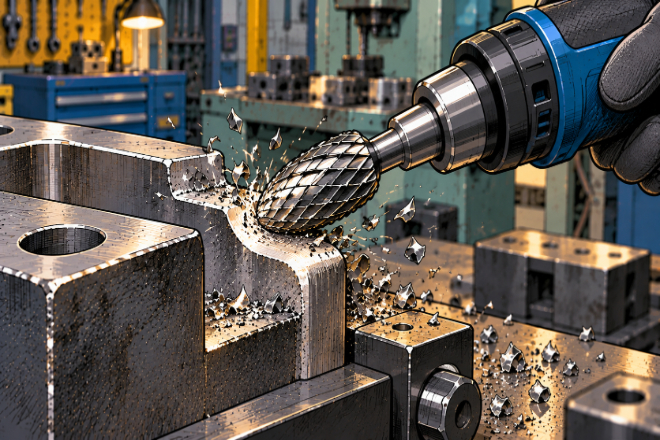
Metalworking can be unforgiving. A tool may need to work on stainless steel in the morning, clean a weld in the afternoon, and shape a cast component before the shift ends.
A useful burr needs to survive this kind of workload without losing its cutting ability too quickly.
Fraises en carbure de tungstène fit this role well because they combine dureté, résistance à l'usure, and fast material removal. Instead of rubbing against the workpiece, their cutting teeth remove small chips.
When the burr, speed, and pressure are correctly matched, this can make finishing work faster and more controlled.
Long tool life is another reason for their popularity. Frequent tool changes may look like a small issue, but across a large workshop they can add up to a surprising amount of lost production time.
A durable carbide burr can reduce interruptions and make tool use more predictable.
They are also versatile. Manufacturers do not need a completely different finishing system every time the material or part geometry changes.
By changing burr shape, size, or cut style, operators can adapt the process to many metalworking jobs.
That flexibility makes carbide burrs useful not only at a workbench but also in maintenance departments, fabrication shops, foundries, mold shops, and larger production facilities.
3. How Are Tungsten Carbide Burrs Used for Deburring?
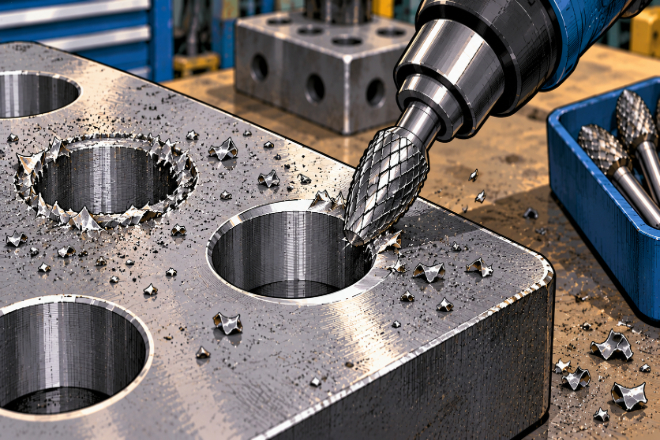
Deburring is one of the most common uses of tungsten carbide burrs.
Machining, drilling, milling, sawing, and cutting can leave sharp or uneven edges on metal parts. These burrs may look small, but they can create real problems.
They may affect assembly, interfere with part fit, damage seals, create safety risks, or simply make a finished component look poorly made.
A carbide burr allows the operator to remove these unwanted edges without taking away large amounts of surrounding material.
This is especially helpful around holes, slots, internal edges, and irregular shapes where a standard grinding wheel may be too large.
For example, after drilling several holes in a steel plate, small raised edges may remain around each opening.
A suitable tungsten carbide burr can quickly clean the hole edges and create a more consistent finish.
Deburring is not about removing as much metal as possible. The goal is controlled removal. Using the correct burr shape and light, steady movement helps protect the dimensions of the finished part.
For companies producing large numbers of metal components, better deburring can also improve downstream assembly and reduce the need for rework.
4. How Do Carbide Burrs Help with Weld Cleaning and Preparation?
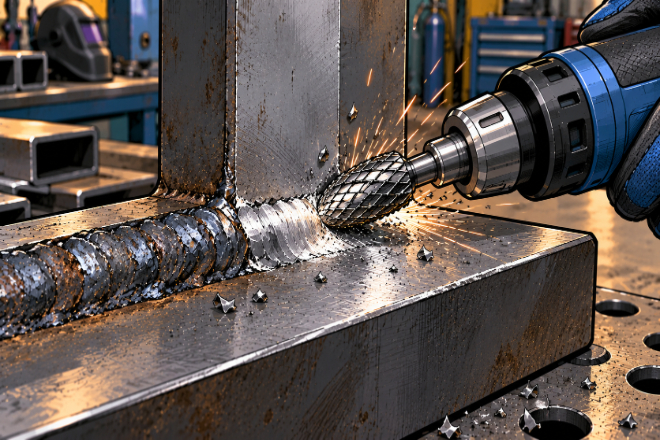
Anyone who has worked around welded parts knows the weld is often not the end of the job. Excess weld metal, spatter, uneven joints, and rough transitions may still need to be cleaned.
Fraises en carbure de tungstène are well suited to this work because they can remove material from a focused area without requiring a large grinding wheel.
Operators can grind down a raised weld, smooth the transition between two joined pieces, or clean around difficult corners.
They can also be used before welding. A burr can help clean or shape a joint area so that parts fit more closely before the welding process begins.
After welding, the same type of tool can be used to blend the joint into the surrounding surface when a smoother profile is required.
This is particularly useful in repair and fabrication work, where part shapes are not always friendly to large tools.
A compact carbide burr can reach into narrow spaces and work around complex weld geometry with much greater freedom.
The result is less wrestling with the tool and more control over where metal is actually removed.
5. Can Tungsten Carbide Burrs Be Used for Shaping Metal?
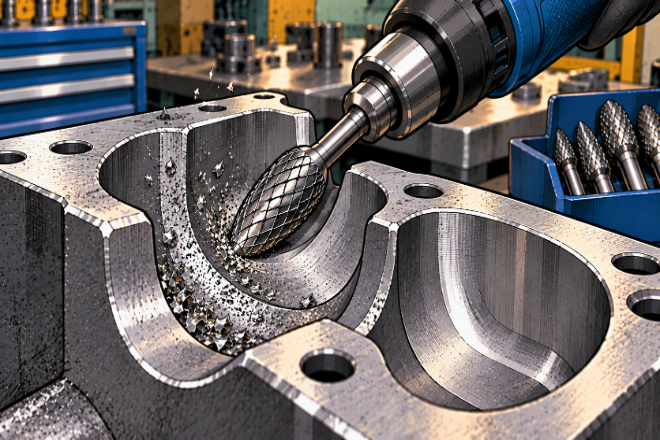
Yes. Carbide burrs are not limited to cleaning edges. They can also be used to change the shape of a metal component.
During fabrication or repair, a hole may need to be enlarged slightly, a groove may need adjustment, or a curved profile may need to be refined.
In these situations, removing the entire part and putting it back on a milling machine may be unnecessary or impractical.
A rotary fraise en carbure provides a more flexible option.
Operators can use it to remove material gradually until the required shape is reached. Ball and oval burrs are useful for curved surfaces, while cone and tree shapes can reach tapered areas and internal profiles.
This ability is especially valuable for one-off parts, repair work, prototypes, and low-volume production. It gives technicians a way to make controlled changes without setting up a larger machine for every small correction.
However, carbide burrs should not be treated as substitutes for precision machining when tight dimensional tolerances are required. They are best viewed as flexible material-removal and finishing tools.
6. How Are Carbide Burrs Used on Castings?
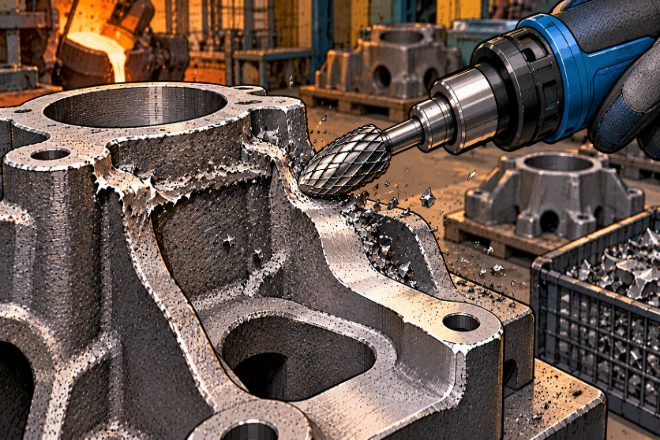
Cast components often arrive with more personality than engineers asked for. Flash, rough edges, parting lines, gates, and uneven areas are common results of casting processes.
Fraises en carbure de tungstène can remove these unwanted features and prepare the casting for later machining, coating, assembly, or inspection.
Their wear resistance is especially helpful when working with hard cast materials.
A suitable burr can remove raised material quickly while giving the operator more control than a large grinding wheel in small or irregular areas.
Common casting work includes removing excess material around gates, smoothing rough transitions, cleaning internal openings, and correcting small surface defects.
Foundries and metalworking plants can also use different burr shapes to match different casting geometries. Instead of forcing one tool into every corner, the burr can be selected according to the surface being worked.
That sounds simple, but it can make a noticeable difference in production speed and consistency.
7. Can Tungsten Carbide Burrs Work on Hard Metals?
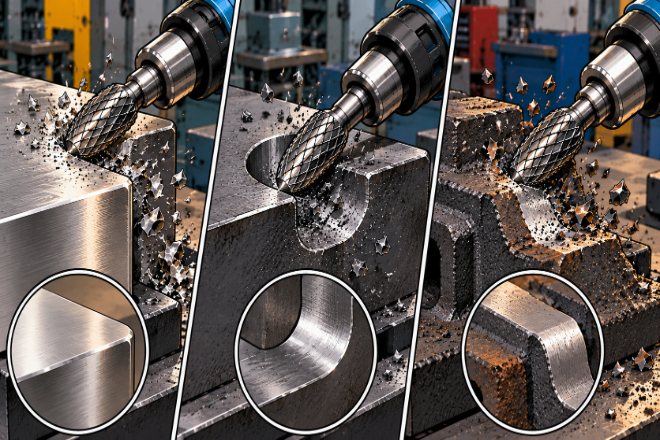
One of the strongest reasons to choose tungsten carbide burrs is their ability to work with difficult metals.
Depending on the burr design and operating conditions, they are commonly used on materials such as steel, stainless steel, cast iron, and various metal alloys.
Suitable burrs can also be used on non-ferrous metals, although cut design should be chosen carefully because softer materials can create chip-loading problems.
Hard materials put significant stress on cutting edges. A softer cutting tool can lose its edge quickly, causing the operator to apply more pressure. More pressure creates more heat and can make the process less stable.
Tungsten carbide’s high hardness helps the burr maintain an effective cutting edge for longer.
This does not mean every carbide burr performs equally well on every metal. Burr geometry, tooth design, tool speed, machine power, and operator technique all affect the final result.
Choosing the right combination is more important than simply choosing “carbide” and expecting magic.
8. How Do Tungsten Carbide Burrs Support Surface Finishing?
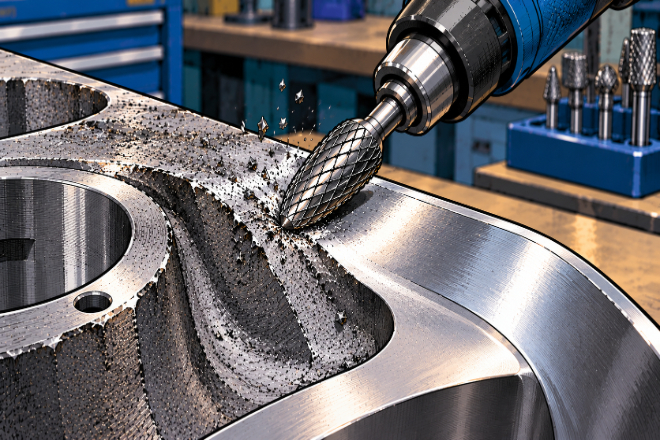
Material removal and surface finishing often overlap.
After a rough machining, casting, or welding process, a component may have high spots, tool marks, or uneven transitions. A tungsten carbide burr can remove these areas before finer finishing steps begin.
This is particularly useful when the surface is curved or difficult to reach with conventional grinding equipment.
The burr cut has a strong effect on the result. A more aggressive cutting pattern can remove material quickly, while a finer or double-cut design can offer better control where a smoother result is important.
Carbide burrs are generally not the final answer when a polished or mirror-like surface is required. Instead, they often act as the bridge between rough material removal and fine finishing.
In other words, they handle the ugly part of the job so polishing tools do not have to.
9. Which Industries Use Tungsten Carbide Burrs?
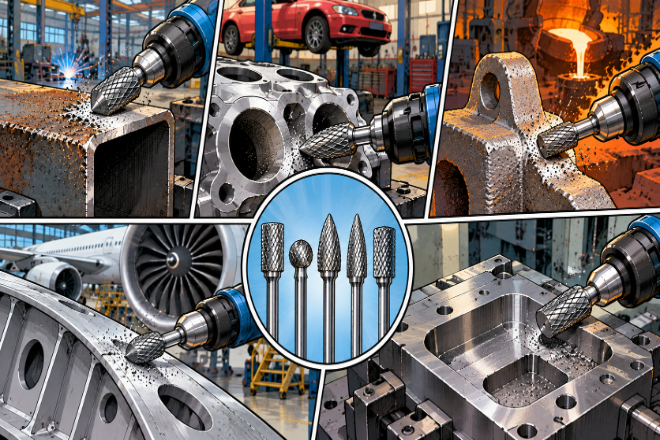
The usefulness of carbide burrs extends across many industries because metal finishing appears almost everywhere.
Dans automobile manufacturing and repair, they can be used for port work, weld finishing, deburring, and component modification.
Dans aérospatial manufacturing, they can support careful finishing of complex metal components where access is limited.
Foundries use carbide burrs to clean castings, while metal fabrication shops rely on them for weld work, edge finishing, and shaping. Tool and die manufacturers may use small burrs for detailed work on molds and dies.
Maintenance teams are another important user group.
When an installed component needs a small correction and taking the entire assembly apart would waste hours, a carbide burr can sometimes solve the problem right where the machine sits.
For decision-makers, this broad application range is valuable because it can reduce the number of specialized finishing tools needed across a facility.
10. How Do You Choose the Right Tungsten Carbide Burr?
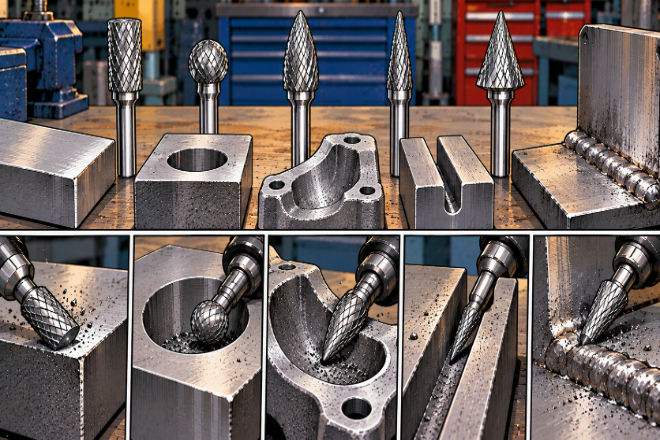
Choisir un fraise en carbure should start with the job rather than the tool catalog.
The first question is what material needs to be removed? Hard steel, cast iron, stainless steel, and softer metals do not always behave the same way.
Next comes geometry. Flat areas, round holes, narrow slots, curved surfaces, and internal corners require different burr shapes. A cylindrical burr may be excellent on a straight edge but frustrating inside a curved cavity.
The required finish is another factor. If fast stock removal is the priority, a more aggressive cut may make sense. If control and surface quality matter more, a different tooth pattern may be better.
Tool speed, burr diameter, shank size, reach, and grinder condition should also be considered. Running the wrong burr at an unsuitable speed can increase vibration, reduce finish quality, and shorten tool life.
For industrial buyers, price per burr should therefore not be the only purchasing metric.
A slightly more suitable tool can reduce processing time, operator effort, and replacement frequency. Those savings can easily matter more than a small difference in purchase price.
11. What Mistakes Reduce Carbide Burr Performance?
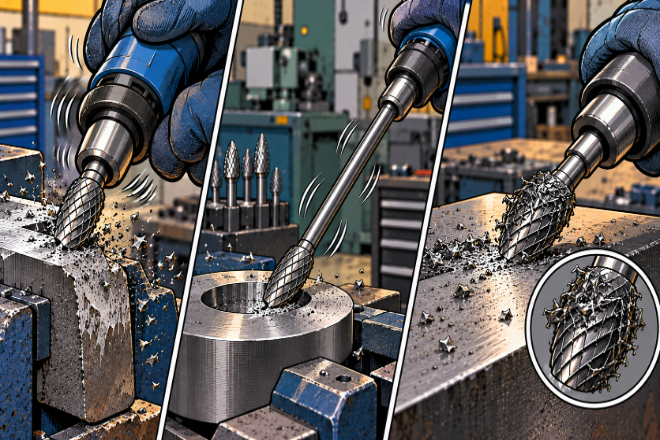
Even a high-quality carbide burr can perform badly when it is used incorrectly.
Too much pressure is a common problem. Operators sometimes assume pushing harder means cutting faster.
In practice, excessive force can increase heat, vibration, and tool wear. The burr should be allowed to cut rather than being forced through the metal.
Holding the burr in one place for too long is another mistake. Continuous movement helps produce a more even surface and prevents unwanted grooves.
Excessive overhang can also cause vibration. The burr should normally be held securely, with only the length needed for the job extending from the tool.
Using the wrong cut style for the material can create poor chip removal or clogging. Finally, continuing to use a damaged or heavily worn burr can harm both surface quality and productivity.
Good technique is not complicated, but it has a large effect on the real value a company gets from its tooling.
12. Why Do Tungsten Carbide Burrs Matter for Production Efficiency?
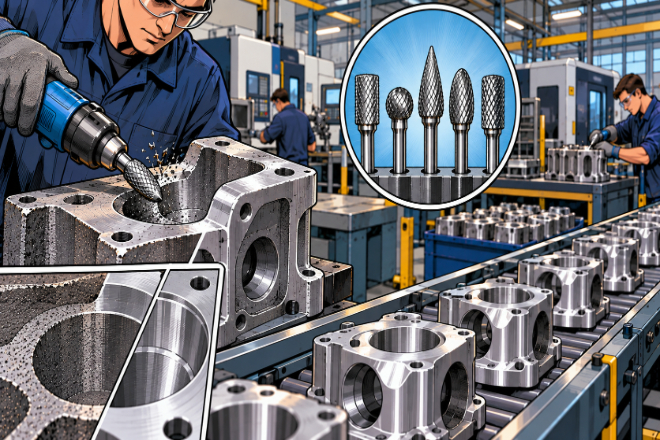
UN fraise en carbure may be one of the smaller tools in a metalworking facility, but small tools can still create large productivity gains.
Fast deburring shortens finishing time. Better weld cleanup reduces rework. Longer tool life means fewer interruptions. The ability to work in narrow or complex areas can also reduce the need to move parts between machines.
For production managers, these improvements affect more than tool cost. They influence labor hours, machine availability, throughput, and delivery schedules.
The most useful way to evaluate tungsten carbide burrs for metalworking is therefore to look at total process efficiency.
A burr that lasts longer, cuts more consistently, and helps an operator complete a job faster can provide far more value than its purchase price suggests.
When selected and used correctly, tungsten carbide burrs are not simply finishing accessories. They are practical production tools that help turn rough metal into finished components with less fuss.
 English
  Español
  简体中文
简体中文  Français
  日本語
日本語  한국어
한국어  العربية
  Tiếng Việt