
1. Why Can a Hard Tungsten Carbide Burr Still Break?
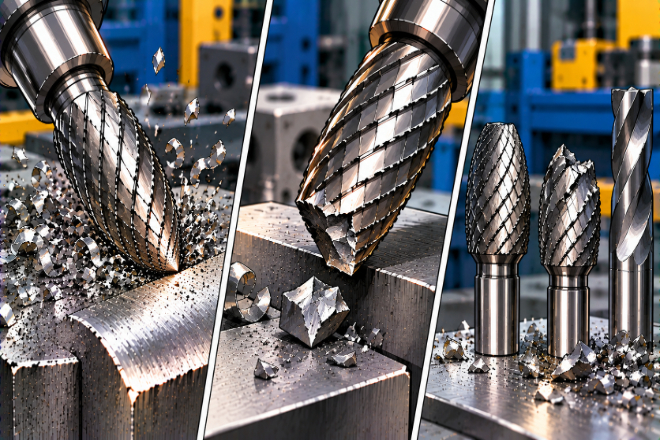
This sounds like a strange question at first.If tungsten carbide is so hard, why can a carbide burr chip? The answer is that hardness and toughness are not the same thing.
Tungsten carbide is extremely useful because it can keep a sharp cutting edge while working on steel, stainless steel, cast iron, hardened materials, and many other difficult workpieces.
Its high résistance à l'usure is one reason carbide burrs can continue cutting long after softer tools begin to lose their edges.
But carbide is also more brittle than many steels.
Think about a hard ceramic cup and a plastic cup. The ceramic surface is much harder, but dropping it can cause it to crack.
A similar idea applies to carbide. It handles wear very well, but sudden impact or heavy bending force can damage it.
This is why carbide burrs prefer steady cutting loads.
Problems begin when the burr is:
Hit against the workpiece
Forced into a corner
Bent sideways
Dropped while not in use
Used with too much overhang
Run in an unstable tool holder
Pushed far harder than necessary
Damage can take several forms. Sometimes only one or two teeth chip. Sometimes a larger section of the carbide head breaks. In more serious cases, the head or shank can fail.
The important point for a production team is that breakage is not always a sign of poor carbide quality. If several good burrs keep breaking in the same operation, the process deserves attention.
A box of stronger burrs cannot fix a bad setup forever. Finding the actual load that causes the damage is usually more useful than simply replacing the broken tool.
2. How Do Excessive Pressure and Impact Damage Carbide Burrs?
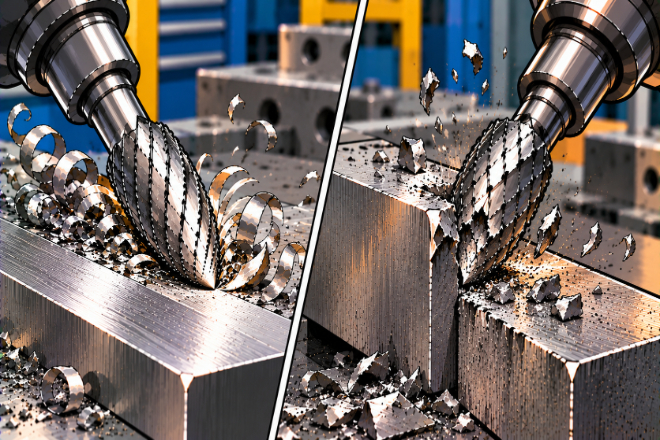
UN carbide burr is supposed to cut. It is not supposed to be pushed through the workpiece by force. This distinction sounds obvious, but excessive pressure is one of the easiest ways to shorten burr life.
When the cutting edges are sharp and the speed is suitable, the teeth remove small chips as the tool moves across the material. The operator mainly controls direction and contact.
When pressure becomes too high, the cutting load on individual teeth increases. That can cause small chips along the cutting edges.
Once several teeth are damaged, the load is no longer shared evenly. The remaining teeth may receive more force, which can make the problem grow.
Sudden impact is even more dangerous. Imagine a rotating burr entering a narrow slot. If the tool suddenly catches an edge, the cutting head experiences a sharp load instead of a smooth one.
Carbide does not enjoy surprises. This can happen during weld removal, casting cleanup, internal deburring, or work around holes and corners.
Interrupted surfaces also need care. When the burr repeatedly enters and leaves the material, each contact creates another change in cutting load.
The solution is not to work painfully slowly. It is to keep the burr under controlled contact. Allow the teeth to cut. Avoid hitting the workpiece. Do not use the side of the burr as a lever to open a slot or bend material.
If cutting becomes slow, investigate the reason. The burr may be worn. The cut may not suit the material. The speed may be wrong.
Chip loading may be reducing performance. Simply pushing harder can turn a cutting problem into a broken-tool problem.
3. Why Do Overhang, Collets, and Spindles Matter So Much?
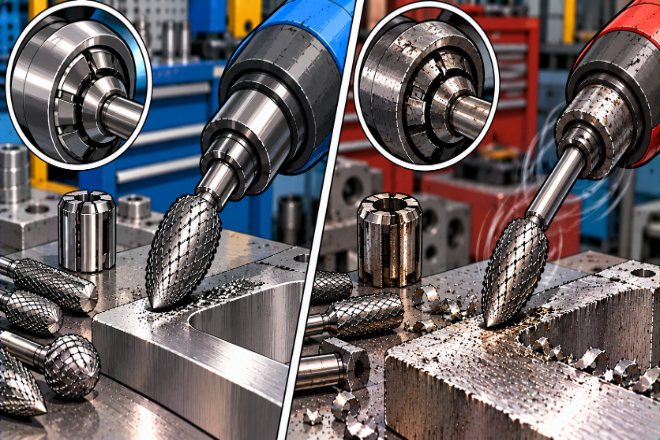
UN carbide burr is only as stable as the system holding it. This makes tool setup one of the most important areas to check when carbide burrs keep breaking. Start with overhang.
Overhang is the distance the burr extends from the tool holder. Sometimes extra reach is necessary because the repair area is deep inside a casting, pipe, mold, or other component.
But longer reach also reduces stiffness. The burr begins to act like a long lever. Side force at the cutting head creates more bending force at the shank and connection area. Vibration can increase, and the risk of damage becomes higher.
Whenever possible, use the shortest practical reach. Next comes the collet.
A worn, dirty, damaged, or incorrect collet may not hold the shank evenly. The burr can rotate off-center, creating repeated impact during every revolution.
At high speed, a small amount of runout becomes a very busy problem. The spindle also matters. Worn bearings or poor spindle condition can produce vibration that is transferred directly into the burr.
A useful troubleshooting table looks like this:
4. Can the Wrong Speed or Burr Selection Cause Chipping?
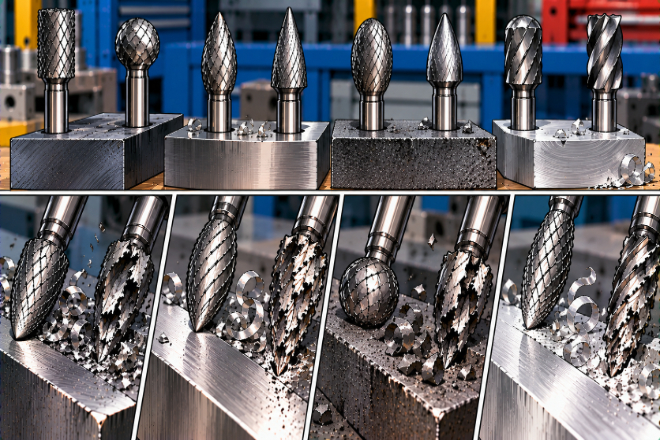
Yes, but speed should not be treated as one universal number. The correct RPM depends on the burr diameter, cut geometry, material, and application. The tool manufacturer’s recommendation should be the starting point.
A larger burr generally needs a lower rotational speed than a smaller burr because its outside cutting edge travels farther during each revolution.
If the operating conditions are wrong, cutting can become unstable. The operator may then compensate with more pressure, increasing the chance of chipped teeth.
Tool selection creates another layer. A burr designed for steel is not automatically the best burr for aluminum. Aluminum can load the cutting teeth, so more open cutting geometry is often preferred.
Stainless steel, cast iron, steel, and other materials can also benefit from cuts designed around their cutting behavior.
The shape must fit the job as well. A large cylindrical burr forced into a narrow curved area can create poor contact and heavy side loading. A ball, oval, tree, flame, or smaller burr may follow the feature more naturally.
Here is a useful selection logic: Material → Amount of material to remove → Surface geometry → Required finish → Burr cut and shape
Not: Find the biggest burr in the drawer → Push until the problem disappears.
The second method certainly removes something. Unfortunately, sometimes that something is part of the burr.
For repeated production work, test the chosen burr under real conditions. Check cutting behavior, vibration, tool temperature, chip formation, edge condition, and tool life.
A burr that removes metal slightly slower but stays stable may complete more parts before replacement. That can make it the faster tool over a full shift.
5. Why Do Long-Shank Burrs Need Extra Care?
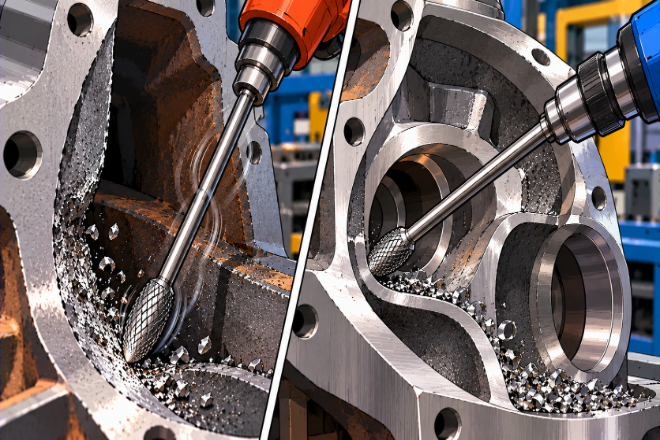
Long-shank carbide burrs are extremely useful. They can reach deep inside pipes, castings, turbine parts, molds, pump housings, welded structures, and other areas where a standard burr cannot reach.
But extra reach changes the mechanics of the tool. The longer the distance between the cutting head and the support point, the easier it is for side force to bend the tool.
That can increase:
Vibration
Deflection
Chatter
Shank stress
Risk of carbide damage
Long reach therefore needs more controlled operation. The tool should not be pushed hard sideways.
Contact should remain light enough for the cutting teeth to work without turning the shank into a spring.
The workpiece should also be secure. If both the long burr and the component are moving, stable cutting becomes much harder. Companies should avoid using a long-shank burr simply because it is available.
Use extra length when the application actually requires it. For deep or difficult features, it may also be worth changing the repair plan.
A different burr shape, smaller head, better access angle, or another machining process may reduce the amount of unsupported reach.
Long tools solve access problems. They should not create new stability problems.
This is particularly important for high-value components. Saving a few minutes by forcing a long burr into a difficult location makes little sense if a broken tool damages the part.
6. How Can Companies Prevent Carbide Burr Breakage?
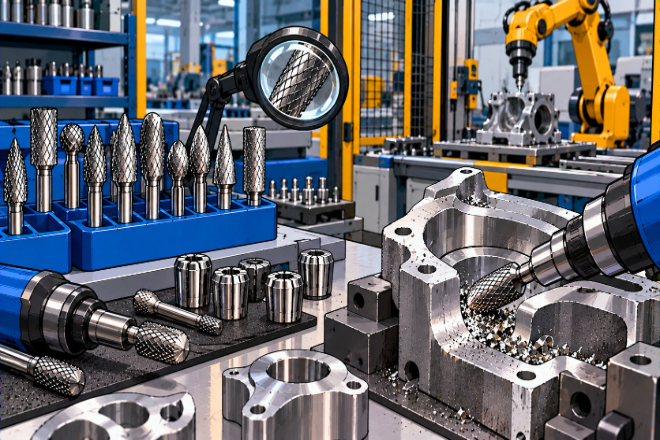
Preventing carbide burr breakage starts before the tool touches metal.
First, select the burr for the actual material and operation.
A tool used for aggressive weld removal has different demands from one used for light edge finishing.
Second, inspect the complete setup.
The burr, collet, holder, spindle, grinder, and workpiece all influence stability. Third, standardize operating conditions.
For repeat work, companies can record the burr type, approved speed range, typical application, tool reach, and replacement condition. This is especially useful when several operators or automated cells perform the same job.
Tool inspection should also become routine.
Rechercher:
Chipped teeth
Cracks or visible head damage
Bent or damaged shanks
Unusual wear
Increasing vibration
Reduced cutting performance
A damaged burr should not be sent back into production just because it still rotates. Storage matters too.
Carbide burrs should be protected from impact. Throwing them together in a metal drawer can damage cutting teeth before the tools even reach the machine.
For automated deburring, companies should monitor tool life instead of waiting for sudden failure. A predictable replacement point can be cheaper than an unexpected broken burr, stopped cell, and damaged workpiece.
Finally, investigate repeated failures.
If one burr breaks after an unusual impact, the cause may be obvious. If five burrs break at the same point in the same operation, that is process data.
Check tool path, contact angle, feed, RPM, overhang, fixture stability, material variation, and holder condition.
Do not turn repeated breakage into a purchasing routine. The goal is not to become very efficient at ordering replacement burrs. The goal is to stop needing so many of them.
 English
  Español
  简体中文
简体中文  Français
  日本語
日本語  한국어
한국어  العربية
  Tiếng Việt