
1. Where Are Carbide Burrs Useful in Flange Repair?
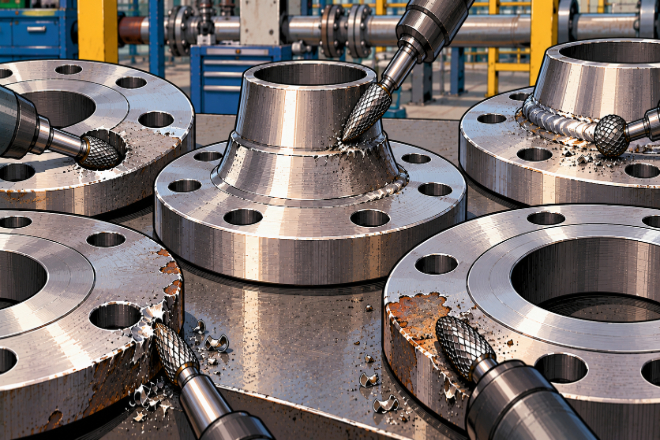
Flanges work in some unfriendly places.
Pipelines, pumps, valves, pressure equipment, chemical plants, refineries, power systems, and marine equipment can expose them to moisture, corrosion, heat, vibration, chemicals, and repeated maintenance.
When a flange is taken apart, the maintenance team may find more than an old gasket.
There can be rust around the outside diameter, burrs around bolt holes, damaged edges, rough weld areas, local mechanical damage, or metal that needs to be removed as part of an approved repair.
These are the kinds of jobs where a carbide burr for flange repair can be useful.
タングステンカーバイドバー have defined cutting teeth. They are made for applications such as deburring, levelling, surface work, hole work, milling out material, and working on weld seams.
Unlike a large grinding wheel, the burr has a small cutting head.
That gives the technician more access and allows metal to be removed from one specific area.
For example, imagine a flange with a burr around one bolt hole. There is little reason to bring a large grinder across the entire flange.
A small carbide burr can reach the hole, remove the unwanted metal, and leave the surrounding area alone.
The same applies to a rough outer edge or a repaired weld beside the flange body.
Carbide is also highly 耐摩耗性, making carbide burrs suitable for repeated work on steel, cast steel, stainless steel, and other common industrial materials when the correct cut is selected.
But there is one area where technicians need much more caution: the gasket seating surface.
A flange sealing face is not just another piece of metal that needs to look smooth. Its surface condition is part of how the gasket and bolted joint work. That changes the rules completely.
2. How Do Carbide Burrs Help With Bolt Holes and Flange Edges?
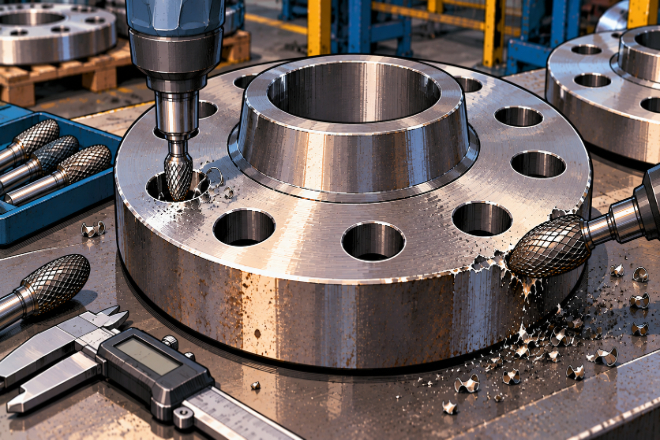
Bolt holes are one of the most natural places to use carbide burrs during flange repair.
A bolt hole may develop burrs or rough edges from previous fabrication, corrosion cleanup, mechanical damage, or repair work.
These small defects can interfere with inspection or make assembly more difficult.
A cone, ball, or small cylindrical carbide burr can reach inside the hole and remove local unwanted metal.
The key word is local. If the bolt hole has serious dimensional damage, is badly elongated, or needs to be restored to a controlled size, simply making it larger with a hand-held burr is not a proper repair.
That job may require machining, welding, inspection, or another approved repair method. Carbide burrs are better suited to deburring and controlled cleanup.
The outer diameter of the flange can create similar jobs.
Edges may become sharp or damaged during removal, handling, transportation, or previous maintenance. Corroded areas may also require local preparation before an approved repair or protective treatment.
Different burr shapes can help here. A cylindrical burr works well on straighter surfaces. A ball burr can follow rounded corners.
An oval burr is useful for blending changing surfaces. Tree and flame shapes can work around curved flange features. Cone-shaped burrs can reach narrow areas and openings.
The operator should choose the smallest practical shape that gives good contact with the repair area. A burr that is too large makes control difficult. One that is far too small turns a simple job into a long afternoon.
Flange repair is often performed in locations where access is already limited. Pipes, valves, bolts, supports, and nearby equipment may leave very little room for a large finishing tool.
A compact straight grinder and carbide burr can be much easier to position.
That flexibility is one of the strongest reasons to keep carbide burrs available in a flange maintenance tool kit.
3. Can Carbide Burrs Be Used on Flange Sealing Faces?
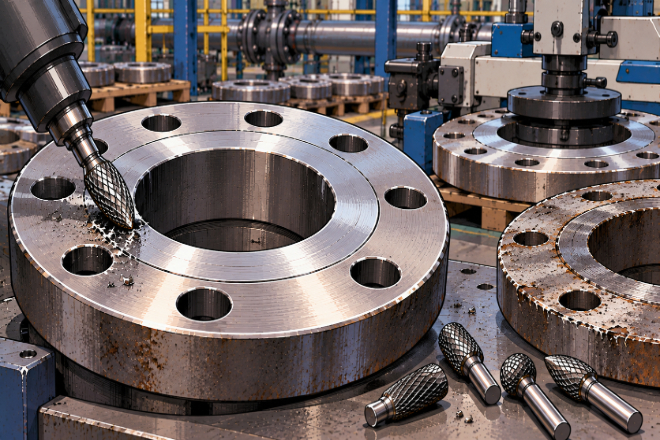
This is the part that needs a careful answer. A carbide burr can remove a raised burr from a flange surface in an approved repair process.
But it should not be treated as a general tool for freehand resurfacing of the gasket seating face.
Why? Because the sealing face has controlled geometry and surface finish.
Damage such as scratches, nicks, gouges, pits, dents, and burrs needs to be evaluated rather than automatically ground away.
A radial scratch crossing the gasket contact area can be especially important because it can create a possible leakage path.
The wrong response is: “There is a scratch. Grind it until it disappears.”
Removing the scratch may also remove important flange material or alter the required surface finish.
That can turn one defect into another. Industry flange-joint guidance calls for inspection of gasket seating surfaces and assessment of imperfections.
Where machining or weld repair is required, the work should follow the applicable approved repair process.
This means carbide burrs have a limited and controlled role around the sealing face. They may help remove an unwanted raised burr when the procedure allows it.
They should not be used to randomly polish, flatten, or reface the gasket seating area.
If the sealing surface requires restoration, dedicated flange-facing or machining equipment is normally the more appropriate approach because it can control flatness, finish, and geometry.
The difference is easy to remember: A carbide burr is excellent at removing a small unwanted piece of metal.
It is not a portable flange-facing machine. For maintenance managers, this boundary matters because a flange that looks cleaner is not necessarily a flange that will seal better.
4. How Are Carbide Burrs Used for Weld and Corrosion Repair?
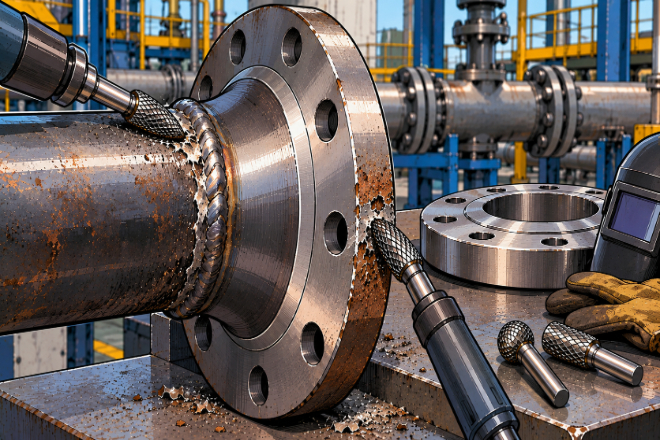
Flange repair is not always limited to the sealing face. Damage may appear around the flange body, neck, outer edge, or nearby welded connection.
This creates a much better working area for carbide burrs. Consider a welded flange connection.
If an approved repair procedure requires a local weld defect to be removed, a carbide burr can help open and clean a small repair area.
Its narrow cutting head gives the technician more control than a broad grinding disc in confined geometry.
After welding, a suitable burr may also be used for permitted local blending. Tree, flame, oval, and ball shapes are particularly useful because weld repair areas are rarely perfectly flat.
Corrosion creates another application. After equipment has been opened and inspected, a repair area may contain local rough metal or corrosion damage that needs preparation before further work.
A carbide burr can remove selected damaged or irregular metal when that removal is part of the approved repair plan.
But again, the burr does not decide how deep the repair should go.
If corrosion has reduced the flange below an acceptable thickness or changed important dimensions, simply grinding until the metal looks clean is not enough.
Inspection comes first. Repair comes second. This sequence is worth keeping: Clean → Inspect → Measure → Define the repair → Remove permitted material → Repair → Inspect again
That may sound slower than immediately reaching for the grinder.
It is usually faster than discovering later that useful evidence—or useful metal—has been ground away.
Carbide burrs are particularly good after the repair boundary is known. At that point, their fast cutting action becomes an advantage rather than a risk.
5. Which Carbide Burrs Work for Flange Materials?
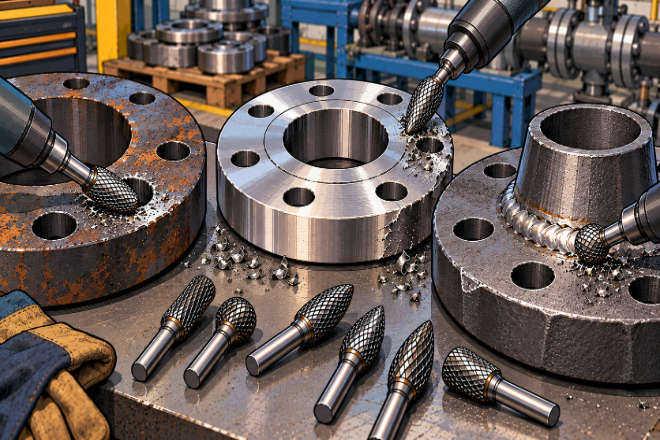
Flanges can be made from many materials depending on pressure, temperature, corrosion conditions, and service requirements.
Carbon and alloy steels are common. Stainless steel is widely used in corrosive service.
Cast steel and other alloys can also appear in industrial flange systems. The burr should match both the material and the repair job.
Carbide burr manufacturers offer cutting geometries developed specifically for steel and cast steel.
These tools can provide high stock removal while maintaining good guidance during operations such as deburring, levelling, surface work, and weld-seam work.
Stainless steel deserves its own tool choice. Stainless-specific cutting geometries can improve chip formation, reduce unnecessary heat, and provide smoother cutting.
This is useful when repairing stainless flanges because heavy rubbing is not what you want from the tool.
For general maintenance shops working across several metals, multi-material carbide burr designs are also available.
Shape then depends on the repair area.
6. What Mistakes Can Turn a Small Flange Repair Into a Big One?
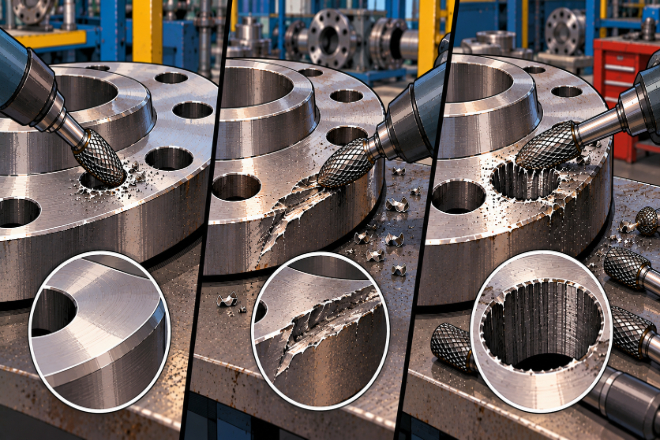
The first mistake is removing metal before the damage has been evaluated. A technician sees a gouge and reaches for the grinder. Thirty seconds later, the gouge is gone.
Unfortunately, so is the evidence needed to understand its original depth. Inspection should happen before aggressive metal removal.
The second mistake is freehand grinding of the gasket seating surface. The surface may look smoother afterward, but appearance is not the acceptance criterion.
Flatness, surface finish, defect position, flange type, gasket type, and service conditions can all matter.
Another mistake is heavy pressure. Carbide burrs are designed to cut. Forcing the burr against the flange can increase vibration and make the tool more difficult to control.
Let the cutting teeth work. Tool speed also needs attention.
There is no universal RPM for every carbide burr. Diameter, cut geometry, material, shank length, and manufacturer recommendations all influence operating speed.
Long shanks can improve access around flange necks and nearby piping, but excessive overhang increases the chance of vibration.
Use the shortest practical reach. The grinder itself matters too.
A worn collet or poor spindle can cause runout. High-quality carbide burrs are made with good concentricity because smooth rotation improves guidance and helps avoid chatter marks.
Stainless steel creates one more common mistake: contamination. Flange maintenance procedures may require approved cleaning tools and separation from carbon-steel tools. Follow the site’s material-control requirements.
And finally, do not confuse “more grinding” with “better repair.” A carbide burr can remove metal much faster than it can put it back.
That is a fairly important feature to remember when the flange belongs to expensive pressure equipment.
7. How Should Maintenance Teams Evaluate Flange Repair Burrs?
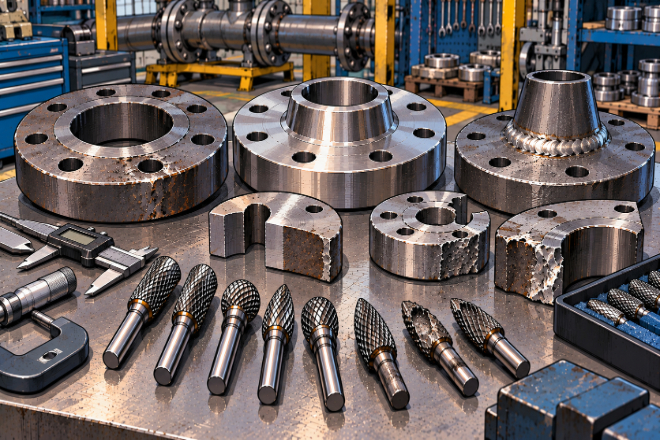
A maintenance company, refinery, plant, or repair contractor should evaluate carbide burrs on real flange work rather than a convenient piece of scrap steel.
Start with common repair tasks. Deburr bolt holes. Work around flange outer edges. Test weld-repair preparation on representative steel.
Try difficult areas around flange necks and welded connections. If stainless steel flanges are common, include the actual stainless grades used by the facility.
Then evaluate control.
Does the burr run smoothly?
Can technicians remove a small amount of metal without fighting the tool?
Does it chatter when working around a hole or curved area?
Check stock removal as well, but do not treat maximum removal speed as the only goal. Flange repair often rewards control more than aggression.
Tool life is another useful measure. A burr that stays sharp across many maintenance jobs can reduce tool changes, but consistent performance from one burr to the next is equally important.
Look at cutting geometry, dimensions, concentricity, shank condition, and the head-to-shank connection when comparing suppliers.
Also consider the burr inventory as a system. A maintenance team probably needs several shapes, but it may not need every shape in every diameter.
Look at the flanges normally serviced, the materials involved, common bolt-hole sizes, weld locations, and access problems.
Build the tool selection around those jobs. Most importantly, separate local repair tools from precision flange restoration equipment.
If the gasket seating surface requires machining, use the correct controlled process. If a bolt hole has a small burr or a weld repair needs local metal removal, that is where the carbide burr can shine.
The useful business measure is not price per burr. It is the cost of completing a safe and acceptable repair without creating another problem.
In flange maintenance, avoiding one unnecessary rework job can matter far more than saving a little money on the tool.
 English
  Español
  简体中文
简体中文  Français
  日本語
日本語  한국어
한국어  العربية
  Tiếng Việt