
1. Why Are Narrow Slots Difficult to Finish?
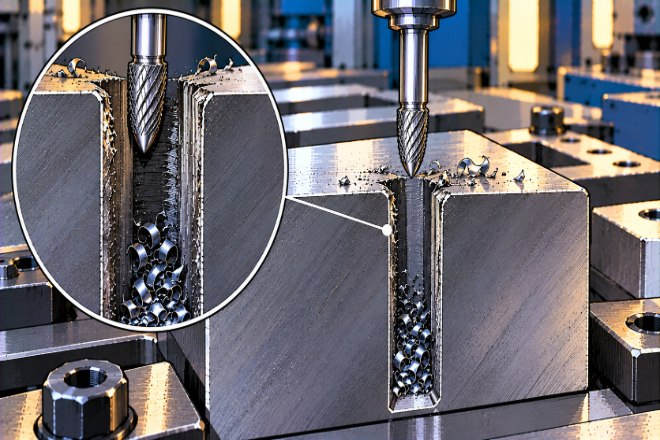
A narrow slot gives the cutting tool very little room to work.
Unlike an open metal surface, a slot has two sidewalls and often a bottom surface. These areas limit tool movement and make it harder to remove unwanted material.
For example, a CNC-machined steel component may have a narrow slot used to hold a small plate or guide. The slot width may be correct, but tiny burrs along the upper edges can prevent the mating part from fitting properly.
The manufacturer does not need to machine the entire slot again. Only the unwanted material needs to be removed.
However, that small correction can be difficult.
One common problem is limited tool clearance. If the cutting head is too wide, it may touch both slot walls at once. This can create unstable cutting forces and increase the risk of removing too much material.
Another problem is visibility.
In a shallow slot, the operator can usually see the working area. In a deep or enclosed slot, the bottom and sidewalls may be difficult to inspect.
Metal chips also have limited space to escape. They may collect inside the slot, especially when the opening is narrow.
This can affect the cutting action and leave scratches on finished surfaces.
Narrow slots are also sensitive to dimensional changes. Removing a small amount of material from both walls may increase the slot width beyond its allowed tolerance.
For this reason, narrow slot finishing is not simply about making the surface smoother.
The real goal is to remove unwanted material while protecting the slot’s width, depth, and function.
That is why manufacturers need to choose the tool and finishing method carefully.
2. Which Tungsten Carbide Burr Shapes Work Best for Narrow Slots?
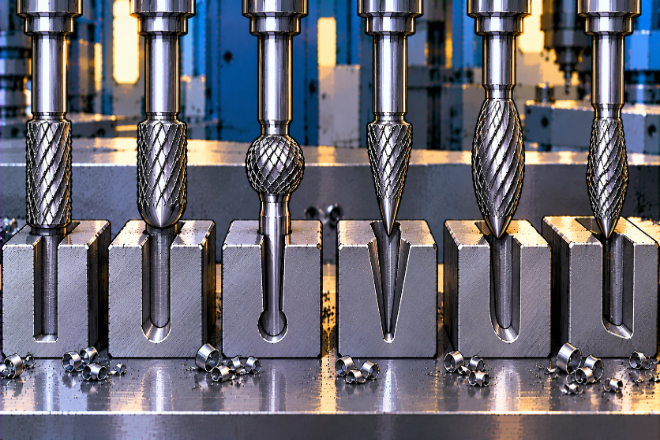
The best tungsten carbide burr for narrow slots depends on the shape of the slot and the area that needs finishing.
A small cylindrical burr is often a practical starting point for straight slot walls.
Its cutting sides can remove raised material along an accessible wall. However, the head must be smaller than the available working space so it does not become trapped between the two sides.
For a slot with rounded bottom corners, a radius-end cylindrical burr may be more suitable.
Its rounded end can help blend the transition between the sidewall and bottom without leaving a sharp corner.
Ball-shaped carbide burrs are useful for local curved areas. They can also help remove a small defect near a rounded slot end.
However, a ball burr is not always the best tool for finishing a long, straight wall because its contact shape is different from that of a cylindrical burr.
Cone-shaped burrs can reach certain angled openings and narrow transitions.
They may be useful when the slot has tapered sides or when a small raised edge needs local correction.
Flame-shaped and pointed-tree burrs can also work on irregular slot profiles, provided there is enough clearance for safe movement.
A useful selection guide is shown below.
3. How Do Burr Diameter and Cutting Pattern Affect Slot Finishing?
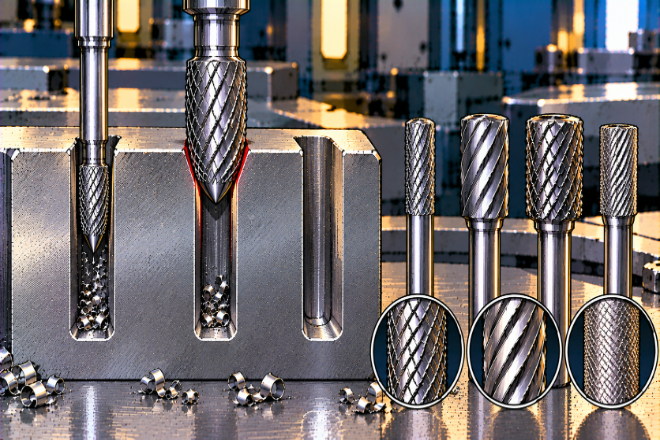
When finishing narrow slots, burr diameter is often more important than cutting speed.
A burr that is almost the same width as the slot may seem like a good fit. In practice, it can be difficult to control.
If the cutting head touches both walls at once, the tool may chatter, jam, or remove material from areas that should remain untouched.
Using a smaller head creates more clearance.
This allows the operator to work on one wall or local defect instead of cutting both sides together.
However, smaller tools have their own limitations.
A very small carbide burr may not be suitable for removing heavy material. It may also require more passes to finish a long slot.
The correct diameter should therefore be selected according to the slot width, defect size, and available tool movement.
The cutting pattern also affects the result.
A more aggressive cut can remove material quickly, which may be useful when a slot contains thick casting flash or a large raised area.
For light finishing, a finer cutting pattern may provide better control and a more even surface.
Double-cut carbide burrs are often useful for general metal finishing because their crossed teeth produce smaller chips and can make cutting easier to control.
However, a dedicated fine-finishing cut may produce a better surface when the work requires very light material removal.
The workpiece material must also be considered.
Steel and stainless steel can require different cutting patterns. Aluminum may need a burr with wider, more open flutes to reduce chip loading.
Inside a narrow slot, clogged teeth can quickly become a problem because chips have little room to escape.
For manufacturers, the best combination is usually a burr diameter that provides safe clearance and a cutting pattern that matches the amount of material being removed.
A smaller burr is not automatically better, and a more aggressive cut is not automatically faster.
The correct choice depends on the complete finishing operation.
4. How Can You Finish Slot Walls, Bottoms, and Corners Safely?
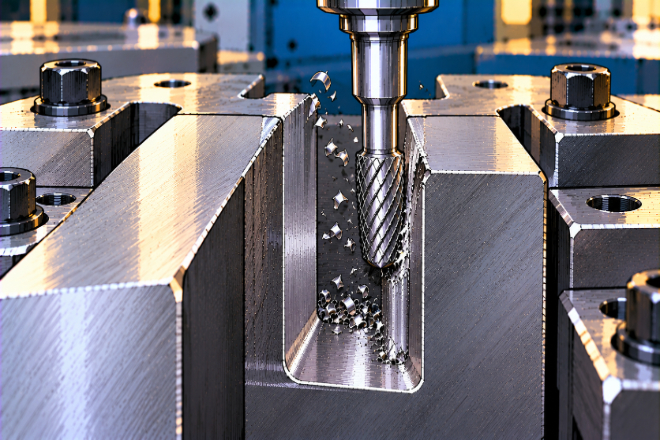
Different areas of a narrow slot require different cutting approaches.
The sidewalls are often the easiest surfaces to reach, but they are also sensitive to unwanted material removal.
When finishing a sidewall, the burr should contact only the area that needs correction.
Light, controlled passes can remove raised metal without changing the entire wall.
The bottom of the slot can be more difficult.
Not every carbide burr has cutting teeth on its end. A cylindrical burr without an end cut should not be used for direct plunge cutting into the slot bottom.
If bottom cutting is required, the selected burr must have a suitable end-cutting design and enough clearance for the operation.
Rounded corners create another challenge.
A sharp-edged cylindrical burr may not follow a rounded transition smoothly. A radius-end or ball-shaped burr may provide better access to the curved area.
However, the operator should avoid changing the intended corner radius.
This is especially important for slots used to locate other components.
A small change in the corner shape may prevent a mating part from sitting correctly.
Tool movement should remain steady throughout the process.
Holding the burr in one location for too long can create a local depression. Moving too quickly may leave raised material behind.
A useful finishing sequence is: Inspect the slot → Identify the defect → Select the burr → Remove material gradually → Clear chips → Check the result
Chip removal should be included between passes when necessary.
Metal chips trapped inside the slot can scratch the surface or interfere with the cutting head.
For blind slots, suitable air, vacuum, or other approved cleaning methods may help remove chips before final inspection.
The final step is to check the slot width, depth, and surface condition.
A slot that looks clean may still be outside its required dimensions.
5. How Do You Prevent Vibration and Tool Damage in Tight Slots?
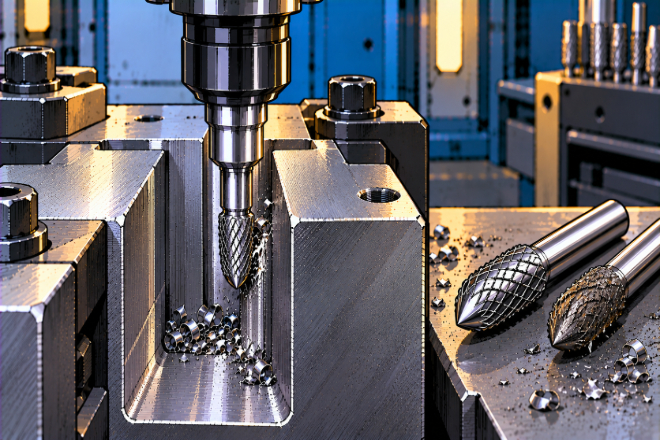
Narrow slots can create unstable cutting conditions because the burr operates close to surrounding surfaces.
One of the biggest risks is excessive tool contact.
If too much of the cutting head touches the workpiece at once, cutting forces can increase sharply.
This may cause vibration, rough surfaces, or damage to the burr teeth.
The best approach is to keep contact limited and avoid forcing the tool against the slot walls.
Tool holding is equally important.
A worn collet, loose holder, or excessive tool overhang can make a small burr vibrate even when the cutting pressure is low.
The tool should be held securely in a suitable drive, with the shortest practical overhang.
Operating speed must also match the tool.
There is no universal RPM for narrow slot finishing. The correct speed depends on burr diameter, material, cutting pattern, and application.
Using a speed outside the recommended range can lead to poor cutting performance or premature tool damage.
Deep slots may require additional reach.
Long-shank carbide burrs can reach certain difficult areas, but they need special operating conditions.
Some long-shank designs are not suitable for CNC, robotic, or other stationary machine applications because the extended shank may bend or break.
For these tools, the specified limits for speed, tool contact, and drive type must be followed.
Another common mistake is trying to remove too much material in one pass.
A narrow slot leaves little room for sudden tool movement. Heavy cutting can cause the burr to catch an edge or strike the opposite wall.
Several light passes are usually easier to control than one aggressive cut.
Tool wear should also be monitored.
Damaged or worn teeth can leave rough surfaces and increase vibration. If the burr begins cutting poorly, it should be inspected before continuing.
For production companies, these precautions are not only about protecting the tool.
They also help prevent damage to expensive components that may already have completed several machining operations.
6. When Should Manufacturers Use Carbide Burrs Instead of Slot Milling Tools?
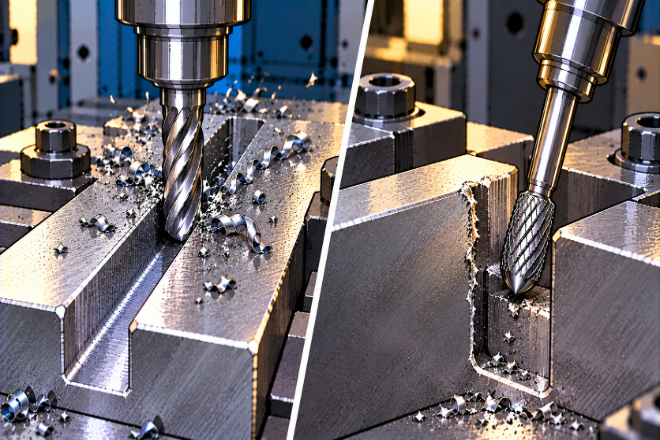
タングステンカーバイドバー are useful for narrow slot finishing, but they are not always the best tools for producing the slot itself.
The difference comes down to the required result.
If a manufacturer needs a new slot with an exact width, depth, and straightness, a dedicated slot milling cutter or small end mill is generally more suitable.
These tools are designed to produce controlled dimensions during machining.
A carbide burr is more useful when the slot already exists and only needs local correction.
For example, a machined steel component may have a small burr along one side of a narrow slot.
The slot dimensions are already correct, so machining the entire feature again would remove unnecessary material.
A small tungsten carbide burr can target the raised edge without changing the rest of the slot, provided the operation is controlled.
Carbide burrs are also useful for repairing irregular slots in cast components.
A casting may contain a narrow channel with local flash or rough areas. A suitable burr can remove these defects without requiring a complete milling operation.
For maintenance work, this flexibility can be valuable.
Some large industrial components are difficult to remove from their installed positions. A compact rotary tool and suitable carbide burr may allow local slot cleanup without extensive disassembly.
However, the process still needs to protect critical dimensions.
If the slot is used for a precision guide, sealing component, or tightly fitted part, a dedicated machining or finishing method may be more reliable.
For production managers, the choice should consider total cost rather than tool price alone.
A carbide burr may reduce setup time for small corrections. A dedicated milling cutter may offer better speed and consistency when producing thousands of identical slots.
Inspection requirements also affect the decision. If every slot must meet a tight tolerance, the process should include suitable measurement and quality control.
The best tool is not always the one that removes metal fastest. It is the one that produces an acceptable slot with the least unnecessary work.
 English
  Español
  简体中文
简体中文  Français
  日本語
日本語  한국어
한국어  العربية
  Tiếng Việt