
1. Why Are Carbide Burrs Useful in Shipbuilding?
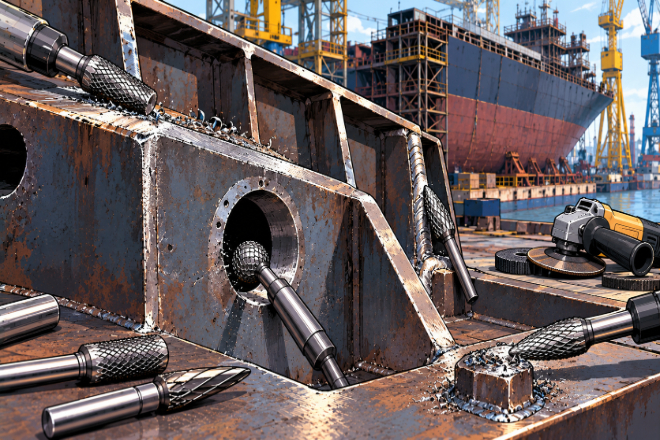
Shipbuilding involves cutting, forming, welding, drilling, fitting, and coating huge amounts of metal.
Steel is the obvious material. Depending on the vessel and system, shipyards may also work with stainless steel, aluminum, cast materials, and other alloys.
After all that fabrication, surfaces are rarely perfect.
A cut plate may have a rough edge. A drilled hole may need deburring. A weld area may contain extra metal. A corner may need rounding before the coating process. A repaired part may need local shaping before it can return to service.
Large grinding tools handle many of these jobs very well. But they are not perfect everywhere.
Try putting a large grinding wheel inside a narrow opening or around a complicated welded joint and the problem becomes clear fairly quickly.
あ tungsten carbide burr is much smaller and available in many shapes. It can reach corners, holes, curved areas, narrow joints, and local defects while removing material in a controlled way.
Carbide burrs are commonly used for operations such as deburring, leveling, hole work, surface work, and machining weld seams on steel and stainless steel.
The carbide cutting edges are also highly wear-resistant, making them useful when repeated metal removal is required.
For a shipyard, however, the main advantage is not simply hardness.
It is flexibility. One small rotary tool can go where a much larger grinding tool simply cannot.
2. How Are Carbide Burrs Used Around Welded Steel Structures?
Walk through a shipyard and you will not need long to find a weld.
Hull sections, decks, frames, bulkheads, supports, pipes, brackets, and many other structures depend on welding.
That creates plenty of work for finishing tools.
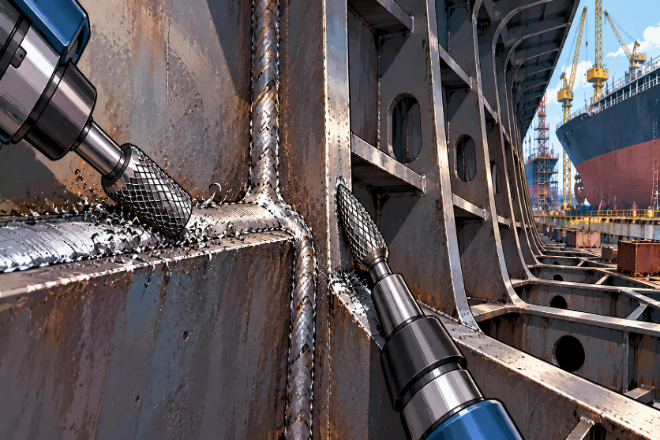
超硬バー can remove small raised sections around welds, clean difficult corners, blend local areas, and prepare metal where further welding or finishing is required.
They are especially useful where access is limited.
For example, a weld located between structural ribs may leave little room for a large disc. A tree-shaped or flame-shaped carbide burr can enter the area more easily and follow the changing shape of the joint.
A cylindrical burr can work along flatter welded areas.
A ball burr can reach rounded corners and curved joints.
Cone shapes can work around narrow grooves or openings.
For weld preparation, specialized burr geometries can also create controlled chamfers on edges.
This is useful when a defined edge shape is required before joining.
The important point is that carbide burrs are not supposed to replace every grinding or weld-preparation tool in a shipyard.
If meters of heavy weld need to be removed, a larger tool may be much faster.
The burr becomes valuable when the work gets smaller, tighter, or more complicated.
Think of it as the tool that arrives after the big grinder says, “I can’t fit in there.”
3. Why Are Carbide Burrs Used Before Anti-Corrosion Coating?
This is one of the more interesting uses of carbide burrs in shipbuilding.
Ships spend their working lives surrounded by an environment that is very good at creating corrosion.
Protective coating systems are therefore extremely important.
Before a coating is applied, the steel surface and its edges need proper preparation.
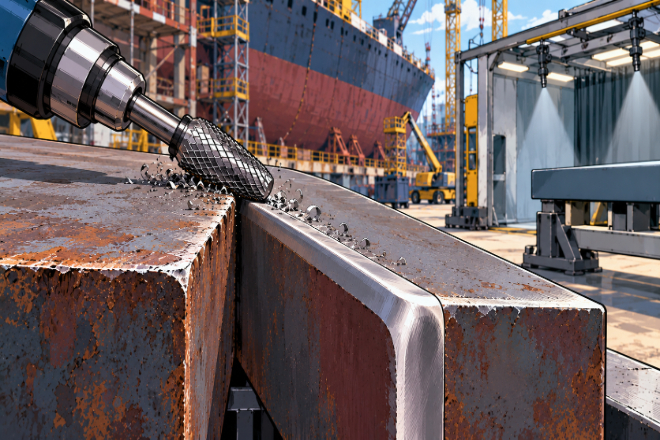
Very sharp edges can be a problem because coating thickness can be harder to maintain around them. For this reason, shipbuilding surface preparation can include breaking or rounding edges before the protective coating is applied.
Special edge-cut tungsten carbide burrs are available specifically for this kind of job.
Instead of allowing an operator to freely grind an edge and guess when it looks right, these tools can be designed to produce a defined radius or chamfer.
That changes the burr from a simple material-removal tool into a more controlled edge-preparation tool.
For shipyards, this can be useful on steel plates and structures that will later receive anti-corrosion protection.
The difference may look small. One edge is sharp. The other is properly prepared.
But on a ship containing an enormous number of exposed steel edges, small details can become very large maintenance issues.
This is why tool selection should consider what happens after the burr operation.
The job is not simply: remove metal → finished. It may actually be: prepare edge → clean surface → apply coating → protect structure.
Looking at the whole process gives purchasing and production teams a much better reason for choosing the correct burr.
4. Where Do Carbide Burrs Help With Holes, Pipes, and Tight Areas?
Ships are full of places that are not easy to reach.
There are pipe systems, brackets, frames, access openings, machinery foundations, structural corners, and many other areas packed into limited space.
This is where burr shape becomes important.
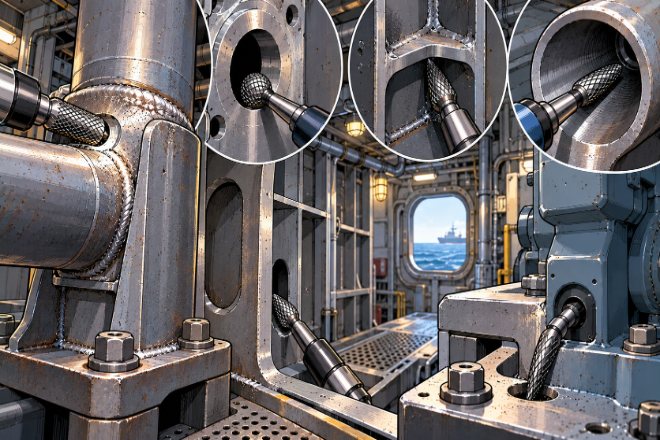
A cylindrical burr is useful for straight walls, flat areas, and some edge work.
A ball burr can follow rounded openings and curved surfaces.
An oval burr is useful for smooth contour work.
Tree and flame burrs fit changing curves and angled areas.
Cone and pointed shapes can reach narrow openings, grooves, and tight corners.
Carbide burrs can also be useful after drilling or cutting holes.
A hole may have a sharp burr around its edge or need minor local correction before assembly.
A small rotary burr can remove the unwanted material without requiring a much larger machine.
The same idea applies to pipe fabrication.
Local weld areas, openings, and edges may need cleanup during fitting or repair.
The correct burr can reach these features without removing large amounts of nearby metal.
But size matters.
A burr that is too large may contact too much of the workpiece at once. A burr that is too small may make a simple job unnecessarily slow.
Long-shank burrs can improve access in some situations, but longer reach can also make vibration harder to control.
More reach sounds useful until the burr starts dancing.
Then it becomes considerably less charming.
Production teams should therefore choose reach based on actual access requirements rather than automatically selecting the longest tool available.
5. What Changes When Working on Stainless Steel and Aluminum?
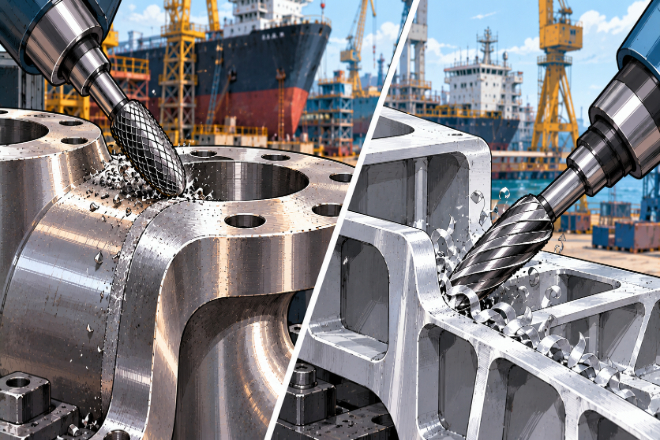
Not every shipbuilding job involves ordinary carbon steel.
Stainless steel is widely used where 耐腐食性, cleanliness, or specific service conditions make it useful. Aluminum is also important in certain vessels and marine structures where lower weight is valuable.
These materials do not behave exactly like shipbuilding steel.
For stainless steel, a suitable carbide burr should cut efficiently without creating unnecessary rubbing and heat.
Material-specific burr geometries are available for stainless steel and can be used for deburring, leveling, surface work, holes, and weld seams.
Aluminum creates a different problem.
It is softer and can stick inside closely spaced cutting teeth.
A burr may still look perfectly good from a distance while its flutes slowly fill with aluminum.
Soon it stops cutting properly.
For aluminum ship structures and components, open flute designs made for aluminum or soft non-ferrous metals are usually a better option. The larger space between cutting teeth allows chips to escape more easily.
This is why a shipyard should not have one box marked “carbide burrs” and expect every tool inside to work equally well on every metal.
Material-specific selection can improve cutting, chip removal, surface quality, and tool life.
A simple production guide can look like this:
6. How Are Carbide Burrs Used in Ship Repair and Maintenance?
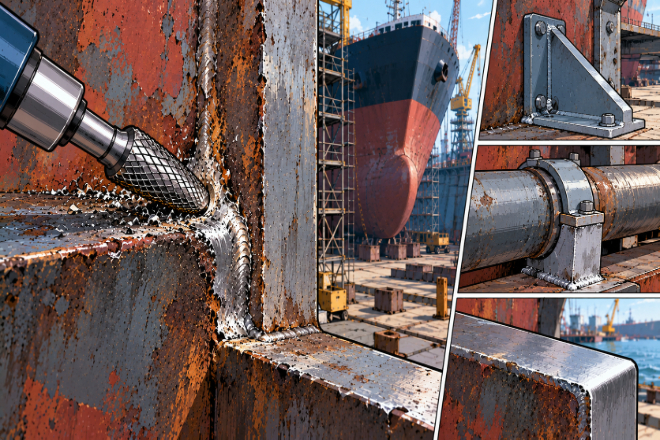
Building a ship is only the beginning.
Ships spend years in service, and eventually something needs repairing.
Actually, many things need repairing.
During dry dock work and marine maintenance, damaged or corroded metal may need removal. Welded repairs may need cleanup. Old brackets and fittings may be replaced. Holes and edges may need local correction before new components are installed.
Carbide burrs are useful in these situations because repair work is rarely as neat as new production.
The operator may be working inside an existing structure where access is poor.
The surface may be uneven.
The repair area may sit beside parts that must not be damaged.
A compact rotary tool can be easier to control in these conditions than larger equipment.
Carbide burrs can also be useful for preparing small local areas before welding or cleaning repaired weld areas afterward.
For maintenance teams, a useful burr selection may include several shapes rather than large numbers of one type.
That gives workers options when they meet unexpected geometry.
And ship repair contains plenty of unexpected geometry.
However, workers should still avoid turning the burr into a universal rescue tool.
Deep corrosion, major structural removal, precision machining, and large weld preparation may require other equipment.
The carbide burr is best when the repair needs controlled, local metal removal.
Knowing when not to use it is part of using it well.
7. How Should Shipyards Choose Carbide Burrs for Production?
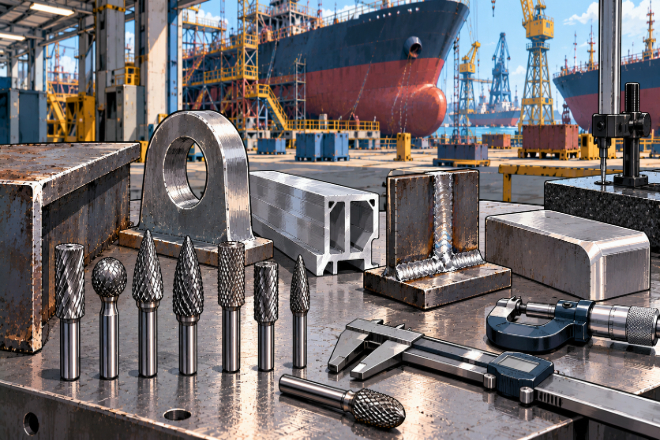
For shipyard managers and purchasing teams, the cheapest burr per piece is not necessarily the cheapest burr to use.
Start with the materials being processed.
If most work is carbon steel, the burr range should reflect that.
If stainless steel and aluminum are common, dedicated options for those materials may make more sense than forcing one general-purpose cut to handle everything.
Then look at the actual jobs.
Are workers mostly cleaning welds?
Rounding edges?
Deburring holes?
Working inside narrow structural areas?
Doing repair work?
The answer determines which shapes, cuts, and sizes should be stocked.
Tool quality also matters.
Check flute grinding, carbide quality, head-to-shank construction, dimensional consistency, and concentricity.
Poor concentricity can create vibration and chatter. In a long shipyard shift, that is not only a surface-quality issue. It can also make the tool less comfortable to control and increase wear.
Before ordering large quantities, test several burrs under real working conditions.
Do not test one tool for five minutes on a convenient steel plate and call the project finished.
Use actual shipbuilding materials and representative operations.
Measure how long the job takes, how much metal is removed, how the surface looks, how often the tool needs replacement, and whether performance stays consistent between burrs.
For edge preparation, check whether the required geometry can be produced reliably.
For weld work, look at both removal speed and control.
For long-reach applications, pay close attention to vibration.
For aluminum, watch for loading.
The purchasing team may see a carbide burr.
The production team sees minutes of labor attached to that burr.
At shipyard scale, those minutes matter.
 English
  Español
  简体中文
简体中文  Français
  日本語
日本語  한국어
한국어  العربية
  Tiếng Việt