1. What Casting Defects Can Carbide Burrs Help Repair?
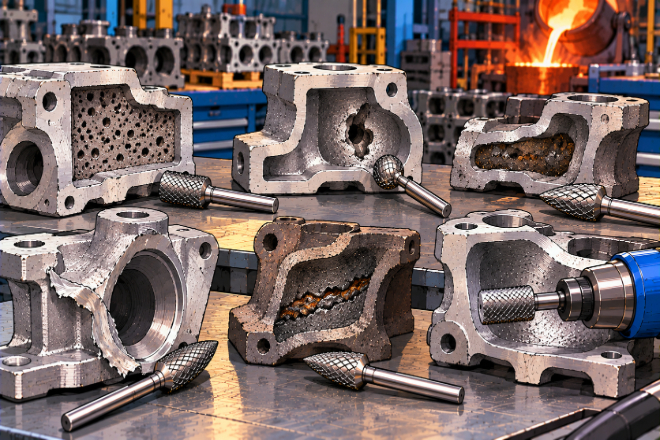
A casting can look solid from the outside while hiding small problems just below the surface.
Porosity, sand inclusions, slag, shrinkage cavities, flash, local surface defects, and cracks can appear during casting. Some are cosmetic.
Others may affect strength, sealing, machining, or later assembly.
The first job is therefore not simply to “grind away the bad area.” It is to understand what the defect is.
텅스텐 카바이드 버 are especially useful when a foundry or repair shop needs to remove a small, controlled amount of material around a defect.
They can reach irregular areas and create a clean repair zone before the next process.
Typical work can include:
Opening small surface cavities
Removing trapped sand or slag around an exposed defect
Cleaning local porosity
Removing flash and unwanted casting material
Preparing an approved area for weld repair
Blending a repaired area after welding
Cleaning edges around a machined opening
But the burr itself does not “heal” the casting. Think of it as a preparation and correction tool.
If a cavity needs welding, the burr prepares the cavity. If a repaired weld sits above the surrounding surface, the burr can help bring it back toward the required profile.
This distinction matters.
A carbide burr is very good at removing metal. It cannot decide whether a crack is structurally acceptable, whether porosity extends deep into the casting, or whether a critical component should be repaired at all.
Those decisions belong to the repair specification, inspection process, and engineering team. For high-value castings, that boundary is important.
The goal is not to save every casting. The goal is to repair the castings that can be repaired safely and economically.
2. How Are Carbide Burrs Used to Prepare a Casting Defect?
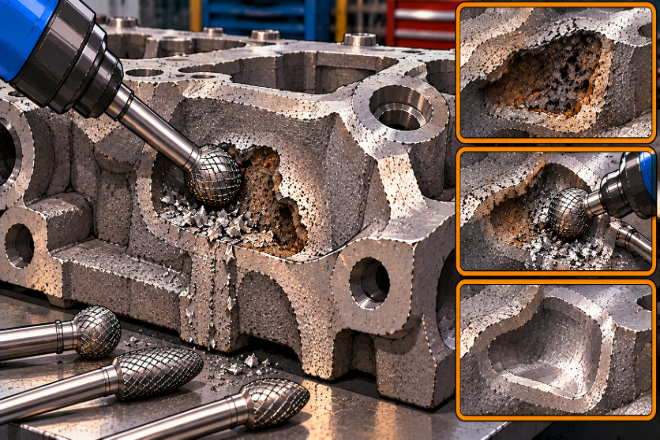
Once a defect has been identified and approved for repair, the damaged area often needs to be opened and cleaned.
This is where a tungsten carbide burr becomes particularly useful. Imagine a small surface cavity containing an inclusion.
Simply welding over the top would trap the unwanted material underneath. Instead, the defective area needs to be removed until the repair zone reaches sound material, according to the approved repair procedure.
A suitable carbide burr can gradually remove the surrounding metal. The operator can follow the shape of the defect rather than creating an unnecessarily large opening.
That control is valuable. A large grinding wheel may be excellent for broad open surfaces, but it can be awkward when the defect is:
Inside a corner
Around a curved wall
Inside a cavity
Near a rib
Close to another casting feature
Different burr shapes help solve these access problems. A ball burr can work inside rounded cavities.
An oval burr is useful for flowing curved areas. A tree or flame shape can reach narrow or changing profiles.
A cylindrical radius-end burr can remove material from a wider surface while still blending into a curved edge.
The repair area should be opened gradually. Remove a little material. Inspect. Continue only if needed.
A carbide burr can remove metal surprisingly quickly, especially with an aggressive material-specific cut.
That is useful until the operator forgets where to stop. The burr should expose the defect. It should not create a second defect.
After material removal, the area may require another inspection before welding or other repair work begins.
This helps confirm that the visible defective material has actually been removed rather than simply hidden by a smoother surface.
3. Which Carbide Burr Works Best for Different Casting Materials?
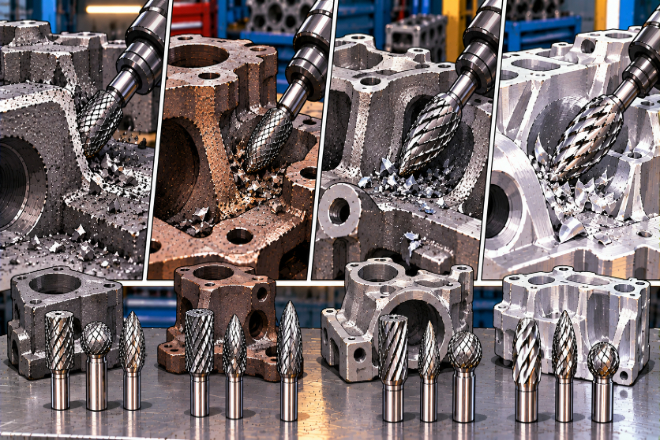
Casting repair covers more than one material. Cast iron, cast steel, aluminum, and other non-ferrous castings have very different cutting behavior.
Using the same burr for all of them can reduce productivity and tool life.
4. How Do Carbide Burrs Help Before and After Weld Repair?
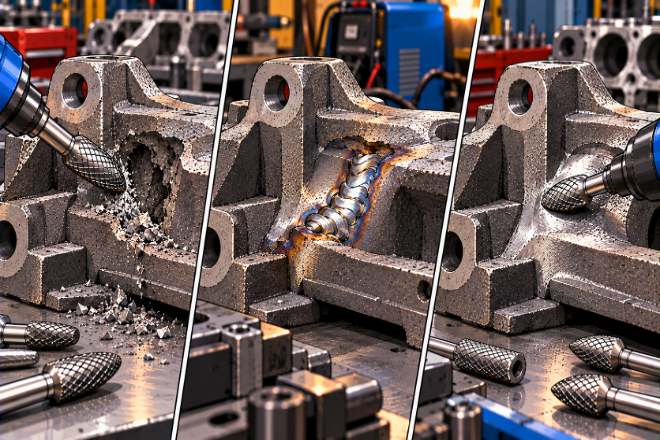
Many repairable casting defects involve more than material removal.
Welding may be used to restore approved defects such as cavities, porosity, inclusions, or other local damaged areas, depending on the casting material and repair procedure.
Carbide burrs can support both sides of that process.
1). Before Welding
Before repair welding, the defective material needs to be removed according to the approved procedure.
The burr can create a clean and accessible repair cavity. The aim is to remove the defect while maintaining enough sound base material around it.
The final cavity should also allow the welding process to reach the required area. A narrow opening with a large hidden cavity underneath is not very helpful.
This is why controlled shaping matters. The operator may begin with a smaller burr to follow the defect and then use a different shape to create better access.
2). After Welding
Once the repair weld has been completed and accepted for finishing, excess weld material may need to be removed.
에이 carbide burr can help level local weld metal and blend the repaired area into the surrounding casting.
Again, control is more important than aggression. The operator should avoid digging into the original casting simply to make the repair disappear faster.
For some components, the repaired area may later be machined. For others, local blending may be enough.
Critical sealing faces, bearing locations, precision bores, and other controlled dimensions normally need suitable machining or finishing processes rather than freehand burr work.
The carbide burr is excellent for local correction. It is not a replacement for a milling machine just because the milling machine is farther away.
5. How Can You Avoid Making the Casting Defect Worse?
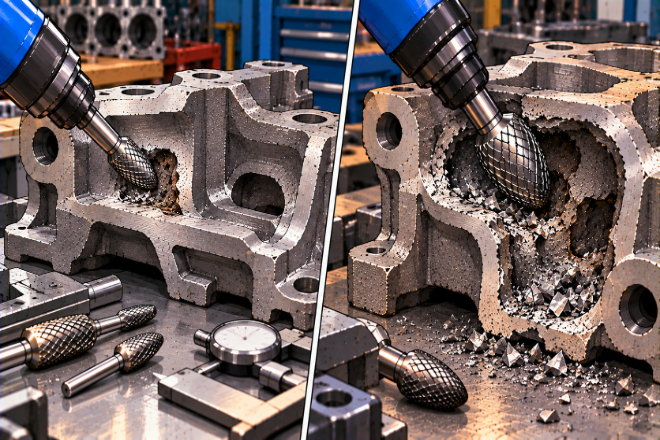
Casting repair has one slightly cruel rule: The tool used to remove a defect can create damage of its own if it is handled badly. The first risk is removing too much material.
If the operator sees porosity and begins chasing every visible pore without understanding the full defect, the repair area can become much larger than expected.
Inspection and repair limits should come first. The second risk is excessive pressure. Carbide burr teeth are designed to cut at speed. Heavy force can increase vibration, create rough marks, and make accurate control harder.
The third risk is poor access. A long-shank burr may be necessary inside a deep casting, but extra reach reduces stiffness. Side pressure can create vibration and make the tool difficult to control.
The fourth risk is using the wrong burr size. A large burr may remove metal quickly but can be too aggressive around a small defect.
Sometimes a smaller burr saves time because it reduces the chance of expensive overcutting. Tool condition matters as well.
A worn or damaged burr can create uneven cutting. A dirty or worn collet can increase runout. Poor spindle condition can add vibration.
Before blaming the casting, check the tool system. A good working sequence is: Inspect → Define the defect → Approve the repair → Remove defective material → Inspect again → Repair → Finish → Final inspection
That second inspection is easy to overlook. But making a cavity shiny does not prove the defect is gone.
For critical components, the required inspection method should follow the applicable repair specification.
6. When Should You Stop Using a Carbide Burr and Choose Another Process?
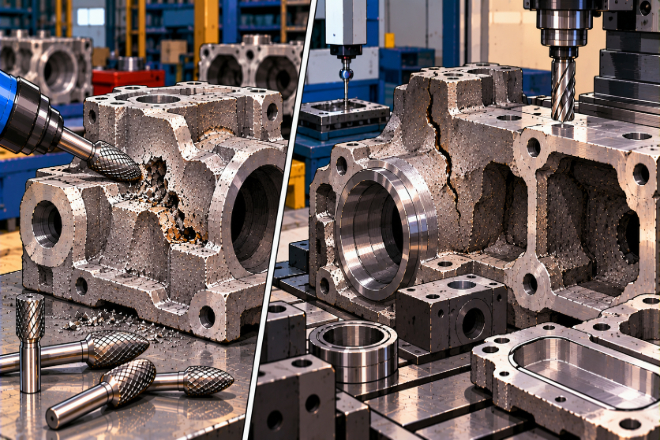
카바이드 버 are useful, but good repair planning also means knowing when not to use them.
A burr is a strong choice for controlled local metal removal. It becomes less suitable when the repair requires precise dimensional restoration over a large area.
Consider another process when the job involves:
Precision bearing fits
Large sealing faces
Critical machined bores
Exact flatness requirements
Large amounts of stock removal
Deep structural defects
Defects outside approved repair limits
A casting with a serious crack is a good example. The visible crack may only be part of the problem.
Grinding the surface until the line disappears does not prove that the crack has been fully removed.
The defect may require deeper inspection and an approved welding or machining procedure. In some cases, the correct decision may be to reject the casting rather than repair it.
The same applies to large shrinkage cavities or widespread porosity. At some point, repair time, inspection time, welding, machining, and quality risk can cost more than replacing the part.
This is where production management becomes important. The question is not: “Can we put a carbide burr on it?”
Almost anything made of metal can meet a carbide burr. The better question is: “Is local burr work the correct process for this defect?” That keeps the tool inside the job it does best.
7. How Can Foundries Build a Better Casting Repair Process?
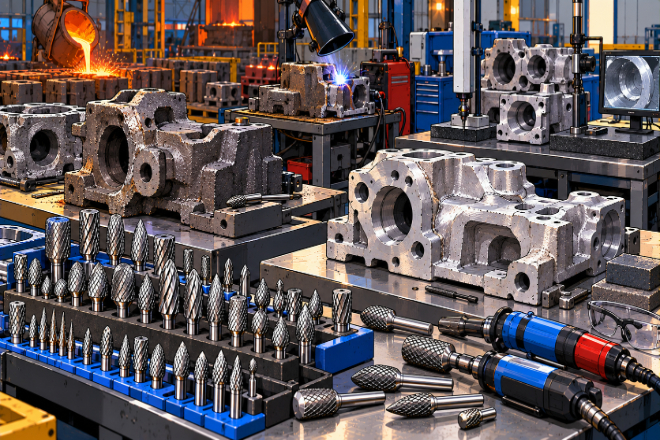
For a foundry handling repeated repair work, carbide burr selection should become part of a controlled system rather than a drawer full of random tools.
Start by grouping repair jobs.
예를 들어:
Small surface defects: Smaller ball, oval, or radius-end burrs.
Heavy cast-iron cleanup: Aggressive cast-iron-specific cuts.
Aluminum defects: Open-flute non-ferrous burrs that resist loading.
Deep cavities: Suitable long-shank burrs with controlled side pressure.
Weld blending: Shapes that follow the repaired surface naturally.
Then measure what happens.
Useful production data can include:
Repair time
Burr life
Material removed
Rework rate
Scrap rate after attempted repair
Surface quality
Tool changes
Operator consistency
This gives purchasing teams a much better way to compare carbide burrs. A cheaper burr is not really cheaper if operators need twice as long to open a defect.
An extremely aggressive burr is not automatically better either if it removes too much material and increases rework.
The best tool is the one that makes the repair process more predictable. Training also matters.
Operators should know which burr belongs to which material, how much pressure to use, when to change shape, and when to stop and request another inspection.
This last point may be the most valuable. A good casting repair operator does not simply know how to remove metal. They know when enough metal has been removed.
For decision-makers, that is where tungsten carbide burrs for casting repair become more than consumable tools.
Used correctly, they can support faster defect preparation, better repair control, and lower avoidable scrap.
 English
  Español
  简体中文
简体中文  Français
  日本語
日本語  한국어
한국어  العربية
  Tiếng Việt