
1. Why Is Trimming Aerospace Composite Parts So Challenging?
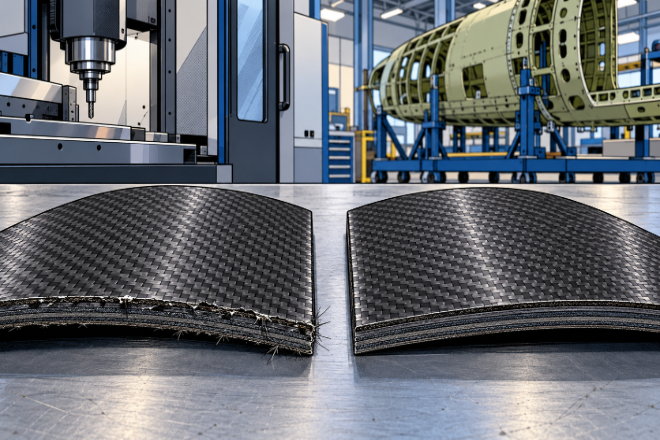
Carbon fiber-reinforced polymer (CFRP) is widely used in 항공우주 structures because it offers high strength at a low weight.
Glass fiber composites and other reinforced materials are also used in selected aircraft components.
Unlike solid metal, a composite contains fibers held together by a resin matrix.
The fibers provide strength, while the resin holds the material together. This structure makes composite trimming more complex than ordinary metal edge finishing.
Several problems can occur during cutting.
Fiber pull-out: Some fibers are pulled from the edge instead of being cut cleanly.
Delamination: Layers may separate when cutting forces are too high or poorly directed.
Rough edges: Exposed or broken fibers can make the finished edge uneven.
Heat damage: Excess heat may soften or damage the resin.
Fast tool wear: Hard carbon fibers can wear cutting edges over time.
These defects are not just cosmetic. They may affect assembly, part inspection, and the quality of the finished component.
For aerospace manufacturers, the goal is to remove excess material while keeping the composite structure intact.
That requires the right tool geometry, suitable cutting conditions, stable workholding, and careful inspection.
This is where selecting the correct 카바이드 트리밍 도구 becomes important.
2. Which Carbide Trimming Tools Are Suitable for Aerospace Composites?
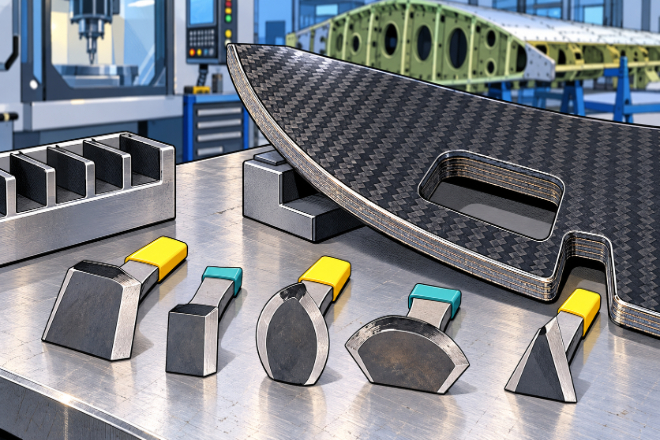
There is no single 카바이드 트리밍 도구 that works best for every aerospace composite.
The right choice depends on the material structure, edge shape, cutting depth, and required finish.
For certain low-volume trimming jobs, small edge-finishing tasks, and selected composite materials, carbide tools can provide a useful balance of precision, availability, and cost.
Three main design factors deserve attention.
1). Sharp Cutting Edges for Clean Trimming
A sharp cutting edge helps separate material cleanly instead of pushing or pulling fibers away from the resin.
For thin composite panels or small edge corrections, a suitable sharp carbide tool may help reduce roughness and limit unnecessary material removal.
However, sharpness alone is not enough. The cutting direction and tool geometry must also suit the fiber layout.
A tool that works well on one composite layup may produce poor results on another.
2). Suitable Flute Geometry for Chip Removal
Flutes provide space for chips and cut material to leave the cutting area. Their design affects cutting force, heat, and process stability.
Single-flute, double-flute, and spiral designs may suit different trimming tasks. The best option depends on the tool diameter, material, machine speed, and cutting path.
For composite parts, the aim is to remove material without creating excessive heat or pulling fibers from the edge.
3). Tool Geometry Matched to Part Shape
항공우주 composite components often include curved edges, narrow openings, and complex contours.
Small-diameter trimming tools can reach tight spaces, while other profiles may be better for longer edges or wider trimming paths.
Tool size must be selected carefully. A very small tool may reach a narrow area, but it can also be more likely to bend or break if the tool is too long or the cutting force is too high.
The best design is one that reaches the required area while remaining stable during cutting.
3. Should Manufacturers Choose Carbide, Diamond-Coated, or PCD Tools?
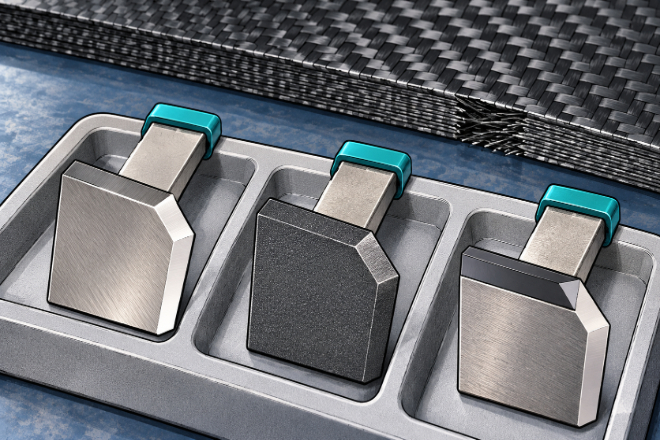
하지만 카바이드 트리밍 도구 can work for selected composite applications, they are not always the best choice for CFRP production.
Carbon fibers are highly abrasive. In demanding, high-volume trimming operations, uncoated carbide may wear too quickly to provide the best cost per part.
Diamond-coated tools and polycrystalline diamond (PCD) tools are also used for composite machining because of their strong resistance to abrasive wear.
The following comparison can help manufacturers narrow down their options.
4. How Do Carbide Trimming Tools Help Prevent Composite Edge Damage?
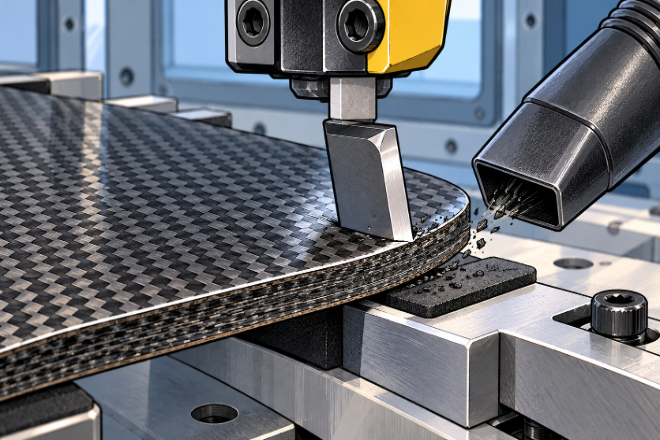
The purpose of composite trimming is not simply to cut off excess material.
The finished edge must remain free from unacceptable fiber damage, delamination, and resin defects.
A suitable 카바이드 트리밍 도구 can help when the tool geometry and cutting conditions are designed around the composite.
1). Control Cutting Forces
Excessive cutting force can pull fibers from the material or separate layers.
A sharp tool with suitable geometry can help reduce unnecessary force, although the result also depends on the cutting direction and fiber arrangement.
Tool engagement should be tested on the actual part rather than chosen by appearance alone.
2). Limit Heat Buildup
Composite resins can be sensitive to heat. If the cutting process creates too much heat, the resin may soften, discolor, or suffer other damage.
Suitable cutting speed, feed, tool condition, and chip removal all matter. Air cooling or another approved cooling method may be useful, depending on the material and process requirements.
3). Inspect the Finished Edge
A clean-looking edge does not always mean the composite is undamaged. Small areas of delamination or fiber pull-out may require close inspection.
Manufacturers should define acceptable edge conditions and use suitable inspection methods to confirm that the finished part meets the drawing and quality requirements.
5. What Factors Should Manufacturers Consider When Selecting Tools for CFRP?
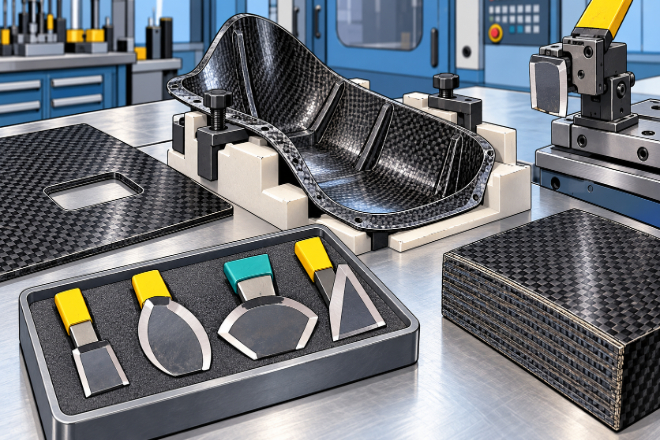
Choosing a trimming tool for 항공우주 composites requires more than checking whether it is made from carbide. The workpiece, machine, and required finish all affect the result.
6. How Can Manufacturers Reduce the Cost of Aerospace Composite Trimming?
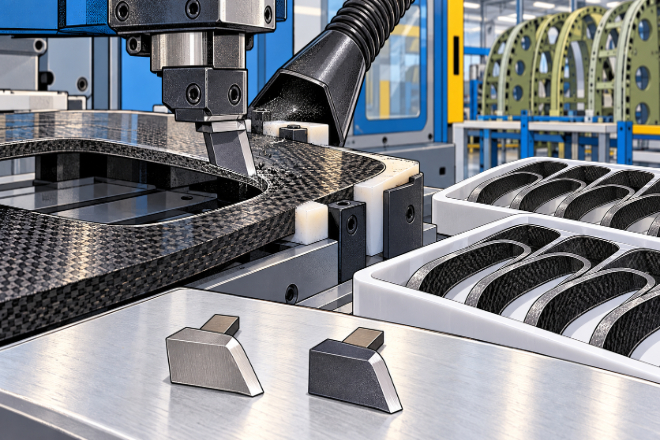
항공우주 composite parts can be expensive to manufacture, and a damaged edge may require extra inspection, repair, or even part rejection.
The finishing process therefore needs to balance tool cost, production time, and quality.
카바이드 트리밍 도구 may offer a lower initial cost for some applications, but a cheaper tool is not always the least expensive option over time.
Manufacturers should track:
Tool life: How many parts can be trimmed before edge quality drops below the required level?
Cycle time: How long does each finishing operation take?
Tool changes: How much production time is lost during replacement?
Rework rate: How often do parts need additional finishing?
Edge quality: Does the process meet the required inspection standard?
Cost per accepted part: What is the total cost of producing a component that passes inspection?
For example, an uncoated carbide tool may be suitable for a small batch but wear too quickly during long CFRP production runs.
A diamond-coated or PCD tool may cost more at the start yet reduce replacement frequency.
The right choice depends on the actual production conditions. A controlled trial helps manufacturers find the best balance between tool price, service life, and finished-part quality.
 English
 Español
 简体中文
 Français
 日本語
 한국어
 العربية
 Tiếng Việt