
1. What Are Precision Carbide Trimming Tools?
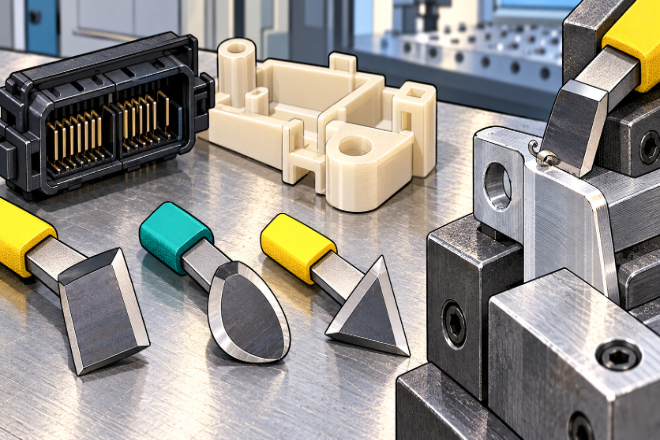
Độ chính xác dụng cụ cắt cacbua are small tungsten carbide cutters that remove burrs, thin flash, and unwanted material around part edges.
Think of them as the tools that handle the last small details before a component is ready for the next step.
Their work might involve cleaning an opening in a connector housing, removing plastic flash, or finishing the edge of a small metal part.
These jobs do not always remove much material, but they leave little room for error. Cut too little, and the defect stays. Cut too much, and a useful feature may disappear.
Tungsten carbide combines hard carbide grains with a metal binder, commonly cobalt. It supports chống mài mòn cutting edges, while the tool’s shape controls how those edges meet the part.
Here is the useful part for buyers: tool types overlap. One cutter can be small-diameter, double-flute, spiral, and coated.
These describe different features of the same tool. Understanding that makes product comparisons much easier.
2. When Are Single-Flute Carbide Trimming Tools Useful?
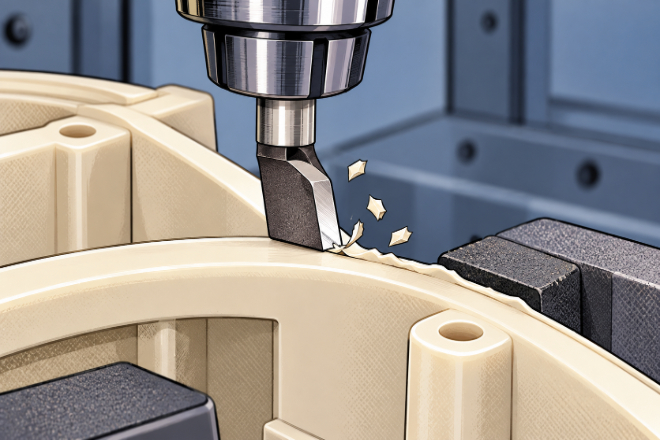
Sometimes, giving chips more room is more useful than adding another cutting edge. That is the thinking behind many single-flute carbide trimming tools.
With one main cutting flute, the design can provide generous chip space for its diameter.
This can help when trimming suitable plastics and other materials that tend to stick around the cutting area. Chips need a way out; otherwise, the cutter may meet the same material again.
Picture a molded plastic housing with a thin line of flash around an opening. The task seems simple, but a poorly matched tool can turn that small defect into a melted or rough edge.
A suitable single-flute design helps remove the flash while allowing chips to clear.
The word “suitable” matters. Unfilled plastic and glass-filled plastic should not be treated as the same job. Feed, speed, edge sharpness, and part support also affect the result.
For a useful trial, inspect more than appearance. Check the opening size, nearby walls, and whether operators still need to clean the edge by hand.
That extra handwork can quietly eat up the savings from a cheaper cutter.
3. How Do Double-Flute and Multi-Flute Trimming Tools Compare?
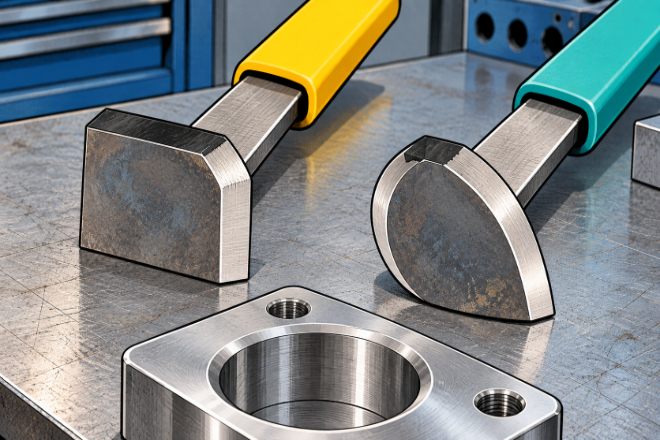
More cutting edges can be useful, but “more” does not automatically mean “better.” Double-flute and multi-flute tools need enough chip space for the work they are doing.
Two-flute dụng cụ cắt cacbua can offer a practical balance between cutting edges and chip clearance.
They are worth considering when the operation needs controlled material removal around a small edge or contour.
The actual fit depends on the workpiece and tool geometry.
Multi-flute tools place additional cutting edges around the tool body. They can be useful for light finishing cuts where the amount of removed material is small.
However, smaller chip spaces may become a problem if too much material enters the cut.
There is also a setup detail that is easy to miss. Changing flute count changes feed per tooth if spindle speed and feed rate stay the same.
Swapping cutters without reviewing the settings can lead to rubbing or an unsuitable cutting load.
For buyers, flute count is a starting point for discussion.
Ask what the design should improve on the actual part, then check burr size, finish, and acceptable output during the trial.
Extra flutes should solve a production problem, not simply make the specification look busier.
4. What Do Spiral-Flute Carbide Trimming Tools Offer?
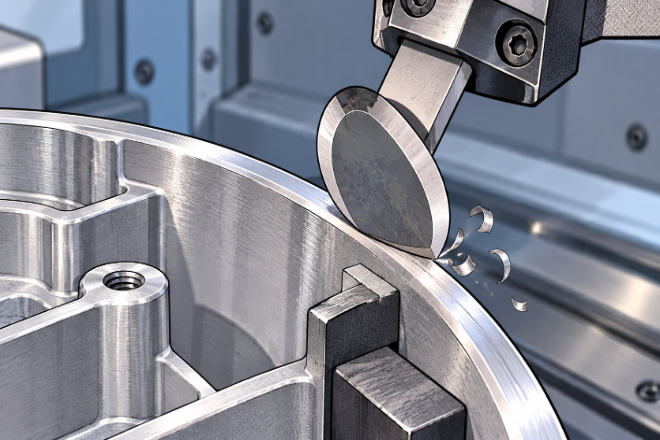
Spiral flutes twist around the cutter rather than running straight along it. That twist influences chip movement and the direction of cutting forces.
This matters when the trimming area is narrow. Chips left beside a small opening can interfere with the next pass or damage a finished surface.
A suitable spiral design helps guide removed material away from the contact area.
But chips are only half the story. The tool also pushes or pulls on the part as it cuts. A thin plastic wall may move, and a lightly supported metal feature may vibrate.
The cleanest-looking cutter in the box still needs the right fixture.
Imagine trimming the curved edge of a small aluminum housing. The tool must follow the shape while the fixture holds the wall steady.
If the part moves, the finished edge may vary even though the machine follows its programmed path.
When comparing spiral-flute dụng cụ cắt cacbua, ask about flute direction, chip flow, and cutting forces. Test them in the production fixture.
A result from a thick, rigid sample does not tell the whole story about a delicate housing.
5. When Are Small-Diameter and Micro-Trimming Tools Needed?
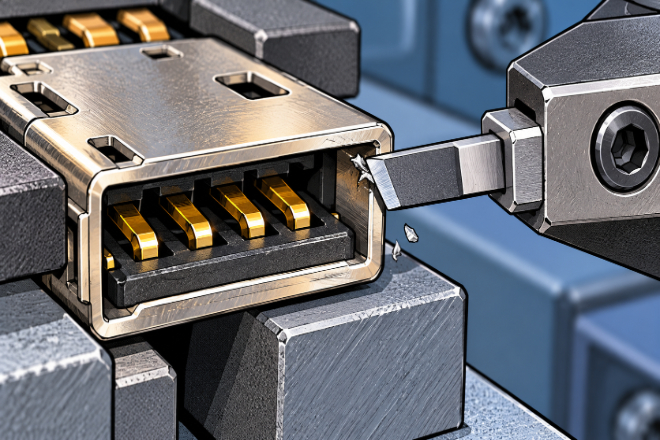
Some edges are simply too crowded for a larger cutter. Small-diameter dụng cụ cắt cacbua reach narrow openings, tight spaces, and details close to neighboring features.
The product range covers diameters from 0.5 mm to 6 mm. The choice of specific size depends on the available operating space, the desired edge profile, and the amount of material to be removed.
It is tempting to think a smaller tool must produce a more precise result. In practice, a thinner tool bends more easily. Give it too much unsupported reach, and the job becomes harder.
Consider a connector opening with a burr tucked beside a raised feature.
The tool needs enough clearance to reach the burr without touching that feature. Its cutting length and neck shape may matter just as much as its diameter.
Tool holding deserves attention too. Runout means the cutter rotates slightly away from its intended center. On a small tool, that can make the cutting edges work unevenly.
Before ordering, confirm cutting diameter, cutting length, shank size, and required reach. Those details are far more useful than choosing a tool because the description says “micro precision.”
6. Why Are Custom-Shaped Carbide Trimming Tools Available?
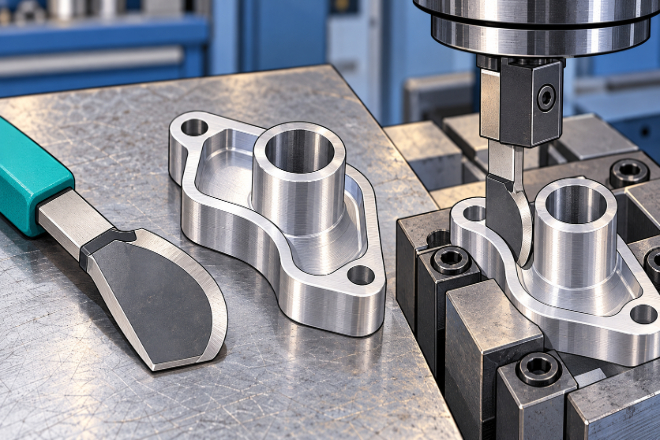
Sometimes the part drawing asks a question that a standard tool cannot answer neatly. A custom-shaped carbide trimming tool can match a specific edge profile or reach around a nearby feature.
The requirement might be a small bevel, a rounded edge, or a shaped section that must stay within tight limits.
A suitable custom profile may reduce the need for several passes or a separate hand-finishing step.
That can be valuable on a part produced thousands of times. A small saving per piece becomes easier to notice across a full production run.
On a design that changes every few weeks, however, special tooling may be harder to justify.
The best starting point is a clear part drawing and an explanation of the current problem.
Show where excess material appears, which surfaces may be cut, and which features must remain untouched.
Also check the less exciting details: replacement lead time, inspection requirements, and resharpening options.
They matter when the first tool wears out. A custom cutter should make production easier to repeat, including the second order and the tenth.
7. How Do Polished and Coated Carbide Trimming Tools Differ?
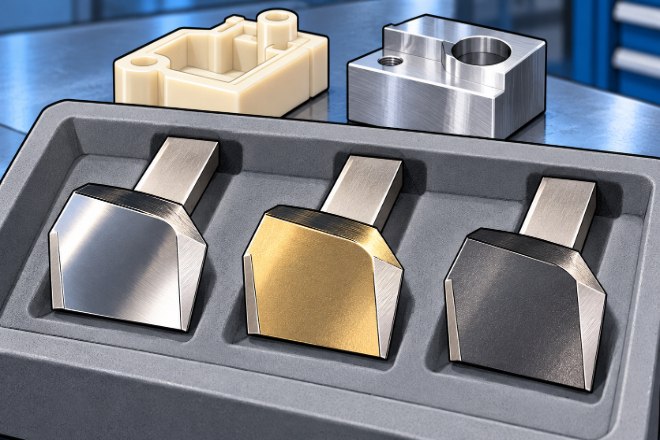
Two dụng cụ cắt cacbua can look almost identical and still behave differently at the cutting edge. Surface treatment is one reason.
Polished cutting surfaces can help reduce material buildup in suitable applications, including certain plastics and nonferrous metals.
When material sticks to the edge, the cutter may stop cutting cleanly and start leaving an uneven finish.
Coated tools add a thin surface layer to address selected wear and cutting conditions. Options may include TiN and TiAlN, but the names alone do not tell you which tool will work better.
A coating needs to match the material and process. It cannot rescue poor chip clearance, and it should not be selected simply because another workshop uses it successfully on a different job.
For very small cutters, coating thickness and edge preparation also deserve attention. Fine trimming depends on the condition and shape of the cutting edge.
The fairest test is straightforward: compare tools against the same part requirements.
Look at buildup, burr formation, tool wear, and finished size. The winning surface treatment is the one that delivers more acceptable work between changes.
8. How Can Manufacturers Choose the Right Type?
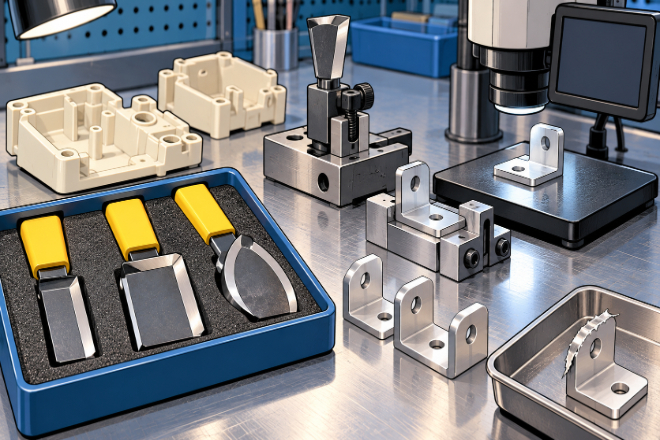
Start with the unwanted material. Is it a thin plastic flash line, a stubborn metal burr, or an edge that needs a defined shape? A clear description of the problem makes tool selection much faster.
Then name the material properly. “Plastic housing” is a useful start, but the material grade and fillers help explain how it will cut. For metals, alloy and condition also matter.
Next, bring the machine and fixture into the conversation. Check spindle capability, tool holding, available access, and support near the cutting area. The tool, part, and fixture have to work together.
When reviewing, combine the features into one specification. For example, the job may call for a small double-flute spiral cutter with a custom tip and polished cutting surfaces. You do not have to choose only one category.
Finally, measure the trial in production terms. Record acceptable parts per tool, cycle time, scrap, and replacement time. Include any cleanup that happens after the machine finishes.
A tool that lasts longer but leaves every part needing handwork may not be the cheaper option. The useful question is simple: how much does it cost to produce an edge that is ready for the next step?
 English
 Español
 简体中文
 Français
 日本語
 한국어
 العربية
 Tiếng Việt