
1. Why Do Aerospace Materials Need the Right Burr?
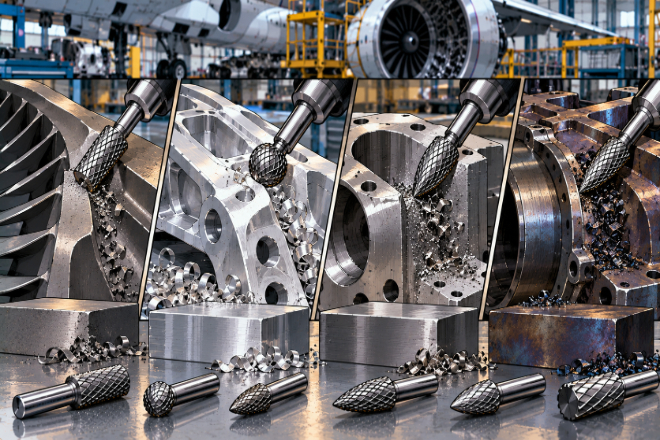
Hàng không vũ trụ manufacturing is not exactly an easy neighborhood for cutting tools.
Aircraft and aerospace equipment use materials chosen for strength, low weight, heat resistance, khả năng chống ăn mòn, or a combination of these properties.
Common examples include aluminum alloys, titanium alloys, stainless steels, and nickel-based heat-resistant alloys.
Great for aircraft. Not always great for the cutting tool.
Titanium is a good example. It can be difficult to machine, and poor cutting conditions can quickly create heat and tool wear. Nickel-based alloys are also demanding because they are strong and can keep their strength under high temperatures.
This is where tungsten carbide becomes valuable. The carbide cutting head is hard and chống mài mòn, allowing its sharp edges to work on materials that can quickly challenge softer tooling.
But độ cứng alone is not enough. The flute geometry must also match the material.
A burr designed for aluminum needs enough open space to help soft chips leave the cutting area. A burr used on hard titanium may need a different cutting geometry that provides good chip removal while reducing unwanted vibration.
So the phrase “carbide burr” only tells part of the story. In aerospace work, the more useful question is: Which carbide burr is right for this material and this operation? That small change in thinking can prevent a lot of trouble on the production floor.
2. Where Are Carbide Burrs Used on Aerospace Parts?
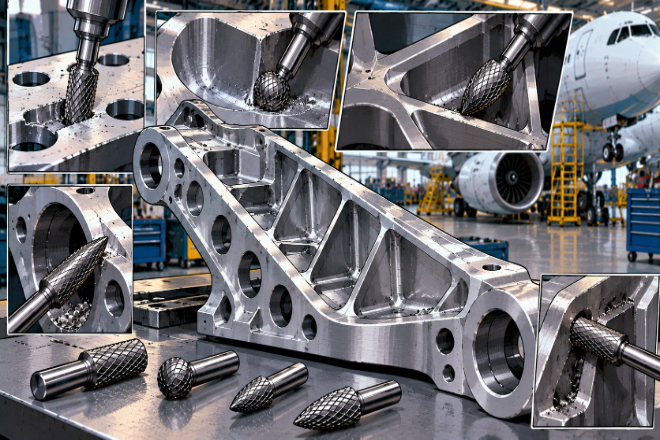
Tungsten carbide burrs are useful when a part needs local metal removal rather than a large machining operation. One common job is deburring.
Drilling, milling, and other machining processes can leave small sharp edges around holes, slots, and machined features. These unwanted edges may need to be removed before the part moves to inspection, assembly, or another finishing stage.
Carbide burrs can also be used for leveling small high spots, enlarging or correcting local openings where the process allows it, surface work, and weld cleanup.
They are especially useful when access is difficult. Think about an hàng không vũ trụ component with ribs, pockets, curved walls, narrow corners, and several holes packed into a small area.
A large grinding wheel is not going to be very happy in there. A small ball, tree, flame, cone, or cylindrical carbide burr can reach much more specific areas.
Different burr shapes make this possible. A ball burr can follow curved surfaces. A cylindrical burr works well along flatter walls and edges. Tree and flame shapes can reach changing contours.
Cone and pointed designs can work in tighter features. This makes the burr a flexible correction tool.
It does not replace CNC machining, reaming, or other precision processes when exact dimensions are required. Instead, it handles smaller jobs where controlled local removal is the real goal.
That difference is important in aerospace manufacturing. The burr should fix the unwanted metal. It should not redesign the part.
3. Why Are Carbide Burrs Useful for Titanium and Nickel Alloys?
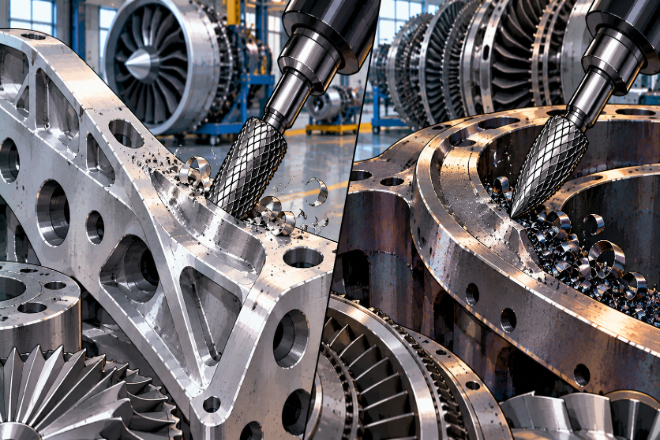
Titanium is one of the clearest examples of why material-specific burr selection matters.
Hàng không vũ trụ manufacturers use titanium alloys because they provide an attractive combination of strength, relatively low weight, and useful performance in demanding environments.
But titanium is not famous for making machining easy.
During burr work, good chip removal and stable cutting are important. A burr that rubs instead of cutting can create unwanted heat and poor performance.
Some tungsten carbide burr designs are made specifically for hard titanium alloys. These use tooth geometry intended to improve stock removal and chip flow while helping reduce vibration.
That can be useful for deburring, leveling, surface work, hole correction, and weld areas.
Nickel-based alloys create another challenge.
Materials in this family are used where strength and heat resistance are important. They can also be demanding on cutting edges.
General-purpose and fine-cut carbide burrs are available for nickel-based and other high-temperature-resistant alloys, but the exact burr should still be matched to the operation.
For both material groups, one rule is worth remembering:
Do not fight the material with pressure.
If a burr is struggling, pushing much harder is rarely the clever solution.
The cutting geometry, speed, burr condition, contact area, and machine stability should all be checked.
The burr should be cutting.
If the process starts feeling like an arm-wrestling contest, something probably needs changing.
4. How Do Carbide Burrs Help With Precision Deburring?
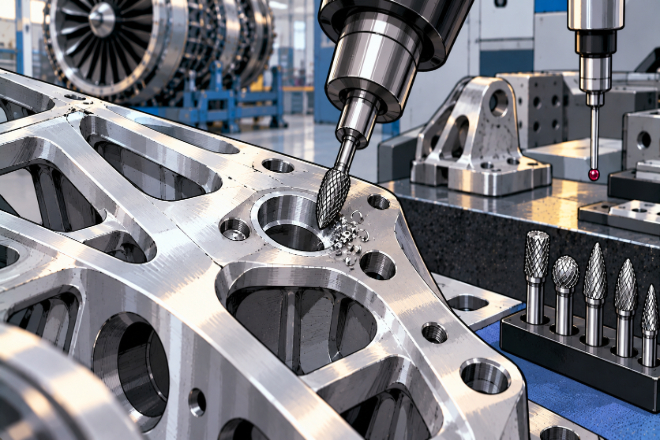
Hàng không vũ trụ deburring has an interesting problem. The material that needs to disappear may be tiny. The part around it may be extremely valuable. That changes the whole idea of productivity.
Imagine a machined aerospace component with a small burr around one opening. The operator does not need maximum material removal. The operator needs to remove that edge while leaving the nearby geometry alone.
A suitable fine or controlled-cut tungsten carbide burr can help with this type of work.
Good concentricity is important because a burr that does not rotate accurately can create vibration and chatter. That makes controlled finishing more difficult and can leave unwanted marks.
Burr size also matters. Using an oversized cutting head on a tiny feature increases the contact area and makes precise control harder.
The shape should match the feature as closely as possible. Here is a practical way to think about common aerospace burr jobs:
5. How Are Carbide Burrs Used on Aluminum Aerospace Parts?
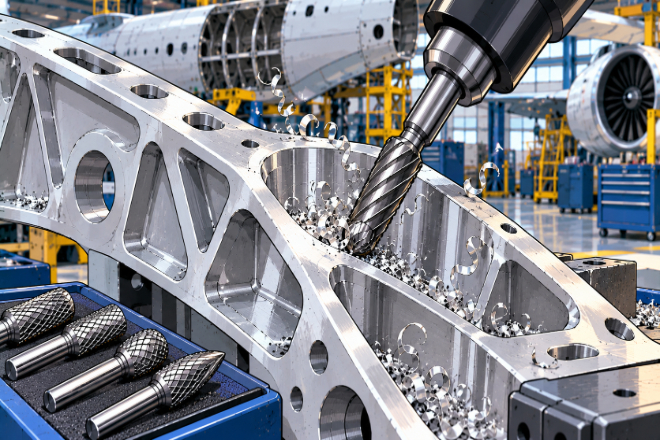
Not every aerospace material is extremely hard. Aluminum alloys remain important because low weight is valuable in aircraft structures and many other aerospace applications.
But softer does not mean problem-free. Aluminum can create its own headache: chip loading.
Soft aluminum chips may stick inside tightly spaced burr teeth. Once the flute starts filling, the burr cuts less efficiently and can begin rubbing against the part.
That produces more heat. The operator may push harder. Then the burr loads even more. It is a fairly boring cycle, and nobody needs more boring cycles in a factory.
For aluminum hàng không vũ trụ components, burrs with open flute geometry are generally a better choice. The larger space between cutting teeth helps the chips escape.
Pressure should also remain controlled. The goal is clean cutting, not forcing the carbide head into the aluminum. Burr shape should match the component as well.
Aerospace aluminum parts can include thin walls, pockets, ribs, openings, and curved structures. The right shape lets the cutting head reach the target without rubbing large areas of the surrounding surface.
This is especially important on thin or detailed components where unnecessary metal removal is unacceptable.
Aluminum may be easier to cut than titanium, but the process still deserves the correct tool. Different material, different problem.
6. Can Carbide Burrs Support Automated Aerospace Production?
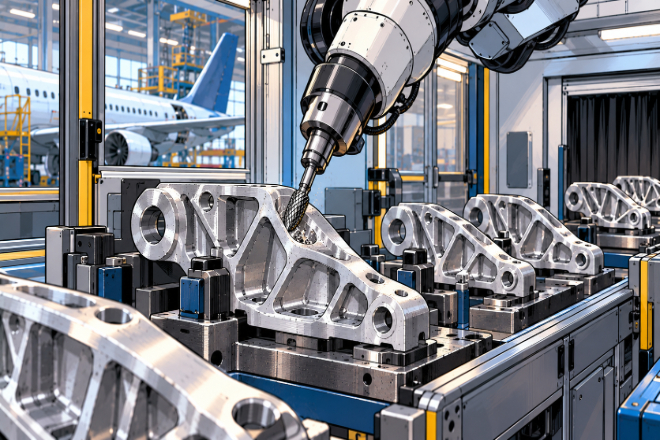
Carbide burrs do not have to stay in a hand-held grinder. They can also be used with machine tools, automated centers, drive spindles, and robotic systems.
That opens the door to automated deburring and finishing of repeat aerospace components. Consider a machined part that develops the same burr around the same feature after every production cycle.
If the component position is controlled and the required tool path is repeatable, an automated system can guide a carbide burr through the operation.
This can reduce variation between operators and make high-volume finishing more predictable. But automation is less forgiving of inconsistent tools.
An experienced operator can notice a change in sound, vibration, or cutting feel. A programmed system follows its path.
That means burr concentricity, cutting geometry, tool wear, spindle condition, fixture accuracy, and part position all become important.
The burr needs to behave consistently from one tool change to the next. This is where purchasing decisions and process engineering meet.
Buying a cheaper burr that varies significantly from batch to batch may save a little at the purchasing stage and create a much larger headache in an automated cell.
Robots are excellent at repeating things. Unfortunately, that includes repeating bad processes.
7. What Should Aerospace Buyers Look for in Carbide Burrs?
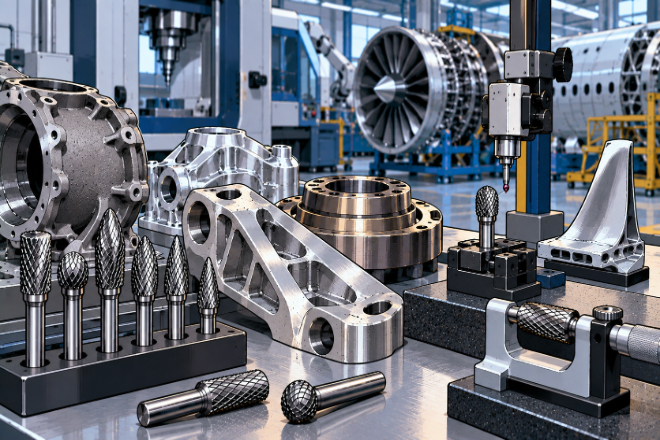
Vì hàng không vũ trụ manufacturers, burr price should be fairly low on the list of questions. The first question should be material compatibility.
Will the burr work correctly on the titanium alloy, nickel-based alloy, aluminum alloy, stainless steel, or other material used in the process?
Next comes geometry. Does the burr shape fit the actual feature? Is the head too large? Is extra reach required? Can the tool contact the target area without rubbing nearby surfaces?
Then look at manufacturing quality. Clean flute grinding, accurate dimensions, stable concentricity, and a reliable connection between the carbide head and shank all matter.
Consistency is especially important for repeat production. Do not test only one sample and declare victory.
Test several burrs from the proposed supply and compare their performance on real parts or suitable production test pieces.
Look at cycle time, surface condition, tool wear, vibration, ease of control, and how often secondary finishing is needed.
For automated processes, test tool-to-tool variation as well. Aerospace companies should also define replacement rules.
Waiting until a burr becomes obviously damaged is not always the best plan. As cutting edges wear, the operator or machine may need more time or force to complete the same operation.
That change can affect process consistency. The cheapest burr is therefore not necessarily the burr with the lowest purchase price. The better question is: How much does it cost to produce an acceptable finished part?
That number includes tool life, processing time, rework, inspection, and process stability. A tiny rotary tool can affect all of them.
 English
  Español
  简体中文
简体中文  Français
  日本語
日本語  한국어
한국어  العربية
  Tiếng Việt