
1. Why Are Carbide Burrs Useful for Railway Repair?
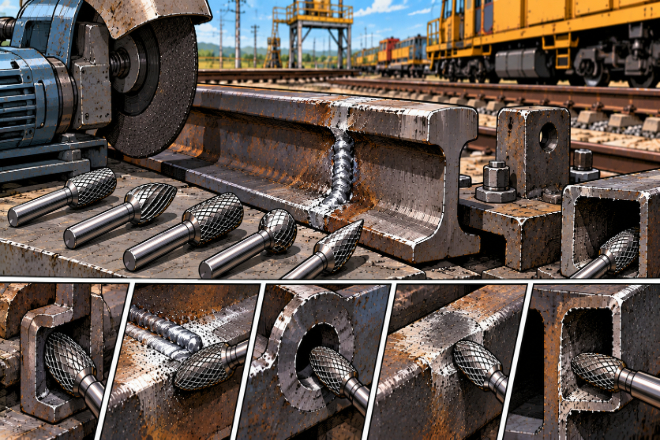
Railway equipment works under repeated loads, vibration, weather, dirt, and long service cycles.
Rails, bogies, carriage structures, brackets, steel frames, and maintenance parts can all need repair during their working life.
Welding, drilling, cutting, and replacement work may also leave extra metal that must be removed before inspection, painting, or assembly.
The first thought might be: use a grinder. And often that is exactly the right answer.
Large grinding tools and dedicated rail grinding machines are much better when a large surface or long rail section needs treatment.
Preventive and corrective rail grinding, for example, are specialized processes used to manage rail profile and surface condition.
A tungsten carbide burr has a different role.
It is small, easy to guide around local features, and available in many shapes. This makes it useful for areas where a large grinding wheel cannot reach easily or where the operator does not want to remove metal from a wide surface.
Carbide burrs cut material with defined teeth rather than relying only on abrasive action. Tungsten carbide also provides strong wear resistance when working on steels and other industrial materials.
That combination is useful for: local weld cleanup, deburring holes, removing sharp edges, working around brackets, correcting small steel areas, and reaching tight spaces inside railway structures.
The key word is local. Nobody wants to send a large maintenance machine down the track because one awkward corner needs five minutes of attention.
2. How Are Carbide Burrs Used Around Railway Welds?
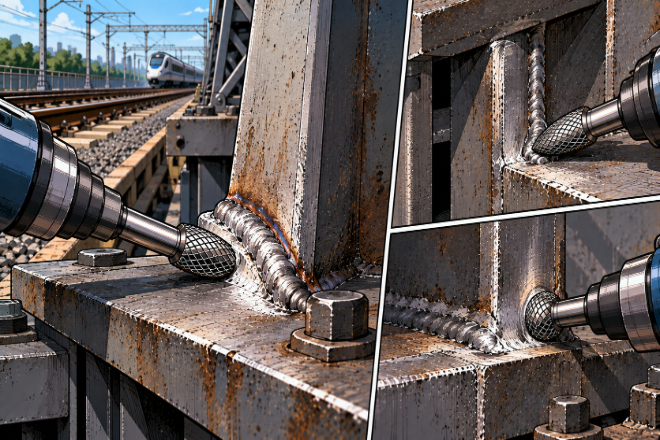
Welding appears in many areas of railway maintenance. Rails themselves are welded, while railway bridges, bogies, frames, brackets, supports, and other steel structures may also contain welded joints.
But not every weld-finishing job is the same.
For the running surface of a welded rail joint, dedicated rail grinding equipment is normally used to restore the correct rail profile. This is precision work because the finished rail must match the geometry around it.
mũi khoan cacbua are more interesting around smaller weld features and structural repairs. One important example is weld toe grinding.
The toe is the transition between the weld and the base metal. In some steel repair procedures, a tungsten carbide rotary burr can be used to carefully grind this area and create a smoother transition.
The burr is especially useful near weld ends, edges, corners, and confined areas. A grinding disc removes metal quickly from an open surface.
Put the same disc beside a narrow bracket or inside a tight structural corner and suddenly it becomes much less impressive.
A ball, oval, tree, or flame-shaped carbide burr can follow these smaller areas more naturally. This does not mean maintenance workers should freely grind every railway weld they see.
Critical weld repairs need approved procedures, inspection, and defined finishing requirements. Removing too much parent metal can create a new problem instead of fixing the old one.
The burr provides control. The repair procedure decides where that control should be used.
3. Where Do Carbide Burrs Help on Bogies and Carriage Parts?
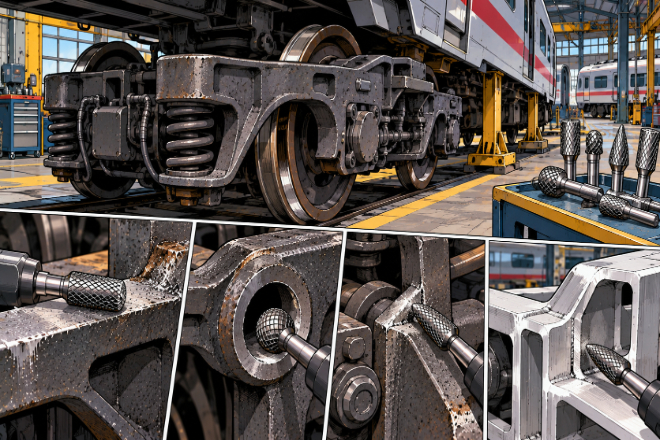
A railway vehicle is much more than wheels and rails. Under the carriage sits a large collection of frames, brackets, suspension parts, brake-related components, mounts, and other metal structures.
The bogie alone gives maintenance teams plenty to inspect.
During repair, parts may be removed, cleaned, welded, drilled, or replaced. These operations can leave burrs, rough edges, or small areas requiring local finishing.
Tungsten carbide burrs can be useful for grinding and deburring these metal parts.
Railway tooling suppliers list applications on cast-steel bogies as well as aluminum carriage structures.
Burr shape makes a big difference. A cylindrical burr works well on straight surfaces and open edges.
A ball burr is useful around rounded features and curved recesses. An oval burr can blend changing surfaces.
Tree and flame burrs can reach angled areas around brackets and welded joints. Cone-shaped burrs can work around openings and narrow features.
This variety matters because bogie and carriage structures are not made from convenient flat test plates.
There are ribs, curves, holes, corners, supports, and parts sitting close to other parts. Sometimes the challenge is not cutting the steel.
It is getting the cutting tool to the steel. Carbide burrs solve that problem surprisingly often.
4. How Do Carbide Burrs Help With Holes and Tight Areas?
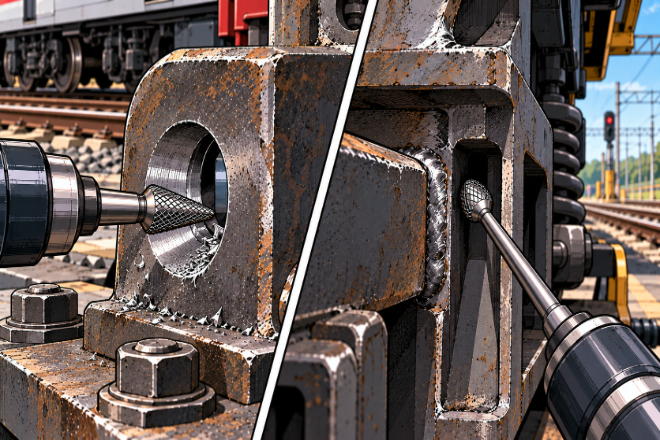
Maintenance work regularly involves holes.
A damaged bracket may need replacement. A repair plate may be drilled. Existing holes may need local cleanup after corrosion or fabrication work. A newly drilled opening may have a sharp burr around its edge.
For these smaller jobs, carbide burrs offer good access.
Technical guidance for steel-structure repair specifically notes that rotary burr grinders can work well at weld edges and can also help enlarge small drilled holes, including situations where the opening is not perfectly round.
That does not make a carbide burr a replacement for precision drilling or reaming. If a railway component requires an exact hole diameter, position, or tolerance, the approved machining process still controls the job.
The burr is useful for local correction and edge cleanup. Tool size should match the opening.
Trying to fit a large burr into a small hole gives the operator poor control. Using a tiny pointed burr on a broad surface creates the opposite problem: lots of movement and very little progress.
Reach matters as well. Long-shank carbide burrs can enter deeper spaces around railway structures, but extra length increases the chance of vibration.
Use the reach you need. Not the reach that looks impressive in the tool cabinet. A stable, correctly supported burr is easier to control and usually produces a cleaner result.
5. What Railway Materials Can Carbide Burrs Work On?
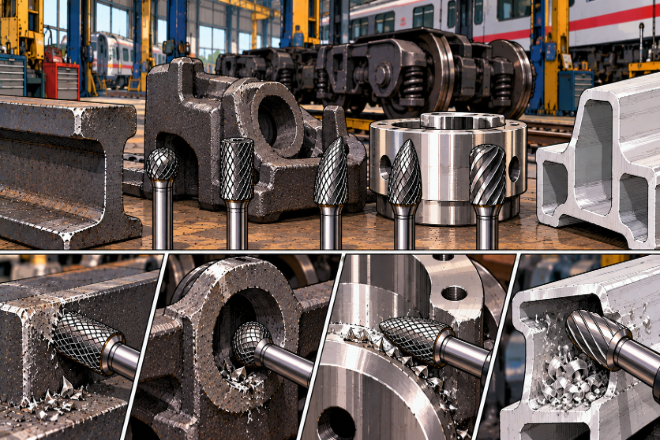
Steel is the obvious starting point.
Railway structures use large amounts of carbon and alloy steel, while cast steel can appear in components such as bogie parts. Stainless steel and aluminum may also be found in different vehicle and equipment applications.
The important point is that these materials should not automatically use the same burr. For steel work, a cut designed for steel can provide a good balance of material removal and control.
Harder steels may place more stress on the cutting teeth, making stable tool operation and correct burr selection more important.
Stainless steel requires good cutting action because excessive rubbing can create unwanted heat. Aluminum presents a completely different problem.
Soft aluminum can stick between tightly spaced teeth. Open flute designs made for aluminum and other non-ferrous materials give chips more space to escape.
A railway workshop dealing with both steel bogie parts and aluminum carriage components can therefore benefit from separating burrs by material and application.
A simple starting point looks like this:
6. What Mistakes Shorten Carbide Burr Life in Railway Maintenance?
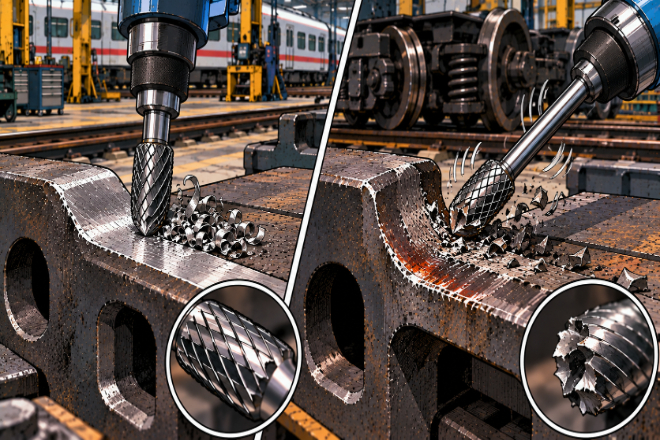
A carbide burr can be tough without being impossible to damage. Tungsten carbide is very hard and chống mài mòn, but the cutting teeth can chip under poor operating conditions.
Heavy pressure is a common mistake. The operator sees a difficult steel surface and naturally thinks more force will make the job faster.
Instead, excessive pressure can increase heat, vibration, radial load, and the risk of tooth damage.
Manufacturer guidance for carbide burrs warns that excessive pressure can contribute to problems such as radial runout, shank distortion, tooth chipping, and overheating.
Speed also needs attention. There is no single correct RPM for every railway maintenance job. Recommended speed changes with burr diameter, work material, overhang, and burr design.
Follow the burr manufacturer’s operating range rather than giving every tool the same grinder setting. Another problem is excessive overhang.
A long unsupported shank is more likely to vibrate. If the job needs a long-reach burr, the operating setup should account for it.
The rotary tool itself matters too. A worn collet or damaged bearing can make a good carbide burr behave like a bad one. When vibration suddenly appears, do not automatically blame the cutting head.
Check the whole setup. And remember that a carbide burr is not the answer to every rail maintenance problem.
Large-scale rail reprofiling, corrugation removal, and full weld-profile restoration belong to dedicated rail grinding or milling processes.
Good maintenance is partly about choosing the right tool. It is also about knowing when to put that tool back in the box.
7. How Should Railway Companies Evaluate Carbide Burrs?
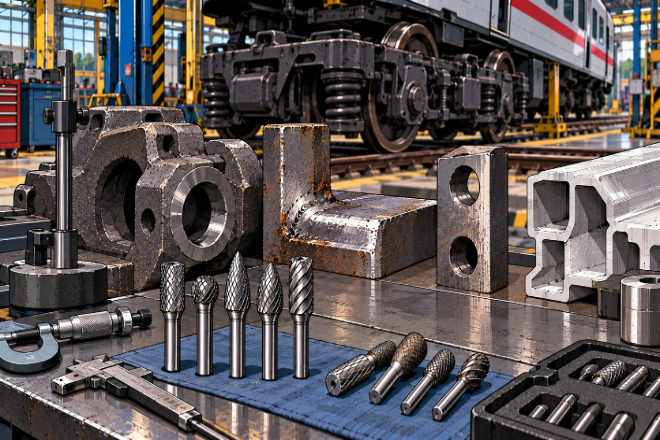
For a railway operator, rolling-stock repair company, or maintenance contractor, tool price is easy to measure. Process cost is more useful. Start by testing carbide burrs on representative maintenance jobs.
Use the steel grades, cast components, aluminum parts, welded samples, and access conditions that technicians actually see.
Measure cutting time. Then inspect the finished area. A burr that removes metal quickly but leaves heavy chatter marks may simply create another operation.
Check tool life as well. How many similar repair jobs can one burr complete before its cutting performance drops?
Operator control is another useful measure. Excessive vibration and pressure can slow the work even when the burr itself is still cutting.
For railway workshops carrying out repeated repairs, consistency between burrs also matters. One excellent sample does not prove that a box of 100 will behave the same way.
Check flute geometry, dimensions, concentricity, shank quality, and the connection between the cutting head and shank.
Most importantly, match the evaluation to the job. A burr intended for weld-toe work should be tested on representative weld geometry. A burr for bogie maintenance should see actual cast-steel features.
An aluminum burr should be tested for chip loading on the aluminum alloy being processed. Then calculate the cost per completed repair, including tool changes, labor time, secondary finishing, and rejected work.
That tells management much more than the price printed beside one burr in a purchasing spreadsheet.
In railway maintenance, the tool is inexpensive compared with the equipment being repaired. The expensive part is usually the time around it.
 English
  Español
  简体中文
简体中文  Français
  日本語
日本語  한국어
한국어  العربية
  Tiếng Việt