
1. Why Do Pipeline Fabricators Need Carbide Burrs?
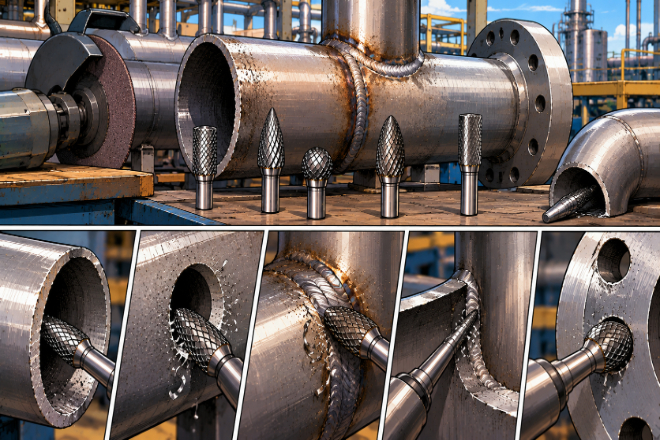
Pipeline fabrication involves much more than joining one pipe to another.
Pipe sections need to be cut, fitted, welded, inspected, coated, and prepared for installation.
Depending on the project, the fabrication shop may also handle elbows, tees, flanges, reducers, supports, branch connections, and many custom parts.
Every cutting or welding operation can create another finishing job.
A freshly cut pipe can have sharp metal around the edge. A hole made for a branch connection may need deburring.
A fitting may need a small local correction before fit-up. A welded area may contain excess metal that needs controlled cleanup.
Large grinders are very useful for open areas and heavy stock removal. But pipelines are round. Fittings are curved. Some joints are crowded. And the annoying piece of metal is rarely kind enough to appear in the easiest place.
This is where a tungsten carbide burr for pipeline fabrication earns its space in the toolbox.
Carbide burrs use defined cutting teeth to remove metal. They are commonly used for deburring, levelling, cutting out holes, surface work, chamfering, and working on weld seams.
Their small heads can also reach areas where a grinding disc becomes awkward.
Tungsten carbide provides high 硬度 and good 耐磨性, which is useful when the tool repeatedly works on steel and other pipeline materials.
The result is not a replacement for every pipe preparation machine. It is a flexible tool for all the smaller jobs between the big operations. And pipeline fabrication has plenty of those.
2. How Are Carbide Burrs Used for Pipe Edge and Weld Preparation?
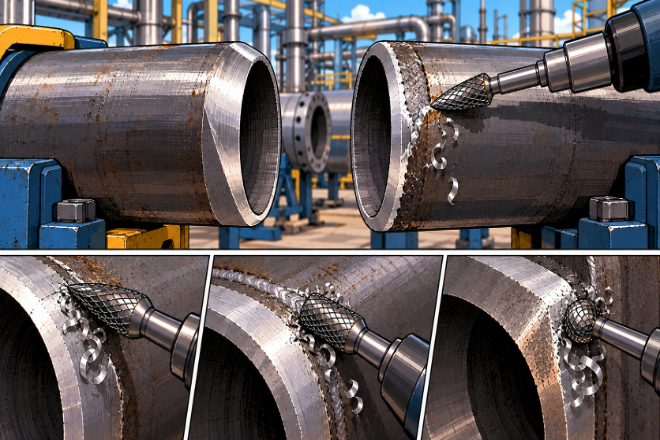
Before two pipe sections are welded, their ends need the correct preparation for the selected welding procedure.
For many pipeline jobs, dedicated pipe beveling machines handle the main bevel because they can produce controlled geometry around the full pipe circumference.
That is usually the right tool for the main job. A carbide burr becomes useful around local details.
After cutting or beveling, a small burr or irregular area may remain. A local point on the edge may need correction. A tight area around a branch or fitting may need additional preparation.
Carbide burrs can also be used for chamfering and weld seam preparation. Special edge-working burrs are available for defined chamfers as well as flexible edge work.
That makes them useful when the fabrication team needs controlled local metal removal rather than another full pass around the pipe.
Shape matters here. A cylindrical burr can work on relatively straight sections. A cone-shaped burr can help around chamfers and openings. Tree and flame shapes are useful when the surface changes direction.
Ball and oval shapes work better around curves. But there is an important limit. A hand-held carbide burr should not be used to guess critical weld geometry.
If the welding procedure requires a defined bevel angle, root face, root gap, or other preparation, those requirements still control the job.
The burr should correct the small problem. It should not redesign the joint.
That difference becomes particularly important when the pipe is going to carry oil, gas, steam, chemicals, or another high-pressure medium. A tiny preparation shortcut can become a very expensive weld problem later.
3. Where Do Carbide Burrs Help With Fittings, Flanges, and Branches?
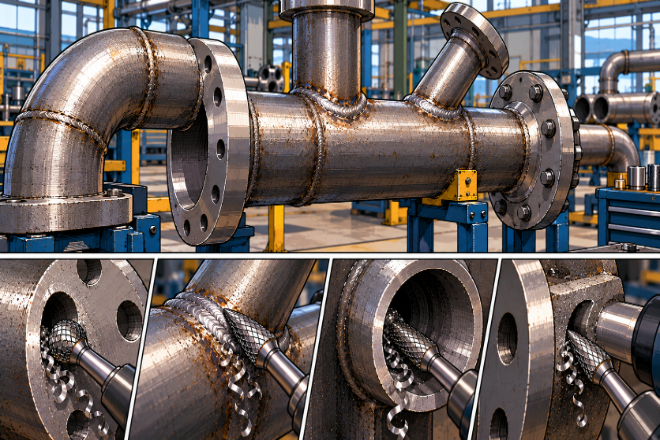
Straight pipe is the easy part. Then someone adds a tee. Or an elbow. Or a flange. Or a branch connection squeezed into a space that seems to have been designed by somebody who never planned to put a tool near it.
Pipeline fabrication quickly becomes more complicated around these components.
A flange may have a sharp local edge after fabrication. A branch opening may need deburring. A welded support may require cleanup. A fitting may contain a small high spot that affects fit-up.
Carbide burrs work well in these situations because shape and size can be matched to the feature. For example, a ball burr can follow the curved surface around an opening.
A tree burr can work where a branch meets the main pipe.
A flame burr can blend a changing contour.
A cone burr can reach into smaller openings.
A cylindrical burr can remove material from a flatter edge or local surface.
Long-shank carbide burrs can provide extra reach when the work is deeper inside a component. However, longer reach is not automatically better.
Extra overhang can increase vibration and reduce control. If the repair can be reached with a standard burr, there is little reason to turn a simple deburring job into a vibration test.
Burr diameter matters for the same reason. A very small burr on a large open surface makes the job slow. A large burr inside a small branch connection gives the operator too little room.
The right burr should fit the geometry naturally. When technicians have to fight the tool to make it touch the correct surface, the tool selection probably needs another look.
4. How Do Carbide Burrs Help After Welding?
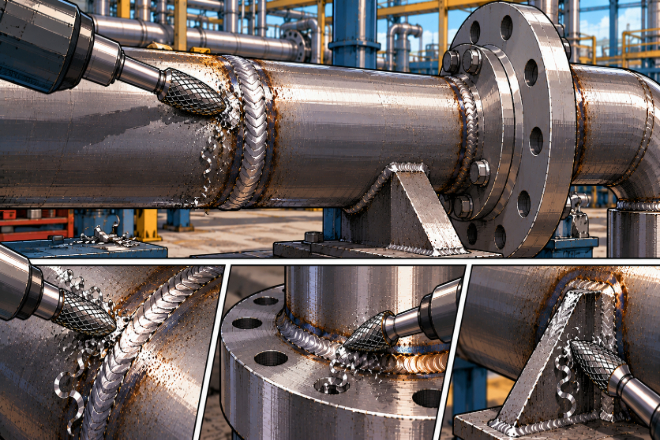
A completed weld does not always mean the finishing work is over.
Depending on the fabrication process and inspection requirements, local weld areas may need cleanup or controlled blending.
There may also be temporary attachments, tack-weld areas, repaired sections, or other fabricated features that require finishing.
碳化钨旋转锉 are commonly used for work on weld seams, making them useful for local weld finishing on pipeline components.
Again, the word local matters. If a large amount of weld metal must be removed from an open area, another grinding tool may be faster.
But consider a weld beside a flange. Or a joint around a small support. Or a curved area where a broad disc cannot make even contact. The carbide burr suddenly makes much more sense.
It can remove a small raised area without grinding half the component around it. This can also help during weld repair.
If inspection finds a defect and the approved repair procedure calls for local metal removal, a suitable carbide burr may help open or clean the area before the next repair stage.
After welding, it may also help blend permitted areas where required. But technicians should avoid uncontrolled grinding of completed welds.
Pipeline welds can have specific profile and inspection requirements. Excessive metal removal can damage the weld or nearby base material.
The goal is not to make every weld look pretty. The goal is to produce an acceptable joint. Those are not always the same thing.
For fabrication managers, this distinction is useful because unnecessary finishing also costs labor.
If the weld already meets the required condition, giving someone a grinder simply because “we always clean them” may be adding work rather than value.
5. Which Pipeline Materials Need Different Carbide Burrs?
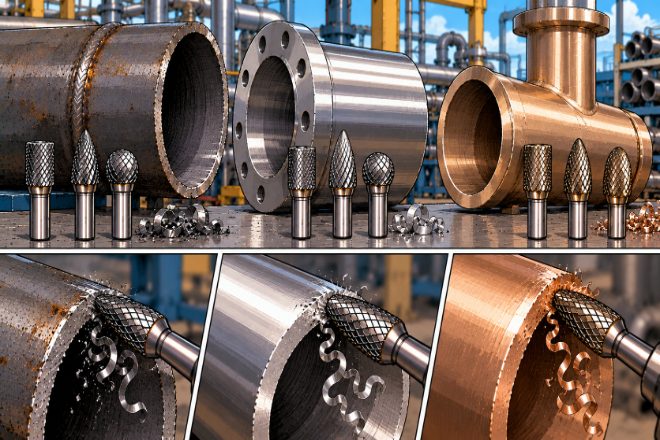
Pipeline projects do not always use the same material. Carbon steel is common, but fabrication shops may also process stainless steel and other alloys for corrosive, high-temperature, or special service conditions.
The carbide burr should match the material. Burrs with steel-specific cutting geometry are designed for steel and cast steel and can be used for operations such as deburring, levelling, hole work, surface work, and weld seams.
Stainless steel can benefit from a cut developed for stainless materials. This matters because good cutting action helps reduce unnecessary rubbing and heat.
Some fabrication shops also process aluminum or non-ferrous components. These softer metals can behave very differently.
Aluminum, for example, can load tightly spaced cutting teeth, so more open flute geometry is often preferred.
The application matters just as much as the material. A simple starting point is:
6. What Mistakes Reduce Burr Performance in Pipe Fabrication?
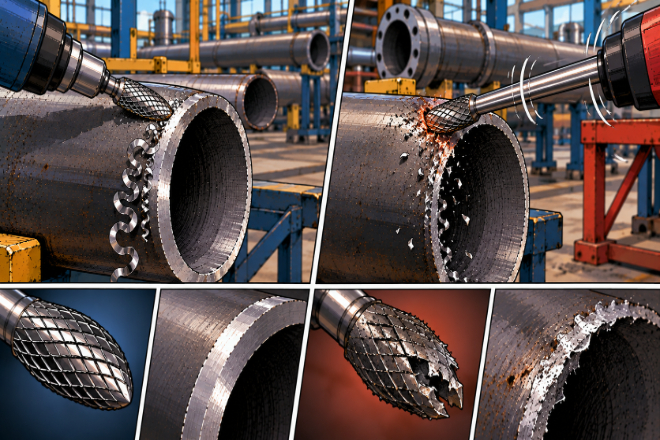
One common mistake is using too much pressure. A worker sees a thick steel pipe and assumes the burr needs to be pushed hard against it.
It does not. 硬质合金旋转锉 cut with their teeth. Excess pressure can increase vibration, heat, and load on the tool.
Tungsten carbide is very hard, but that does not mean it enjoys being used as a pry bar. Another mistake is poor speed selection.
The correct rotational speed depends on burr diameter, material, cut style, and manufacturer recommendations. Larger and smaller burrs should not automatically be run under identical conditions.
Keep the burr moving during surface work rather than holding it against one point unnecessarily. Tool condition also matters.
A worn collet, poor spindle, damaged shank, or excessive overhang can create chatter. High-quality burrs are manufactured with good concentricity partly because stable rotation improves cutting and helps avoid chatter marks.
Contamination can also matter in stainless fabrication.
If a fabrication shop has material-separation procedures for stainless steel, the burr inventory should follow those procedures as well.
A tool that has been used heavily on carbon steel should not casually move into a controlled stainless production area if the shop’s process prohibits cross-contamination.
Finally, do not let a carbide burr become a substitute for inspection. If a pipe end does not fit correctly, find out why. If a weld preparation is outside specification, measure it.
If a hole is in the wrong position, making it larger until the bolt fits is not exactly precision fabrication.
The burr is good at removing metal. That is both its advantage and its danger.
7. How Should Pipeline Companies Evaluate Carbide Burrs?
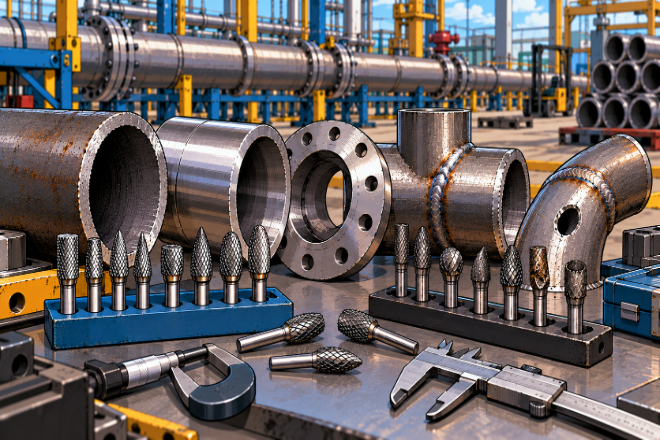
For pipeline fabricators, the lowest tool price does not automatically produce the lowest fabrication cost.
A carbide burr may be inexpensive compared with a pipe spool, flange, valve, or completed pipeline system.
The labor around it is another story.Test burrs on real fabrication jobs. Use the actual pipe grades and wall thicknesses processed by the shop. Include stainless steel if it is part of regular production.
Try the burr around branch connections, weld preparation areas, holes, fittings, and other difficult features. Then measure more than tool life.
How quickly does it remove the required metal?
How easy is it to guide?
Does it vibrate?
What does the finished surface look like?
Does the operator need another tool afterward?
How often is the burr changed?
Also compare different shapes rather than only different brands. Sometimes the “bad burr” is simply the wrong shape for the job.
Concentricity and batch consistency deserve attention when buying larger quantities. A burr that runs smoothly can make detailed work easier, while excessive runout can create vibration and chatter.
For repetitive fabrication, small improvements can become important. Saving a little time on one branch opening may not sound exciting.
Multiply it across hundreds or thousands of fabricated joints and it starts looking much more interesting.
That is why purchasing managers should consider cost per completed fabrication operation, not only cost per burr.
A slightly more expensive tool that cuts reliably, lasts longer, and reduces secondary finishing can be the less expensive choice once it reaches the production floor.
 English
  Español
  简体中文
简体中文  Français
  日本語
日本語  한국어
한국어  العربية
  Tiếng Việt