
1. Why Are Carbide Burrs Valuable During Power Plant Outages?
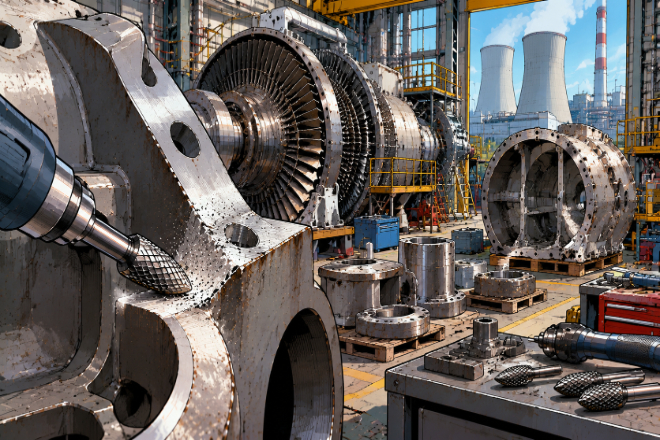
Power plant maintenance is full of large equipment, but many repair jobs are actually quite small.
A turbine casing may be several meters across, yet the area that needs attention could be a rough edge only a few centimeters wide. A pump may be heavy enough to need lifting equipment, while the maintenance problem is one small burr around an opening.
这就是 tungsten carbide burrs earn their place in the toolbox.
Their small cutting heads allow technicians to work on a limited area instead of grinding a large section of the component. They can be used for milling, levelling, deburring, surface work, and working on weld seams.
Modern high-performance burrs are also available with cuts designed for different materials and applications.
That flexibility matters during an outage. Maintenance teams may move between carbon steel, stainless steel, cast steel, cast iron, and other alloys.
One technician may be cleaning a weld repair in the morning and working around a casing edge later the same day.
Different burr shapes also solve different access problems. A cylindrical burr can work along a straighter surface. A ball or oval burr can follow a curve.
Tree and flame shapes are useful around changing contours and narrow joints. Cone-shaped burrs can enter smaller openings.
The result is a tool that fits between large grinding equipment and precision machining. That does not mean carbide burrs replace either one.
A large grinder is still better for broad material removal. A machine tool is still needed when a controlled diameter, flatness, alignment, or precision surface must be restored.
The carbide burr handles the smaller local work between those two extremes. During an outage, that can be a useful place to be. Nobody wants to set up a large machine for a ten-minute deburring job.
2. Where Do Carbide Burrs Help Around Turbines?
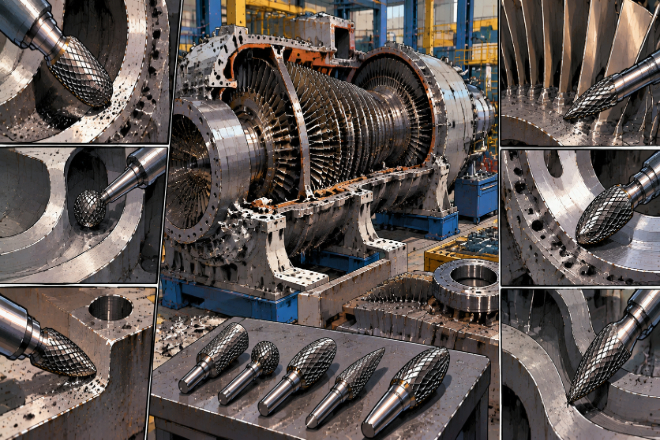
Steam and gas turbines contain many complex metal surfaces.
Depending on the turbine design and repair scope, maintenance teams may work around casings, blades, rotors, diaphragms, diffusers, seals, valves, and related parts.
These components can suffer from erosion, corrosion, rubbing, cracking, wear, and other forms of service damage.
硬质合金旋转锉 can support local repair and finishing work where the approved maintenance procedure allows mechanical material removal.
Gas turbine MRO is a real example.
PFERD lists tungsten carbide burrs among tools used for manufacture and maintenance of gas turbines and their components, including surface finishing of diffuser areas and custom carbide-burr machining.
Shape selection becomes important here. A cylindrical radius-end burr can work around relatively open transitions.
Ball and oval shapes are useful for curved areas. Tree and flame shapes can reach changing profiles and narrow spaces.
A conical burr with a radius end can follow some internal turbine component surfaces more naturally than a broad grinding wheel.
The word local is important. Turbine components often have controlled geometry.
Bearing journals, rotor surfaces, seal areas, casing joint faces, valve seats, blade tips, and other critical features may require dedicated machining, grinding, metrology, or OEM-approved repair methods.
Specialist turbine repair companies use processes such as in-line boring, casing joint-face machining, valve-seat reprofiling, bearing-journal machining, flange facing, and precision measurement for this reason.
A carbide burr is excellent when the instruction is: “Remove this unwanted metal from this small area.” It is a much less sensible choice when the instruction is: “Please restore this precision turbine geometry by hand.”
That distinction should be clear before the grinder starts.
3. How Do Burrs Support Valve, Pump, and Casing Repairs?
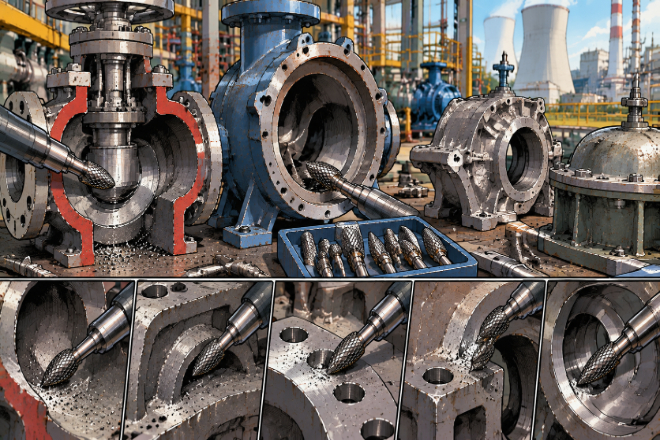
Not every important component in a power plant spins at turbine speed.
Valves, pumps, casings, covers, brackets, and other supporting equipment also create plenty of maintenance work.
Valve bodies can contain narrow passages, curved internal areas, old repair zones, and difficult corners. Pump casings may have similar access problems.
一个 tungsten carbide burr can reach areas where a large grinding disc cannot.
For example, a technician may need to remove a sharp burr after another machining process, clean a rough edge around an opening, blend permitted repair material, or prepare a small local area for the next maintenance step.
Cast components are another useful example. Power plant equipment can include cast iron and cast steel parts.
Material-specific carbide burr cuts are available for cast materials, with designs intended to provide high stock removal while controlling vibration and chip removal.
But again, there is a boundary. Valve seats, pump sealing surfaces, bearing fits, flange faces, and precision bores may have strict requirements.
Those surfaces should not be casually “cleaned up” with a hand-held burr if the maintenance procedure calls for controlled machining.
Consider a damaged valve seat. The rough area beside the seat may be suitable for local burr work. The seat itself may need dedicated reprofiling equipment.
They are physically close together, but they are not the same maintenance job. That is why technicians need more than a good tool.
They need a clearly defined repair area. A carbide burr removes exactly what the operator guides it toward. Unfortunately, it has never read the maintenance manual.
4. Why Are Carbide Burrs Useful for Weld and Repair Preparation?
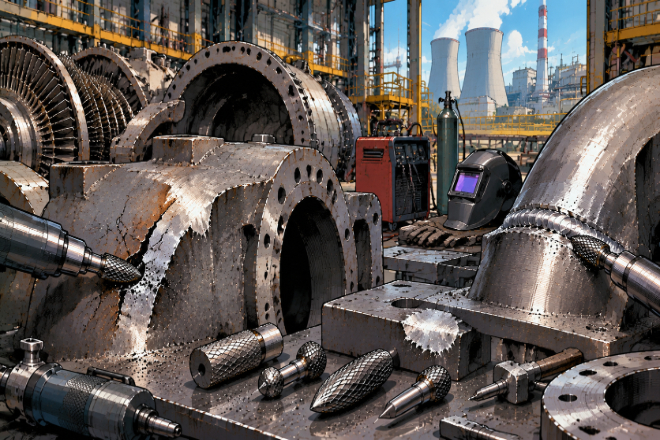
Welding is common in power plant maintenance.
Casing repairs, structural repairs, pipe-related work, component restoration.
And other maintenance tasks can involve removing damaged material, preparing a repair area, adding weld metal, and then finishing the repaired section.
Recent power-generation repair work continues to use on-site weld restoration for cracked steam-turbine shells and valve-chest areas, followed by controlled machining and other repair steps.
Carbide burrs can support this process before or after welding.
Before welding, a burr may be used to remove local unwanted metal or prepare a small area when the approved procedure permits it.
After welding, excess weld metal may need controlled removal or blending before inspection or another finishing step.
This is where the small head becomes useful.
A large grinding wheel can remove weld metal quickly on an open surface. But a repair may sit beside a corner, inside a curve, around a hole, or deep inside a casing.
Tree and flame-shaped burrs can work around narrow welds and changing contours. Ball and oval burrs can follow rounded areas. Cylindrical shapes are useful on straighter sections.
High-performance burr designs are specifically available for work on weld seams, and specialized cuts can improve stock removal and guidance.
For narrow fillet welds, burr selection also affects vibration and chatter because the cutting head may experience repeated impacts against confined surfaces.
The important point is that the burr supports the repair procedure. It does not create the procedure.
Crack removal depth, weld geometry, preheat, welding process, heat treatment, inspection, and final dimensions may all be controlled separately.
The fastest burr in the maintenance shop is not allowed to make engineering decisions. That is probably for the best.
5. How Do Carbide Burrs Help in Tight and Difficult Areas?
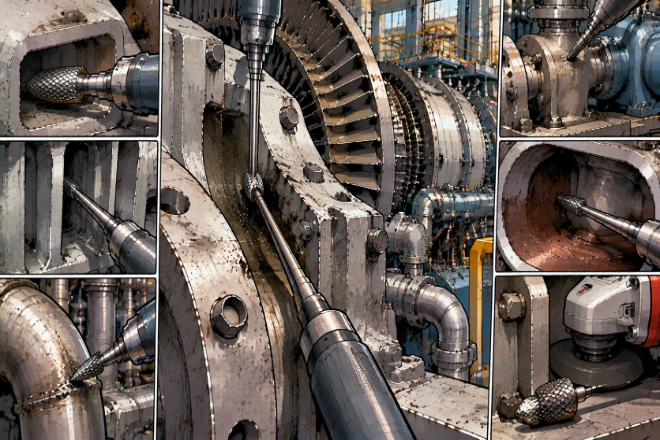
Access is one of the strongest reasons to keep carbide burrs available during power plant maintenance.
Power generation equipment was designed to generate power.
It was not always designed around the comfort of the technician holding a grinder twenty years later.
Maintenance teams may need to work between casing features, behind brackets, around pipes, inside openings, near support structures, or within partially disassembled equipment.
A large grinder may physically not fit.
Moving the component to a machine tool may require more disassembly than the repair itself.
A compact straight grinder and a correctly shaped carbide burr can provide a practical alternative for suitable local work.
Long-shank burrs can extend that reach even further.
But longer is not automatically better.
Extra shank length increases overhang, and too much overhang can increase vibration. That can reduce control, leave chatter marks, and put more stress on the burr.
Use the shortest tool that reaches the work comfortably.
Good concentricity matters as well. High-performance carbide burrs use accurate concentricity to support smoother cutting and reduce chatter.
The grinder and collet also need to be in good condition.
A premium carbide burr mounted in a worn drive is still going to behave like a premium carbide burr mounted in a worn drive.
Tool shape can reduce awkward movement too. If a technician is twisting the grinder into a strange position just to make a cylindrical burr touch a curved surface, the answer may not be “try harder.”
It may simply be “use an oval burr.” Small choices like that can make outage work faster and more predictable.
6. How Should Maintenance Teams Choose and Control Carbide Burrs?
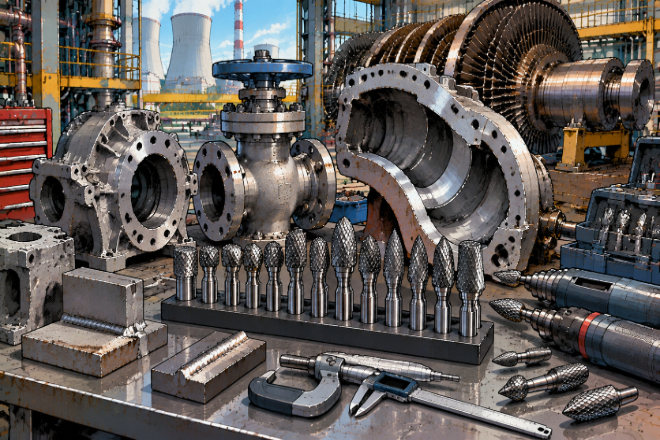
Power plants should not treat carbide burrs as random consumables sitting in a drawer. A small standardized tool range is usually more useful. Start with the materials found during maintenance.
Steel and cast steel may benefit from steel-specific cuts. Stainless steel can use an INOX-type geometry.
Cast iron has dedicated CAST cuts. Multi-material cuts can be useful for maintenance teams that move frequently between different metals.
Then look at common operations. If weld repair is frequent, include shapes that work around welds and corners.
If casing work is common, ball, oval, tree, and flame shapes may deserve more attention. If open surfaces dominate, cylindrical and radius-end cylindrical burrs may cover more of the workload.
Edge work may require another solution. Dedicated EDGE-cut carbide burrs can create controlled chamfers or radii and are also used for defined deburring and weld-seam preparation.
The operating process matters just as much as the product. Burr diameter, cut, material, and application affect the correct rotational speed.
Technicians should not assume that every burr belongs at the same grinder setting. Tool condition should also be checked before and during the job.
Look for damaged teeth, poor cutting, unusual vibration, or shank damage. Replace a burr when it is no longer cutting properly instead of solving every problem with more pressure.
For outage planning, purchasing teams can go one step further. Track which burrs are actually used.
Which shapes run out first?
Which repairs consume the most tools?
Which material causes the most wear?
Where are technicians spending time changing tools or doing secondary finishing?
Then compare cost per completed maintenance operation, not only price per burr.
A slightly more expensive burr that reduces technician time during a critical outage can have a very different real cost.
When the plant is waiting to return to service, saving money on the wrong small tool can become an impressively expensive idea.
 English
  Español
  简体中文
简体中文  Français
  日本語
日本語  한국어
한국어  العربية
  Tiếng Việt