
1. What Is Excess Brazing Material?
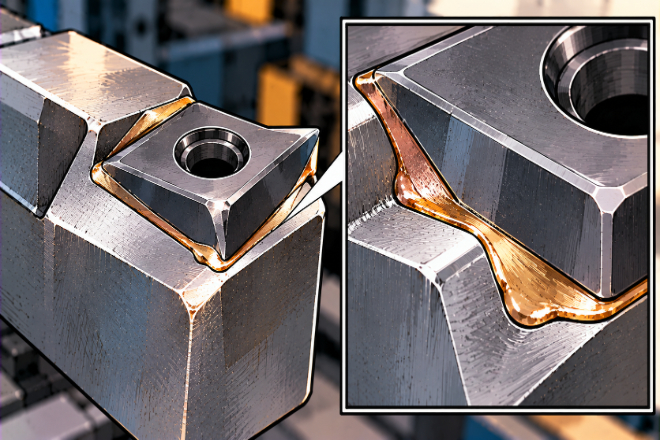
During brazing, a filler metal melts and flows between two parts to form the joint. A small amount of extra filler may flow outside the intended joint area.
This can leave raised metal, thin fillets, drops, or smeared material around the brazed area.
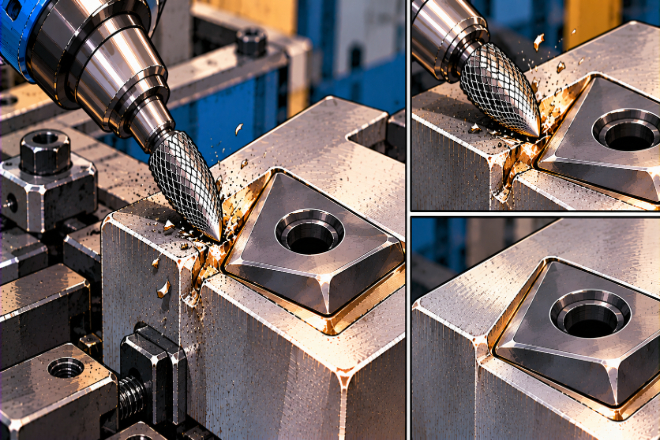
For example, a tungsten carbide insert may be brazed into a steel cutting tool. After the joint cools, some filler can remain around the outside of the carbide insert.
If this material is not needed, it may have to be removed before the tool moves to the next production stage.
Not all visible brazing material is waste, however.
Some material around a joint may be part of the intended fillet or may help support the joint. Removing too much can weaken the assembly or expose an area that should remain protected.
This is why the first question should not be: “How fast can we remove it?”
A better question is: “Which material needs to be removed, and where should removal stop?”
That difference matters when the brazed component is expensive or has a controlled working edge.
Excess filler can also be difficult to remove because it may spread over the steel surface instead of forming one clean, easy-to-cut lump.
Some post-braze cleaning applications therefore use focused abrasive methods to remove unwanted filler while protecting nearby tool features.
2. Can Tungsten Carbide Burrs Remove Excess Brazing Material?
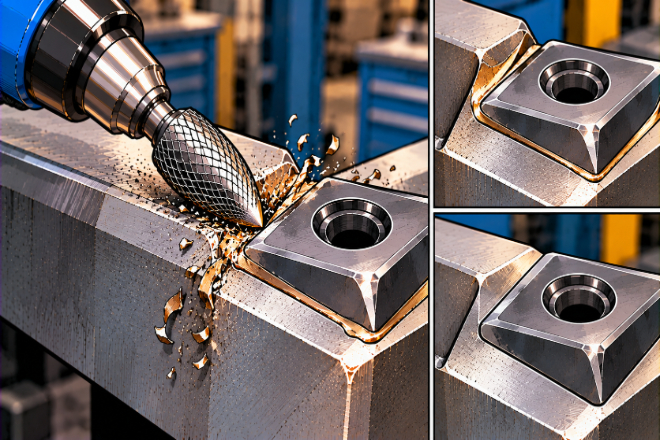
Yes. A tungsten carbide burr can remove localized excess brazing material when the filler is accessible and the surrounding part can tolerate controlled cutting.
The burr works by cutting small amounts of material with its teeth. This makes it useful when the excess braze appears as a raised area, narrow buildup, uneven edge, or local overflow.
The biggest advantage is control.
A grinding wheel may work well on a broad surface, but a burr can reach smaller areas around carbide inserts, corners, holes, pockets, and other detailed features.
Different burr shapes also make it possible to approach the unwanted material from different directions.
For example, a cylindrical burr can work well on a relatively open flat area. A ball or radius-end burr can be useful around curved transitions. A smaller cone-shaped burr may help reach narrow or angled areas.
Modern carbide burrs are also available for a wide range of materials and applications, including deburring, leveling, edge work, and weld-seam work.
Their use should still follow the recommended speed and contact conditions for the specific tool.
However, there is an important limitation: A carbide burr should remove the excess braze—not the joint itself.
If the operator cuts too deeply into the brazed area, the process can damage the joint or the component underneath it.
For this reason, controlled passes are much better than trying to remove the entire buildup in one aggressive move.
3. Where Are Carbide Burrs Most Useful for Braze Cleanup?
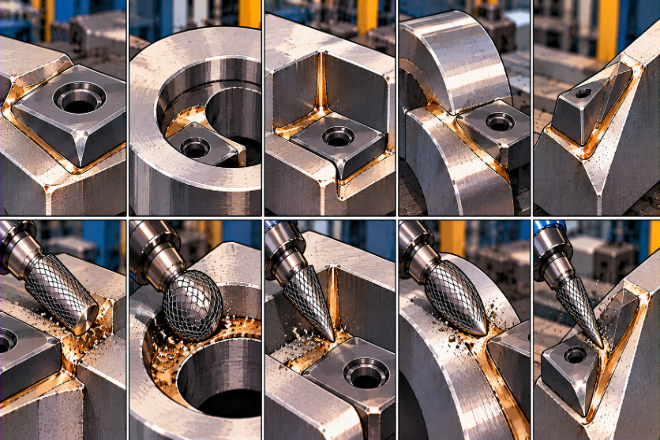
The best applications are usually local areas where excess brazing material needs to be removed without changing the main geometry of the component.
Common examples include brazed cutting tools, carbide-tipped components, repair parts, saw-related components, and other metal assemblies where a carbide piece is joined to a steel body.
A burr can be especially useful when the excess filler is:
Around the outside of a carbide insert
Along a small brazed joint
Near a corner or transition
Inside a narrow opening
Around a hole or pocket
On a local area that needs later finishing
Blocking access to another machining operation
The shape of the buildup matters too.
A thin ridge needs a different approach from a large lump. A narrow corner may need a small burr, while a broad flat buildup may be easier to handle with a cylindrical shape.
The surrounding material also matters. A steel body, stainless component, aluminum part, or cast metal assembly will respond differently to cutting.
A material-specific burr can make the work more stable and reduce loading or poor cutting behavior.
This is particularly important when a production line handles several types of brazed components.
Instead of giving every job the same burr, the tooling process should match the material, joint geometry, and amount of excess filler.
4. How Should You Choose a Tungsten Carbide Burr for Braze Removal?
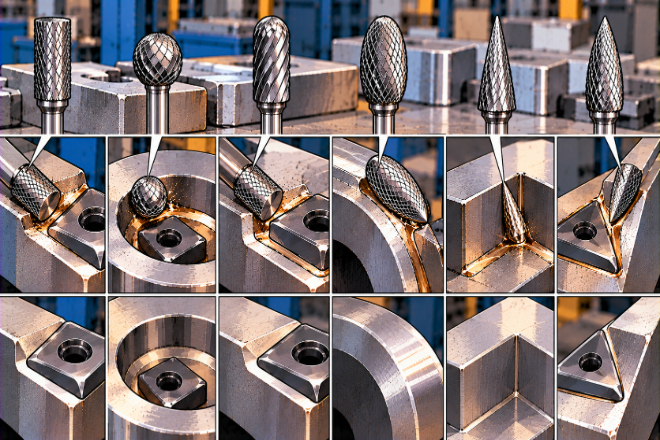
Choosing the right burr is less about finding a “strongest” tool and more about matching the tool to the cleanup area.
A general-purpose carbide burr can be a good starting point for mixed materials. For repeated production work, however, a material-specific cut or geometry may give better control.
Shape is equally important. A cylindrical burr is useful for open surfaces, while a cylindrical burr with a radius end can help when the operator needs to blend an area without creating a sharp transition.
Ball and oval shapes are useful around curved areas, while tree and cone shapes can provide access to tighter spaces.
Current carbide burr guidance also links shape selection with applications such as deburring, leveling, edge work, and weld-seam work.
A simple selection guide looks like this:
5. How Do You Remove Excess Brazing Material Without Damaging the Joint?
This is where technique becomes more important than brute force.
Start by inspecting the brazed area. Identify the carbide, the steel body, the useful part of the braze, and the material that actually needs to be removed.
Then secure the workpiece firmly. A loose part can move suddenly when the burr contacts the filler, creating an unwanted cut.
Use the correct operating speed for the burr diameter, material, and application.
There is no single RPM that works for every carbide burr. The correct speed depends on the material, cut, application, and burr diameter.
During cutting, use light and steady pressure. Let the teeth remove the material instead of forcing the burr into the joint.
It is also better to use several controlled passes: Inspect → Remove a small amount → Check → Remove again → Final blend → Inspect
This approach may look slower at first, but it reduces the chance of cutting into the steel body or carbide insert.
The contact area should also remain controlled. Proper tool contact, concentric running, and recommended operating speed help reduce vibration and unwanted tool wear.
Heat deserves attention as well. A burr that is pushed too hard or used under poor conditions can generate unnecessary heat.
Excessive heat can affect the tool, the workpiece, and the quality of the finishing operation.
The goal is simple: remove the unwanted filler while leaving the important joint alone.
6. When Should You Not Use a Carbide Burr for Braze Removal?
一个 tungsten carbide burr is useful for local cleanup, but it is not the right answer for every brazed component.
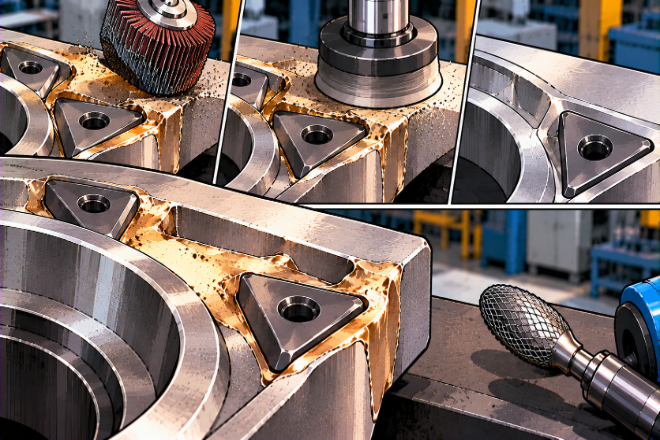
If the excess material covers a large area, a different process may be faster and more consistent.
Focused abrasive blasting, grinding, machining, or another controlled cleaning method may be better depending on the component and production volume.
A burr should also be avoided when the removal area is too close to a critical dimension or working edge for safe freehand control.
This includes areas such as:
Precision seating surfaces
Critical cutting edges
Controlled bores
Bearing locations
Sealing surfaces
Surfaces with strict dimensional limits
In these cases, the process should be defined by the required tolerance rather than by the convenience of a hand tool.
There is another important point: do not assume every visible braze is excess.
A brazed joint needs enough filler to create the intended bond. Removing material without understanding the joint design can therefore create a bigger problem than the original excess.
For production managers and purchasing teams, this is an important process question.
The right tooling should be judged by the final part quality, rework rate, operator time, tool consumption, and repeatability—not simply by how quickly one operator can make a joint look clean.
 English
  Español
  简体中文
简体中文  Français
  日本語
日本語  한국어
한국어  العربية
  Tiếng Việt