
1. Why Use Tungsten Carbide Burrs for Edge Rounding?
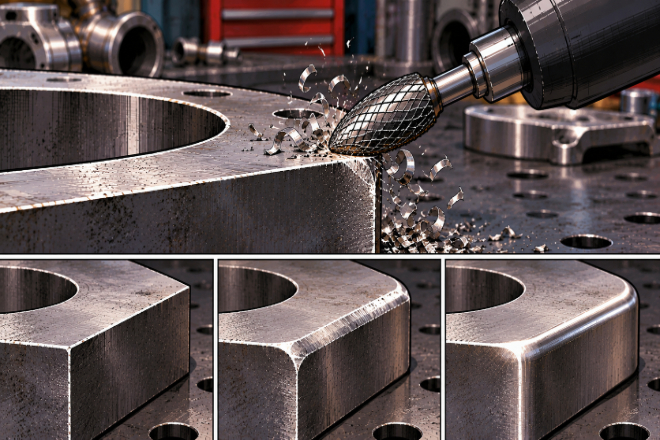
Edge rounding sounds like a simple job. Take a sharp corner and make it less sharp. In reality, there are several different goals hiding behind that sentence.
Sometimes a manufacturer only wants to remove a dangerous sharp edge after cutting. Sometimes the edge needs a small smooth radius for handling or assembly.
In other cases, a specified radius is required before painting or applying an anti-corrosion coating.
أ tungsten carbide burr can handle many of these jobs because it removes material with defined cutting teeth.
Carbide burrs are already widely used for deburring, chamfering, surface work, hole work, and weld finishing. Edge rounding is a natural extension of these applications.
But there is an important difference between breaking an edge and creating a defined radius.
If the goal is simply to remove a sharp corner, several general carbide burr shapes can work. The operator guides the burr along the edge and gradually removes the sharp point.
If the drawing requires a controlled radius, freehand grinding may not be enough. This is where dedicated edge rounding carbide burrs become much more useful.
Concave radius burrs have a curved cutting profile that sits around the outside edge of a workpiece. Instead of asking the operator to create a curve by eye, the tool geometry helps form the radius.
Dedicated EDGE-cut tungsten carbide burrs are specifically designed for defined edge work. Some current systems can produce precise chamfers or a defined 3 mm outer radius.
That changes the job from: “Make this corner less sharp.” to: “Produce this particular edge shape.” For production managers, that difference is important.
One is general finishing. The other is a repeatable manufacturing operation.
2. What Is the Difference Between Deburring and Edge Rounding?
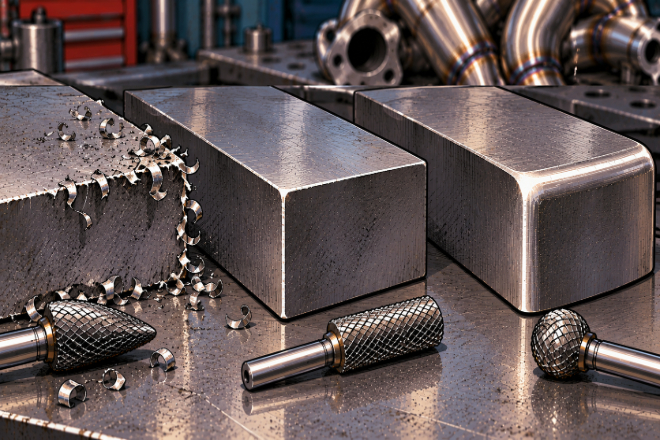
These two operations are often discussed together, but they are not exactly the same. Deburring removes unwanted material created by another manufacturing process.
Cutting, drilling, milling, laser cutting, punching, and other operations can leave thin or rough metal along an edge. The purpose of deburring is to remove that unwanted material.
Once the burr is gone, however, the original corner can still be sharp. Edge rounding goes further. It intentionally removes material from the corner to create a curved transition between two surfaces.
Imagine the cross-section of a steel plate. A freshly cut plate may have an almost square corner. Deburring removes the loose or raised material around that corner.
Edge breaking removes the sharp point. Edge rounding creates a more controlled curved profile. Chamfering is different again. Instead of producing a curve, it produces an angled flat surface.
Carbide burrs can be used for all of these operations, but the best tool shape changes with the target. A general cylindrical, ball, or tapered burr may be enough for flexible deburring and edge breaking.
A conical counterbore burr is better suited to controlled chamfering. A concave radius burr is designed for creating and processing outer radii and rounded edges.
Dedicated EDGE designs take this further by allowing the cutting profile to follow the workpiece edge more consistently.
For a purchasing manager, asking for “a deburring burr” is therefore not always specific enough.
The supplier needs to know what the finished edge should look like. Otherwise, the company may buy a perfectly good tool for the wrong operation.
3. Which Carbide Burr Shapes Work Best for Rounded Edges?
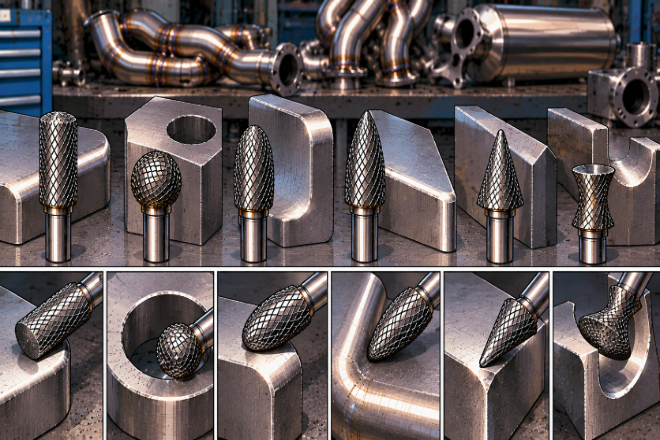
The correct burr shape depends on whether the edge rounding is flexible or defined. For simple manual edge breaking, several common carbide burr shapes can be useful.
A cylindrical burr with a radius end can work along straight edges while also handling nearby curved areas.
A ball burr can soften corners and work around irregular shapes. An oval burr is useful where the surface and edge change direction. A flame-shaped burr can follow curved profiles and complex contours.
These tools give the operator freedom. That freedom is useful on fabricated parts where the goal is simply to remove sharp edges or blend an irregular corner.
But freedom has a downside: the final radius depends heavily on the operator. If ten workers manually round ten identical parts, the results may not be exactly identical.
For a defined outer radius, a concave radius burr is a much better match. Its cutting surface wraps partly around the outside edge. This naturally guides the tool along the corner and helps produce a more consistent rounded shape.
Specialized EDGE-cut radius burrs are designed specifically for this type of work. Current versions can produce a defined 3 mm outer radius in one operation.
There are also dedicated carbide burrs for controlled chamfers. Depending on the design, these can produce defined 30° or 45° chamfers.
So the selection logic is fairly simple:
4. Why Does Edge Rounding Matter Before Coating?
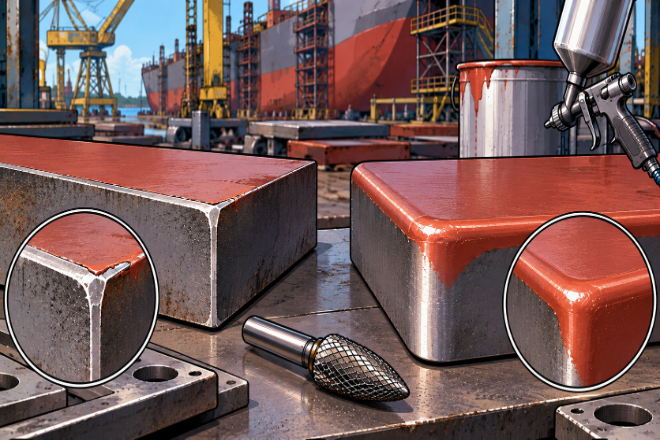
This is one of the more interesting reasons for rounding an edge. Imagine painting a flat steel plate. The coating can spread across the broad surface fairly evenly.
Now imagine the same coating trying to wrap around a very sharp 90-degree corner. Maintaining coating thickness around that sharp edge becomes more difficult.
This can leave the edge with weaker protection than the surrounding surface. For steel structures exposed to moisture, salt, chemicals, or outdoor conditions, that small detail matters.
A rounded edge provides a smoother path for the coating. PFERD recommends defined edge rounding as part of preparation for anti-corrosion coatings and notes its use in shipbuilding, crane systems, and other steel structures exposed to corrosion.
Its edge-working guidance also references ISO 12944-3 and ISO 8501-3 in relation to this type of preparation.
This creates several practical applications for tungsten carbide burrs for edge rounding.
Steel plates used in marine structures can have their sharp edges rounded before coating. Crane and structural steel components can receive similar preparation.
Fabricated frames, supports, beams, and welded structures exposed outdoors may also benefit from controlled edge preparation where the coating specification requires it.
A dedicated concave radius burr can follow the plate edge and remove the sharp corner in a controlled way.
This is very different from randomly waving a grinder along the steel until the edge looks softer. For companies handling repeated structural parts, consistency matters.
If the required radius is defined by a drawing, coating specification, or customer requirement, the process needs to produce that radius reliably.
This is where a purpose-built carbide edge rounding tool becomes much more valuable than general hand grinding. The coating may be applied later. But its success can start at the metal edge.
5. What Materials Can Be Edge-Rounded With Carbide Burrs?
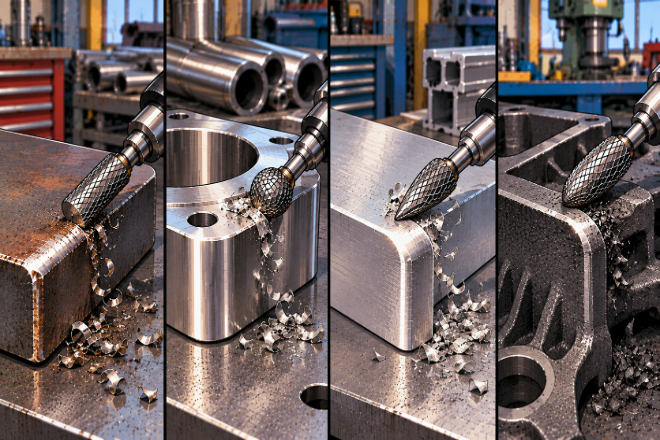
Edge rounding is not limited to ordinary carbon steel. قواطع كربيد التنغستن for edge work are available for several materials, including steel, cast steel, stainless steel, non-ferrous metals, and cast iron.
The tool still needs to match the work material. Steel is a common application because structural fabrication creates many cut edges that need deburring, chamfering, or rounding.
Stainless steel requires more attention to cutting geometry and tool control. A burr that cuts efficiently is preferable to one that rubs heavily and creates unnecessary heat.
Aluminum behaves differently again. It is softer, and chips can stick between tightly spaced cutting teeth. For regular aluminum edge work, a geometry developed for aluminum can improve chip removal and reduce loading.
Material selection becomes especially important in production. A fabrication company working mainly with structural steel has different needs from a company making stainless food-processing equipment or aluminum structures.
The radius requirement also matters. If the job only calls for a small broken edge, flexible work with a standard carbide burr may be enough.
If a specific outer radius is required, check whether the radius tool is available for the material and required size.
There is no prize for using the most complicated burr. The correct tool is simply the one that creates the required edge with the least unnecessary work.
6. How Can Manufacturers Keep the Radius Consistent?
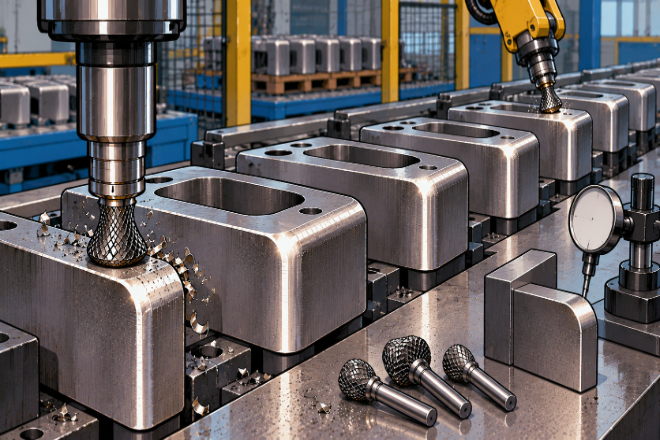
This is where edge rounding becomes a production question rather than just a metalworking question. A skilled operator can create a smooth edge with a normal carbide burr.
But can the next operator create the same edge?
And the next?
What about the five-hundredth part?
Freehand work naturally creates some variation. The operator’s angle, pressure, movement, tool wear, and experience can all change the result.
A dedicated concave radius burr reduces some of that variation because the shape of the tool helps define the finished profile. Guided systems can improve control further.
For example, carbide edge systems are available with guide sleeves that help position the burr relative to the workpiece. This makes controlled edge processing easier and can reduce dependence on freehand movement.
Automation is another option. Carbide burrs for edge work can be used with straight grinders, flexible-shaft drives, machine tools, and robots.
For repeated parts, robotic or machine-guided edge rounding can make sense because the tool path can be repeated from component to component.
But automation does not fix a bad process automatically. The company still needs to control part position, tool wear, burr geometry, spindle condition, and the amount of material entering the cutting path.
Tool concentricity also matters. A burr that does not rotate smoothly can create chatter marks and make a defined edge harder to produce.
High concentricity supports cleaner cutting and can also reduce unnecessary wear on the burr and drive.
For decision-makers, the level of control should match the product. A one-off fabricated bracket probably does not need a robotic edge-rounding cell. Thousands of identical coated steel components might be a different story.
7. How Should Companies Evaluate Edge Rounding Burrs?
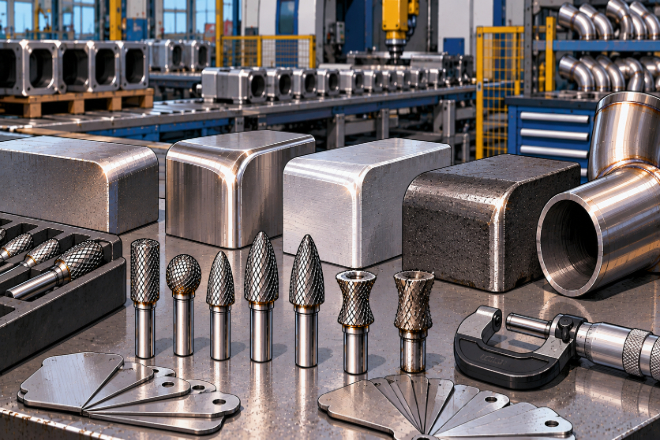
Do not evaluate an edge rounding burr only by asking how long it lasts. Start with the finished edge.
Does the burr produce the radius or edge condition required by the drawing, coating process, or customer?
Then check consistency. Measure several finished parts, not just the best one.
If a defined radius is required, compare the actual edge profile across multiple parts and multiple burrs. Next, look at process time.
How long does it take to round one edge?
Does the operator need several passes?
Is secondary finishing needed?
A burr that lasts a very long time but works slowly may not be the lowest-cost choice. Operator control matters as well.
A tool that is easy to guide can reduce mistakes and training time. Dedicated edge burrs are designed to follow the edge more naturally, which can be useful when many workers perform the same operation.
Also test the burr on the real material. Steel, stainless steel, and aluminum do not cut in exactly the same way.
If the company makes coated steel structures, test coated-structure parts before coating. If the company processes stainless fabrications, test the actual stainless grade and edge geometry.
For larger production runs, examine burr-to-burr consistency, concentricity, tool wear, and the quality of the radius as the tool ages.
The useful calculation is cost per acceptable rounded edge. That includes tool price, operator time, tool changes, secondary finishing, and rejected or reworked parts.
A carbide burr is a small purchase. But if thousands of edges pass through the same operation every month, the process around that little tool can become a fairly large business decision.
 English
  Español
  简体中文
简体中文  Français
  日本語
日本語  한국어
한국어  العربية
  Tiếng Việt