
1. What Makes Tungsten Carbide Burrs So Hard?
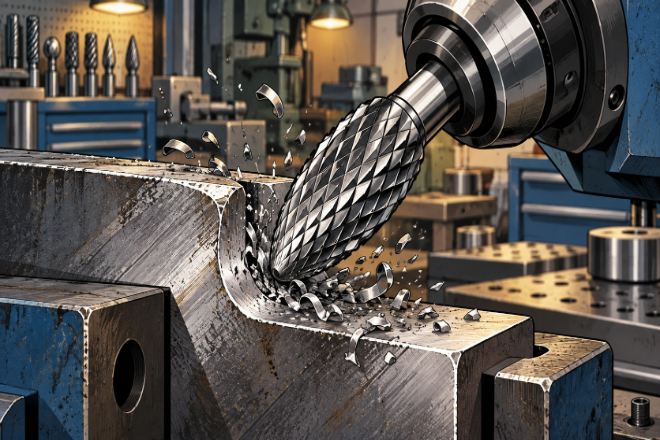
أ tungsten carbide burr is not made in the same way as a normal steel cutting tool.
Its cutting head is made from cemented carbide, which normally combines hard tungsten carbide grains with a metallic binder. This structure gives the burr a useful balance between صلابة و صلابة.
That difference becomes important as soon as the burr touches a hard workpiece. A softer cutting edge can slowly round over as it works.
Once this happens, the tool needs more pressure to remove the same amount of material. More pressure creates more heat, and the cutting process becomes less efficient.
A quality tungsten carbide burr keeps its cutting edges sharp for much longer. This allows the burr to continue cutting instead of rubbing against the workpiece.
The benefit is especially easy to see during long production runs.
A tool that performs well for the first few parts but quickly becomes dull can create hidden costs through tool changes, slower work, and inconsistent results.
2. Why Do Carbide Burrs Cut Hard Metals Better?
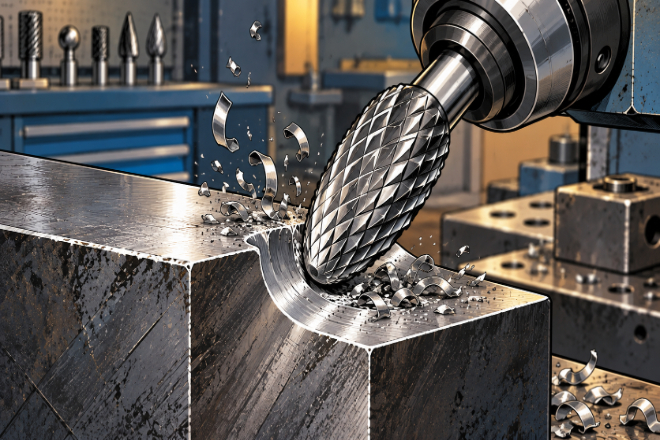
Hard metal does not respond well to a weak or dull cutting edge. Instead of producing a clean cut, the tool may rub, generate heat, chatter, or require excessive force.
Tungsten carbide burrs are well suited to these conditions because their cutting teeth resist deformation.
When the burr is used at the correct speed, its edges make many small cuts as the tool rotates. Material is removed in controlled chips rather than being pushed or rubbed away.
This makes carbide burrs useful for materials such as:
الفولاذ المقاوم للصدأ
Hardened steel
Cast iron
التيتانيوم
Nickel alloys
Tool steel
Welded metal
The exact result still depends on burr geometry, cut style, machine speed, and operator technique. Carbide is not a shortcut around correct machining conditions.
What it provides is a cutting material that can handle demanding metal much better than many conventional alternatives.
3. How Does Wear Resistance Improve Productivity?
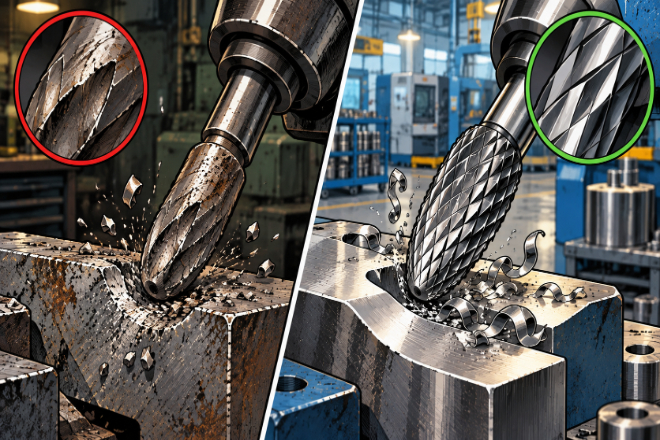
Tool life matters because every worn burr affects more than the cost of the burr itself.
Imagine an operator cleaning welds from a large batch of stainless steel components. If the burr becomes dull halfway through the work, production has to stop.
The operator changes the tool, checks the new burr, and starts again. If this happens often, those small interruptions become a real production cost.
The strong مقاومة التآكل ل tungsten carbide burrs for hard metals helps reduce this problem.
Because the cutting edges stay usable for longer, operators can complete more work between tool changes. Cutting performance is also more stable from one component to the next.
For a production manager, this matters more than simply asking which burr has the lowest unit price. A more useful question is: how much work can each burr complete before its performance becomes unacceptable?
A carbide burr that costs more but completes far more parts can have a lower tool cost per finished component.
4. Can Tungsten Carbide Burrs Handle High-Speed Cutting?
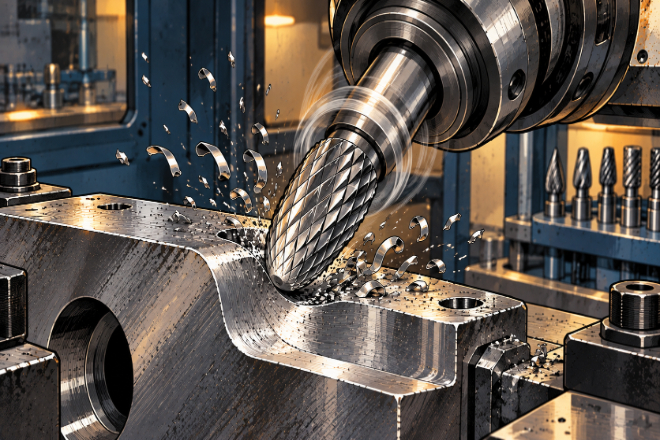
Carbide burrs are commonly used with high-speed rotary tools, including die grinders and pneumatic tools.
هُم صلابة allows the cutting edges to remain effective at speeds that would be difficult for many softer tool materials.
Higher cutting speed can increase material removal, but speed alone is not the goal.
The burr diameter, material being cut, machine power, and cut style all affect the correct operating range.
Too little speed may cause poor cutting and chatter. Excessive speed can create unnecessary heat and place extra stress on the tool. Heavy pressure is also usually a poor approach.
A sharp carbide burr should do the cutting; forcing it into the workpiece can increase the risk of chipping.
For companies using carbide burrs in regular production, following the manufacturer’s recommended speed range is a small step that can have a large effect on tool life.
5. Which Carbide Burr Cut Works Best for Hard Metals?
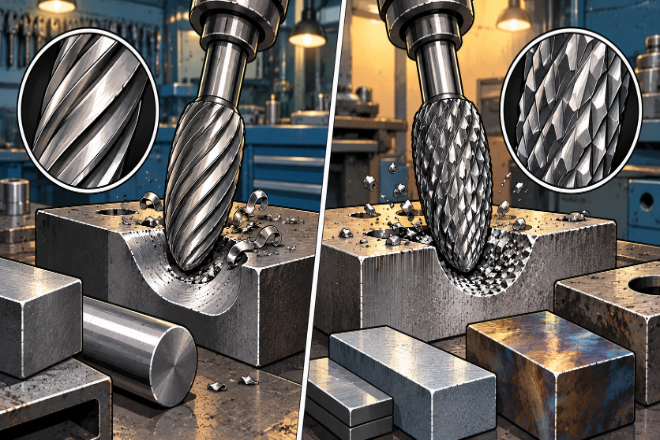
Choosing carbide is only half of the decision. The tooth pattern also changes how the burr behaves.
Single-cut carbide burrs have one set of cutting flutes. They can provide fast material removal and are often useful when long chips can be managed easily.
Double-cut burrs use crossing flute patterns. This breaks the removed material into smaller chips and can give the operator better control.
They are widely used for deburring, weld cleaning, shaping, and general metal fabrication.
The right choice depends on the work rather than one cut being better in every case.
Here is a simple comparison:
6. Where Are Carbide Burrs Used on Hard Metals?
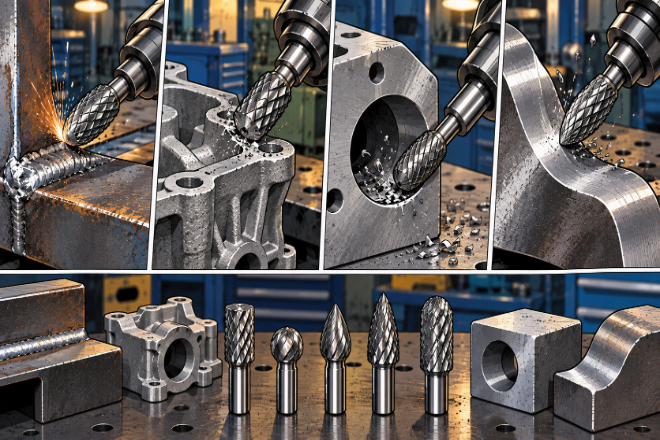
One reason tungsten carbide burrs are so useful is that one tool family can handle many metalworking jobs.
In fabrication shops, operators use them to clean welds, smooth rough edges, enlarge holes, and correct component shapes.
In foundries, carbide burrs can remove flash and excess material from cast parts. Tool and die shops use smaller burrs when working on detailed areas that larger grinding tools cannot easily reach.
Maintenance teams also depend on carbide burrs. A damaged steel component may need a small area cleaned or reshaped without removing the entire part from a machine.
A rotary burr gives the technician good access and control in these situations.
For stainless steel fabrication, the burr can remove weld material and prepare edges. For cast iron, it can clean cast surfaces and remove unwanted material.
When working with harder alloys, carbide provides the edge strength needed to keep cutting.
This flexibility is valuable for companies that work with many component shapes and cannot use a large cutting machine for every operation.
7. Do Carbide Burrs Produce a Better Surface Finish?
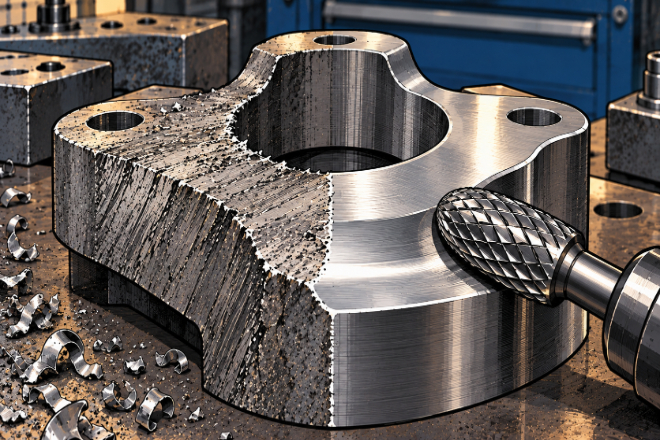
A good surface finish is not created by tool material alone. Still, a sharp and stable cutting edge makes the job easier.
As softer burrs wear, their edges become less effective. The operator may push harder, which can increase chatter and leave uneven marks.
أ tungsten carbide burr maintains its cutting geometry for longer, helping produce more predictable results.
Double-cut carbide burrs are particularly useful when the job requires both material removal and a controlled finish.
The smaller chips and smoother cutting action can make later finishing steps easier.
For manufacturers, consistency is important. If one part needs much more finishing than the next, labor time becomes difficult to predict. Stable burr performance helps make the process more repeatable.
It is worth remembering that carbide burrs are still material-removal tools. If the final component requires a very fine polished surface, additional grinding or polishing may still be necessary.
8. How Can Carbide Burrs Lower the Real Cost of Metalworking?
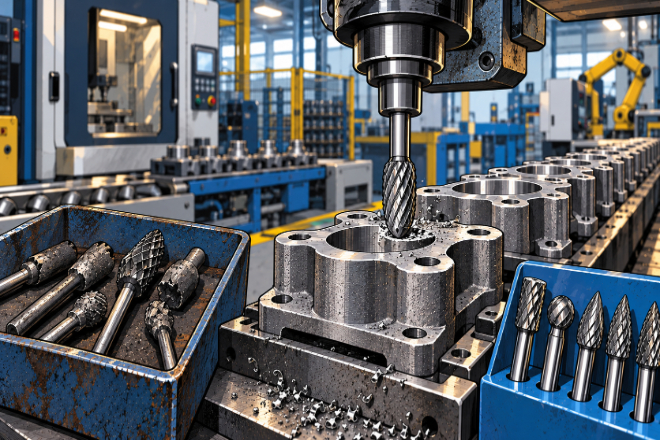
The purchase price of a burr is easy to measure. The cost of using it is more complicated.
A purchasing team should consider tool life, material removal speed, tool-change time, rejected parts, finishing time, and machine downtime.
These costs can easily be larger than the difference between a cheap burr and a high-quality carbide burr.
For example, suppose a lower-cost tool needs to be replaced several times during one production batch.
Each replacement takes only a few minutes, but those minutes include operator time and lost machine output. If cutting performance drops before the tool is changed, each component may also take longer to finish.
A durable carbide burr for hard metals can reduce these interruptions.
This does not mean carbide is automatically the lowest-cost choice for every job. For light work on soft materials, a less expensive tool may be enough.
Carbide shows its strongest economic value when the material is hard, production is continuous, or downtime is expensive.
That is why industrial buyers should compare cost per job or cost per finished part instead of only cost per burr.
9. What Should Buyers Check When Choosing Carbide Burrs?
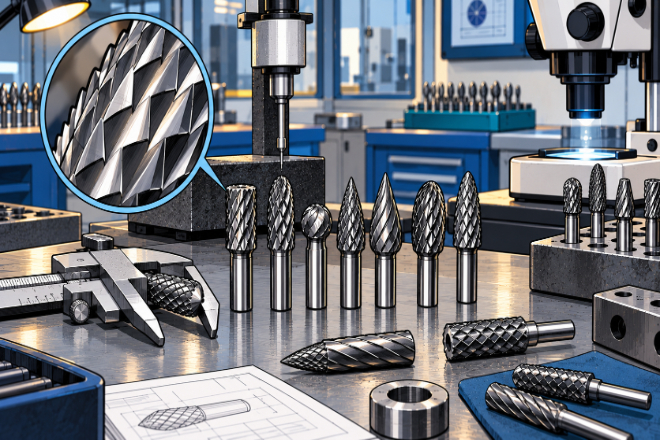
Two carbide burrs with the same shape can perform very differently. Material quality, carbide grade, flute geometry, grinding accuracy, and brazing quality all influence performance.
For regular industrial use, buyers should look closely at whether the burr is designed for the actual workpiece material.
The correct head shape and cut style should also match the operation.
Consistency between production batches is another important point. A sample that performs well has limited value if the next shipment behaves differently.
Reliable dimensional control and stable carbide quality become more important as purchasing volume increases.
Buyers should also discuss recommended operating speeds and application limits with the supplier. If a supplier cannot explain where a burr works well—or where it does not—that can be a warning sign.
For large users, testing several burrs under the same production conditions is often more useful than comparing specifications on paper.
Measure tool life, processing time, surface quality, and the number of parts completed. The results give purchasing teams a much clearer view of actual value.
 English
  Español
  简体中文
简体中文  Français
  日本語
日本語  한국어
한국어  العربية
  Tiếng Việt