
1. What Problems Need to Be Removed After Casting?
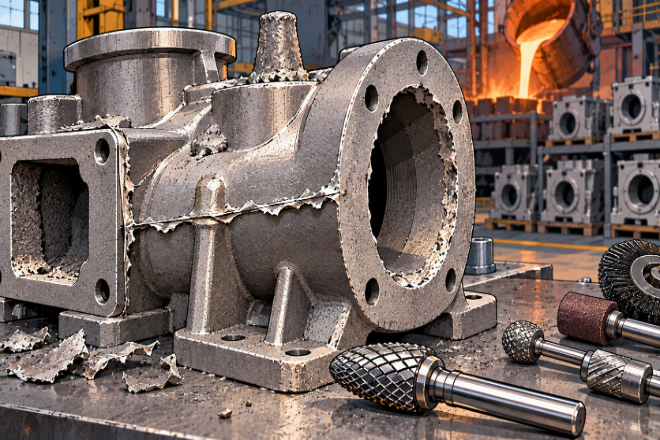
Pouring the metal is only part of making a casting. Once the metal has cooled and the casting has been removed from the mold, there is usually more work waiting.
Gates and risers have to be removed. Flash may appear along mold parting lines. Some surfaces can be rough. Sharp edges may remain around openings.
Local high spots can also appear and may need to be reduced before machining, coating, inspection, or assembly.
This stage is often called fettling or casting cleanup. Some of the unwanted metal is large enough for saws, cutting equipment, or heavy grinding tools.
Then the job gets smaller. A large gate may already be gone, but a raised section remains. A grinding wheel may have cleaned the main surface, but it cannot reach a narrow corner.
A hole may need deburring. An internal curve may have a small high spot. This is where a tungsten carbide burr for foundry work becomes useful.
Instead of grinding a broad area, its cutting teeth remove metal from a much smaller target.
This gives the operator more control over where material is removed. That matters because the goal of fettling is not simply to remove as much metal as possible.
The goal is to remove the metal that should not be there while keeping the casting that should. It sounds obvious.
A surprising amount of production time can disappear when that simple distinction is ignored.
2. Why Are Carbide Burrs Good for Foundry Fettling?
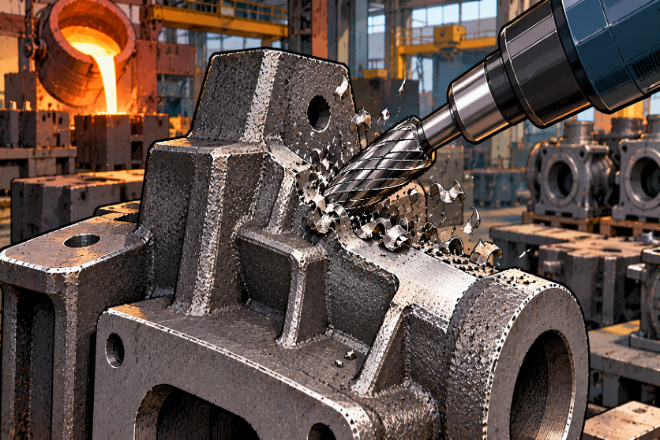
Foundry work is not gentle on tools. Cast surfaces can be rough and abrasive, and the tool may move between edges, corners, holes, and uneven areas during the same shift.
Tungsten carbide works well in this environment because it is hard and wear-resistant.
The cutting teeth can keep their cutting ability while working on materials such as cast iron when the burr and operating conditions are correctly selected.
But the real advantage is not just material صلابة. It is the combination of stock removal and control.
A carbide burr uses defined cutting teeth to remove chips. This makes it useful for operations such as deburring, leveling, milling out local areas, surface work, and cutting or correcting openings.
For cast iron, material-specific cutting geometries are also available. These designs can use a more aggressive tooth pattern and larger chip spaces to improve material removal and chip flow on cast materials.
This can be valuable in a foundry because cycle time matters.
If an operator spends an extra minute cleaning every casting and the factory processes 500 castings, that “little minute” has suddenly become a fairly large problem.
Vibration matters too. A well-made carbide burr with good concentricity can run more smoothly. Less chatter can improve control and reduce unnecessary wear on both the burr and the rotary tool.
That is particularly useful during long fettling shifts. A burr does not need to be exciting.
If it removes metal quickly, runs smoothly, and keeps doing the same thing part after part, most production managers will happily accept boring.
3. Where Do Carbide Burrs Work Best on Complex Castings?
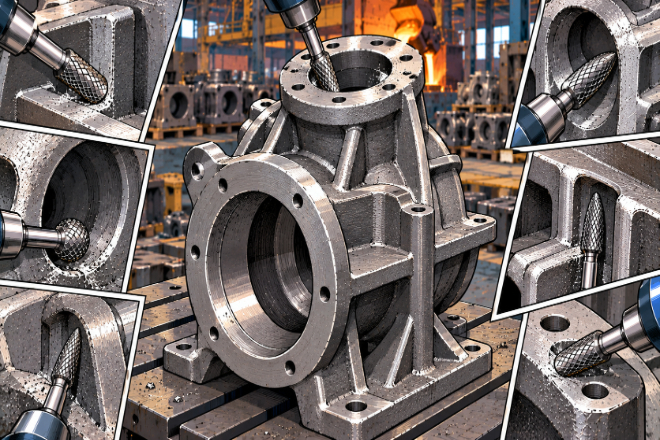
Castings have a habit of becoming complicated. A simple block is easy. A pump housing with ribs, internal curves, bolt holes, narrow channels, and several changing wall shapes is another story.
Large grinding tools work well on accessible surfaces, but they become less useful as the geometry gets tighter.
نتوءات كربيد solve part of this problem because they come in many shapes. A cylindrical burr can clean flatter surfaces and straight internal walls.
A ball burr works naturally inside rounded cavities. An oval burr can blend curved areas.
Tree and flame burrs are useful where the surface changes direction or narrows. Cone and pointed burrs can enter tighter corners, grooves, and openings.
The correct shape allows more of the useful cutting area to contact the casting at a natural angle.
That helps the operator guide the tool instead of fighting it. Imagine cleaning a curved internal housing with a large cylindrical burr.
It may technically work. So would eating soup with a fork, given enough patience. A better-matched ball or oval burr can follow the geometry more naturally.
Burr diameter and reach also matter. Smaller heads can reach detailed features, while larger burrs can remove material faster from more open areas.
Long-reach burrs may help with deep features, but unnecessary overhang can increase vibration.
The best foundry tool setup therefore comes from the actual casting geometry—not simply from whatever burr happens to be closest to the operator.
4. How Do Carbide Burrs Help Remove Flash and Gate Remains?
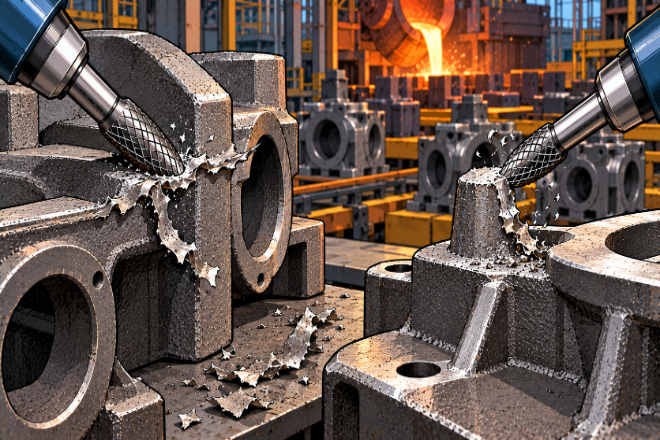
Flash is one of the most obvious cleanup jobs after casting. Thin extra metal can form where mold sections meet. After the casting is removed, this unwanted material has to go.
Some flash can be removed by larger equipment. Carbide burrs become especially useful around smaller areas, corners, curves, holes, and features where more control is needed.
Gate and riser removal creates another job. The main gate or riser can be cut away, but the remaining metal may still stand above the required surface.
The operator then needs to bring that area down without digging unnecessarily into the casting. A carbide burr can work on that local high spot.
For heavy stock removal on cast iron, a more aggressive cast-iron-specific cut can help remove material efficiently.
As the surface approaches the required shape, a more controlled operation may be used if the finish demands it.
This is where foundry managers should look beyond individual tool speed. Suppose one burr removes the gate remain very quickly but leaves deep marks that require another finishing operation.
Another burr takes slightly longer but leaves the area ready for the next production stage.
Which one is faster? The stopwatch on the first operation does not tell the whole story.
Total processing time does. A practical foundry selection guide may look like this:
5. Do Different Casting Materials Need Different Carbide Burrs?
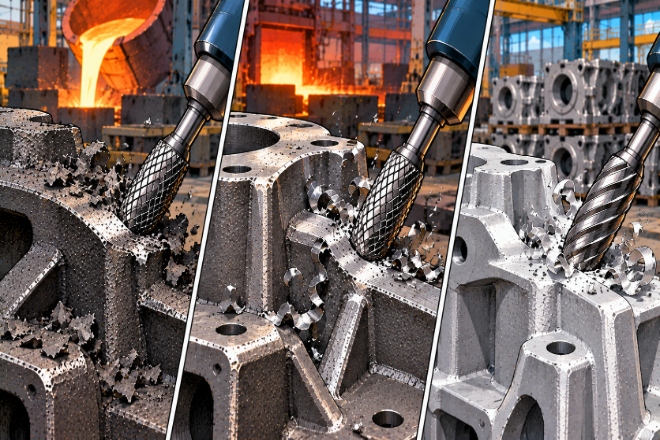
Yes, and this is an important point for foundries producing more than one alloy.
Cast iron is a major application for tungsten carbide burrs. Special CAST-type cutting geometries are available for grey cast iron, nodular cast iron, and other cast iron grades.
These burrs are designed around the way cast iron behaves during stock removal, including chip formation and the need for efficient cutting on abrasive cast surfaces.
Cast steel is different. A burr suitable for steel or cast steel may use another tooth geometry. Then there is aluminum. Aluminum foundries have almost the opposite chip problem.
Instead of short, brittle cast iron chips, soft aluminum can stick inside the cutting flutes. A tightly spaced burr may start collecting aluminum until the cutting edges become covered.
For aluminum castings, open flute geometries designed for aluminum are generally more suitable. The wider spaces help chips leave the cutting area.
Other non-ferrous cast materials may also benefit from cuts designed for their material group. This means a foundry handling iron castings and aluminum castings should not automatically use the same burr inventory for both.
The tool may have the same tungsten carbide base. The cutting geometry can be very different. For purchasing teams, material-specific tool organization can also prevent mistakes on the floor.
A good system makes it easy for operators to pick the correct burr without studying a product catalog every time a new casting reaches the bench.
The best tool system is usually the one people can actually use correctly at 4:30 on a busy Friday afternoon.
6. Can Foundries Automate Carbide Burr Fettling?
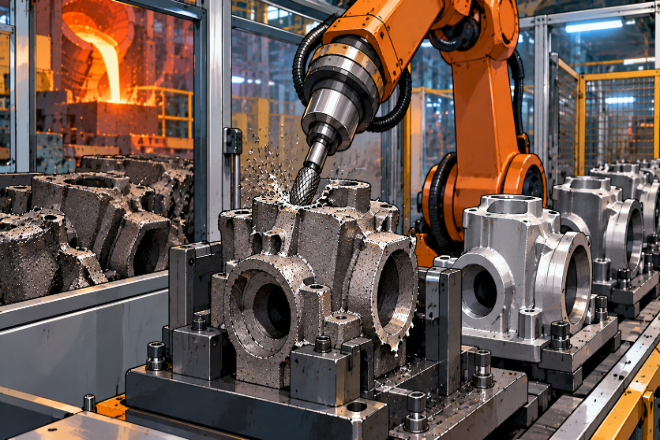
Yes, and this is where carbide burrs become especially interesting for high-volume foundries. Fettling can require a lot of manual work.
An operator may repeat the same flash removal, edge cleanup, or local grinding operation hundreds of times.
If the casting geometry and unwanted material are reasonably consistent, some of these operations may be suitable for automated processing.
قواطع كربيد التنغستن can be used with automated centers and drive spindles as well as straight grinders and other tool machines.
A robot can guide the burr along a defined path around the casting. For repetitive work, this can improve process consistency and reduce the amount of manual finishing required.
But automation changes what matters. With manual work, an experienced operator can adjust the tool angle or movement when a casting varies slightly.
A robot follows its programmed path. That means casting position, fixture accuracy, burr dimensions, runout, tool wear, and the amount of excess metal all need better control.
The burr itself must also be consistent. If one tool cuts smoothly and the next has noticeably different geometry or runout, the automated process can change after every tool replacement.
That is not the kind of surprise a production manager wants. Automated fettling therefore works best when the entire process is treated as a system: casting consistency + fixture + spindle + burr + tool path + wear control.
Buying a robot is the visible part. Making all those smaller pieces behave consistently is what makes the robot useful.
7. How Should Foundries Evaluate Carbide Burr Performance?
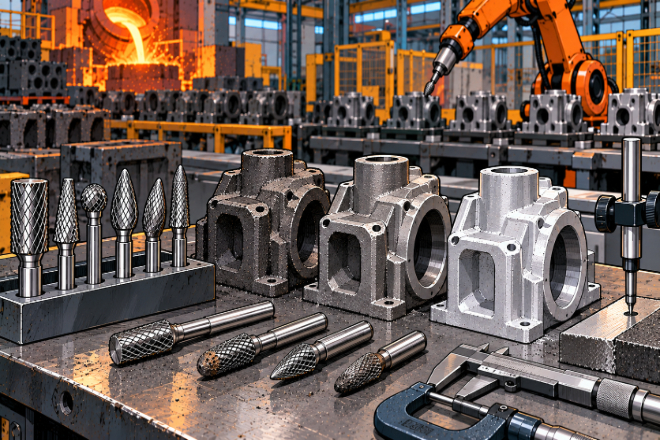
Foundries buying carbide burrs in volume should test them where they will actually work: on real castings.
Start with cycle time. How long does it take to remove the required flash, gate remain, or high spot?
Then look at tool life. How many castings can the burr process before cutting performance clearly drops?
Surface condition matters too. A fast burr that creates deep chatter marks may simply move the work to another finishing station.
Operators can provide useful information as well.
Does the burr feel stable?
Does it require heavy pressure?
Does vibration increase as the tool wears?
Can it reach the required features easily?
For automated operations, add consistency between burrs to the test. The purchasing team should also calculate cost per processed casting rather than looking only at price per burr.
Consider a higher-priced carbide burr that processes more parts, cuts faster, and reduces secondary finishing.
Now compare it with a cheap burr that needs frequent replacement and adds extra cleanup. The cheaper purchase can easily become the more expensive process.
Foundry economics can be surprisingly simple once the right number is measured. Do not ask only: “How much does this burr cost?”
Ask: “How much does it cost us to finish one acceptable casting?” That question connects tooling directly to production.
 English
  Español
  简体中文
简体中文  Français
  日本語
日本語  한국어
한국어  العربية
  Tiếng Việt