
1. Why Are Carbide Burrs Useful in Automotive Production?
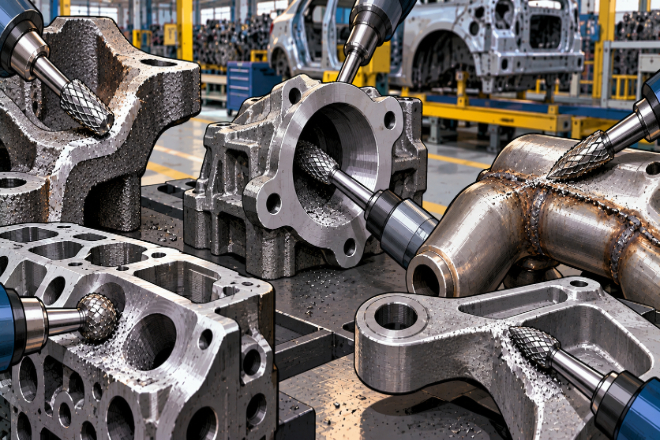
Automotive manufacturing involves a huge mix of metal parts.
Steel, stainless steel, cast iron, aluminum alloys, and other metals can all appear in vehicles or production equipment. Some components are cast. Others are machined, stamped, formed, or welded.
Each process can leave something behind that should not be there.
It may be a sharp burr around a hole. It may be extra metal on a casting. It may be a rough weld transition or a small area on a die that needs correction.
A tungsten carbide burr gives manufacturers a practical way to remove this material without setting up a large machining process for every small correction.
The carbide cutting head has defined cutting teeth. Instead of simply rubbing against the metal like an abrasive tool, those teeth cut away small chips.
That makes carbide burrs useful for deburring, leveling, surface work, enlarging or correcting holes, and working on weld seams.
Their small size is another advantage.
Automotive parts are full of awkward places: narrow channels, curved housings, holes, corners, ribs, and internal surfaces. A large grinding wheel may not fit. A correctly shaped carbide burr often can.
And because burrs are available in many shapes, the tool can be matched closely to the feature being processed.
That flexibility is one reason such a small tool can find so many jobs inside a very large industry.
2. How Are Carbide Burrs Used on Automotive Castings?
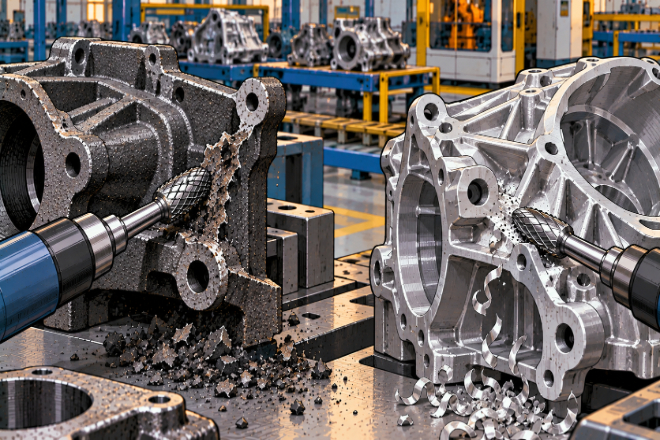
Cast components are everywhere in automotive manufacturing.
Engine-related parts, transmission housings, brackets, pump bodies, steering parts, brake components, and many other parts can begin as castings.
A casting does not always come out of the mold ready for assembly.
There may be flash along a parting line. Gate or riser removal can leave raised areas. Internal passages may contain rough sections. Some edges may need local correction before machining or assembly.
Carbide burrs can clean these areas without removing large amounts of surrounding material.
For cast iron components, the material tends to produce shorter, brittle chips during cutting. A carbide burr can therefore work well for local stock removal and cleanup.
Automotive aluminum castings need a different approach.
Aluminum is softer and can stick between closely spaced cutting teeth. For this reason, open-flute burr designs made for aluminum or non-ferrous metals are usually more suitable.
The wider flute space helps chips escape instead of packing around the cutting head.
The material matters just as much as the part shape.
Using one general burr for every casting may sound convenient, but convenience disappears quickly when operators spend half their time cleaning clogged tools.
For high-volume casting lines, burr selection should therefore start with the alloy and the actual cleanup operation.
A burr used to remove heavy flash from a cast iron housing may need a different cut from one used to clean an aluminum transmission component.
Same tool family. Very different job.
3. Where Do Carbide Burrs Help With Welds and Body Parts?
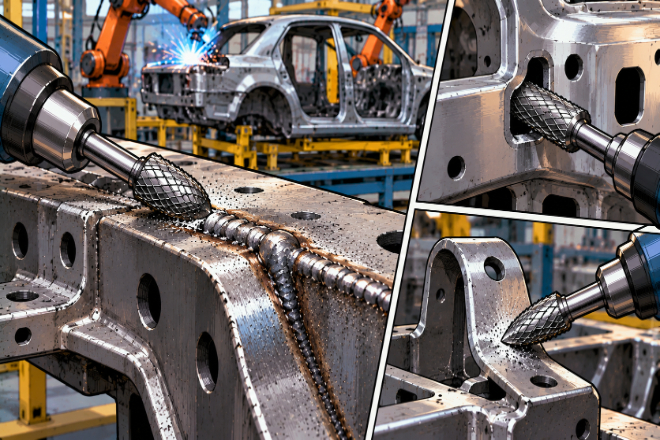
Automotive manufacturing involves a lot of joining.
Frames, brackets, exhaust components, structural parts, and many other assemblies may contain welded areas.
Most welds do not need to be made invisible. But some do need extra metal removed, edges cleaned, or transitions blended before the next production step.
A carbide burr can work directly on these local areas.
For heavier weld cleanup, a more aggressive cut may help remove raised material quickly.
For lighter blending, a controlled cut can make it easier to approach the final surface without digging into the surrounding metal.
Burr shape matters here as well.
A cylindrical burr can work along flatter areas. A tree-shaped or flame-shaped burr can reach into angled weld joints and changing contours. A ball burr can work around rounded areas.
The ability to choose different shapes is useful because automotive welds rarely sit on one perfect flat plate.
The tool may need to reach around a bracket, inside a corner, or between two structural features.
Carbide burrs can also help clean edges and holes on fabricated parts after cutting or drilling.
The goal is not always to make the surface beautiful.
Sometimes the goal is much more practical: remove the sharp edge so the part fits, moves, seals, or assembles correctly.
That tiny burr around a hole may look harmless.
On a production line, thousands of tiny problems have a habit of becoming one large problem.
4. How Are Carbide Burrs Used on Engine and Transmission Parts?
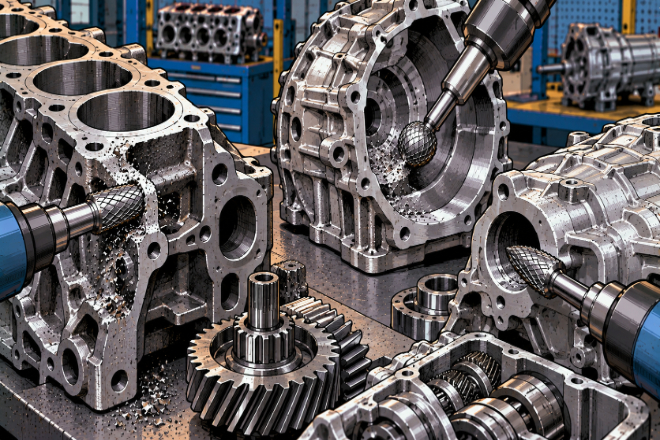
Engine and transmission parts often contain complex geometry.
Housings may have holes, channels, curved internal walls, sealing areas, and machined edges close together.
After casting or machining, some of these features may need local deburring or correction.
A carbide burr can reach areas where a large cutting or grinding tool would be difficult to use.
For example, a ball or oval burr can follow a rounded internal profile. A cylindrical burr can clean a straight wall or edge. A cone-shaped burr can work around tapered openings or narrow features.
Carbide burrs can also remove small amounts of material after machining when a feature needs correction.
This does not mean burrs should replace precision machining.
They should not.
If a bore needs an exact diameter or a sealing face requires a controlled tolerance, the correct machining process is still needed.
A carbide burr is better suited to local material removal, edge cleanup, blending, and correction where the final requirement allows it.
That distinction is important for automotive manufacturers.
The burr is not there to solve every metalworking problem.
It is there to solve the small, awkward ones efficiently.
For production managers, this makes process definition important. Operators should know which areas can be burr-finished and which features must remain under controlled machining.
That avoids a situation where a useful hand tool quietly becomes an unofficial machining center.
5. Why Are Carbide Burrs Useful for Die and Mold Work?
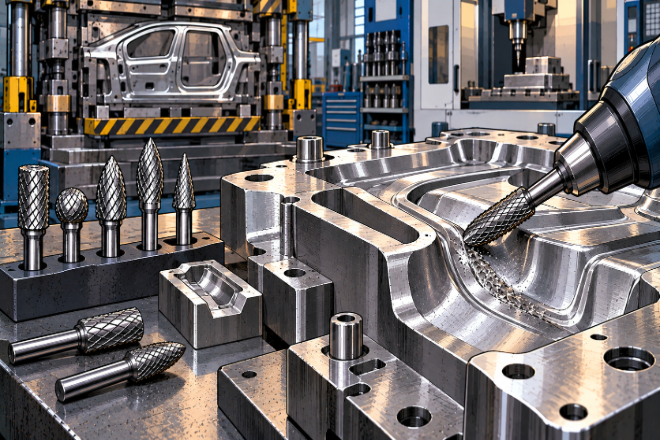
Cars need more than vehicle parts to be manufactured.
They also need the tooling that makes those parts.
Stamping dies, forming tools, molds, fixtures, and other production tooling may need adjustment during setup, maintenance, or repair.
This is another area where tungsten carbide burrs can be valuable.
A die may have a small high spot.
A corner may need blending.
A repaired tool surface may require local cleanup.
Or a difficult area may need a small correction without sending the whole tool through another large machining operation.
For this work, control is especially important.
Removing too little metal means another pass.
Removing too much can turn a simple correction into a much more expensive repair.
Fine-cut carbide burrs can be used for finishing and corrections in tool and mold work. High concentricity and low vibration are particularly useful here because chatter marks are not welcome on precision tooling.
Different burr shapes also help toolmakers follow complex geometry.
Ball and oval shapes suit curved areas. Tree and flame shapes can follow changing contours. Cone and pointed designs can reach narrow features.
The toolmaker is not trying to win a race against the steel.
The goal is to make the correction and stop at exactly the right moment.
That is a very different type of productivity.
6. Can Carbide Burrs Be Used in Automated Automotive Production?
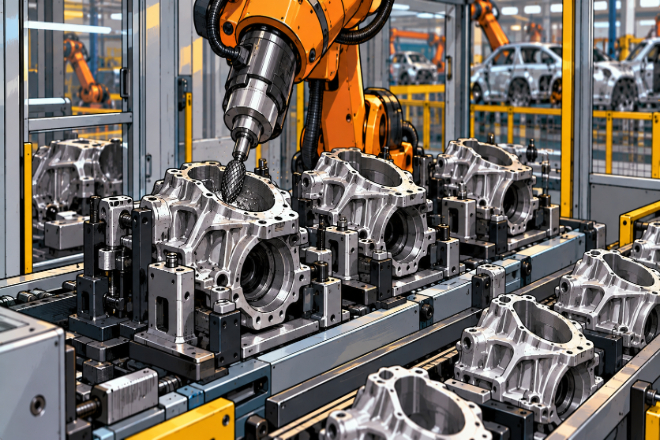
Carbide burrs are often associated with someone holding a die grinder.
That is only part of the story.
They can also be used with machine tools, automated centers, and robotic systems.
This creates interesting opportunities in automotive production, especially for repeated deburring operations.
Imagine a cast component coming out of production with the same flash in the same location every time.
If the geometry and part position are predictable, that cleanup operation may be a candidate for automation.
A robot or fixed spindle can guide a carbide burr along the required path repeatedly.
This can be useful for deburring castings, cleaning edges, working around holes, or processing repeat features.
But automation makes tool quality even more important.
A human operator can feel when a burr starts cutting differently.
A robot cannot “feel” in the same way unless the system has suitable monitoring and control.
Tool runout, flute consistency, burr wear, part position, and cutting conditions therefore need close attention.
High concentricity can help reduce chatter and wear, while a stable drive system helps keep the burr cutting smoothly.
For high-volume automotive manufacturers, automated deburring is not simply about replacing manual work.
It is about creating a repeatable process.
If every part arrives in the same position and every burr behaves in a similar way, automation becomes much easier to manage.
If every tool cuts differently, the robot will faithfully repeat the problem all day.
7. How Should Automotive Manufacturers Select Carbide Burrs?
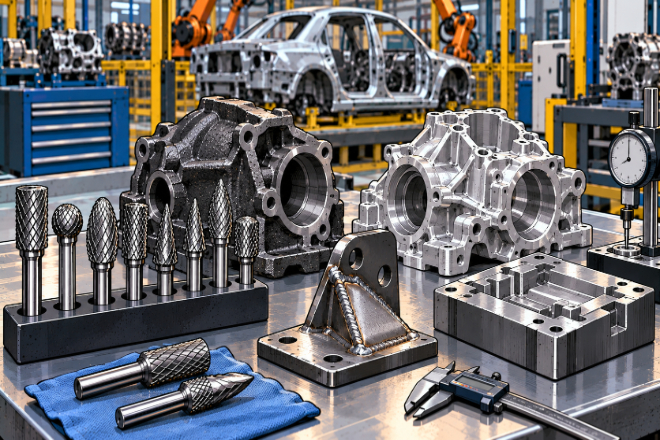
There is no single “automotive carbide burr.”
The correct choice depends on the material, feature, operation, and required finish.
A production team can begin with four basic questions.
What material are we cutting?
How much material needs to be removed?
What shape is the area?
What surface condition is needed afterward?
The answers quickly narrow the options.
 English
  Español
  简体中文
简体中文  Français
  日本語
日本語  한국어
한국어  العربية
  Tiếng Việt