
1. Why Are Carbide Burrs Useful in Oilfield Repair?
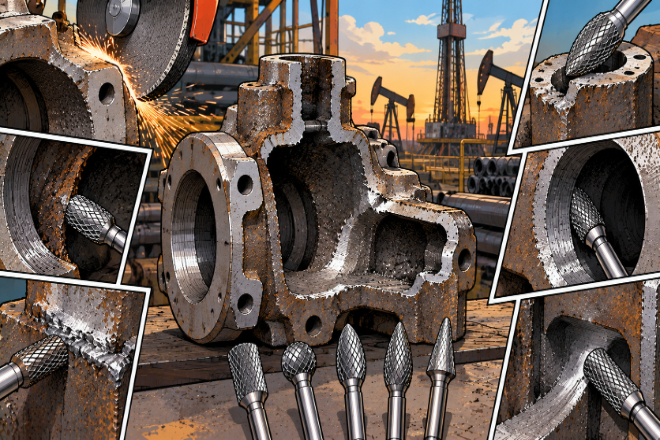
Oilfield repair is different from working on a new, clean piece of steel.
A used component may arrive covered with wear marks, corrosion, damaged edges, old weld material, or rough areas caused by abrasive service. The repair team first needs to inspect the part and decide what can be restored.
Many oilfield components operate around abrasive fluids and solids. Chokes, valves, mud pumps, and downhole tools can all face erosion and wear during service.
That means repair often involves removing a small amount of damaged material before another process begins. A tungsten carbide burr is useful because it gives the technician local control.
Instead of grinding a large area, the burr can work on one edge, groove, hole, weld, or damaged section.
Tungsten carbide is also much harder than common tool steel and has strong wear resistance. That helps the cutting teeth stay useful when working on steels and other hard materials found in industrial equipment.
But perhaps the biggest advantage is access. Oilfield components are full of awkward geometry.
Valve bodies have internal cavities. Pump parts contain bores and pockets. Drilling tools may have slots, shoulders, and narrow areas. Weld repairs can sit inside corners where a large grinding disc simply cannot go.
Carbide burrs are available in cylindrical, ball, oval, tree, flame, cone, and other shapes. That gives repair shops options.
When the damaged area looks like it was designed specifically to annoy the maintenance team, there is usually a burr shape that can make the job easier.
2. Where Are Carbide Burrs Used on Valves and Chokes?
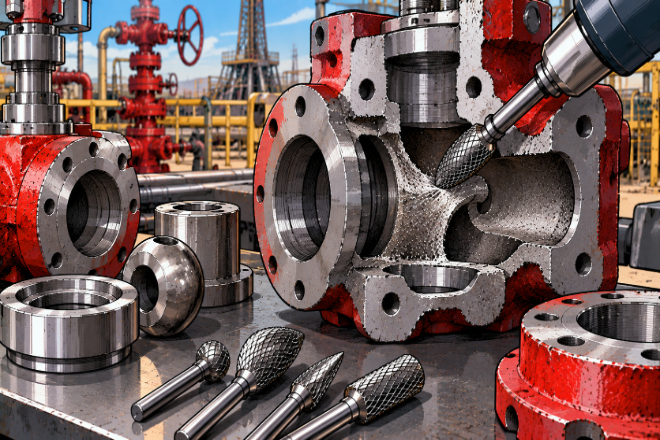
Valves and chokes are important parts of oilfield flow-control systems.
They can operate with pressure differences and fluids containing abrasive solids. Over time, some internal areas can suffer erosion, scoring, or other surface damage.
Major damage may require machining, replacement parts, coating, or full component replacement. Carbide burrs are more useful for the smaller work around those larger repair operations.
For example, a repair technician may need to clean a damaged edge before inspection. A local rough area may need to be blended.
A groove or opening may contain a small burr after machining. A welded repair area may need excess metal removed before final machining.
Different shapes help here. A cylindrical burr can work along a straight internal wall. A ball or oval burr can follow curved valve-body surfaces. Tree and flame burrs can reach changing contours.
Cone-shaped burrs can work around tapered or narrow areas. However, sealing surfaces need special care.
If a valve seat pocket, seal groove, or other critical feature has a defined dimension or surface requirement, freehand burr work should not replace the specified machining process.
Oilfield valve repair can include operations such as skim cutting, re-machining seal grooves, welding damaged areas, heat treatment, pressure testing, and restoring parts to defined specifications.
The carbide burr supports these operations. It does not magically replace them. That distinction can save an expensive valve from becoming an expensive piece of scrap.
3. How Do Carbide Burrs Help With Weld Repair?
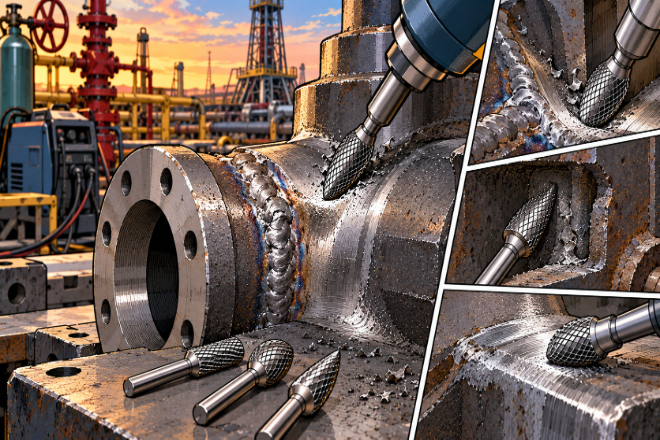
Welding is a common part of industrial repair. A worn or damaged area may be machined or prepared, rebuilt with weld metal, and then brought back toward the required shape.
After welding, the new material does not always look particularly elegant. That is fine. Its first job is to restore the area. The finishing tools come next.
Tungsten carbide burrs can remove small amounts of excess weld metal, blend weld transitions, clean corners, and shape local repaired areas.
This is especially useful when the repair geometry is too narrow or complex for a large grinding wheel.
Imagine a welded repair inside a valve body or around a small support on a drilling tool. A large disc may remove metal quickly, but getting it into the right place is another matter.
A tree, flame, ball, or cylindrical carbide burr gives the technician more local control. Burr cut also matters. If the repair needs heavier stock removal, a more aggressive cutting pattern may be useful.
As the repaired surface gets closer to its required shape, a more controlled burr can make finishing easier. The important point is not to confuse blending with precision restoration.
A burr may prepare or clean a repaired area, but critical dimensions, sealing surfaces, threads, and pressure-containing features still need the correct machining, inspection, and testing process.
For oilfield repair shops, the burr is part of the repair chain. It is not the whole chain.
4. Where Do Burrs Help With Pumps and Drilling Tools?
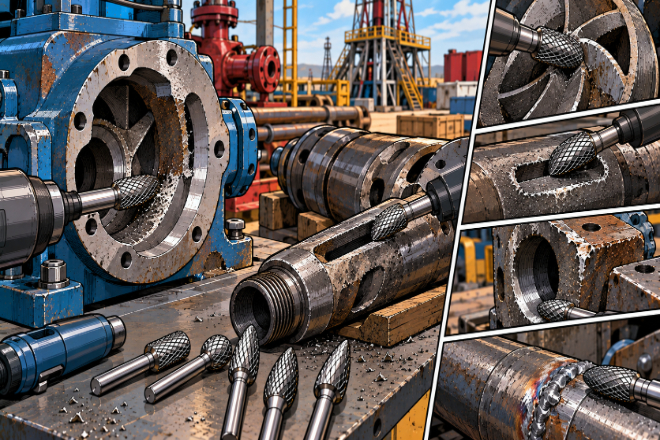
Mud pumps and downhole tools operate in some very unfriendly conditions. Drilling fluids can contain abrasive solids, while downhole equipment may face vibration, pressure changes, erosion, and continuous mechanical wear.
When these components come in for service, repair teams may find rough edges, damaged local surfaces, worn openings, old hardfacing, weld repairs, or small areas that need preparation.
Carbide burrs can help with local cleanup before inspection or repair. On a pump component, a burr may be used around a machined opening or repaired edge.
On a drilling tool, it may clean a slot, blend a local weld, remove a sharp edge, or shape a small repair area.
They can also help prepare metal around some repair zones before welding or hardfacing, provided the process specification allows it.
The main advantage again is controlled access. A long drilling tool may be enormous compared with the burr. But the repair problem itself may be only a few millimeters wide.
Using a huge tool for a tiny problem does not automatically make the job faster. Sometimes it just makes the mistake bigger.
Long-shank carbide burrs can help reach deeper areas, but extra reach should be used carefully. More tool overhang can increase vibration and make the burr harder to control.
The repair team should therefore choose the shortest practical reach for the job. Stability beats unnecessary length.
5. How Do You Match the Burr to Oilfield Materials and Damage?
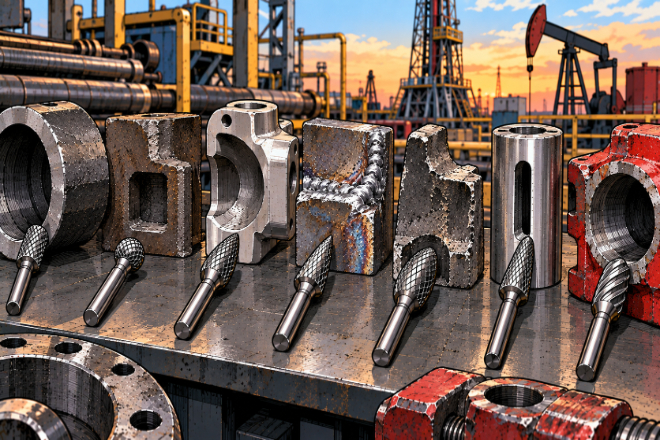
There is no single carbide burr that is best for every oilfield repair. Start with the base material.
Carbon and alloy steels may need one type of cutting geometry. Stainless steel can benefit from cuts designed for stainless applications. Non-ferrous materials require different chip control.
Some oilfield components also contain hardfacing, wear-resistant coatings, or tungsten carbide wear parts.
These require extra care. A tungsten carbide burr should not automatically be used to grind every hard surface just because the word “carbide” appears in both places.
The repair method must consider the actual material, coating, hardness, thickness, and required final condition.
Then consider how much metal needs to come off. Heavy local stock removal needs a different approach from light deburring. Finally, consider geometry.
6. What Mistakes Can Cause Problems During Oilfield Repair?
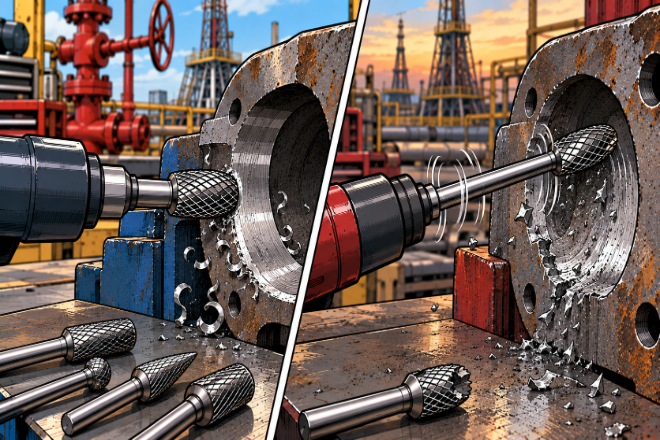
The first common mistake is using too much pressure. When a hard or damaged surface does not disappear quickly enough, pushing harder feels like the obvious answer.
With carbide burrs, it can be the wrong one. Excess pressure can increase heat, vibration, and load on the cutting teeth. Tungsten carbide is very hard, but it is also less tolerant of shock than steel.
Let the teeth cut. Do not turn the burr into a hammer. Speed is another factor.
The correct rotational speed depends on burr diameter, material, tool design, and manufacturer guidance. One speed should not be used blindly for every burr in the repair shop.
Tool condition matters too. A worn collet, damaged grinder bearing, bent shank, or excessive overhang can create runout and chatter.
If the burr starts bouncing across the workpiece, pressing harder is not going to make the situation more professional.
Stop and find the cause. Another mistake is removing material before the damaged part has been properly inspected.
In oilfield repair, wear patterns can tell engineers useful things about what happened during service. Grinding away the evidence before inspection is not helpful.
The repair sequence should therefore be clear: clean → inspect → define repair → remove material → restore → inspect again.
For critical pressure-control or downhole equipment, approved repair procedures, dimensions, inspection requirements, and testing always take priority over convenient hand finishing.
7. How Should Repair Companies Evaluate Carbide Burr Performance?
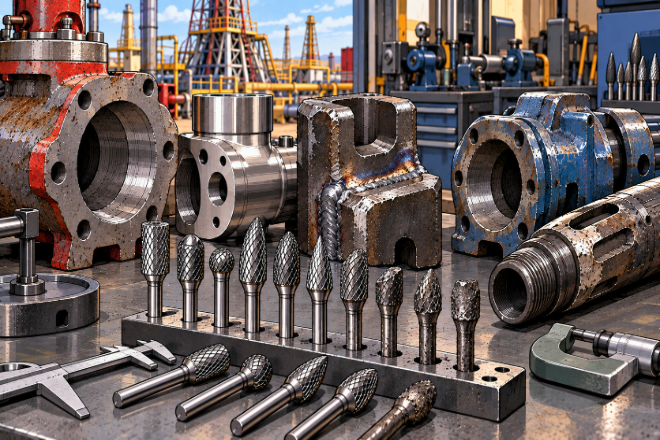
For an oilfield repair company, burr life alone is not a very useful purchasing measure. The real question is what happens to the whole repair process. Start with removal speed.
How long does the burr take to prepare or blend the damaged area? Then check control. Can technicians reach the required surface without damaging nearby features?
Look at vibration and surface condition. Does the burr remain stable as it wears? How often does it need changing? And does performance remain similar from one burr to the next?
Consistency matters because repair work is already full of variation. Two used valves may arrive with very different wear patterns. Two drilling tools may require completely different repairs.
The cutting tool should not add even more uncertainty. Repair shops should test burrs on representative materials and real repair tasks before placing large orders.
Do not judge a burr only by making a few cuts on a clean piece of mild steel. That is not what the tool will see on Monday morning.
A more useful test might include alloy steel, stainless steel, welded areas, narrow access, and representative damaged surfaces. Then calculate labor time and secondary work as well as tool consumption.
A burr that costs slightly more but cuts smoothly for longer and reduces finishing time can easily be the lower-cost choice.
For oilfield repair, downtime adds another layer. The customer often wants equipment back in service quickly. Saving a few dollars on a rotary tool does not mean much if it adds hours to the repair.
 English
  Español
  简体中文
简体中文  Français
  日本語
日本語  한국어
한국어  العربية
  Tiếng Việt