
1. Why Are Internal Corners Difficult to Finish?
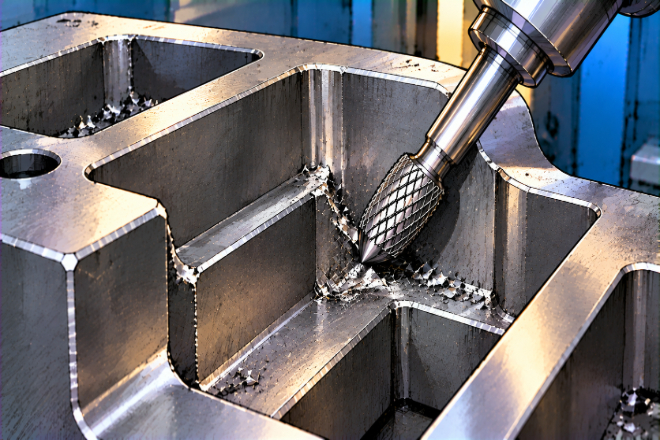
Internal corners create one of the most challenging areas in metal finishing.
Unlike flat surfaces or outside edges, internal corners are surrounded by material. The tool has less space to move, and the cutting angle changes as the burr approaches the corner.
A small mistake can easily damage the surrounding surface. One common problem is leftover material after machining.
During milling, drilling, casting, or grinding, small burrs may remain where two surfaces meet. These burrs are often difficult to remove because they sit inside the corner rather than on an open edge.
Another challenge is visibility. Operators may not have a clear view of the cutting area, especially inside deep cavities or narrow channels. This makes it harder to control material removal.
Tool access is also important. A burr that is too large may not reach the corner properly. A burr that is too small may remove material too slowly and increase finishing time.
Internal corners are also sensitive to shape changes. In many components, the corner radius has a specific purpose. It may affect stress distribution, part fitting, or fluid flow.
Removing too much material can change the original design.
For example, a machined housing may contain internal pockets with rounded corners. If the finishing tool cuts too aggressively, the corner radius may become larger than required.
This is why internal corner finishing is not just about removing metal. The goal is to remove unwanted burrs, improve the surface, and maintain the intended geometry.
Tungsten carbide burrs are useful because they provide different shapes and cutting options for these difficult areas.
However, manufacturers must select the correct tool based on the corner shape, material, and finishing requirement.
2. Which Tungsten Carbide Burr Shapes Work Best for Internal Corners?
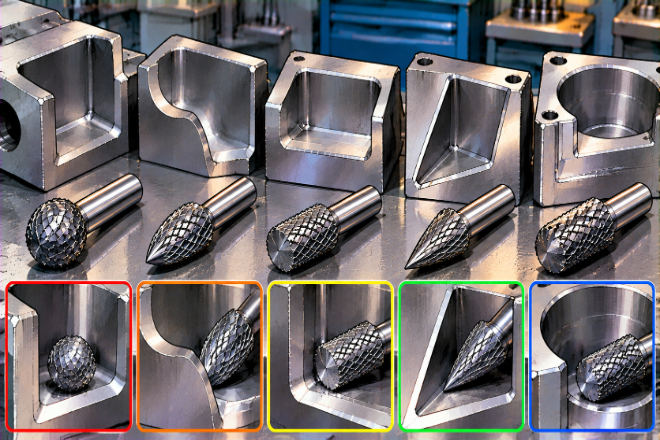
The shape of the burr determines how well it can reach and control an internal corner. Different corner designs require different tool profiles.
1). Ball Burrs
Ball-shaped tungsten carbide burrs are one of the most common choices for rounded internal corners.
Their curved cutting head can follow a radius smoothly and remove material without creating sharp transitions.
They are useful for:
Blending corner radii
Removing small defects
Smoothing curved transitions
However, a ball burr is not always the best choice for a sharp 90-degree corner because its rounded shape cannot reach the deepest point of a square corner.
2). Flame Burrs
Flame-shaped burrs are useful for many internal corner applications.
Their tapered profile allows better access to narrow areas and curved transitions.
They can remove material gradually while maintaining better control compared with very aggressive shapes.
Flame burrs are often used for:
Corner blending
Die and mold finishing
Irregular internal surfaces
Radius-End Cylindrical Burrs
These burrs combine straight cutting sides with a rounded end. They are useful when an internal corner has a flat wall connected to a controlled radius.
The side teeth help remove material along the wall, while the rounded end helps protect the corner transition.
3). Cone Burrs
Cone-shaped burrs are useful for angled internal corners and narrow access areas. They can reach areas where larger burr shapes cannot enter.
However, they require careful control because the pointed shape can remove material quickly in a small area.
4). Cylindrical Burrs
Cylindrical burrs can work on internal corners when the area is open enough. They are often useful for wall finishing near corners rather than deep corner blending.
The following table provides a basic selection guide.
3. How Does Corner Geometry Affect Burr Selection?
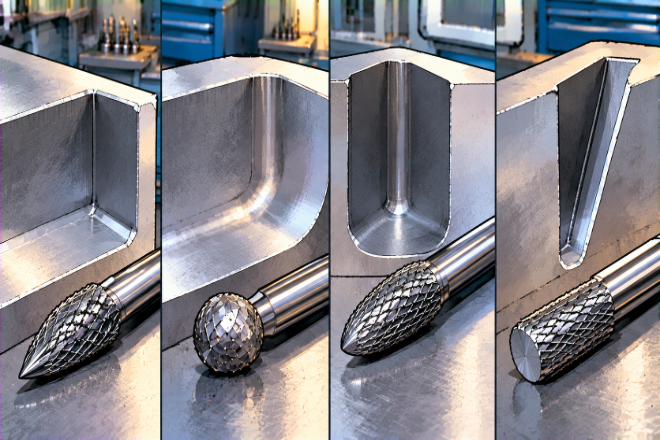
Before choosing a carbide burr, manufacturers should understand the actual corner design. A 90-degree internal corner and a rounded corner require completely different approaches.
A sharp internal corner has limited space because the cutting tool must reach the intersection point of two surfaces.
In many cases, a burr cannot create a perfectly sharp internal corner because the tool itself has a radius.
For these situations, the goal is usually removing unwanted material while maintaining the intended design.
Rounded corners are easier to finish because the tool can follow the curve. However, the corner radius must still be protected.
Using a burr with a smaller radius than required may create an uneven surface. Using excessive pressure may flatten the curve.
Deep internal corners create another challenge. The tool must have enough reach while maintaining stiffness.
A longer burr can reach deeper areas, but longer tools are more sensitive to vibration. This can create poor surface quality or even tool damage.
The corner depth also affects chip removal. When chips collect inside a deep corner, they can scratch the surface or reduce cutting performance.
For automated machining, corner geometry must be included in the tool path.
The machine needs to control:
Tool angle
切断速度
Feed movement
Contact area
A poor tool path can create inconsistent corner results even when using a suitable burr.
For decision-makers, the first question should not be: “Which burr is strongest?” The better question is: “What corner shape and finishing result are required?”
The answer determines the correct tool.
4. How Does Material Type Affect Internal Corner Finishing?
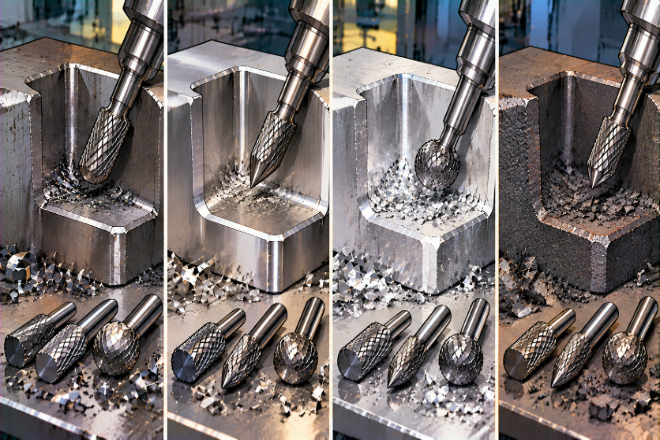
The workpiece material has a major influence on carbide burr performance. Different metals create different cutting conditions.
For carbon steel, tungsten carbide burrs can provide efficient material removal for corner cleanup and blending.
A suitable cutting pattern can help balance speed and surface quality. Stainless steel requires more attention.
Some stainless materials generate more heat during cutting and may become harder near the surface.
Using proper speed and avoiding excessive pressure helps prevent poor results. Aluminum creates another challenge.
Because aluminum is soft and sticky, chips can attach to the cutting teeth. This problem becomes worse in internal corners because there is less space for chips to escape.
For aluminum corner finishing, burrs with more open cutting spaces can help reduce clogging. Cast iron is often found in industrial components with complex internal shapes.
Carbide burrs can help remove casting flash and improve rough internal corners. However, dust control and cleaning are important because cast iron particles can affect the working environment.
Material selection should always be part of the tool decision. A burr that performs well on one material may not provide the same result on another.
The best finishing process considers:
Material hardness
Chip behavior
Required surface quality
Amount of material removal
5. How Can You Finish Internal Corners Without Damaging the Part?
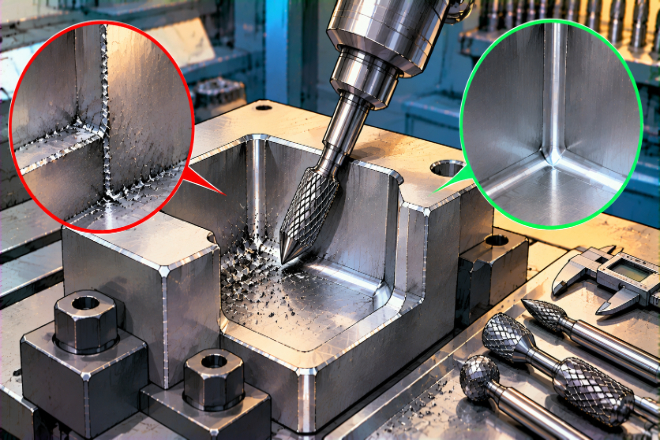
The biggest risk during internal corner finishing is removing too much material. A carbide burr is powerful, but that does not mean it should always cut aggressively.
The first step is inspection. Identify where the unwanted material is located. Is it a small burr? A casting defect? A rough transition?
The answer affects the tool choice and cutting method. Light passes are usually better than heavy cuts.
Removing a small amount of material gradually gives better control and reduces the chance of changing the corner shape.
Tool speed also matters. A speed that is too low may create poor cutting action. A speed that is too high can increase heat and tool wear.
The correct speed depends on burr size, material, and application. Tool holding is another important factor.
A loose tool holder or excessive tool extension can create vibration. Inside a corner, vibration can quickly damage the surface.
The workpiece should also be fixed securely. Movement during cutting can create uneven corner geometry. For repeated production work, manufacturers should define a clear process.
This may include:
Selected burr shape
Tool speed
Cutting direction
Inspection method
交換時期
A stable process creates consistent results and reduces rework.
6. When Should Manufacturers Use Carbide Burrs for Internal Corners?
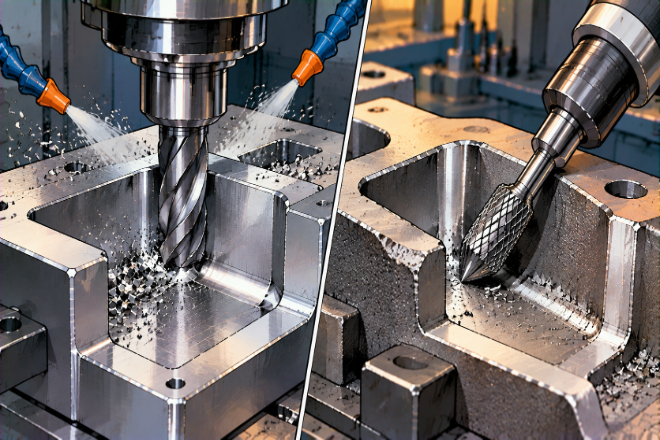
Tungsten carbide burrs are valuable tools for many internal corner applications, but they are not always the best choice.
They work well when manufacturers need:
Local burr removal
Corner blending
Casting cleanup
Repair work
Surface improvement
For example, a component may already have the correct internal geometry but contain a small burr after machining.
Using a carbide burr can solve the problem without repeating the entire machining process. They are also useful in maintenance work where large components are difficult to move.
However, if the internal corner requires extremely accurate dimensions, dedicated machining methods may provide better control.
For high-volume production, specialized cutting tools may offer better repeatability.
The decision should consider:
Required accuracy
Production volume
Access difficulty
Finishing cost
A carbide burr is most valuable when flexibility matters. It allows manufacturers to solve local problems without unnecessary machining.
 English
  Español
  简体中文
简体中文  Français
  日本語
日本語  한국어
한국어  العربية
  Tiếng Việt