
1. Why Is Deburring Important in CNC Machining?
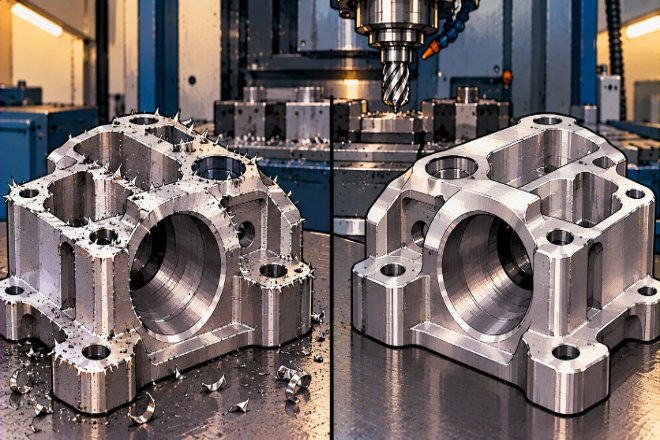
CNC machining is known for accuracy, but even a well-programmed machine cannot prevent every burr.
During milling, drilling, turning, and other cutting operations, small pieces of metal may remain attached to the workpiece. These burrs often appear where the cutting tool enters or leaves the material.
A burr may look harmless, especially when it is only a thin piece of metal. However, it can create problems during assembly, inspection, and normal product use.
For example, a small burr around a bolt hole can prevent a fastener from sitting correctly.
A sharp edge inside a hydraulic component may damage a seal. Loose metal particles can also enter sensitive equipment and cause problems later.
That is why deburring is not simply about making a part look better.
It is part of producing a component that fits, functions, and meets its quality requirements.
Many manufacturers still remove burrs manually after CNC machining. Workers take the finished parts to another station, use handheld tools, inspect the edges, and return the components for the next operation.
This method can work for small batches. However, it becomes less attractive when production volume increases.
Every additional handling step takes time. Manual deburring can also produce different results depending on the operator and the shape of the part.
Using tungsten carbide burrs for CNC deburring allows manufacturers to bring suitable edge-finishing work into the machining process itself.
Instead of treating deburring as a separate problem, it becomes another controlled machining operation.
2. What Makes Tungsten Carbide Burrs Suitable for CNC Deburring?
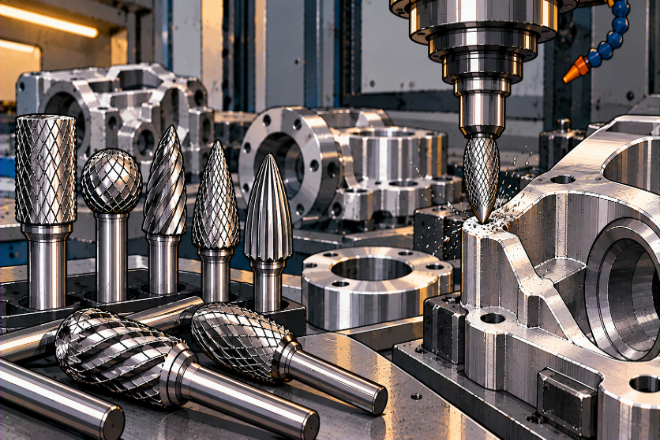
タングステンカーバイドバー are rotary cutting tools with sharp teeth designed to remove unwanted material.
Unlike a grinding tool that mainly wears material away through abrasion, a carbide burr cuts small chips from the workpiece.
This cutting action makes tungsten carbide burrs useful for removing larger burrs, correcting uneven edges, and cleaning areas that need more than light polishing.
One important advantage is 耐摩耗性.
Tungsten carbide is harder and more wear-resistant than many common tool steels. Under suitable cutting conditions, its teeth can remain effective through repeated operations.
For a CNC machining center, this matters because tool performance needs to remain predictable.
If a cutting tool changes too quickly, the same programmed movement may no longer produce the same edge.
Another advantage is the wide range of available shapes.
A cylindrical carbide burr can work along an open edge. A ball-shaped burr can reach curved areas. A cone-shaped burr can approach narrow openings and angled surfaces.
This flexibility is useful for CNC-machined parts with different features.
Carbide burrs can also handle materials such as carbon steel, stainless steel, cast iron, and aluminum when the correct cutting geometry is selected.
However, their 硬度 does not mean they can be used without limits.
Tungsten carbide is relatively brittle compared with steel. Heavy impact, excessive cutting force, poor tool holding, or unstable contact can damage the teeth.
For CNC deburring, the real advantage comes from combining a suitable carbide burr with a controlled machining process.
3. How Can Carbide Burrs Reduce Secondary Deburring Operations?
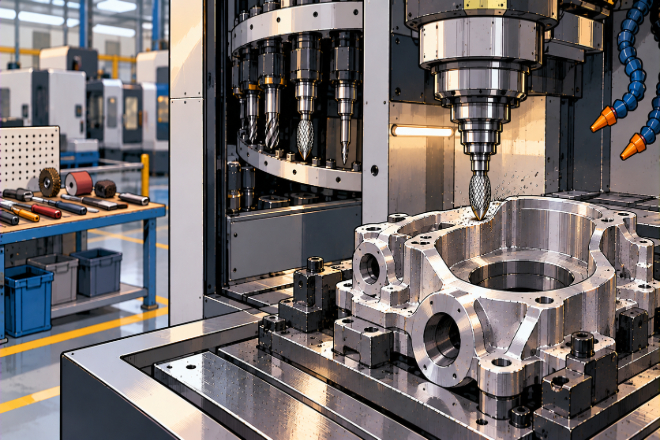
One of the biggest reasons to use tungsten carbide burrs for CNC deburring is the possibility of finishing a part before removing it from the machine.
Consider a CNC milling operation that produces a metal housing.
The machine drills holes, mills pockets, and finishes the outside surfaces. After these operations, small burrs remain around several edges.
Without an in-machine deburring process, the operator must remove the part, carry it to another station, clean the edges, and inspect the result.
That means additional handling, labor, and production time.
Now consider a different process.
After the main machining operations are complete, the CNC machine changes to a carbide burr and follows a programmed path around the required edges.
The burr removes the unwanted material while the workpiece remains in its original fixture.
This approach offers several potential benefits.
Less part handling: The component may not need to move to a separate deburring station.
Better position control: The CNC machine can use the same workpiece reference established during machining.
More predictable finishing: A tested toolpath can repeat the same edge treatment across many parts.
Fewer manual tasks: Workers can spend less time removing routine burrs and more time on inspection or other production work.
There is also a quality benefit.
When a part is removed and clamped again, small position changes can occur. Completing suitable deburring operations in the original setup can reduce this additional source of variation.
Of course, in-machine deburring is not automatically faster.
A carbide burr adds machining time, and some complex edges may require a long toolpath.
The best approach is to compare the complete process, including part handling, tool changes, deburring time, and inspection.
For many repeated CNC machining jobs, removing an entire secondary operation can be more valuable than saving a few seconds during cutting.
4. Which CNC Deburring Applications Benefit Most from Carbide Burrs?
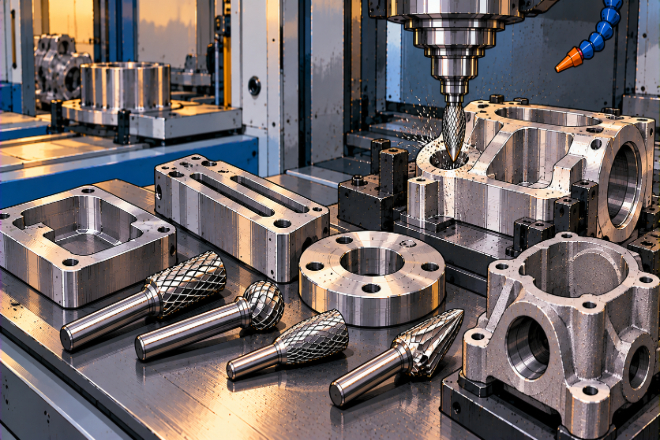
Not every CNC-machined part needs the same type of deburring.
Some components have only very small burrs that can be removed with brushes or other finishing tools. Others have thicker burrs, difficult edges, or local areas that need controlled cutting.
タングステンカーバイドバー are particularly useful in the second group.
Machined hole edges
Drilling and milling can leave raised material around hole entrances. A suitable small carbide burr can remove these burrs when the CNC machine can reach the edge safely.
For precise, uniform chamfers, however, a dedicated chamfering tool may be the better choice.
Milled slots and pockets
Slots and pockets often contain narrow corners or short edges that are difficult to clean with large tools.
A small cylindrical, ball, or cone-shaped burr may provide better access, depending on the feature.
Cast components after CNC machining
Many cast parts receive additional machining to create accurate holes, faces, and mounting areas.
A carbide burr can help remove local flash, remaining rough material, or machining burrs around accessible features.
Complex metal contours
Parts used in pumps, industrial equipment, and machinery may have curved edges or uneven transitions.
A suitably shaped carbide burr can follow these areas through a programmed CNC toolpath.
The following table shows common applications.
5. How Do You Choose the Right Carbide Burr for a CNC Machine?
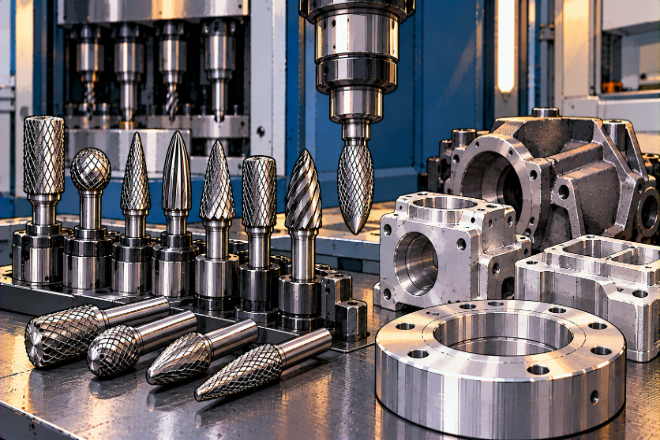
Choosing a tungsten carbide burr for CNC deburring requires more than selecting a head shape.
The first factor is the workpiece material.
For steel, a cut designed for steel machining may provide effective chip removal. Stainless steel can benefit from a suitable stainless-specific cut.
Aluminum often requires more open teeth because soft metal can stick between closely spaced cutting edges.
The second factor is burr size.
A small machining burr may need only light cutting. A thick burr or local casting flash may require a more aggressive tool.
Using an aggressive burr on a delicate edge can remove more material than intended. Using a very fine burr on heavy flash may increase cycle time and tool wear.
The third factor is tool geometry.
The cutting head must reach the required area without hitting nearby surfaces. Burr diameter, cutting length, shank size, and total tool length all need to fit the machine setup.
Tool holding is particularly important. The burr must be suitable for the CNC spindle and holder. Excessive runout can cause uneven cutting, vibration, and early damage.
Long tool overhang should also be avoided where possible. It reduces stiffness and can make the burr less stable.
Not every long-shank burr is suitable for stationary CNC use, so the tool’s application limits must be checked before installation.
Finally, consider the required edge.
If the drawing calls for a defined chamfer or exact radius, a dedicated CNC chamfering or radius tool may be more reliable.
A carbide burr is often most useful when the goal is controlled removal of unwanted material rather than creating a highly accurate finished profile.
6. How Can Manufacturers Improve CNC Deburring Efficiency and Costs?
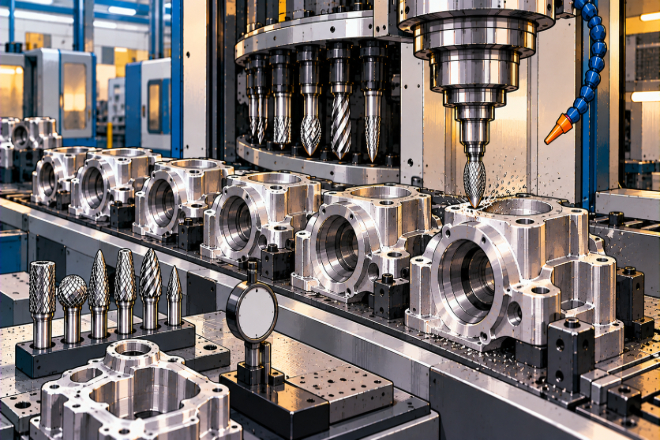
Adding a carbide burr to a CNC tool magazine is easy. Building an efficient deburring process takes more thought.
Start by defining the required result.
Does the part need a burr-free edge, a small edge break, or a measured chamfer? These are different requirements and should not be treated as the same operation.
Next, create a suitable toolpath.
The path should keep the burr in controlled contact with the workpiece. It should also avoid unnecessary travel, sudden heavy engagement, and collisions with nearby features.
Spindle speed and feed rate must match the selected burr.
The correct speed depends on burr diameter, cutting geometry, workpiece material, and operating conditions. There is no universal RPM for all carbide burrs.
Too much cutting pressure can increase vibration and damage the tool. Poor engagement can also leave burrs behind or create an uneven edge.
A stable CNC process uses suitable cutting conditions rather than forcing the tool to remove material as quickly as possible.
Chip removal should not be ignored either.
Loose chips can remain in pockets and holes, especially when the part has deep internal features. Suitable air or coolant methods, where approved for the tool and material, can help keep the cutting area clear.
Tool life is another important cost factor.
A burr that becomes worn may need more cutting time to achieve the same result. It may also leave rough edges or increase rework.
Instead of replacing tools only when they visibly fail, manufacturers can track the number of acceptable parts produced by each burr.
For purchasing and production teams, the most useful comparison is often:
Total CNC deburring cost = Tool cost + Machine time + Tool changes + Inspection + Rework
A low-priced burr is not necessarily the cheapest option if it wears quickly or causes frequent interruptions.
At the same time, an expensive high-performance burr is not automatically the best choice for every job.
The right decision comes from testing tools on actual parts and comparing the complete production result.
For example, a factory may find that a slightly more expensive carbide burr lasts longer and reduces edge rework. Another factory may discover that a simpler tool produces the same acceptable finish at a lower cost.
The best solution depends on the application.
It is also worth asking whether the CNC deburring operation is solving the right problem.
If the main milling or drilling process creates unusually large burrs, improving the original cutting conditions may reduce the amount of deburring needed.
That can sometimes save more time than increasing the speed of the finishing operation.
 English
  Español
  简体中文
简体中文  Français
  日本語
日本語  한국어
한국어  العربية
  Tiếng Việt