
1. Why Is Edge Finishing Important in Manufacturing?
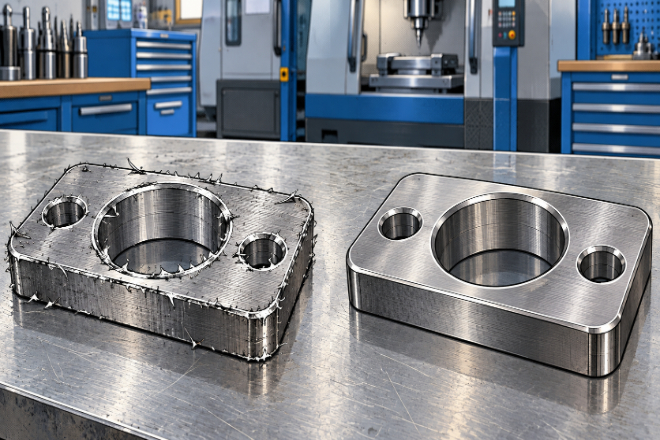
In many manufacturing processes, producing the main shape of a part is only the first step.
After machining, molding, or cutting, the surface and edges often need additional treatment before the component can be used.
Common edge problems include:
sharp corners
machining burrs
excess material
rough surfaces
uneven contours
Although these issues may look small, they can create bigger problems during production.
For example, a sharp edge may affect assembly between two parts. A small burr inside a precision component may influence movement or sealing performance.
In products that require close tolerances, even a tiny amount of unwanted material can reduce the final quality.
This is why edge finishing has become an important part of modern manufacturing.
The goal is not simply to remove material. The goal is to create a controlled edge that meets requirements for:
size accuracy
surface quality
safety
product performance
Traditional finishing methods may require manual grinding or additional processing steps.
However, as production speed increases, manufacturers need tools that can provide more stable and repeatable results.
This is where carbide edge finishing tools become valuable.
2. How Do Carbide Trimming Tools Improve Edge Finishing?
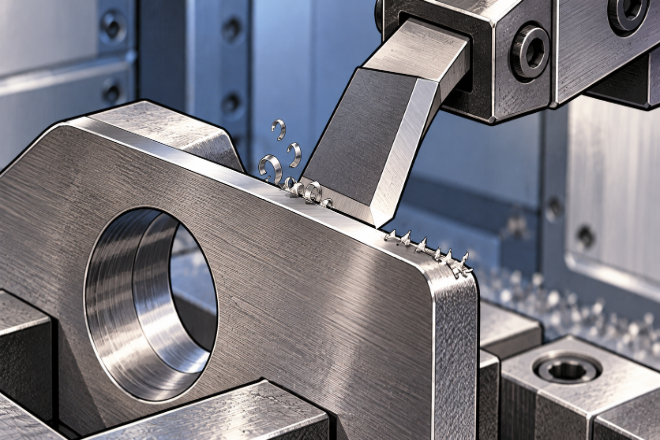
Carbide trimming tools improve edge finishing through their combination of cutting ability, tool strength, and precision control.
Unlike abrasive tools that mainly remove material through friction, carbide trimming tools use sharp cutting edges to remove small amounts of material in a controlled way.
This creates several advantages during finishing operations.
1). They Remove Burrs with Better Control
One of the main purposes of carbide trimming tools is burr removal.
Burrs are small unwanted pieces of material created during machining processes such as:
milling
掘削
切断
molding
casting
If burrs are not removed properly, they can affect:
part fitting
surface contact
assembly accuracy
product safety
Carbide trimming tools use sharp tungsten carbide edges to cut away these unwanted areas instead of simply wearing them down.
This cutting action helps achieve:
cleaner edges
less surface damage
more predictable results
For manufacturers producing large quantities of parts, consistent burr removal is especially important. A stable tool allows each part to receive similar finishing quality.
2). They Create More Accurate Edge Shapes
Different products require different edge conditions.
Some applications only need sharp edges removed. Others may require:
rounded edges
small chamfers
smooth transitions
specific contour shapes
Carbide trimming tools can be designed with different cutting geometries to match these needs. The tool shape, flute design, and cutting angle all influence the final edge result.
例えば:
A fine cutting design can help achieve a smoother finish on precision parts. A stronger cutting design may be better for removing larger amounts of extra material.
This flexibility makes carbide trimming tools suitable for many manufacturing situations.
3). They Maintain Edge Quality During Long Production Runs
For industrial manufacturers, tool life is a major consideration.
A tool that loses sharpness quickly can create several problems:
unstable edge quality
frequent tool replacement
machine downtime
higher production costs
Tungsten carbide provides excellent 硬度 そして 耐摩耗性, allowing carbide trimming tools to maintain their cutting performance for longer periods.
This is especially useful in:
automated production lines
CNC加工
high-volume manufacturing
When the cutting edge remains stable, manufacturers can achieve more consistent finishing results from the first part to the last.
3. What Makes Tungsten Carbide Trimming Tools Effective for Edge Finishing?
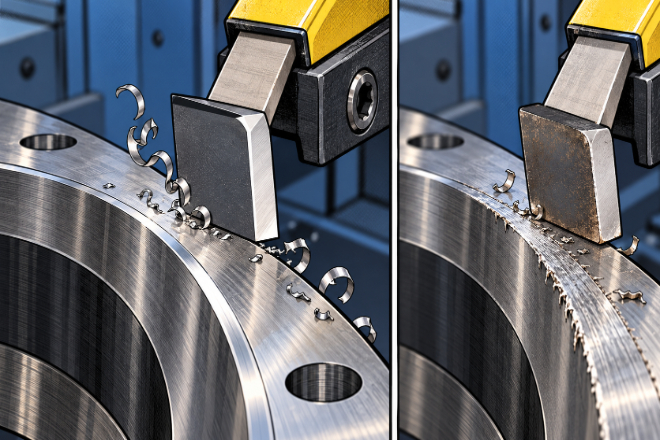
The main reason 超硬トリミングツール perform well is the material used for the cutting section.
Tungsten carbide combines high 硬度 with good 耐摩耗性, making it suitable for precision machining applications.
A typical carbide trimming tool uses tungsten carbide material that provides:
4. How Do Carbide Trimming Tools Improve CNC Edge Finishing?
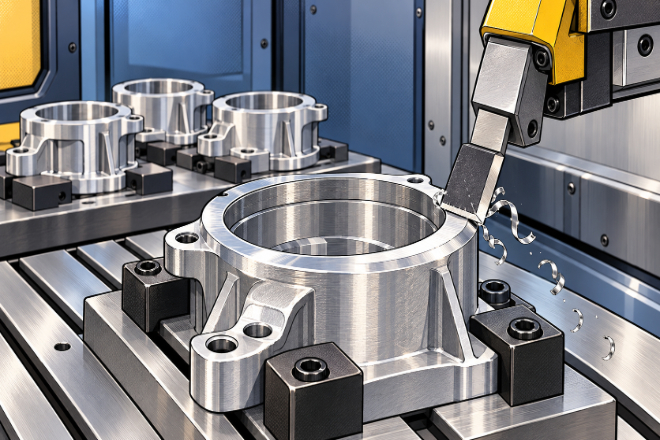
CNC machining requires high accuracy and repeatable results. While CNC machines can create precise shapes, the machining process can still leave small defects on part edges.
These defects may include:
small burrs
sharp corners
uneven edges
leftover machining marks
For manufacturers, removing these problems manually is often slow and difficult, especially when dealing with complex parts or large production volumes.
Carbide trimming tools for CNC machining provide a more efficient solution by allowing machines to complete edge finishing operations with better control.
During CNC edge finishing, the tool follows a programmed path and removes unwanted material from specific areas.
Because carbide tools maintain a sharp cutting edge, they can create consistent results across many parts.
This helps manufacturers improve:
dimensional accuracy
surface quality
production efficiency
process stability
For example, when machining aluminum components, precision mechanical parts, or molded components, a carbide trimming tool can remove small imperfections without changing the original design of the part.
This is especially important for industries where every component needs to meet strict quality requirements.
5. What Materials Can Carbide Trimming Tools Finish?
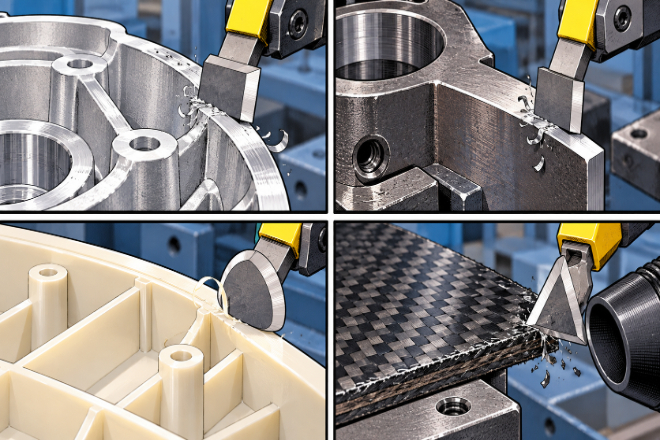
One of the advantages of 超硬トリミングツール is their ability to work with different materials.
Because tungsten carbide has excellent 硬度 そして 耐摩耗性, these tools can handle materials that may quickly damage standard tools.
Common materials include:
6. Where Are Carbide Trimming Tools Used for Edge Finishing?
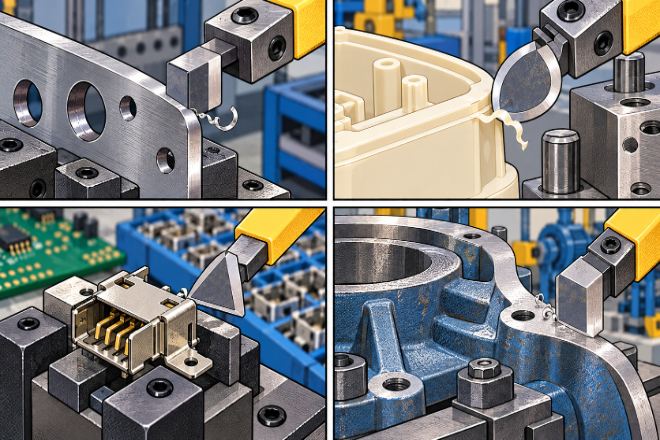
Carbide trimming tools are widely used in industries where part quality and precision are important.
1). Precision Metal Parts
Metal components often require additional finishing after machining.
Examples include:
mechanical parts
aluminum housings
industrial components
precision brackets
Even when the machining process is accurate, small burrs can remain on edges.
Carbide trimming tools help remove these imperfections while keeping the original dimensions of the part.
For manufacturers, this means fewer rejected parts and more stable production quality.
2). Plastic Mold and Injection Parts
Plastic molding processes often create extra material around parting lines.
This excess material can affect:
product appearance
assembly performance
customer experience
Carbide trimming tools can remove plastic flash and improve edge appearance without damaging the main structure.
They are especially useful when manufacturers need clean finishing on detailed plastic components.
3). Electronic Components
Electronic products often contain small and precise parts.
These components usually require:
smooth edges
accurate dimensions
clean surfaces
A small defect can influence assembly or product reliability. Carbide edge finishing tools provide the precision needed for these applications.
4). 自動車 and Industrial Equipment Parts
Many automotive and industrial components require strong and reliable finishing processes.
Examples include:
metal brackets
engine-related parts
machine components
In these applications, manufacturers need tools that can handle continuous production while maintaining quality.
The long tool life of 超硬トリミングツール makes them suitable for these demanding environments.
7. How Do Carbide Trimming Tools Reduce Manufacturing Costs?
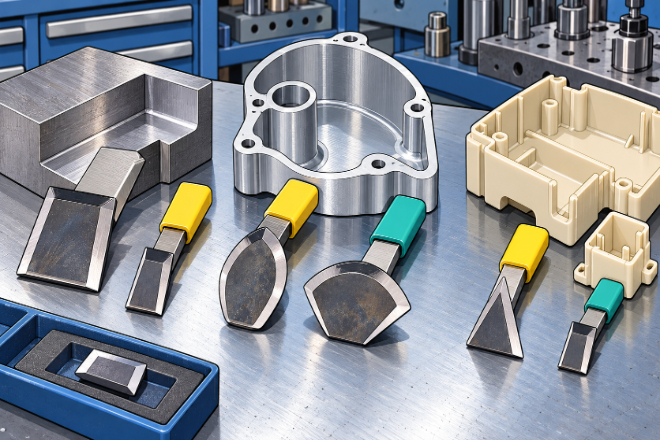
When choosing industrial tools, manufacturers usually look beyond the initial purchase price.
The real value comes from overall production performance. Carbide trimming tools can help reduce costs in several ways.
1). Fewer Tool Changes
Tool replacement takes time. Frequent changes can interrupt production and reduce machine efficiency.
Because carbide trimming tools have strong 耐摩耗性, they often last longer during continuous operations.
This helps reduce:
machine stops
operator workload
production delays
2). More Stable Product Quality
Poor edge finishing can lead to:
rejected parts
additional repair work
customer complaints
A stable finishing process helps manufacturers produce more consistent parts.
This improves quality control and reduces unnecessary waste.
3). Higher Production Efficiency
A good finishing tool allows machines to complete more work in less time.
利点は次のとおりです:
faster finishing processes
improved production flow
reduced manual operations
For companies producing large quantities of components, these improvements can create significant long-term value.
8. How Should Manufacturers Choose Carbide Trimming Tools?
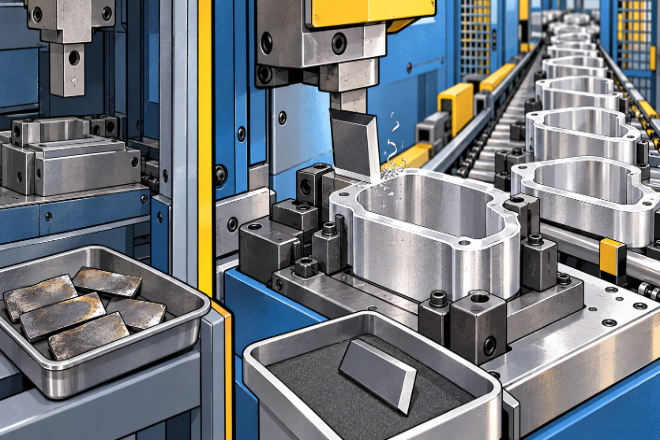
正しい選択 超硬トリミングツール requires understanding both the application and production requirements.
A tool that works well for one material may not provide the best result for another.
Important factors include:
1). Material Type
The first step is identifying the workpiece material.
Different materials require different tool designs.
例えば:
soft materials may need sharper cutting edges
harder materials may require stronger carbide grades
2). Required Edge Quality
Manufacturers should consider the final finishing requirement.
Questions to ask include:
Is the goal burr removal?
Is a smooth surface required?
Does the part need a specific edge shape?
The answer affects tool selection.
3). Machining Equipment
The tool must match the machine system.
Important factors include:
rotation speed
tool holding method
machining stability
production environment
A properly matched tool can improve both performance and service life.
4). Production Volume
High-volume production requires reliable tools.
For repeated machining operations, manufacturers usually need tools that provide:
stable performance
long service life
consistent finishing results
Selecting the right carbide trimming tool can reduce production risks and improve overall efficiency.
9. Why Are Carbide Trimming Tools a Good Choice for Modern Manufacturing?
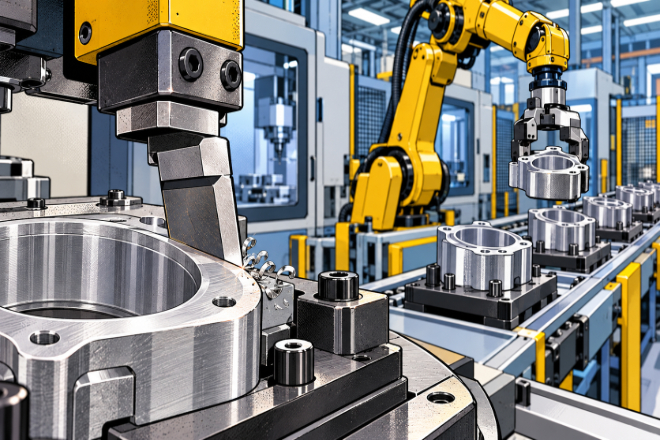
Modern manufacturing continues to demand higher precision, faster production, and better product quality.
Simple finishing methods are often no longer enough for advanced applications.
Carbide trimming tools provide a practical solution because they combine:
high 硬度
accurate cutting performance
long tool life
reliable edge finishing
They allow manufacturers to improve the final quality of parts while keeping production efficient.
From CNC machining to precision component manufacturing, carbide trimming tools have become an important option for companies that need better control over edge finishing.
 English
 Español
 简体中文
 Français
 日本語
 한국어
 العربية
 Tiếng Việt